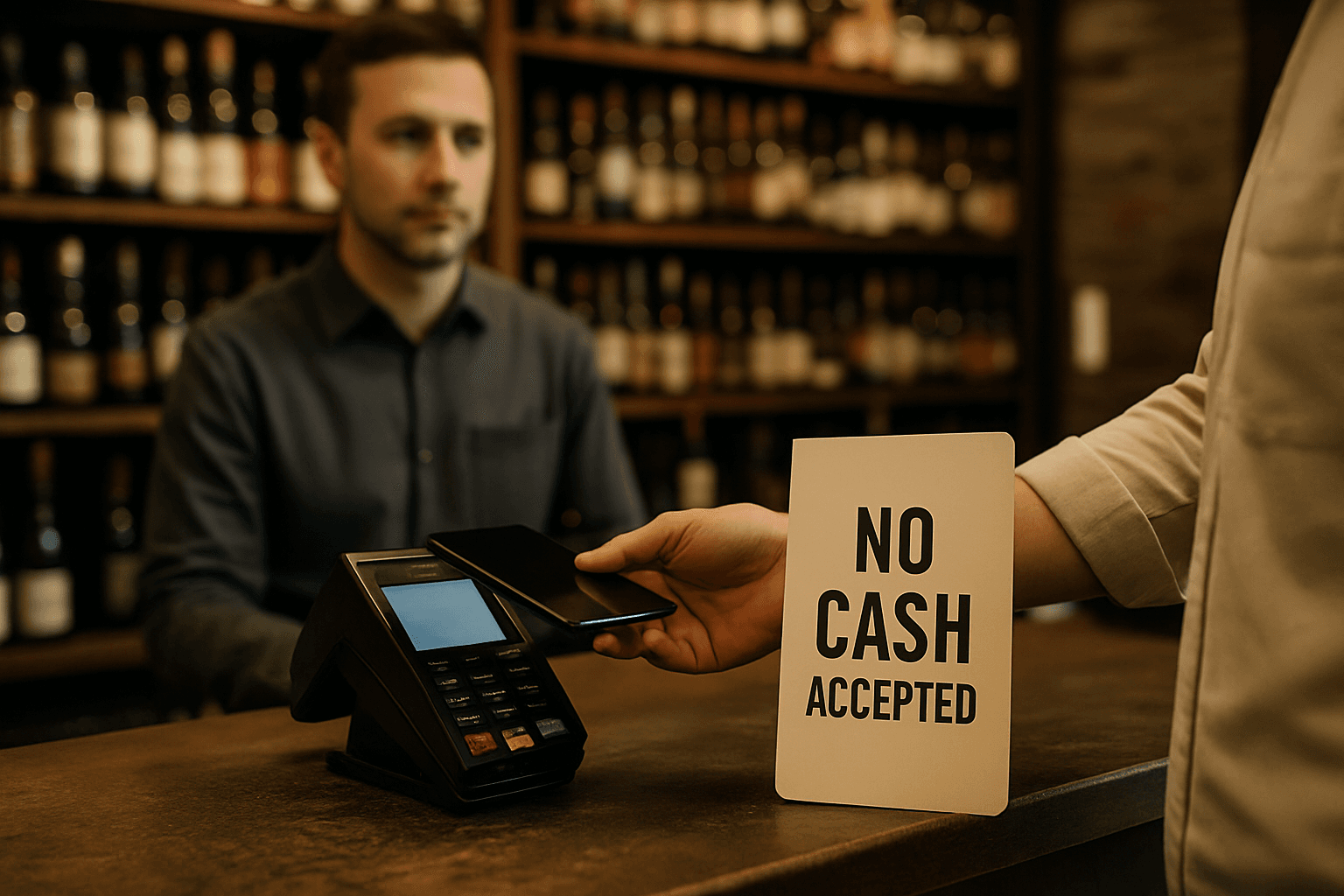
Going Cashless in Your Liquor Store: Security Benefits, Customer Friction, and State-by-State Legal Restrictions You Need to Know
By Intentionally Creative, Editorial Team11 min read
Listen to this article15:41
Schedule a free strategy call and Intentionally Creative will build a custom plan for you.
Schedule Your Free Strategy CallFree audit. No commitment.
Get a Free Audit. No commitment.
Should your liquor store go cashless? Explore security benefits, customer friction risks, and state-by-state legal restrictions every cashless liquor store must know.
Every liquor store owner has had the thought, usually while counting down a cash drawer at midnight or dealing with the aftermath of a shortage that nobody can explain. What if we just stopped accepting cash? The idea of a cashless liquor store is seductive: fewer robbery targets, cleaner books, faster lines. And with consumer payment habits shifting faster than ever, the conversation has moved from theoretical to urgent.
But going cashless in liquor retail isn't the same as going cashless at a juice bar. Your customers are different. Your regulatory burden is heavier. And depending on where you operate, dropping cash entirely might actually be illegal. The gap between what sounds like a smart move and what is a smart move for your specific store comes down to three things: security realities, customer impact, and the law.
This guide breaks down all three, with real numbers, real examples, and the state-by-state legal landscape you need to navigate before making any changes to how your store handles payments.
Let's start with the number that matters most: more than one-third of Americans say they've gone completely cashless as of 2025, according to Pew Research Center data. Not "prefer cards." Not "sometimes use Apple Pay." Fully, completely done with paper money.
That's a massive chunk of your potential customer base already comfortable paying digitally, and they're walking into your store expecting the same frictionless experience they get everywhere else.
Learn how email segmentation for liquor stores drives repeat sales with a 4,200% ROI. List-building tactics, purchase...
But here's where it gets interesting for liquor retailers specifically. While a third of consumers have ditched cash entirely, some stores report the exact opposite reality. BWS, a major Australian liquor chain, found that approximately 60% of its sales still come from cash transactions. U.S. numbers will vary by market, but the gap, between where consumers are heading and where many liquor stores still operate, is exactly why this conversation deserves your attention right now.
COVID-19 was the accelerant nobody predicted. The share of cashless businesses more than doubled between February 2020 and February 2021. What would have taken a decade of gradual adoption happened in twelve months. Customers who'd never used contactless payment suddenly refused to touch a pin pad. Retailers who'd never considered going card-only started weighing the benefits of improved payment security and faster checkout lines.
Five years later, those habits stuck. The pandemic didn't create a temporary blip, it permanently rewired how people pay.
In August 2023, Downtown Spirits in Seattle opened a 4,200-square-foot location using Amazon's "Just Walk Out" technology, making it one of the first liquor stores to go fully cashierless. Customers grab what they want and leave. No registers. No lines. No cash drawer to reconcile at closing.
Learn how to run compliant, high-performing Google Ads for liquor stores. Covers campaign setup, bidding strategies, ...
It's a bold move, especially considering that cashless payment laws vary wildly by jurisdiction (more on that shortly).
But here's the takeaway: going cashless isn't a hypothetical anymore. It's happening in the liquor industry right now. The real question isn't whether it's possible, it's whether it's right for your store, your customers, and your state's compliance requirements.
The consumer trend is one thing. But let's talk about the reason most owners even begin this conversation: safety.
Liquor stores are disproportionately targeted for armed robbery. The logic is simple from a criminal's perspective, late hours, limited staff, and the assumption that there's a full cash drawer behind the counter. A cashless liquor store removes that assumption entirely.
12 wine and spirits content marketing ideas for liquor stores that drive foot traffic, boost engagement, and move inv...
No cash on hand means no incentive to rob. It's that straightforward.
If you spend any time on Reddit forums where liquor store owners swap notes, you'll find this exact discussion playing out. Owners in high-crime areas and those running late-night operations are increasingly weighing no-cash policies as a frontline safety measure, not a tech trend, but a survival strategy. When your staff's physical safety is on the line, the calculus changes fast.
Beyond the human cost, there's a financial one. Fewer robbery incidents can improve your insurance risk profile, potentially lowering premiums over time. That's a measurable security improvement that hits your bottom line.
Robbery gets the headlines, but internal shrinkage is the quieter margin killer. Miscounts, drawer shortages, and employee skimming are notoriously difficult to catch with cash-heavy operations. The more cash flowing through your registers each shift, the more room there is for error, intentional or otherwise.
A cashless system creates a clean digital paper trail for every single transaction. No ambiguity, no "the drawer was short $40 again." Every dollar is tracked, reconciled, and auditable. For owners managing multiple employees across shifts, that transparency alone can justify the switch.
The security benefits are compelling. But before you rip out the cash drawer and call it progress, let's talk about what you might actually lose.
The cashless trend is real and accelerating. But here's the thing about trends: they don't pay your rent. Your actual transaction data does.
International data gives us a useful benchmark: BWS, the Australian liquor chain, reports that roughly 60% of its sales are still cash. Your U.S. store's split will depend on your market, demographics, and location, maybe it's 30%, maybe it's 70%. But if you don't know the exact number, you're making a major business decision blind. Pull your POS reports before you pull the trigger.
Liquor store demographics skew differently than a tech-forward coffee shop downtown. Many of your customers, particularly older adults, unbanked populations, and cash-budget shoppers, rely on physical currency. These aren't edge cases. They're regulars.
Going cashless can create a perception of exclusion that damages community goodwill fast, especially in neighborhood stores where loyalty is everything. Customers turned away at the register don't just leave empty-handed. They leave frustrated, and they may not come back.
The counterargument is fair. Faster checkout times, shorter lines, and tighter security do appeal to a growing customer segment. Downtown Spirits is proving the cashierless model works in the right market. But the real question isn't whether cashless works somewhere. It's whether it works for your customers, in your neighborhood, right now.
So the security benefits are real, the customer friction is real, and the legal landscape is a patchwork. Where does that leave you?
For most independent liquor stores, the smartest play isn't flipping a switch, it's going cash-light. You encourage digital payments, make them faster and more convenient, but you keep at least one register that accepts bills. You capture most of the security and efficiency benefits without alienating customers or running afoul of cash-acceptance laws.
Start by removing friction from digital payments. Offer contactless payment at every register. Put up signage promoting Apple Pay, Google Wallet, and tap-to-pay options. If your store volume supports it, consider a card-only self-checkout kiosk for express transactions while maintaining one staffed, cash-accepting lane.
You can also set soft nudges: round-up donation prompts on card transactions, loyalty points that only accrue on digital payments, or small discounts for tap-to-pay. These don't force anyone's hand, but they shift behavior over time.
This approach strengthens your security posture and keeps you on the right side of cash-acceptance laws in every jurisdiction.
Smart safes and cash recyclers dramatically reduce the risk of holding cash on-site. They count, validate, and secure bills automatically, cutting shrinkage and limiting employee access to the drawer.
Age verification technology integrated directly with your payment processing isn't a nice-to-have, it's table stakes for any liquor store modernizing checkout, cashless or otherwise. Pair it with your POS system and you've built a faster, safer, more compliant operation that still says "yes" to every customer who walks through the door.
All of this, the security upside, the customer risk, the legal maze, the hybrid option, comes down to one thing: your specific situation. Here's how to cut through the noise.
1. What percentage of your transactions are cash? If your store is anything like the international benchmarks, where some liquor retailers still see a majority of sales in cash, going fully cashless is a revenue risk, not a strategy. Quantify the potential loss before you act.
2. What are the cash-acceptance laws where you operate? At least seven U.S. jurisdictions, including Massachusetts, New Jersey, New York City, Philadelphia, San Francisco, Rhode Island, and King County, WA, require businesses to accept cash. California has both state and local laws on the books. Confirm the rules for your specific state, county, and city, or have your attorney do it.
3. What's your actual security exposure? If you've experienced robberies or significant shrinkage, the calculus shifts hard toward reducing cash on-site, that's where payment security improvements pay for themselves. If your loss history is clean, the urgency drops considerably.
Pull your POS data from the last 90 days. Look at cash vs. card transaction volume and average ticket size. Cash customers often spend differently than card customers, sometimes more per visit, sometimes less. Your customer base isn't a national average. It's the people walking through your door. Know your numbers before making a cashless liquor store policy decision.
The trend is real: a growing share of Americans don't carry cash at all, and the pandemic permanently accelerated digital payment adoption. But running a cashless liquor store isn't like going cashless at a coffee shop.
Even if the security math checks out and your customers are ready, there's a third factor that can override everything else. Here's where the cashless liquor store conversation gets legally complicated, and where skipping your homework could cost you real money.
As of 2025, at least seven U.S. jurisdictions have laws or ordinances on the books requiring businesses to accept cash: Massachusetts, New Jersey, Rhode Island, Philadelphia, San Francisco, New York City, and King County, WA. California has layered both state-level and local cashless restrictions, a critical detail given the state's massive independent liquor store market.
The penalties vary, but the principle is consistent: refusing cash from a paying customer can result in fines, and "I didn't know" isn't a legal defense.
Here's an irony worth noting: King County, WA, the same county where Downtown Spirits opened its cashierless store, has its own cash-acceptance ordinance. Even in progressive markets embracing automation, regulators are pushing back on fully cashless models. That tension isn't going away.
The list of cash-mandate jurisdictions is growing, not shrinking. Tennessee has considered bills that would prevent stores from requiring cashless-only payments, and similar proposals are surfacing in other states. The political momentum behind cash-acceptance protections makes sense when you consider how many Americans, and how many liquor store customers specifically, still depend on physical currency.
The trend line is clear: more states will likely follow.
Going cashless doesn't simplify your compliance picture. Liquor stores are already classified as high-risk merchants by payment processors, which means you're navigating specialized processing solutions with age verification integration before you even get to cash-acceptance laws.
Compliance is a real, enforceable obligation, not a suggestion. Layer that on top of your existing liquor license requirements, and you've got a regulatory stack that demands attention.
Our strong recommendation: Before changing any payment policy, check your specific state and municipal regulations. If there's any ambiguity, and there often is, consult legal counsel. The fine for getting this wrong will always cost more than the consultation.
Intentionally Creative specializes in digital marketing strategies that drive real results. Let us show you what's possible.
Schedule a CallYou're dealing with high-risk merchant classifications, age verification requirements, and the reality that many liquor store customers still pay in cash. Layer in cash-acceptance laws across multiple jurisdictions, from Massachusetts to San Francisco, and the picture gets complicated fast.
The stores that win aren't chasing trends. They're making decisions based on their customers, their risk profile, and their legal landscape. That's payment security and compliance done right.
Planning a cashless or cash-light transition for your store? Start with the data, then make sure your customers know about the change before they're standing at the register. If you need help communicating the shift and building a strategy that keeps customers coming back, Intentionally Creative can help ↗.