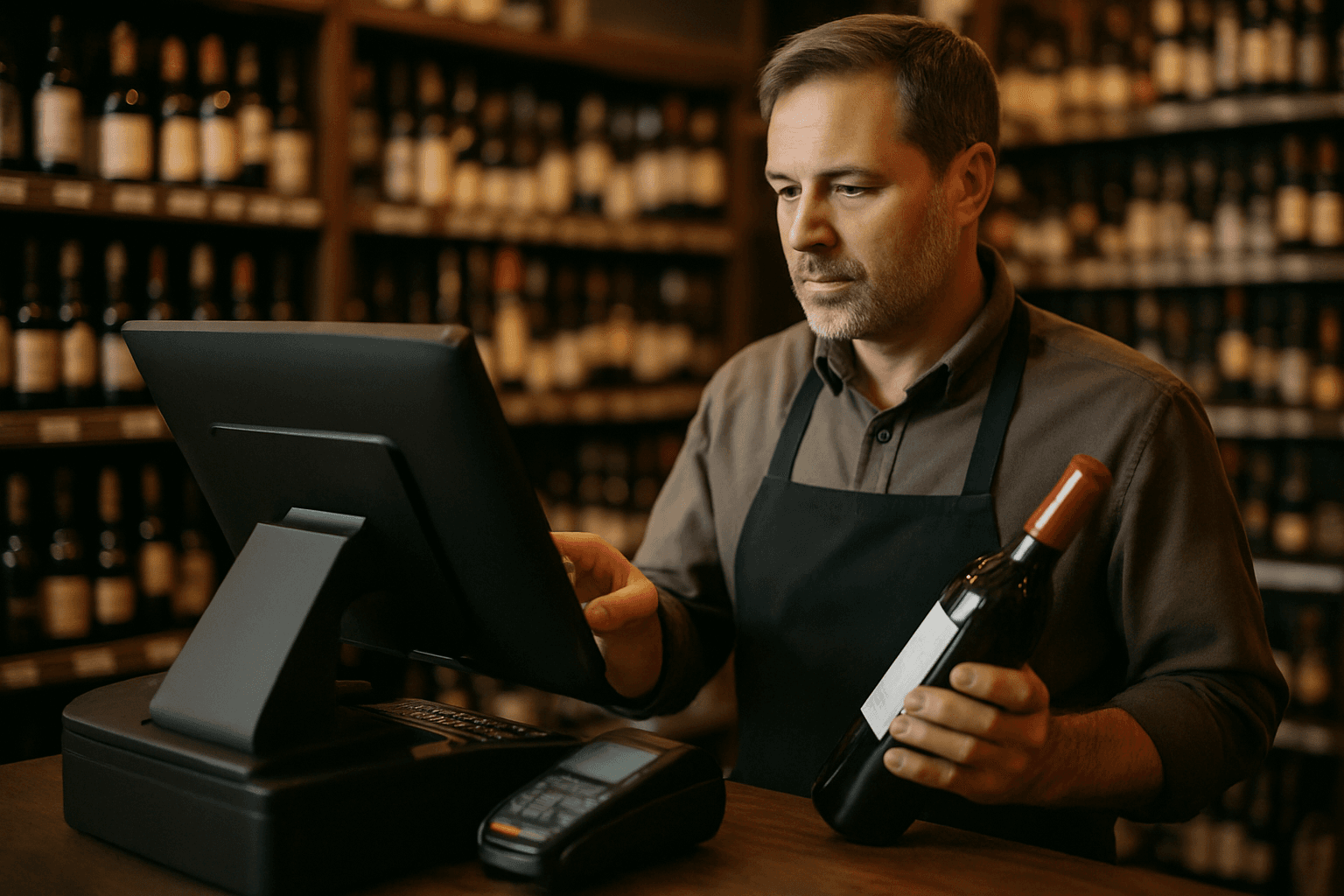
How to Use Customer Purchase Data to Build Automated Upsell and Cross-Sell Campaigns in Your Liquor Store POS System
By Intentionally Creative, Editorial Team11 min read
Listen to this article15:08
Schedule a free strategy call and Intentionally Creative will build a custom plan for you.
Schedule Your Free Strategy CallFree audit. No commitment.
Get a Free Audit. No commitment.
Learn how to use your liquor store POS upsell cross-sell features to turn customer purchase data into automated campaigns that increase basket size and revenue.
Every time a customer taps their card at your register, your POS system quietly logs a story, what they bought, when they bought it, how much they spent, and what they passed on. Multiply that by hundreds of transactions a week, and you're sitting on a detailed playbook for selling smarter. The problem? Almost nobody opens it. For most independent liquor store owners, liquor store POS upsell cross-sell capabilities are the most valuable features they're already paying for, and completely ignoring.
This guide is going to change that. We'll walk through exactly how to pull actionable insights from your existing customer purchase data, build automated campaigns that suggest the right product to the right customer at the right time, and deploy those campaigns across every channel your store touches, in-store prompts, email, online, and loyalty. No data science degree required. No six-figure tech stack. Just the POS system you already own, configured to actually earn its keep.
Whether you're running a single neighborhood shop or managing a handful of locations, the playbook is the same: start with the data you have, automate the recommendations your best employee would make, and let the system compound results over time. Here's how.
Let's be honest. Most independent liquor store owners use their POS system for two things: ringing up sales and tracking inventory. That's it. Meanwhile, the reporting and customer purchase data features, the ones that can directly drive revenue, sit there collecting digital dust.
You're not alone. But you are leaving money on the register.
Discover 7 proven Instagram content ideas for liquor stores that boost engagement and drive sales. Learn how to promo...
Here's what's telling: POS platforms like Lightspeed and Square treat reporting and data analytics as a core function, not a bonus feature, but a pillar right alongside payments and inventory management. These platforms are built around the assumption that you'll use customer data to sell more. Most store owners just haven't caught up yet.
And the stakes are real. Major retailers like Coles are deploying AI across their Australian bottle shop networks (including First Choice and Liquorland) to optimize product assortment and automate recommendations. [VERIFY: specific Coles AI deployment details and timeline] That enterprise-level thinking is filtering down to independent retailers fast. The question isn't whether this wave hits your store, it's whether you're ready when it does.
To build effective campaigns, you need to understand what each strategy actually means in your world:
Both strategies work. Together, they turn your POS system into a marketing engine, not just a cash register.
Avoid TTB violations and Google Ads suspension with this guide to alcohol advertising rules for liquor stores. Expert...
Now let's look at the raw material you're building with.
Your POS system collects valuable data every single transaction. The problem isn't access, it's knowing which data points actually move the needle for automated campaigns.
This isn't theoretical. Data-driven selling strategies are standard practice across the broader consumer goods industry, and the tools to execute them are already baked into the POS platforms independent retailers use every day.
Forget complex analytics. Think in customer profiles you already recognize:
Learn how email segmentation for liquor stores drives repeat sales with a 4,200% ROI. List-building tactics, purchase...
These segments drive completely different strategies, and that's the point.
Platforms like Square, Lightspeed, and ECRS offer built-in reporting and customer tracking that make this segmentation possible without third-party tools or manual spreadsheet gymnastics. But the richest data layer? Your loyalty program integration. When loyalty lives inside your POS, you're tracking purchase frequency, category preferences, and spending thresholds that can trigger personalized offers automatically, no manual work after initial setup.
The data's already there. Now it's time to make it sell for you.
Nobody wants to be that store, the one where every transaction feels like a used car negotiation. But here's the thing: upsell and cross-sell campaigns work incredibly well when they're built on actual customer data instead of gut instinct. The key is making every suggestion feel like a favor, not a pitch.
Modern POS systems can display smart prompts right on the checkout screen when a specific product gets scanned. A customer grabs a mid-range vodka? The terminal suggests a top-shelf alternative and gives your cashier a ready-made talking point: "That's a solid pick, we also have [Brand X] for $8 more, and it just won a double gold at the San Francisco Spirits Competition." It can even show the margin difference so your team knows what moves the needle.
This is where automation really shines. Your newest hire gets the same intelligent recommendations as your most seasoned floor manager. You're not relying on one person's product knowledge, you're systematizing it across every shift, every register, every transaction.
Here's a concrete example. A customer buys the same $20 red blend three times in two months. Your POS detects the pattern and sends a loyalty app notification: "Love that Malbec? Try this $30 bottle from the same region, here's 10% off as a thank you."
That's customer purchase data doing real work.
One rule: respect the frequency. One well-timed, personalized suggestion beats five generic blasts every time. Limit automated outreach so each message actually gets read. When upsells feel like helpful recommendations from a knowledgeable friend, customers spend more, and come back more often.
Upselling moves customers up the price ladder. But to truly grow basket size, you need to widen the basket itself.
Your customers don't shop in just one place anymore, and your campaigns shouldn't live in just one place either.
Integrated POS platforms now consolidate in-store sales, online sales, payments, inventory management, reporting, and staff management into a single ecosystem. For independent liquor stores, this means your automated campaigns don't need a separate marketing platform. Your POS already connects inventory, customer data, loyalty programs, and marketing. You just need to turn it on.
Here's what a real workflow looks like:
A customer buys a case of craft beer in-store. Your POS logs the purchase. Five days later, your loyalty system triggers an email suggesting a new craft IPA arrival, cross-sold alongside a popular beer glass set. The customer redeems the offer online. Your POS tracks the full loop, no manual intervention required.
That's a closed-loop liquor store POS upsell cross-sell system in action. This level of automation isn't enterprise-only anymore. The tools exist in the platforms you're already paying for, they just need to be configured and activated.
The liquor retail landscape is shifting fast, and the stores that prepare now will have a serious head start.
Enterprise retailers are already using AI and machine learning to predict what customers want before they walk through the door. Predictive analytics that anticipate purchase intent, powering smarter product recommendations and dynamic pricing, will soon be standard features in mid-market POS platforms, not just enterprise tools.
The gap between what large chains can do with data and what independents can do is shrinking every software update cycle. POS vendors are racing to bring these capabilities downstream.
Here's the actionable takeaway: start building clean customer purchase data in your operation today. Even basic purchase tracking and loyalty enrollment counts. The stores collecting and acting on data now will be the ones AI tools supercharge tomorrow. That's not a tech trend, it's a competitive advantage with a widening gap.
Week 1: Audit your POS reporting features. Turn on customer purchase tracking, most platforms already have dedicated reporting and analytics built in. You're just not using them yet.
Week 2: Pull your top 20 SKUs. Build logical upsell and cross-sell pairings based on actual transaction data from your store.
Picture this: a customer grabs a bottle of Casamigos Reposado. Your POS system, drawing from actual transaction data, knows that 40% of tequila buyers in your store also pick up premium margarita mix, limes, or Tajín. So it automatically surfaces those suggestions on the cashier's screen, in the customer's online cart, and even in a follow-up email the next day.
That's not guesswork. That's your data doing the selling for you.
This kind of automated campaign works because it mirrors how customers already think. They're not buying a bottle, they're buying an experience. Your POS just helps them complete it.
Generic "buy wine, get crackers" bundles are fine. But they leave money on the table.
The smarter play? Purpose-driven bundles triggered by actual purchase patterns. Think a "Date Night Bundle" that appears when a customer who's previously bought Pinot Noir and charcuterie starts shopping again. That's marketing with emotional resonance, and it converts.
Start here: Take your top 20 selling SKUs and build 2–3 cross-sell pairings for each. Run them for 30 days. Let the data tell you which pairings actually convert, then expand from there. Simple, scalable, and grounded in what your customers are already buying.
Of course, the best campaign in the world won't reach its potential if it only fires at the register. Your customers interact with your store across multiple channels, and your campaigns need to follow them there.
Intentionally Creative specializes in digital marketing strategies that drive real results. Let us show you what's possible.
Schedule a CallWeek 3: Configure automated upsell prompts at checkout. Launch one triggered email campaign tied to purchase history.
Week 4: Review conversion data. Refine what's working. Kill what isn't.
The same foundational data that powers enterprise AI recommendations lives in your POS system right now. The question is whether you'll use it before your competitors use theirs.
Your POS system isn't just a cash register. It's a customer intelligence platform, a marketing engine, and an automated sales assistant, if you let it be. The liquor store POS upsell cross-sell strategies in this guide aren't theoretical. They're built on data you're already collecting, tools you're already paying for, and customer behaviors you're already seeing every day behind the counter.
The stores that win in the next five years won't be the ones with the biggest selection or the lowest prices. They'll be the ones that know their customers best, and act on that knowledge automatically, consistently, and at scale.
You don't need to do everything at once. You need to start. Pick one section of this guide, implement it this week, and let the data show you where to go next.
Ready to turn your POS data into automated upsell campaigns without adding hours to your week? Intentionally Creative builds liquor store POS upsell and cross-sell systems designed specifically for independent retailers. Let's talk.