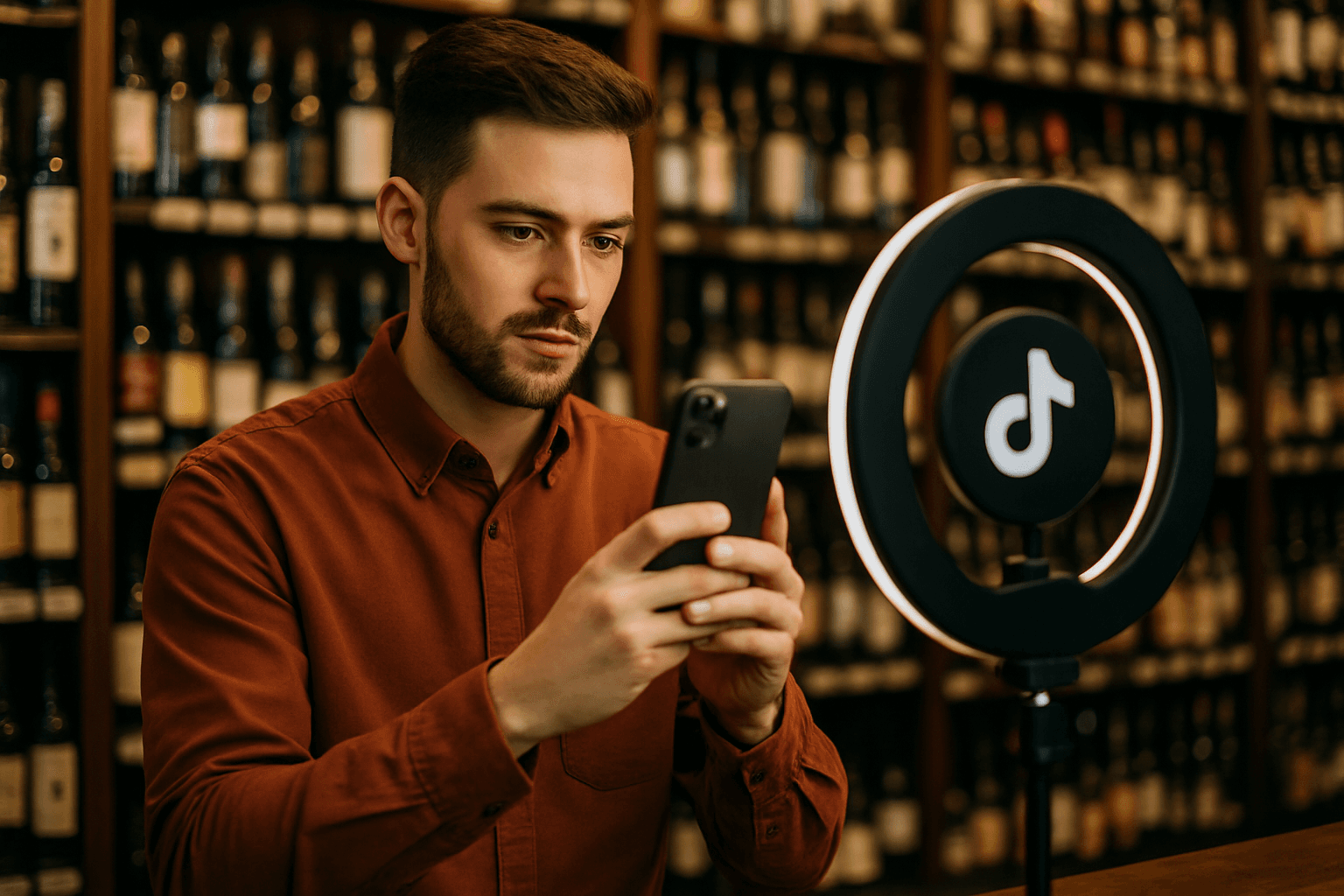
Liquor Store TikTok Marketing: How to Use Short-Form Video Without Getting Flagged
By Intentionally Creative, Editorial Team17 min read
Listen to this article23:29
Schedule a free strategy call and Intentionally Creative will build a custom plan for you.
Schedule Your Free Strategy CallFree audit. No commitment.
Get a Free Audit. No commitment.
Learn liquor store TikTok marketing strategies that drive foot traffic without violating platform rules. Content ideas, age-gating tips, and compliance guide.
Every liquor store owner knows the feeling: you watch a competitor's video blow up online, think "I should be doing that," and then immediately wonder whether posting a bottle on TikTok will get your account nuked. It's a legitimate concern. Alcohol content on social media sits in one of the most heavily regulated corners of digital marketing, and the platforms aren't exactly handing out instruction manuals.
But here's the reality: liquor store TikTok marketing is one of the biggest untapped opportunities in independent retail right now. Stores with no ad budget and no marketing team are racking up thousands of views, driving foot traffic, and building brand recognition that used to require a billboard and a prayer. The catch? You have to understand the rules before you hit record.
This guide breaks down everything you need, the compliance landscape, content ideas that actually work, platform-specific strategy, age-gating setup, real-world examples, and a 30-day plan to get started. Whether you've never posted a video or you've been winging it and hoping for the best, you'll walk away knowing exactly how to use short-form video to grow your store without getting flagged.
Here's something most liquor store owners don't know, and it changes everything about how you should think about marketing on TikTok.
You literally cannot pay to promote your store on TikTok.
Read that again. It's not a limitation. It's your biggest competitive advantage.
TikTok's alcohol advertising policies are strict and surprisingly specific. While the platform has opened paid ad opportunities for major alcohol brands, think Diageo, Constellation, the companies that make the bottles, it has not extended that access to retailers. No boosted posts. No sponsored content. No paid reach for stores that sell alcohol.
This distinction matters, and almost nobody in the retail space is talking about it. TikTok requires age-gating to 21+ for all alcohol-related advertising in the US, responsible drinking messaging in any ads, and outright bans alcohol ads entirely in markets like Thailand and Norway. For retailers specifically? The door to paid promotion is completely shut.
Master liquor store product photography with your smartphone. Get lighting, composition, and editing tips that make y...
Most store owners hear "you can't advertise" and walk away. That's the wrong move.
Think about what this means: Total Wine can't outspend you here. The big-box chains with six-figure ad budgets? They're stuck playing by the exact same organic rules you are. Short-form video marketing in liquor retail rewards one thing above all else, personality.
And that's exactly where independent stores win.
The proof is already out there. Big Bear Wine posted a single TikTok about alternative alcohol brands and pulled 903 likes and 27 comments, serious engagement for one store's organic content. The NH Liquor & Wine Outlet leaned into a Gen Z-style marketing video that went viral, generating news coverage across multiple outlets within a month. Meanwhile, accounts like @brownbagliquor are building loyal followings on Instagram Reels using nothing but behind-the-scenes clips and POV-style content.
No ad spend. No agency. Just a phone and a point of view.
Alcohol advertising compliance on social media isn't going away, but neither is the opportunity. Organic short-form video rewards creativity over budget, and if you're an independent retailer who hasn't started yet, you're leaving the most level playing field in digital marketing completely empty.
Now that you understand why this opportunity exists, let's talk about the thing that keeps most store owners on the sidelines: the rules. Because the level playing field only works in your favor if you're still standing on it, and that means knowing exactly what will and won't get your content pulled.
Discover 7 proven Instagram content ideas for liquor stores that boost engagement and drive sales. Learn how to promo...
Before you film a single video, you need to understand the rules, because short-form video for liquor stores lives and dies on compliance. Get this wrong, and you're not just losing a post. You're risking your entire account.
Let's break down what's actually allowed, what's banned, and where the two major platforms diverge.
Here's the part most store owners miss: TikTok's Community Guidelines restrict alcohol-related content broadly, not just paid promotions. That means your casual bottle showcase or tasting room walkthrough can still get flagged.
TikTok explicitly prohibits:
TikTok also requires age-gating to 21+ in the US for all alcohol-related advertising, plus responsible drinking messaging. In practical terms, this means configuring your account settings so content is only served to users 21 and older, and avoiding content formats, like challenges or dances, that skew heavily toward younger audiences.
What "getting flagged" actually means: There are three tiers of consequences. Content removal is the mildest, your video disappears with a policy notice. Shadow banning is sneakier, your content stays up but stops appearing in feeds and search results, tanking your reach without warning. Account suspension is the worst case, temporary or permanent loss of your account. Each tier compounds. Multiple removals accelerate you toward suspension.
Instagram Reels for liquor stores operates under a different but overlapping rulebook. Here's a side-by-side snapshot:
10 proven liquor store social media content ideas to connect with customers, boost brand visibility, and drive both i...
| Policy Area | TikTok | Instagram/Meta |
|---|---|---|
| Age-gating requirement | 21+ (US) for all alcohol content | 21+ (US) for paid ads; organic has fewer restrictions |
| Discount/promotion content | Prohibited | Allowed with restrictions, no encouragement of excessive consumption |
| Prizes/giveaways with alcohol | Banned entirely | Banned in paid ads; organic falls into a gray area |
| Responsible drinking messaging | Required | Required in paid ads; recommended for organic |
| Minor-targeting restrictions | Strict, applies to organic and paid | Strict for paid; organic relies on account-level age settings |
The key difference? Instagram gives you slightly more flexibility on organic content, particularly around promotions and discounts. But Meta's ad targeting restrictions are arguably tighter, you must use age and country targeting on every paid campaign, and Meta's automated review system flags alcohol-related content aggressively if targeting parameters aren't set correctly.
Don't let Instagram's looser organic rules make you careless. Both platforms penalize repeat offenders, and compliance mistakes on one platform should inform your strategy on the other.
This one catches multi-location operators and online retailers off guard. TikTok's alcohol advertising policies vary by country, and some markets ban alcohol ads entirely, including Thailand, Norway, Russia, and several others.
If you're a US-based store, you're operating in one of the more permissive markets. But "permissive" doesn't mean "unrestricted." State-level regulations can layer on additional requirements, and TikTok's enforcement doesn't always distinguish between federal and state rules.
Before you post, verify:
The bottom line: the rules aren't designed to stop you from posting. They're designed to stop irresponsible content. Learn the boundaries, and you'll find there's plenty of creative room inside them.
So the rules are clear, and they're more workable than most people think. The next question is obvious: what should you actually post? Here are seven content formats that stores are already using to drive real engagement, all without crossing a single compliance line.
Here's the thing about liquor store TikTok marketing: the accounts winning aren't the ones pushing products hardest. They're the ones educating, entertaining, and showing personality, while keeping consumption encouragement completely out of the frame.
Here are seven proven content formats that drive engagement and stay compliant.
1. "If You Like X, Try Y" Recommendation Videos
This is the single easiest format to start with. The framing is pure education: you're helping customers discover products, not telling anyone to drink more. Think of yourself as a guide, not a promoter. Big Bear Wine built strong engagement with exactly this approach, a straightforward TikTok about alternative brands that resonated because it felt helpful, not salesy.
2. Customer Q&A and Myth-Busting Content
"Does expensive wine actually taste better?" "What's the difference between bourbon and whiskey?" These questions live in your customers' heads already. Answer them on camera and you build authority and trust fast. The compliance-safe angle? You're a retailer sharing expertise, no different from a bookstore owner recommending reads.
3. Store Operations and Daily Routines
@brownbagliquor nails this on Instagram Reels, showing the retail experience itself rather than promoting consumption. Stocking shelves, building displays, opening shipments. It's naturally compliant because the star is your business, not the bottle.
4. New Arrival Unboxings and Shelf Restocks
Here's the thing that trips up most store owners: the platforms actually have built-in tools to keep you compliant. You just have to turn them on.
And this isn't optional. TikTok requires age-gating to 21+ in the US for all alcohol-related content. Skip this step, and you're one flag away from losing your account, along with all that content you worked hard to create.
On TikTok: Navigate to your account settings and look for content restriction or audience controls. Set your content visibility to 21+. This is your first line of defense.
On Instagram: Open Meta Business Suite → Settings → Age Restrictions → set your page minimum age to 21. This restricts your content visibility across both your feed and Reels to age-appropriate audiences. Simple, takes two minutes.
Responsible messaging doesn't have to feel like a PSA. Think subtle, not preachy:
These steps protect your account and your content strategy. Compliance and creativity aren't mutually exclusive, the stores winning on short-form video right now are proof of that.
You don't need a massive budget or a production crew. These three stores prove that smart, consistent short-form video can drive real results.
Big Bear Wine (@bigbearwine) posted a straightforward TikTok highlighting alternative alcohol brands, no flashy editing, no hard sell. The result? 903 likes and 27 comments on a single organic video. That's strong engagement for any independent retailer.
Why it worked: the content was educational and discovery-driven. Viewers felt like they were learning something, not being sold to. It's a format any store owner can replicate, grab your phone, pick a shelf, and talk about what makes a product interesting.
NH Liquor & Wine Outlet leaned into the "very demure" trend with a video that felt native to TikTok rather than corporate. It went viral organically and generated news coverage across multiple outlets within one month. That's earned media you can't buy, and it came from trend-jacking paired with genuine brand personality.
The takeaway: short-form video pays off when you meet the platform's culture instead of fighting it.
Brown Bag Liquor (@brownbagliquor) uses Instagram Reels content that focuses on the retail experience, "day in the life" clips, humorous POV formats, behind-the-counter moments. By keeping products in the background rather than the spotlight, their content stays compliant and deeply relatable to local followers.
A note on influencer partnerships: Influencer marketing is gaining traction in alcohol-related TikTok content. But for independent retailers, the additional compliance requirements, age-gating, FTC disclosures, responsible drinking messaging, make this a higher-risk play. Start with organic content first and consider influencer collaborations once you've built a compliance-tested foundation.
These are visually satisfying, algorithm-friendly, and product-focused without a single "drink this" message. Sometimes a clean restock timelapse does all the work.
5. Staff Picks and Team Spotlights
Let your people be the personality. A 30-second staff pick video humanizes your brand and builds the kind of trust that turns viewers into regulars.
6. Cultural Moments and Humor
The NH Liquor & Wine Outlet went viral by leaning into Gen Z phrases like "very demure", a video that felt native to TikTok rather than corporate. No compliance violations. Just personality meeting the moment. This proves you don't need ad spend to get massive organic reach; you need timing and a willingness to not take yourself too seriously.
7. Gift Guides, Holiday Content, and Party Planning Tips
Holiday bourbon gift guides. Super Bowl snack-and-pairing roundups. Summer cocktail ingredient checklists. The key framing: you're positioning your store as a resource, not incentivizing consumption or offering drink-to-win promotions, which is where compliance issues get brands flagged.
The through-line across all seven ideas? Focus on education, entertainment, or the retail experience. Never on encouraging people to drink more or drink to earn a reward. That's not just good compliance strategy, it's better content.
You've got seven content ideas in your back pocket. Now let's talk about where to post them, because TikTok and Instagram Reels aren't interchangeable, and understanding each platform's strengths will save you time and get you better results.
You don't have to pick one platform. But you should understand what each one does best so you're not wasting effort posting the same way everywhere.
TikTok's algorithm is uniquely generous to small accounts. Unlike Instagram, where your follower count heavily influences reach, TikTok actively pushes content from new and niche creators to broad audiences. That's why even brand-new liquor store accounts can produce outsized results.
The NH Liquor & Wine Outlet is the clearest proof: a single trend-jacking video earned them news coverage and massive organic reach without a dollar of ad spend. TikTok is your brand awareness engine.
Instagram Reels shines where TikTok falls short: driving people through your door. Instagram's ecosystem, location tags, Stories, DMs, shopping features, creates a tighter funnel from "that looks cool" to "I'm stopping by after work." For building a loyal local customer base, Reels integrated with your broader Instagram presence is hard to beat.
Here's the workflow: shoot once, edit twice. Film your video vertically (9:16). Post the TikTok version first with trending sounds and hashtags. Then export a clean version, no TikTok watermark (Instagram's algorithm deprioritizes those), and repost to Reels with location tags and locally relevant captions.
Start with three videos per week across both platforms, batch-filmed in one 30-minute session. That's sustainable short-form video marketing without burning out. One filming block, six posts, two platforms covered.
Before you start filming, though, there's one critical setup step that protects everything you build. Age-gating and responsible messaging aren't just nice-to-haves, they're the foundation your entire strategy sits on. Here's how to get them right in minutes.
Intentionally Creative specializes in digital marketing strategies that drive real results. Let us show you what's possible.
Schedule a CallAll of this sounds good in theory. But does it actually work in practice? Let's look at three stores that are already doing it, and what you can steal from each of them.
You've seen the proof. Now it's time to make it happen. The following 30-day plan takes everything above, the compliance rules, the content ideas, the platform strategy, and turns it into a week-by-week action plan you can start this weekend.
You don't need a production crew or a marketing degree. You need a phone, decent lighting, and four weeks of focused effort. Here's exactly how to launch your liquor store TikTok marketing strategy without overthinking it.
Week 1: Foundation. Set up business accounts on TikTok and Instagram. Enable age-gating (21+ restriction for all alcohol-related content in the US), add responsible drinking disclaimers to your bios, and film three simple videos, a staff pick, a new arrival spotlight, and a quick store tour. Don't aim for perfect. Aim for done.
Week 2: Go live. Post your first batch and experiment with one trending audio or format. Monitor closely for compliance flags or content removals. Learn the guardrails early so they don't bite you later.
Week 3: Learn and adjust. Check what performed best. Big Bear Wine's educational TikTok pulled nearly a thousand likes, find your version of that winner and double down. Try one new content idea alongside your top performer.
Week 4: Build your rhythm. Aim for three posts per week per platform. Review your analytics and decide: is your local audience more active on TikTok or Instagram Reels? Go where your customers are.
You need about 2–3 hours per week once you hit your stride. Use CapCut (free) for editing, your phone's camera, and each platform's native analytics.
Key metrics to track:
Ask customers at checkout: "How'd you hear about us?" You'd be surprised how often the answer is "I saw you on TikTok" or "that Reel popped up on my Instagram."
Ready to skip the learning curve? If you want a done-for-you short-form video strategy built around your store's brand, voice, and compliance requirements, Intentionally Creative can build it for you →. More results, less guesswork.
Liquor store TikTok marketing isn't some future trend you can afford to wait on. It's happening right now, and the stores that are showing up, even imperfectly, are the ones building audiences, driving foot traffic, and creating the kind of brand recognition that no shelf talker or newspaper ad can match.
The rules are real, but they're manageable. Set up your age-gating. Keep consumption encouragement out of your content. Focus on education, personality, and the retail experience. That's it. That's the formula.
You don't need to go viral. You need to be consistent. Three videos a week, shot in 30 minutes, posted across two platforms. Do that for 30 days and you'll have more data, more visibility, and more customer conversations than most stores generate in a quarter of traditional marketing.
Pick up your phone. Film your first staff pick. Post it today.
And if you'd rather have a team handle the strategy, the filming guidance, and the compliance details while you run your store, reach out to Intentionally Creative. We build short-form video strategies specifically for liquor retailers, so you get the results without the guesswork.