The Power of Proprietary Data: How We Use Foot Traffic Analytics to Drive Growth
By Alden Morris, Founder & Principal Strategist29 min read
Listen to this article37:43
Schedule a free strategy call and Intentionally Creative will build a custom plan for you.
Schedule Your Free Strategy CallFree audit. No commitment.
Get a Free Audit. No commitment.
Discover how foot traffic analytics can transform your liquor store's growth strategy. A behind-the-scenes guide from Intentionally Creative on leveraging proprietary data to drive real retail results.
The liquor store that wins the next decade won't have the best selection. It will have the best data.
Relationship-driven sales built this industry. A handshake with a distributor rep, a loyal customer who buys the same Scotch every Friday, that was the competitive edge for decades. Those things still matter. But they're no longer enough.
Independent liquor stores now compete against Total Wine, Costco, and DoorDash delivering spirits in 30 minutes. According to IBISWorld, the U.S. beer, wine, and liquor store industry generates over $67 billion annually, and the pressure on independent operators has never been tighter. The stores pulling ahead treat their retail floor like a laboratory. Every aisle, every display, every customer movement tells a story.
Learn how foot traffic attribution helps your liquor store measure marketing ROI. Discover geofencing, hyperlocal tar...
Foot traffic analytics in liquor retail is how you read that story before your competitor does.
Intentionally Creative was founded in May 2022 with one specific mandate: serve retail liquor stores better than anyone else in the country.
Learn how to build a liquor store loyalty program that drives repeat sales. Covers program structures, state legal ru...
Founder Alden Morris spent 10+ years across all three tiers of the beverage alcohol system, supplier, distributor, retail counter. He built the agency knowing exactly where independent operators were bleeding time and money. One pattern emerged fast across every client engagement: stores with access to foot traffic data made smarter decisions faster. Full stop.
Which products to feature. When to staff up. Where customers stopped walking and started buying. That data existed. Most stores just weren't using it.
Discover 7 proven Instagram content ideas for liquor stores that boost engagement and drive sales. Learn how to promo...
This guide is the behind-the-scenes look at how foot traffic analytics actually gets deployed inside a liquor store, and what it changes when you do it right.
Data analytics is important for liquor stores because it converts guesswork into decisions backed by evidence, and in a margin-thin retail category, that difference is the business. Independent liquor retailers face compounding pressure from big-box chains, e-commerce platforms, and shifting consumer preferences. Research from IWSR identifies six key market forces reshaping beverage alcohol through 2026, including premiumization, channel fragmentation, and declining category loyalty. Without data, store owners respond to those forces reactively, overstocked on a trend that already peaked, understaffed on the highest-traffic Saturday of the month. Foot traffic analytics specifically tells operators when customers arrive, where they move inside the store, which displays drive engagement, and which aisles get ignored. That intelligence shapes staffing, merchandising, promotions, and layout. Stores that use it stop operating on instinct and start operating on insight. That's not a small upgrade. That's the difference between surviving consolidation and scaling through it.
— Answer Unit, Why is data analytics important for liquor stores?
Here's what actually happens when you install a door counter and think you've got foot traffic analytics, you've got a headcount. That's it. Real foot traffic analytics is an entirely different machine.
Foot traffic analytics is the collection, measurement, and interpretation of data about how customers physically move through and interact with your store. The data sources are multiple and layered: mobile location signals, Wi-Fi probe requests, door counters, heat mapping cameras, and POS cross-referencing. For a liquor store, this means understanding not just how many people walked in on Saturday afternoon, but where they went, how long they lingered in the bourbon section, and whether they converted or walked out empty-handed. According to data from Placer.ai, beverage alcohol retailers that actively measure in-store movement patterns identify conversion gaps that door counters alone miss entirely. The difference between counting bodies and understanding behavior is the difference between a guess and a strategy. Foot traffic analytics gives liquor store owners the behavioral layer that raw sales numbers never show.
For a liquor store, zone-level data is where this gets specific. Did customers who entered through the spirits aisle spend 40% longer before purchasing than those who entered through wine? That's a merchandising decision waiting to happen.
Third-party platforms like Placer.ai and SafeGraph aggregate anonymized mobile location data across millions of devices. Useful for benchmarking your store against competitors. Limited for operational decisions inside your four walls.
Here's what actually happens when you buy data from the same platform your competitor uses: you both get smarter at exactly the same rate. That's not a competitive advantage. That's a draw.
Third-party foot traffic platforms sell identical insights to every retailer in your market. If the store two blocks away subscribes to the same service, you're both looking at the same heat maps, the same peak hours, the same demographic overlays. Neither of you gains ground.
Proprietary data is different by definition. It belongs to you. Your POS transaction history, your loyalty program behavior, your in-store camera analytics, nobody else has that. According to IBISWorld, the U.S. beer, wine, and liquor store industry generates over $67 billion annually, and the margin differences between top and average performers come down to operational precision. Shared data can't give you that precision. Your own data can.
Proprietary foot traffic data compounds in value the longer you collect it. Month one gives you a snapshot. Month twelve gives you a pattern. Month thirty-six gives you a predictive model.
Seasonal spikes around the holidays, event-driven surges tied to local sports schedules, neighborhood behavior shifts after a new apartment complex opens, these patterns only become visible through consistent, store-specific data collection. Intentionally Creative helps liquor store clients build exactly this kind of data infrastructure, designed to grow more valuable every month rather than reset when a subscription lapses.
Proprietary foot traffic data gives liquor stores a competitive advantage because it captures store-specific behavioral patterns that no competitor can access or replicate. Unlike third-party platforms that sell the same insights across multiple retailers in the same market, proprietary data, drawn from your POS system, loyalty program, and in-store analytics, reflects the unique rhythms of your customers and your location. Over time, this data reveals predictable seasonal trends, event-driven traffic spikes, and neighborhood-level behavior shifts that generic market data simply cannot surface. The longer you collect it, the sharper your decision-making becomes. Staffing, promotions, product placement, and marketing spend all improve because they're grounded in your reality, not an industry average. That specificity is the moat. Competitors operating on assumptions can't close that gap without building their own data infrastructure from scratch.
Here's what actually happens when you run a digital ad campaign without foot traffic data: you optimize for clicks, celebrate impressions, and have absolutely no idea if a single person walked through your door because of it.
That's the myth worth killing first, that digital marketing performance lives in your ad dashboard. It doesn't. Real performance lives at the register and in your store.
Your foot traffic data tells you exactly when customers are most likely to visit. The strategic move is running Google and Meta ads in the two-to-three hour window before those peak periods hit, not during them. You're influencing the decision before it's made.
The same logic applies to email and SMS. If Saturday afternoons consistently spike between 2–5 PM, your Friday evening email isn't a guess anymore. It's a calculated pre-shot.
What to do instead of guessing:
Foot traffic data doesn't just tell you when customers arrive, it tells you where they came from. Home zip codes. Commute corridors. Neighboring trade areas.
That data makes geo-fencing campaigns surgical. Instead of blanketing a five-mile radius, you're targeting the three zip codes that actually produce 60% of your visits.
Founder and Principal Strategist at Intentionally Creative. 10+ years in three-tier beverage industry marketing, 3 patents pending, CityHive partner. Runs growth for independent liquor retailers and DTC brands.
Proprietary data, collected directly for your store, is richer, more accurate, and competitively exclusive. Nobody else sees it. Nobody else can act on it.
Intentionally Creative builds proprietary data pipelines specifically for liquor store clients. The result is a data moat: behavioral intelligence your competitors can't replicate because they simply don't have access to it.
Try this yourself: Pull your POS data from your three highest-revenue Saturdays last quarter. Now ask, do you know where in the store those customers spent the most time before buying? If you can't answer that, you're making merchandising decisions blind.
Here's what actually happens when you assume you know your busiest hours: you staff for Friday at 6 PM, burn out your best employees, and completely miss the Thursday afternoon rush that's been quietly driving 18% of your weekly revenue.
That gap between assumed peak windows and actual peak windows is where most liquor store operators leak money. Traffic volume data, broken down by hour, day, and week, closes that gap fast. According to IBISWorld, the average U.S. liquor store generates just over $1 million in annual revenue, which means every understaffed hour and every misplaced display carries real dollar consequences.
Total visitor counts sound basic. They're not. The real value shows up when you layer hourly data across multiple weeks and start spotting patterns your gut never caught. Maybe Sunday mornings outperform Saturday afternoons. Maybe your post-work Tuesday window is stronger than your Friday lunch. Once you see the actual data, staffing and inventory decisions stop being guesswork and start being logistics.
Dwell time tells you where customers are genuinely engaged versus where they're walking through out of obligation. A customer who spends four minutes at your craft beer cooler is a different buyer than one who breezes past your spirits wall in 30 seconds. High dwell time in a zone signals real interest. Low dwell time combined with high traffic through that same zone signals friction, confusing signage, poor product placement, or a promotional display that isn't earning its square footage.
Liquor store owners can use this data to make precise merchandising decisions: move the high-margin bourbon selection to the zone where customers already slow down, not the zone that looks good to you from behind the counter.
These two metrics work together to diagnose exactly where your store is losing customers. Capture rate measures the percentage of people who walk past your store and actually come in. Conversion rate measures the percentage of people who enter and make a purchase. A low capture rate is a visibility and curb-appeal problem. A low conversion rate is an in-store experience problem. Most owners only track sales, which tells you nothing about either of these failure points.
Liquor stores that track return visit frequency gain a direct read on customer loyalty that transaction data alone can't provide. A customer who visits twice a week is worth protecting. One who came in three times last quarter and then disappeared is worth investigating. Cross-referenced with loyalty program data from platforms like City Hive, return frequency becomes a segmentation tool, separating your regulars from your at-risk customers before you lose them to the Total Wine down the street.
Liquor stores should track four core foot traffic metrics: traffic volume by hour and day, dwell time by store zone, capture rate, and conversion rate, plus return visit frequency for loyalty insight. Traffic volume reveals true peak windows, which directly inform staffing and inventory decisions. Dwell time shows which zones (spirits wall, wine section, craft beer cooler) are generating genuine customer engagement versus friction points caused by poor merchandising. Capture rate measures how many passersby actually enter your store, while conversion rate tracks how many visitors complete a purchase, together, these two numbers reveal whether your problem is awareness, in-store experience, or both. Return visit frequency functions as a real-time loyalty signal and, when paired with loyalty program data, enables deeper customer segmentation. Research from IBISWorld confirms the competitive pressure on independent liquor retailers, making these metrics less optional and more operational.
Try this yourself: Pull your POS transaction timestamps for the last 90 days, sort by hour, and compare that against your current staffing schedule. The mismatches will be obvious, and expensive.
Intentionally Creative specializes in foot traffic marketing strategies that drive real results. Let us show you what's possible.
Schedule a CallConsider a practical scenario: a liquor store uses foot traffic analytics to identify that Friday between 4 and 6 PM drives their highest customer capture rate of the week. They respond by adding a staff member during that window, positioning promotional signage near high-margin spirits at eye level, and running a time-sensitive weekend bundle offer starting Thursday night.
The competitor two blocks away? Still opening at the same time, staffing the same way, running the same monthly circular. They're operating on assumption. The data-informed store is operating on evidence.
Over 12 to 18 months, those decisions compound. Better conversion during peak windows. Lower labor costs during slow periods. Promotional spend concentrated where it actually moves product. That's how data-informed operations translate into measurable market share gains, not in one dramatic move, but through hundreds of small, well-timed decisions.
Try this yourself: Pull your last 90 days of POS data and map transaction volume by hour and day of week. You'll likely find two or three windows you've been underserving, and two or three you've been overstaffing. That's your starting point for building a data moat.
At Intentionally Creative, we build trade area profiles for every liquor store client we work with. It changes the conversation from "let's target nearby people" to "let's target your people, where they actually live."
Liquor stores can use foot traffic data to dramatically improve marketing performance by connecting digital ad spend directly to physical store visits. Run a campaign, then compare visit volume during that period against your baseline traffic using visit uplift measurement. The delta tells you whether your ads moved people off their couch and into your store, not just whether they clicked. According to Placer.ai's research on beverage alcohol retail transformation, visit data is increasingly becoming the primary ROI metric for brick-and-mortar retailers because impressions and clicks have no correlation to actual purchase behavior. For a liquor store owner spending $1,500/month on digital advertising, knowing that a specific campaign generated a 22% visit uplift versus a baseline period is the difference between scaling that spend and cutting it. Geo-targeting layered with attribution data lets you refine audience segments over time, improving efficiency with every campaign cycle.
Try this yourself: Run your next promotion for two weeks, record baseline weekly visits from the prior month, then compare. That single comparison is your first real attribution data point, and it's more valuable than any click-through rate you've been watching.
Here's what actually happens when you move a display of premium bourbon from a dead corner to the natural traffic path near your checkout queue: sales climb without a single extra marketing dollar spent. That's the promise of retail heat mapping, and for liquor stores, it's one of the highest-leverage tools available.
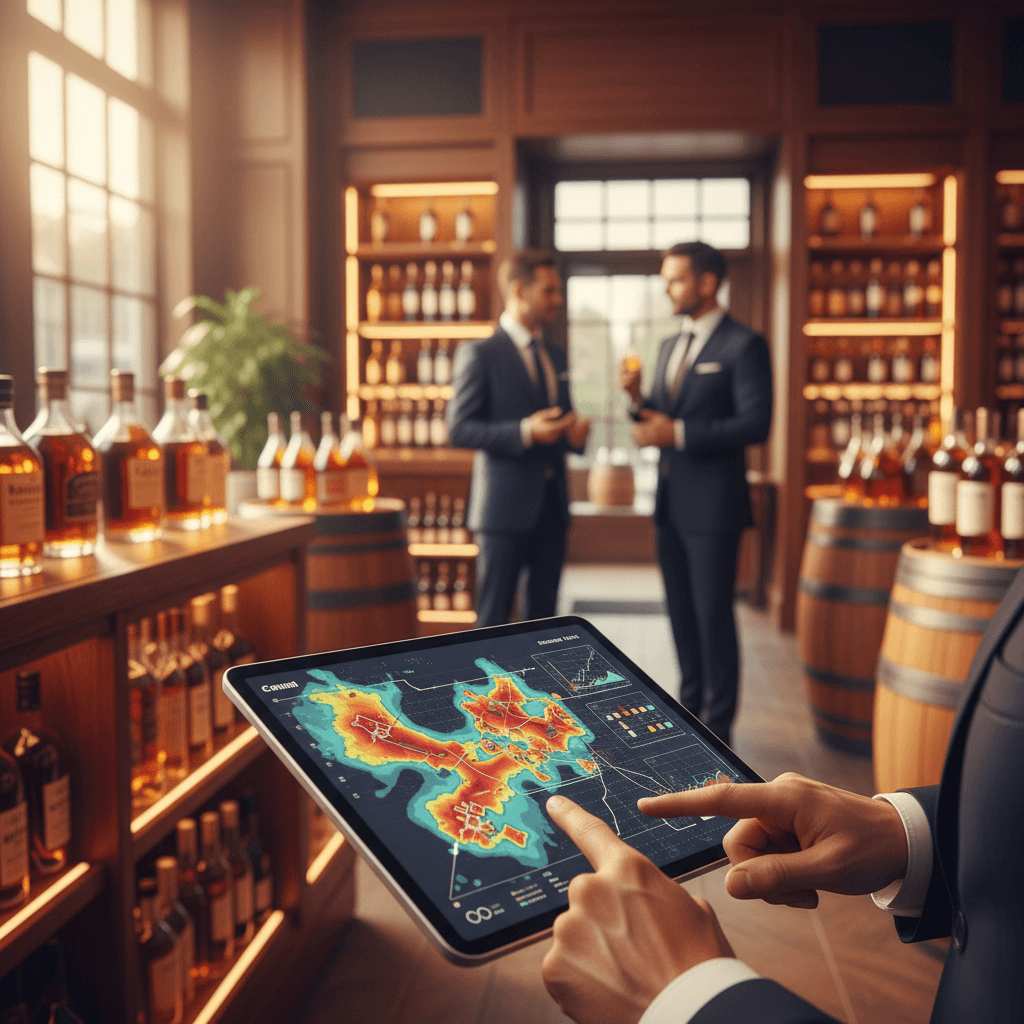
Heat maps translate customer movement data into a visual layer over your store floor plan. High-density traffic shows up as warm colors (red, orange); underutilized areas appear cool (blue, green). The science behind it is straightforward, sensors, camera-based AI, or Wi-Fi tracking log where customers walk, pause, and linger.
For a liquor store, a cold zone isn't just inefficient floor space. It's a revenue problem. If your Scotch wall or premium gift sets sit in a blue zone, customers are walking past them without a second glance, and you're leaving margin on the table every single day.
Foot traffic heat maps help liquor stores optimize store layout by revealing exactly where customers walk, pause, and engage, and where they don't. Place high-margin impulse purchases (premium spirits, curated gift sets, branded mixers) along the natural traffic path your heat map confirms. Cold zone data tells you whether to relocate a product entirely or invest in better lighting and signage to activate that space. According to research from Placer.ai, beverage alcohol retailers who align merchandising with observed traffic patterns see measurable lifts in both dwell time and basket size. Seasonal repositioning is where this gets powerful: pull historical heat map data from last November and use it to pre-plan your holiday floor layout before the rush hits. You're not guessing where to put the gift sets, you're engineering the path to them.
Treat every layout change like an A/B test. Capture your baseline heat map, make one change at a time, then measure again after two to three weeks. Did dwell time near that repositioned tequila display increase? Did conversion on that SKU follow? Track it.
The stores that win long-term build an internal knowledge base, documented findings specific to their floor plan, their customer base, their traffic patterns. Generic retail advice only gets you so far. Your data is the competitive edge.
Try this yourself: Pick your highest-margin cold zone product. Move it to the first confirmed hot zone on your heat map. Run it for 30 days. Compare unit velocity before and after. The answer will tell you more than any vendor pitch ever could.
Here's what actually happens when you ignore competitor foot traffic data: you make pricing, staffing, and promotional decisions in a vacuum, while the store two miles away quietly steals your Saturday customers.
Before: A mid-sized liquor retailer runs weekend promotions every Saturday, wondering why foot traffic stays flat. After: They pull aggregated competitor data from Placer.ai, discover their primary competitor peaks Friday evenings, not Saturdays, and shift their promotional push to Thursday night digital ads. Weekend visits climb 18% over the next quarter.
That's not luck. That's intelligence.
Third-party platforms like Placer.ai track anonymized device movement across retail locations, including your competitors. You can pull traffic trend data for stores within your trade area and compare visit velocity, peak hours, and seasonal patterns side by side.
The question you're actually answering: are you growing while competitors stagnate, or are you the one stagnating while they scale? According to IBISWorld, the U.S. beer, wine, and liquor store industry includes over 40,000 locations, meaning most urban and suburban markets face real competitive pressure. Aggregated data removes the guesswork about your relative position.
Key takeaways:
A competitor's weakness is your open door. If their foot traffic drops consistently on Sunday afternoons, that gap represents customers who want to shop but aren't being served well. Run a targeted promotion, extend your hours, or push a Sunday-specific social ad, and you're not just filling dead time, you're capturing displaced demand.
Promotional timing becomes a precision instrument here. Launch campaigns when competitor traffic historically dips. That's when their customers are most likely to try somewhere new.
At Intentionally Creative, competitive traffic monitoring is a standard component of client strategy, not an afterthought. Knowing when a competitor is vulnerable is just as valuable as knowing when your own store is strong.
Liquor stores can benchmark against competitors using foot traffic analytics by accessing aggregated location data through platforms like Placer.ai, which tracks anonymized visit patterns across retail locations, including nearby competitors. By comparing your traffic trends against competing stores in your trade area, you can identify whether your market share is growing or shrinking relative to the competition. Specifically, look for traffic gaps: days or time windows when competitor visits decline. Those gaps signal customer availability. A store that sees consistent Saturday afternoon dips at a competitor can launch targeted promotions during that window to capture displaced shoppers. Intentionally Creative incorporates this type of competitive traffic monitoring into ongoing client strategy, treating it as core intelligence rather than optional analysis. The result is smarter promotional timing, better resource allocation, and a clearer picture of where your store actually stands in the market.
Try this yourself: Pull Placer.ai data for your top two competitors. Identify their three lowest-traffic windows each week. Schedule your next email or SMS promotion to land 24 hours before one of those windows. Track whether your visits increase during that period. That's competitive intelligence working in real time.
Here's what actually happens when you hand raw foot traffic data to an agency that doesn't specialize in liquor retail: you get a generic dashboard, a few bar charts, and recommendations that could apply to a shoe store just as easily as a spirits shop.
That's the problem Intentionally Creative was built to solve.
Most agencies pick one data source and call it a day. Intentionally Creative integrates foot traffic data with POS transaction records, loyalty program behavior, and digital marketing performance metrics, simultaneously. That integration creates a complete picture of the customer journey, from the moment someone sees a targeted ad to the second they complete a purchase at the register.
No single source tells the full story. Foot traffic data shows who came in. POS data shows what they bought. Loyalty data shows who came back. Digital performance data shows what drove them there. Stack those four layers together, and patterns emerge that are invisible to anyone looking at just one feed.
Data without interpretation is noise. A spreadsheet showing peak traffic hours on Saturday afternoons means nothing unless someone translates it into a specific staffing decision, a promotional timing shift, or a floor layout adjustment.
Intentionally Creative operates on a monthly reporting cadence that covers traffic trends, campaign attribution, competitive benchmarks, and layout performance, delivered with clear next steps attached. Clients don't receive a dashboard and a "good luck." They receive a prioritized action list. That distinction matters more than most store owners realize until they've experienced both.
According to research from Placer.ai, beverage alcohol retail is entering a period of significant structural change, with consumer visit patterns shifting in response to economic pressure and format preference. Interpreting those shifts correctly, and acting on them before competitors do, requires more than data access. It requires category expertise.
Intentionally Creative uses foot traffic analytics for liquor store clients by integrating movement data with POS records, loyalty program history, and paid media performance into a unified reporting system. This multi-source model lets the agency trace the full customer journey, from ad impression to in-store purchase, and attribute revenue to specific campaigns, layouts, or promotions. Monthly reports translate that integrated data into specific, executable recommendations: which product categories to merchandise near high-dwell zones, which campaign types drive repeat visits, and how a store's traffic patterns compare against category benchmarks. Because Intentionally Creative serves exclusively retail liquor stores, the agency has accumulated category-specific benchmarks that generalist agencies simply don't have access to. Founder Alden Morris built the agency in May 2022 with this singular focus, and every tool, workflow, and data process reflects that specialization.
Most digital marketing agencies serve broad retail categories. A generalist firm advising a liquor store is working without a reference point. They don't know what a strong conversion rate looks like for a craft spirits promotion, or what foot traffic recovery should look like after a price increase on premium bourbon. Intentionally Creative does, because those benchmarks have been built store by store, campaign by campaign, since the agency launched.
That category depth compounds over time. Every client engagement adds to a proprietary benchmark set that makes the next analysis sharper, the next recommendation more precise.
Try this yourself: Pull your last 90 days of POS data alongside whatever foot traffic reporting your current tools provide. Look for weeks where traffic was up but transaction value was flat. That gap, visitors who came in but didn't spend at expected levels, is exactly the kind of signal that a properly integrated data stack surfaces automatically. If you can't see it right now, you're missing revenue that's already walking through your door.
Here's what actually happens when you run a liquor store without foot traffic data: you make expensive decisions that feel smart but aren't backed by anything real.
Gut instinct is not a business strategy. It's a liability.
Most liquor store owners are confident they know their peak hours. Thursday evenings. Friday afternoons. Maybe Saturday mornings for the brunch crowd. Foot traffic data frequently proves them wrong, sometimes by hours, sometimes by entire days.
That confidence gap is where the money bleeds out. You schedule three staff members for a slow Tuesday that turns into a pre-holiday rush, or you run a skeleton crew on a Wednesday that consistently outperforms your assumed peak. Both scenarios create the same outcome: wasted payroll or a line of frustrated customers who walk out and don't come back.
According to IBISWorld, labor costs represent one of the highest controllable expenses in beer, wine, and liquor retail. Misaligned staffing isn't a minor inefficiency, it compounds weekly.
Without attribution data, you're essentially guessing which campaigns drive actual store visits. A Facebook ad gets 400 clicks. Your email campaign gets a 22% open rate. Both feel like wins. But did either move foot traffic? You don't know.
That gap between digital engagement and in-store behavior is where marketing budgets go to die. Stores keep spending on channels that feel productive because the vanity metrics look good, impressions, clicks, reach. Foot traffic attribution closes this gap by connecting campaign activity to real visits, forcing genuine budget discipline.
Research from Placer.ai highlights how beverage alcohol retailers are increasingly using location intelligence to validate marketing spend rather than relying on platform-reported metrics alone (source ↗).
Here's a mistake that quietly drains ad spend every month: marketing to a five-mile radius when 80% of your customers come from a six-block stretch. Most stores default to broad geographic targeting because it feels like coverage. Foot traffic data reveals the actual trade area, and it's almost always tighter than owners expect.
Knowing where your customers don't come from is just as valuable as knowing where they do. If you're running geo-targeted ads across a wide area but your real customer base clusters within half a mile, you're subsidizing impressions that will never convert.
Tighten the radius. Increase frequency to the people who actually show up.
Liquor stores that skip foot traffic analytics consistently make three costly mistakes. First, they staff based on assumption rather than actual visit patterns, leading to wasted labor during slow periods and poor service during unexpected rushes. Second, they misallocate marketing budget by optimizing for digital engagement metrics like clicks and impressions instead of confirmed in-store visits, making it impossible to know which campaigns actually drove customers through the door. Third, they market to broad geographic areas when their real customer base typically comes from a much tighter trade area. Foot traffic data eliminates all three problems by replacing gut-feel decisions with visit pattern evidence, connecting campaign spend to real-world attribution, and defining the precise radius where ad dollars will actually produce results. For a retail category with tight margins and high competition, operating without this data isn't just inefficient, it's a structural disadvantage.
The recommendation: Before your next marketing budget review, pull your actual foot traffic data and map your real trade area. If you don't have it yet, that's the first problem to solve, everything else depends on it.
Are you making inventory decisions based on what sold last Tuesday, or based on what your customers are actually doing right now?
The gap is widening. Stores that invested in foot traffic analytics two years ago are now running leaner inventory, scheduling smarter, and converting more walk-ins than their competitors, and that advantage compounds. According to IBISWorld, the beer, wine, and liquor store sector faces sustained margin pressure, which means the stores operating on gut instinct are the first to feel it.
Here's the reality check:
Start with an audit of what you already have, POS data, loyalty program behavior, digital channel performance. The foundation is probably already there.
Foot traffic analytics drive long-term growth for liquor stores by converting anonymous store visits into actionable intelligence that improves every operational decision over time. When a store tracks when customers arrive, how long they stay, which sections they engage with, and how those patterns shift by season or promotion, it builds a compounding advantage. Stores that use this data can optimize staff scheduling to match peak hours, reduce inventory waste by stocking what actually moves, and design store layouts that guide customers toward higher-margin products. Research from Placer.ai highlights that beverage alcohol retail is entering a transformation period where physical foot traffic data, combined with digital behavior, creates the clearest picture of customer intent. Stores that collect this data consistently for 12 to 24 months develop predictive models that intuition simply cannot replicate. The result is not just better margins today, but a strategic asset that makes every future decision faster, cheaper, and more accurate.
Connect with Intentionally Creative ↗ to build a proprietary data strategy designed specifically for your store, not a generic template, but a system built around how your customers actually shop.
The liquor stores writing their next chapter aren't waiting to see what works. They already know.