Anchor Tenant Brewery Partnerships Are Reshaping Local Retail Foot Traffic: What Saskatoon's Gather Local Market Model Means for Liquor Store Location Strategy
By Intentionally Creative10 min read
Listen to this article14:04
Schedule a free strategy call and Intentionally Creative will build a custom plan for you.
Schedule Your Free Strategy CallFree audit. No commitment.
Get a Free Audit. No commitment.
Brewery anchor tenants are rewriting liquor store location strategy. Learn how the public market model is driving local retail foot traffic for beverage retailers.
The rules for picking a great liquor store location haven't changed in decades — until now. Traffic counts, demographics, zoning, competition mapping: these are the fundamentals, and they still matter. But a new variable is rewriting the playbook, and most independent retailers haven't factored it in yet. Breweries are being recruited as anchor tenants in mixed-use developments across North America, and the foot traffic they generate is creating high-value retail locations that never show up in a traditional site selection analysis.
This isn't about craft beer hype. It's about developers — people who bet millions on getting location economics right — choosing breweries over big-box retailers to anchor entire projects. When that happens, the gravity of where people shop, gather, and spend shifts. And if you sell alcohol for a living, that shift lands squarely on your desk.
From Saskatoon's Gather Local Market to Washington, D.C.'s Bridge District to San Francisco's Mission Rock development, a pattern is emerging that independent liquor retailers can either study and exploit — or watch from the sidelines while chains figure it out first. Here's what's happening, why it matters, and exactly how to use it.
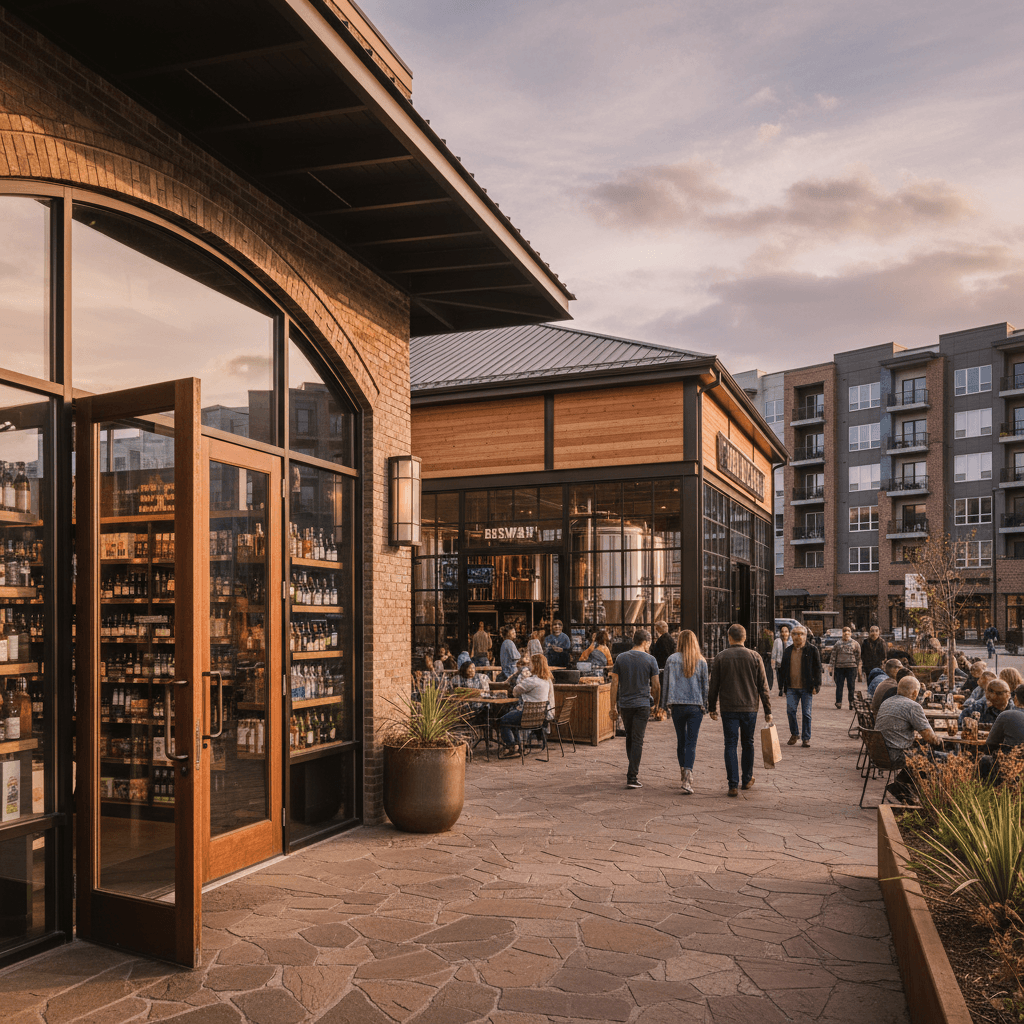
Developers across North America are actively recruiting breweries as anchor tenants in mixed-use retail projects. Not tucking them into a corner unit. Anchoring entire developments around them — a role traditionally reserved for grocery chains and big-box retailers.
That's not a trend. That's a structural change in how retail space gets planned, leased, and marketed. And it has direct implications for how you think about your next location.
Avoid TTB violations and Google Ads suspension with this guide to alcohol advertising rules for liquor stores. Expert...
The examples are stacking up fast:
When developments of this scale view a brewery as a high-value traffic driver, the calculus around local retail foot traffic has fundamentally changed.
Developers don't make these bets on vibes. Taprooms generate consistent, repeatable visits — evening crowds, weekend gatherings, event nights. They create dwell time that spills over into neighboring businesses. That's the same logic behind putting a food court in a shopping mall, updated for a generation that values experience over convenience.
So here's the question every independent liquor store owner should be asking: if breweries are the new foot traffic magnets reshaping where people shop and gather, what does that mean for where you open — or stay?
Discover the 7 essential marketing budget benchmarks for liquor stores. Learn how top performers allocate spend for m...
The answer starts with understanding what the traditional location playbook gets right — and where it falls short.
Let's give credit where it's due. The standard liquor store location strategy framework exists for good reason — and most of it still holds up. Average daily traffic volume, local demographics (household income, household size), zoning regulations, competition density, and market demand analysis are all legitimate, proven variables. If you're ignoring any of them, you're gambling.
These fundamentals have guided successful store openings for decades. They belong in every site selection conversation, full stop.
Here's what the current playbook misses: the brewery anchor model is quietly reshaping foot traffic patterns — and most industry frameworks haven't caught up.
Learn how to optimize your Google Business Profile for liquor stores with tips on photos, posts, reviews, and categor...
Experiential retail co-tenancy — locating near a brewery, food hall, or public market — isn't a nice-to-have anymore. As consumer behavior shifts toward destination shopping, it's becoming a core part of any serious location and marketing strategy for liquor retailers.
The plain-language takeaway? The spreadsheet that tells you where to open a store probably doesn't have a column for "nearby taproom traffic." It should.
And if you want to see what this model looks like when it's purpose-built from the ground up, look north.
Saskatoon's Gather Local Market represents a Canadian iteration of the brewery-anchored public market concept that's already gaining traction in U.S. cities. The model combines local food vendors, artisan producers, and craft beverage anchors into a single experiential destination — the same formula developers in Rocklin, Livermore, and D.C. are betting on.
What makes it notable: almost nobody in the Canadian liquor retail space is paying attention to this model yet. South of the border, developers are allocating serious square footage to brewery anchors and watching foot traffic follow. Gather Local Market is applying that same logic in a mid-size Canadian city.
Mid-size cities like Saskatoon are ideal testing grounds. Real estate costs are lower. Local food and beverage communities are tight-knit and collaborative. And consumers are genuinely hungry for experiential retail destinations that give them a reason to show up in person.
For independent liquor store owners rethinking their location strategy, this is the replicable playbook worth studying. Proximity to a brewery anchor in a public market setting means built-in traffic from consumers already in a buying mindset for craft beverages. You're not generating demand from scratch — you're intercepting it.
Cities like Regina, Kelowna, and Halifax could be next. Independent retailers who study and adapt now — before national chains catch on — position themselves to capture first-mover advantages in markets where community trust still beats corporate scale.
Of course, you don't have to take the independent retailer's word for it. The chains are already validating this strategy with real dollars.
When a brewery signs on as the anchor tenant in a mixed-use development, it creates a gravity well for foot traffic that every neighboring retailer benefits from. If your liquor store location strategy puts you near one of these developments, the question isn't whether to lean in. It's how.
Think of your store as the second chapter of a customer's experience. Taproom visitors who loved a hazy IPA on draft want to take something home — stock the anchor's bottles and cans prominently. Then go further: feature local craft spirits, small-batch wines from regional producers, and build cross-promotional bundles ("Loved the stout? Pair it with this local bourbon for $45").
Co-host tasting events. Share social media audiences. Create a "local loop" where taproom visitors walk to your store and vice versa. This model works best when both businesses actively send customers to each other.
Here's the line to walk carefully. The best independent bottle shops — retailers like Camperdown Cellars in Sydney — credit store individuality and a customer-first philosophy as their key differentiators. That approach becomes even more powerful when paired with a brewery anchor's built-in community.
But symbiosis isn't dependence. Your marketing strategy should position your store as a destination in its own right, enhanced by the anchor, never defined by it. Stock their products, yes — but make sure 80% of your identity is uniquely yours. The brewery brings people to the block. Your expertise, curation, and personality keep them coming back to your door.
Building identity gets people through the door. But to systematically capture the foot traffic flowing past it every day, you need a digital component.
Geofencing — location-based digital advertising that serves ads to people's phones when they enter a defined geographic area — is tailor-made for this model. You're targeting consumers who are already physically near your store, already in a craft beverage mindset, and already spending money.
A simple playbook:
Geofencing alone isn't a strategy. Pair it with local SEO, an optimized Google Business Profile, and social media that taps into the anchor's audience. That's how a smart liquor store location strategy becomes a full-funnel growth engine.
10+ years helping liquor retailers and beverage brands grow through data-driven digital marketing. Learn more
If you think co-location strategy is just a theory, the biggest players in grocery and beverage retail are already betting real money on it.
Winn-Dixie's parent organization has been rolling out liquor store co-locations alongside grocery remodels as a growth strategy. The playbook is straightforward: pair liquor retail with high-traffic grocery destinations to capture cross-shopping behavior. They're not opening standalone shops on random corner lots. They're deliberately building adjacency into the model.
When chains invest in co-location, they're validating something independents should pay close attention to: foot traffic driven by complementary anchors is a proven growth lever. If major grocery chains are building their liquor retail strategy around who's next door, you should be too.
But here's where it gets interesting for you. Chains move slowly. They follow formulas. Independent operators can move faster, forge brewery partnerships, and embed themselves in mixed-use developments that chains wouldn't touch.
The real advantage independents hold? The ability to build hyper-local identity and curated product selection that no chain can replicate — which is exactly what the next wave of co-location models demands.
Intentionally Creative specializes in foot traffic marketing strategies that drive real results. Let us show you what's possible.
Schedule a CallDemographics and traffic counts still matter. But the brewery anchor model is creating high-value locations that traditional analysis completely overlooks — and foot traffic patterns are shifting accordingly.
If you're evaluating a new location or rethinking your marketing strategy around an existing one, this is your framework.
The brewery anchor tenant model isn't coming — it's here. Developers are building around it. Chains are investing in co-location. Public markets from Saskatoon to San Francisco are proving that experiential retail destinations generate the kind of consistent, repeat foot traffic that every liquor retailer wants but few know how to find.
The independent operators who win the next five years won't just pick locations with good traffic counts and favorable demographics. They'll pick locations where the strategy accounts for who's anchoring the block, what kind of customer that anchor attracts, and how to build a digital and in-store experience that captures that traffic before a competitor does.
You don't need to wait for the data to get cleaner or the model to get more proven. The proof is in the lease agreements being signed right now. The question is whether you'll be positioned next to the next brewery anchor — or across town wondering where your foot traffic went.
Ready to build a location and marketing strategy around the brewery anchor model? Get in touch with Intentionally Creative ↗ — we'll help you identify the right opportunities and build the digital engine to capture them.