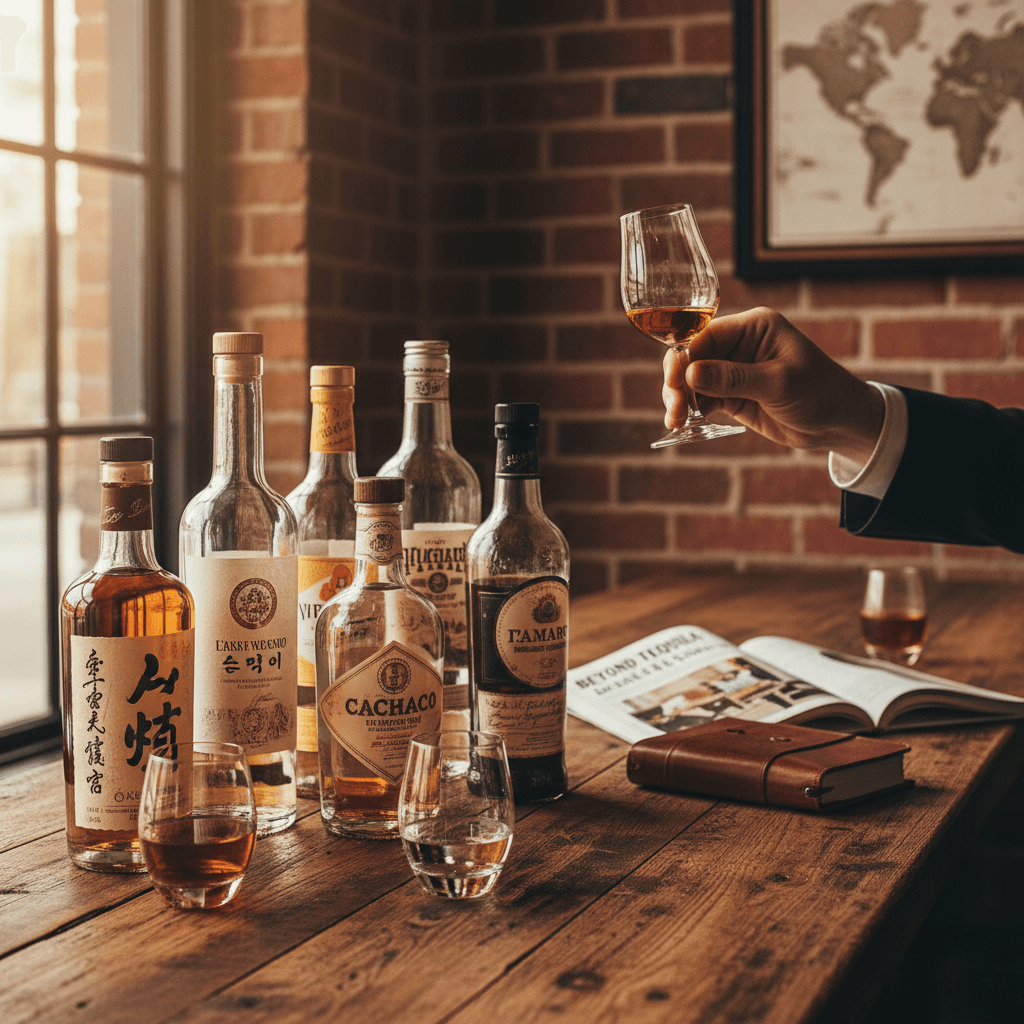
Beyond Tequila: Capitalizing on the Next Big Spirits Trend
By Alden Morris, Founder & Principal Strategist34 min read
Listen to this article48:22
Schedule a free strategy call and Intentionally Creative will build a custom plan for you.
Schedule Your Free Strategy CallFree audit. No commitment.
Get a Free Audit. No commitment.
Discover the emerging spirits trends reshaping the liquor retail landscape. From Japanese whisky to agave alternatives, this guide helps liquor store owners capitalize on the next big category before the competition.
Tequila didn't just grow, it redefined what premium means at retail.
Twenty years ago, tequila lived on the bottom shelf next to the well vodka. Then came the celebrity investment wave, George Clooney's Casamigos sale to Diageo for $1 billion in 2017 sent a signal to every consumer: this category deserves attention. Overnight, perception shifted. Retailers who read that moment early and repositioned their agave sets captured margin they're still benefiting from today.
Discover 7 proven Instagram content ideas for liquor stores that boost engagement and drive sales. Learn how to promo...
The lesson wasn't about tequila specifically. It was about category timing. Retailers who moved first, who gave premium agave spirits the shelf real estate and staff education they deserved, won the decade.
Discover 9 proven liquor store content marketing strategies that combine data-driven personalization, social media en...
According to IWSR, spirits category growth increasingly follows a predictable pattern: authenticity narrative, premiumization, then mainstream adoption. Mezcal is already mid-cycle. Sotol and Raicilla are earlier. The next tequila is already on your shelf, you may just not know it yet.
10 proven liquor store social media content ideas to connect with customers, boost brand visibility, and drive both i...
Liquor stores should look beyond tequila because the category's growth blueprint is actively repeating itself across multiple spirits right now. Tequila's ascent from well-pour to premium staple happened in under two decades, accelerated by celebrity investment, additive-free production conversations, and consumers willing to pay more for a compelling origin story. IWSR data confirms this pattern isn't unique to agave, it's a repeatable cycle. Mezcal is currently in its premiumization phase. Rhum Agricole is building its authenticity narrative. Gin has already completed the cycle in key markets. Retailers who waited to stock Casamigos lost margin to competitors who moved first. The same risk exists today with emerging categories. Identifying which spirits are in the early stages of that cycle, and positioning your shelf accordingly, is the difference between leading a trend and chasing it. That's exactly what this article is built to help you do.
Here's what actually happens when a spirit goes from niche curiosity to mainstream staple: it doesn't explode overnight. It trips five specific wires, usually in sequence, over a three-to-seven year window. Miss the signal, and you're buying at peak margin compression. Catch it early, and you're the retailer with the best selection before your competitors even know what to reorder.
So how do you read those wires before the rest of the market does?
Five indicators that a spirits category is building real momentum:
What signals indicate an emerging spirits category is about to break through?
Here's what actually happens when a category lacks labeling standards: consumers give up and buy something they understand instead.
That's rum's story in a single sentence. While Scotch whisky built a global premium reputation on the back of strict regional classifications, rum producers across dozens of countries operated under wildly different rules, or no rules at all. A bottle labeled "aged 12 years" from one country might mean something completely different from another. Consumers couldn't decode it. Retailers couldn't explain it. The category stalled.
Rum accounts for roughly 10% of global spirits volume, yet its premium segment has historically punched far below its weight compared to whisky or even tequila. That gap is closing fast.
The labeling chaos is real, but it's being addressed. Advocacy organizations like the West Indies Rum & Spirits Producers' Association have pushed hard for production transparency, and craft producers are responding with back-label education that actually tells the consumer something useful, still fermentation method, still type, aging environment.
Cocktail culture is doing the heavy lifting on consumer acquisition. The Daiquiri revival brought Rhum Agricole into craft bars nationwide. The Tiki resurgence put Wray & Nephew overproof and funky Jamaican expressions in front of drinkers who'd never considered rum a serious spirit. According to research from IWSR, rum's premium-and-above segment posted volume growth outpacing the broader rum category, a signal that the education is working.
Rum earns its place as the next major premium spirits category because it offers what whisky drinkers already value, terroir, age statements, and production transparency, at a fraction of the price point, with more flavor diversity. Martinique's AOC-designated Rhum Agricole expressions, made from fresh sugarcane juice rather than molasses, carry the same protected-origin credibility as Cognac. Aged agricole from producers like Clément or Neisson delivers grassy, vegetal complexity that serious whisky drinkers find immediately compelling. Barbadian expressions like Doorly's 12-Year and Foursquare Exceptional Cask releases routinely draw comparisons to single malt Scotch, at $40, $60 versus $80, $120. The IWSR has flagged premiumization as a primary driver in spirits across 2025–2026, and rum sits directly in that current. The category has the raw material. It just needed the narrative.
Here's what actually happens when a customer asks for "something like mezcal, but different", you either have an answer or you lose the sale to the store that does.
The myth worth busting first: mezcal is a niche product for adventurous drinkers only. That was true in 2015. The IWSR now tracks mezcal as one of the fastest-growing premium spirits categories in the U.S., with volume projected to grow through 2027 even as tequila's growth rate cools. Mezcal didn't lose its cachet by going mainstream. It expanded the ceiling.
Mezcal's growth followed a specific arc: craft credibility first, then distribution scale. Brands like Del Maguey and Banhez built the category's reputation for additive-free production and village-level terroir before the major players arrived. That foundation matters because it shaped what consumers expect, authenticity, traceability, and a story worth telling.
The smoky flavor hesitation is real but manageable. The science behind it: mezcal's smoke comes from roasting agave piñas in earthen pits, a process that embeds guaiacol and syringol compounds into the spirit. These are the same compounds in Scotch whisky. Customers who drink Islay Scotch? They're already mezcal drinkers who don't know it yet. Frame it that way and watch the hesitation drop.
Raicilla comes from Jalisco, the same state as tequila, but uses different agave varieties, primarily Agave maximiliana. It's fruitier and more floral than mezcal, with less smoke. Bacanora comes from Sonora, produced from Agave pacifica, and carries a DO (Denomination of Origin) that limits production to a specific region. Drier climate, leaner spirit. Sotol isn't technically an agave spirit, it comes from the Dasylirion plant, but it drinks like one and attracts the exact same consumer.
Founder and Principal Strategist at Intentionally Creative. 10+ years in three-tier beverage industry marketing, 3 patents pending, CityHive partner. Runs growth for independent liquor retailers and DTC brands.
An emerging spirits category signals a breakthrough when it simultaneously shows cocktail menu penetration at influential on-premise accounts, accelerating media coverage moving from trade to mainstream outlets, and measurable import volume growth tracked by organizations like IWSR or DISCUS. Celebrity equity investment, not just endorsement, indicates serious capital is building distribution infrastructure. Consumer search behavior on Google Trends and social listening platforms often leads retail sales data by 12 to 24 months, making it one of the most actionable early indicators available to retailers. When three or more of these five signals align within the same 12-month window, the category is typically 18 to 36 months from hitting mainstream retail demand. Waiting for all five to confirm means buying inventory at full price with compressed margins.
Tequila checked every single box between 2010 and 2016, and most retailers missed it anyway. Craft cocktail bars started swapping well tequila for quality blanco expressions around 2011. Publications like Food & Wine and Esquire picked up agave coverage by 2013. Celebrity investment followed, George Clooney's Casamigos sale to Diageo for $1 billion in 2017 was the closing bell on the early-adopter window, not the opening one. IWSR data showed tequila import volumes climbing steadily through that entire period.
Retailers who built deep agave sections between 2012 and 2015 captured outsized margin on bottles they'd purchased before demand spiked. By 2018, everyone was fighting over the same Patrón and Don Julio allocations.
That's the playbook. The same framework that explains tequila's rise now points toward categories like Rhum Agricole, premium gin expressions, and additive-free production spirits gaining traction with the same cocktail-forward consumer cohort. According to Southern Glazer's 2026 Liquid Insights Tour, authenticity and provenance are the primary purchase drivers for spirits consumers under 40, the exact profile that drove agave's ascent.
Try this yourself: Pull your Google Trends data for "mezcal," "sotol," and "rhum agricole" right now and compare the curve shapes. You're looking for the mezcal pattern from 2014, steady climb, not viral spike. That's organic category development. That's where your shelf space investment belongs.
Here's what actually happens when a customer picks up a bottle of Hibiki Japanese Harmony: they pause. They read the label. They ask someone a question. That moment of curiosity is worth more than any endcap display you've ever built, and it's the core of why Japanese whisky deserves serious shelf space in your store right now.
Japanese whisky ages in barrel for years before it ever reaches your shelf. Suntory's Yamazaki distillery, for example, operates on production timelines that stretch 10, 18, even 25 years, meaning the whisky available today was committed to barrel long before the global demand surge hit. That structural scarcity isn't marketing spin. It's distillery math. And it creates something genuinely rare in retail: a category where limited allocation drives consumer urgency organically, without manufactured hype.
According to IWSR data, Japanese whisky has maintained premium price positioning even as other premium spirits categories softened in 2024. Your pricing strategy should reflect that reality. Don't race to the bottom. Position Japanese whisky as a premium discovery, a category where $65 feels like a bargain and $120 feels attainable. Customers who feel like they found something rare become loyal customers. That's not a theory. That's how allocation-driven categories work across every tier of the beverage alcohol system.
Japanese whisky is still a growth opportunity for liquor stores. Yes, and the window to build category authority is still open, but it's narrowing. IWSR projects continued volume growth in the premium-and-above Japanese whisky segment through 2027, driven by consumer migration away from bourbon and toward global whisky styles. Suntory's Hibiki Harmony and Yamazaki 12 remain the category anchors, with strong brand recognition built through years of critical acclaim and cocktail culture crossover. Nikka's Coffey Grain offers an accessible, distinctive entry point under $60. Beyond the established names, a wave of craft Japanese distilleries, Nagahama, Mars Shinshu, Akkeshi, are beginning to reach U.S. allocations through distributors like Southern Glazer's, giving forward-thinking retailers a first-mover advantage. Non-age-statement (NAS) expressions are your volume play: they're more consistently available, more approachable on price, and serve as the gateway that converts a curious customer into a repeat buyer. Single malts, meanwhile, serve your collector segment, customers already spending on allocated bourbon who are ready to diversify.
Shelf talkers earn their keep in this category more than almost any other. Japanese whisky carries a production story, the influence of Scottish distilling tradition, the Japanese philosophy of monozumi (craftsmanship through repetition), the specific water sources and climate conditions, that customers genuinely want to understand. A three-sentence shelf talker that explains why Yamazaki tastes different from a Speyside Scotch closes sales your staff doesn't have time to close manually.
Cross-merchandising works here too. Position Japanese whisky near cocktail accessories, Japanese mixing glasses, bar spoons, premium ice molds, and you're building a lifestyle sell, not just a bottle sell. Pair it with Japanese snacks or matcha products if your store layout allows. The visual story does the selling. Staff education, though, is your highest-leverage investment. A floor associate who can explain the difference between Nikka's Coffey still production and Suntory's pot still approach, and who can connect that to flavor, converts high-ticket bottles at a rate no signage can match. Train your team on two or three key expressions, give them tasting notes in plain language, and watch your Japanese whisky turns improve within a single quarter.
Try this yourself: pull your last 90 days of Japanese whisky sales data and identify which expressions have the highest reorder rate. Those are your core four. Build your staff training, shelf talkers, and cross-merchandise strategy around those specific bottles first, then expand.
Intentionally Creative specializes in digital marketing strategies that drive real results. Let us show you what's possible.
Schedule a CallPosition aged rum as a whisky alternative, not a rum upgrade. That framing changes everything.
Stop organizing your rum shelf by brand. Organize it by region and production style, molasses-based vs. agricole, column-distilled vs. pot-still, unaged vs. aged. That single change transforms a confusing wall of bottles into a self-guided education.
Your whisky buyer is your rum convert. They already value age statements, barrel influence, and production provenance. Identify them. Talk to them. A shelf talker that reads "If you drink Glenfarclas 15, try this" next to a Foursquare 14-Year is a conversion tool, not just a label.
Southern Glazer's 2026 Liquid Insights Tour flagged rum as an underdeveloped premium opportunity at retail, meaning your distributor rep likely has programming support available right now. Hosting a focused rum tasting, three to five bottles, organized by production style, accelerates the education cycle that normally takes years. Try this yourself: pull your top five whisky SKUs by velocity, identify the flavor profiles driving those sales, and match each one to a rum equivalent. That's your starting lineup.
According to Southern Glazer's 2026 Liquid Insights Tour, trade buyers are actively seeking "the next mezcal" to position ahead of consumer demand. These three categories fit that brief precisely. They appeal to the customer who discovered mezcal two years ago and now wants to go deeper. That customer exists in your store right now.
U.S. availability has expanded: look for Puntagave Raicilla, Cielo Rojo Bacanora, and Desert Door Sotol as accessible entry points with distributor support in most markets.
What liquor stores should stock in the agave-beyond-tequila category:
Liquor stores serious about the agave category should stock at minimum one expression each of mezcal, raicilla, bacanora, and sotol. For mezcal, prioritize brands with additive-free certification and clear agave sourcing, Del Maguey Single Village andPutaendo are strong anchors at different price points. For raicilla, Puntagave offers approachable entry pricing with distributor reach. Bacanora remains the most underdeveloped shelf opportunity: Rancho Tepua is one of the few widely available expressions, and scarcity is a selling point. Sotol from Desert Door (Texas-produced) or Hacienda de Chihuahua covers the category's geographic range. Together, these four spirits tell a coherent story about agave diversity that tequila alone cannot tell, and that story sells bottles. Research from the IWSR confirms that premium agave spirits as a combined category outperforms individual segment projections when merchandised together.
What to do instead of waiting for customers to ask:
Try this yourself: put a bottle of Cielo Rojo Bacanora next to your mezcal section with a handwritten tag that reads "What mezcal drinkers discover next." Track how many conversations it starts in 30 days. The category practically sells itself, it just needs the shelf space to breathe.
Here's what actually happens when the TTB draws a legal line around a spirit category: retailers gain a shelf story, consumers gain confidence, and a fragmented group of craft producers suddenly becomes a category.
That's exactly what happened in 2024 when the Alcohol and Tobacco Tax and Trade Bureau established the official Standard of Identity for American Single Malt whiskey. The ruling wasn't just regulatory housekeeping. It was the signal that this category had arrived.
Start with Westland Distillery's Sherry Wood expression, around $75, rich with dried fruit and Pacific Northwest terroir. Before 2024, a bottle like that sat in an ambiguous retail purgatory. Was it bourbon-adjacent? A Scotch alternative? The new TTB standard answers that question cleanly: American Single Malt must be produced at a single distillery, made from a mash of 100% malted barley, distilled to no more than 160 proof, and aged in oak containers in the United States.
Compare that to Scotch single malt, which requires maturation in oak casks for a minimum of three years in Scotland, typically in used bourbon or sherry barrels. American producers face no such barrel restriction, which opens the door to extraordinary experimentation: new charred oak, wine casks, even locally sourced barrels from regional cooperages.
That legal clarity matters for your store. Retailers now have a defined category to merchandise, a consumer-facing explanation that fits on a shelf talker, and a standard that distributors, including major players like Southern Glazer's, can communicate consistently up and down the supply chain.
The Pacific Northwest built this category's early credibility. Westland (Seattle) and Copperworks (also Seattle) proved that American barley, Pacific maritime climate, and serious craft infrastructure could produce whiskeys worth $60, $120 retail. Both prioritize grain provenance, Westland has sourced heritage barley varieties that produce flavor profiles you won't find in any Scotch.
Colorado and the Rocky Mountain corridor bring a different variable: altitude. High-elevation aging accelerates interaction between spirit and wood due to temperature swings and lower atmospheric pressure. Distilleries like Stranahan's (technically a Colorado single malt pioneer, pre-TTB) have built loyal followings around this regional signature.
East Coast producers are now entering at volume. New York, Virginia, and Pennsylvania distilleries are leveraging local grain programs and established whiskey infrastructure. Expect entry-level expressions in the $45, $55 range from this corridor, which gives your shelf a price point that competes directly with accessible Scotch.
Price mapping matters here:
American Single Malt whiskey is a TTB-defined category of whiskey produced from 100% malted barley at a single U.S. distillery, aged in American oak. Retailers should stock it now because it bridges the gap between the bourbon buyer and the Scotch loyalist, two of the highest-spending consumer segments in any liquor store. According to IWSR data, the premium-and-above whiskey segment continues to outperform the broader spirits market, and American Single Malt sits squarely in that growth band. The 2024 TTB ruling gives the category legal legitimacy that converts casual curiosity into confident purchase decisions. Shelf placement adjacent to Scotch single malts drives trial from the right consumer. Tasting note language, "coastal salinity," "dried stone fruit," "gentle smoke", speaks directly to that buyer without alienating the bourbon drinker who's ready to explore.
The crossover consumer is real and spending. Research from Southern Glazer's 2026 Liquid Insights Tour confirms that whiskey drinkers increasingly shop across subcategories rather than staying loyal to a single style. The American Single Malt buyer often has Scotch in their home bar and bourbon in their regular rotation. They're not choosing, they're collecting.
Shelf placement is a genuine strategic decision. Position American Single Malt adjacent to Scotch rather than in the American whiskey section. The visual association does the selling. A customer scanning Glenfiddich and Glenlivet who spots Westland's Garryana expression at $95 gets curious, and curious customers ask questions that lead to sales.
Tasting note language is your bridge. Use descriptors that honor both worlds: "malted grain sweetness with the structure of a Highlands Scotch" or "new oak influence you'd expect from bourbon, complexity you'd expect from single malt." Train your staff on two sentences per bottle. That's the whole pitch.
Practical tip: Pull one American Single Malt into your next staff tasting alongside a comparable Scotch and a bourbon. Let your team find the language organically. The descriptors they land on will be more authentic, and more persuasive, than anything printed on a back label.
Here's what actually happens when a whisky drinker discovers Calvados: they realize they've been ignoring an entire AOC-regulated category that delivers the complexity they love, at a price point that makes single malt look aggressive.
Before: Your brandy shelf is Cognac-heavy, and customers who've maxed out their whisky exploration have nowhere to go.
After: A three-SKU Calvados section, anchored by a Pays d'Auge AOC expression, a VSOP, and an XO, gives those same customers a discovery moment that builds basket size and loyalty simultaneously.
Calvados earns its credibility through France's AOC designation system. Calvados Pays d'Auge requires double distillation in copper pot stills and minimum two years of oak aging. That's not marketing language, that's a production standard that quality-conscious cognac and whisky drinkers understand immediately when you explain it at the counter.
Key takeaways for your floor staff:
On-premise, bartenders are pulling Calvados into Old Fashioned riffs and Sour builds. That cocktail menu presence is your leading indicator. When a spirit appears on craft cocktail menus, retail demand follows, typically within 12 to 18 months.
Calvados is where whisky drinkers go when they want to feel like they discovered something.
— A sentiment echoing across specialty spirits forums and increasingly, distributor sales decks.
Try this yourself: Pull your Armagnac and Cognac velocity reports side by side. If Armagnac is moving, Calvados will too. Same customer, same motivation.
Here's what actually happens when a bar puts a Pisco Sour on its signature cocktail menu: it sells, customers ask what's in it, and then they walk into your store the following weekend looking for a bottle they can't find because you don't carry it.
That's the gap. And it's costing you sales right now.
Before: Pisco is the bottle your rep mentioned once, you passed, and now it's a dead end when a customer asks.
After: Four SKUs, two Peruvian, two Chilean, and a shelf talker explaining the difference turns that dead end into a conversion.
The Peruvian vs. Chilean distinction matters more than most retailers realize. Peruvian pisco must be made from specific grape varieties, distilled to proof, and bottled without dilution or additives, a production philosophy that overlaps directly with the additive-free production conversation driving interest in categories like Mezcal. Chilean pisco allows blending, aging, and dilution, producing a softer, more approachable spirit. According to research from IWSR, world spirits categories with clear origin narratives and production differentiation outperform generic imports in specialty retail, and pisco has both.
Key takeaways for building your pisco section:
According to Southern Glazer's 2026 Liquid Insights Tour, world spirits with cocktail menu momentum are translating into measurable retail velocity within two quarters of on-premise penetration. Pisco Sour is already on menus. The retail moment is now, not later.
The stores that win with emerging categories aren't the ones who waited for the trend to be obvious. They're the ones who stocked it when the bartenders started asking.
Try this yourself: Call the three best cocktail bars in your market this week. Ask if they're running a Pisco Sour. If two of them say yes, you're already behind.
Standalone Answer, Which international spirits categories represent untapped retail opportunities?
Calvados and Pisco represent two of the strongest untapped retail opportunities in international spirits right now. Calvados, France's AOC-regulated apple brandy, appeals directly to whisky and cognac drinkers seeking complexity with a discovery narrative. Its Pays d'Auge AOC designation signals production standards that quality-conscious consumers recognize and respect. Pisco, the South American grape-based spirit, is gaining cocktail menu traction through the Pisco Sour, which historically functions as a reliable leading indicator of retail demand. The Peruvian production model, distilled to proof, no additives, single varietal, connects with the same consumer values driving interest in Mezcal and additive-free spirits. Research from IWSR confirms that world spirits categories with clear geographic origin stories and differentiated production methods consistently outperform generic imports in specialty retail. A curated selection of three to five SKUs across both categories, supported by trained staff and strong shelf communication, positions a retail store as a trusted authority before these categories hit mainstream velocity.
Here's what actually happens when a sober-curious shopper walks into your store looking for non-alcoholic spirits: they scan the shelves, find nothing labeled for them, and leave, often to buy online instead. That's a sale you lost before it started.
The no/low alcohol category didn't sneak up on anyone. It announced itself loudly. According to IWSR, the no/low alcohol segment has posted double-digit year-over-year growth consistently, with Zero-Proof Spirits among the fastest-moving subcategories in the broader spirits space. This isn't a niche. It's a structural shift in how a growing segment of consumers relates to alcohol.
Who's buying? Primarily millennials and Gen Z, but not exclusively abstainers. The majority of no/low buyers also purchase full-strength spirits. They're moderating, not quitting. That distinction matters enormously for how you stock and market these products. These shoppers research before they visit, cross-reference ingredients, and respond to wellness framing. They also spend more per transaction when they find what they're looking for.
Seedlip built the category. Lyre's scaled it. Ritual Zero Proof made it accessible at a $30 price point that doesn't intimidate. These three brands anchor any credible NA spirits set, each positioned differently, each serving a distinct buyer.
Beyond the category leaders, watch these emerging craft NA spirits: Monday Gin (which mimics botanical gin structure convincingly), Ghia (a bitter aperitif built around adaptogens), Kin Euphorics (targeting the wellness-meets-social drinking space), and St. Agrestis Phony Negroni (a ready-to-drink format that removes all friction). Research from Southern Glazer's 2026 Liquid Insights Tour confirms that functional and low-ABV beverages are among the top ten drink trends reshaping retail buying decisions this year.
The low-ABV aperitif segment, Ghia, Kin, St. Agrestis, deserves its own conversation. These products sit at the intersection of flavor, ritual, and wellness. They're not replacements for gin or vodka. They're a new occasion entirely.
Should liquor stores stock non-alcoholic spirits and low-ABV options?
Yes, and the window to get ahead of this is closing. Liquor stores should stock non-alcoholic spirits and low-ABV options because the category is growing at double-digit rates annually, according to IWSR, and the consumer driving that growth is already walking into your store. The sober-curious shopper doesn't replace your core spirits buyer, most no/low purchasers also buy full-strength alcohol. Stocking brands like Seedlip, Lyre's, Ritual Zero Proof, and low-ABV aperitifs like Ghia gives you a complete offer for the moderating consumer without cannibalizing existing sales. Retailers who ignore this segment aren't protecting their shelf space, they're handing those transactions to grocery chains and e-commerce platforms that moved faster. A curated NA section signals that your store understands where the market is going, which builds loyalty across all buyer types, not just the sober-curious ones.
Here's where most retailers get this wrong: they tuck two bottles of Seedlip next to the tonic water and call it a strategy.
Integration has merit, placing NA gin alternatives near your gin set, for example, captures the shopper already in that aisle. But it also buries the category. A dedicated wellness or NA section functions as a destination. It tells a story. It signals that your store made a deliberate choice to serve this customer, which earns trust and repeat visits.
The signage matters as much as the placement. Avoid language that frames NA spirits as a consolation prize. "Mindful Drinking" outperforms "Non-Alcoholic" on shelf talkers. "Craft Zero-Proof" outperforms "Alcohol-Free." The framing should celebrate the choice, not explain it defensively.
The forward-looking move: build your dedicated NA section now, before your nearest competitor does. Assign it real shelf real estate, eye level, not the bottom shelf, and treat the category with the same merchandising discipline you'd apply to your premium whiskey set. Try this yourself: pull your last 90 days of NA spirits sales data, identify your top three SKUs, and build a four-foot section around them. Then watch the adjacent basket size. You'll see the pattern within 60 days.
Here's what actually happens when you stock an emerging spirits category without a plan: it sits. The bottles gather dust, your cash is tied up, and your staff can't answer a single question about what's in them. Trend awareness doesn't generate revenue. Execution does.
Inventory Strategy: How Much to Commit to Emerging Categories
Apply the 80/20 rule to your spirits buying with discipline. Eighty percent of your shelf space and budget belongs to proven movers, your Jack Daniel's, your Crown Royal, your core vodka and gin SKUs. The remaining 20% is your discovery inventory: the emerging categories where margin and differentiation actually live.
Within that 20%, allocate in tiers. Commit 10-12% to categories with documented momentum, mezcal, rhum agricole, zero-proof spirits, where IWSR data already shows accelerating velocity. Reserve 6-8% for genuine early-stage bets: sotol, raicilla, additive-free production expressions that your best customers don't know they want yet.
Cash flow risk is real. Limit single-SKU emerging category buys to no more than 3-4 units until you've tested velocity for 60 days. Work your Southern Glazer's or regional distributor reps hard for limited allocations, those relationships get you early access before a category hits mainstream radar and margins compress.
Staff Training as a Competitive Advantage
A customer who picks up a bottle of sotol and can't get a straight answer puts it back. Every time. Knowledgeable staff are the single highest-ROI investment you can make in emerging category sales.
Build a monthly spirits education cadence using distributor resources, most reps will do a 20-minute staff training for free if you ask. Pair that with digital content from Intentionally Creative reinforcing the same category stories your team just learned. Consistency between what staff say and what customers read online builds trust fast.
Incentivize category ambassadors. A small spiff, $25-50 per month, for the staff member who sells the most units in a designated emerging category creates internal competition that directly converts to shelf movement.
Digital Marketing to Drive Emerging Category Discovery
Most customers don't walk into your store looking for rhum agricole. You have to create the curiosity before they arrive. According to research from Southern Glazer's 2026 Liquid Insights Tour, consumers increasingly discover new spirits categories through digital content before they ever engage with a product in-store.
Social media does the introduction. A 30-second Reel explaining the difference between mezcal and sotol, shot in your store, featuring your actual staff, outperforms any generic product post. Email sequences do the education. A three-email series that moves from "what is this category" to "here's what to buy first" to "here's a cocktail to make tonight" drives measurable foot traffic.
Optimize your Google Business Profile for category-specific searches. "Best mezcal selection [city]" is a real search query with real buying intent behind it.
Standalone Answer Unit:
Liquor stores operationalize emerging spirits trends by pairing disciplined inventory allocation with staff education and targeted digital marketing. Start by reserving 20% of your spirits budget for discovery categories, then tier that allocation, higher commitment to momentum categories like mezcal and zero-proof spirits backed by IWSR data, smaller test buys for early-stage categories like sotol or raicilla. Train staff monthly using distributor resources so they can convert browsers into buyers at the shelf level. Simultaneously, run digital marketing that creates category awareness before customers arrive, social content, email education sequences, and Google Business Profile optimization for category-specific searches. According to Southern Glazer's 2026 Liquid Insights Tour research, consumers form category curiosity digitally before purchasing in-store, which means your marketing and your staff need to tell the same story. A digital marketing partner like Intentionally Creative builds that content infrastructure so trend awareness translates directly into register activity.
Try this yourself: Pull your spirits sales data from the last 90 days and identify your bottom 15% of SKUs by velocity. That's your dead inventory. Liquidate it, reallocate the cash into one emerging category with distributor support, schedule a staff training before the product hits the shelf, and run a single social post introducing the category the same week it arrives. Measure sell-through at 30 and 60 days. That's the full execution loop, and it's repeatable.
What if the real opportunity isn't choosing between tequila and everything else, but recognizing that curious drinkers are buying more, not just buying differently?
Mezcal didn't kill tequila. Rhum Agricole didn't cannibalize rum. Category growth compounds. According to IWSR's 2026 outlook, premium spirits across multiple categories are expanding simultaneously, driven by consumers who want to understand what's in their glass, not just what's trending on Instagram.
The liquor store has always been a discovery destination. Right now, consumer curiosity about production methods, regionality, and additive-free production is at a genuine peak. The retailers who told the tequila story early, who stocked Raicilla before it was searchable, built the kind of customer loyalty that advertising can't buy.
That same window is open today. The question is who walks through it first.
Are your shelves and your digital presence telling the same story, or are they strangers to each other?
Three moves to make this week:
That third step is where most independent retailers stall. Knowing the product is one thing. Building the digital presence to match that in-store expertise is another.
That's exactly what Intentionally Creative does. We help liquor stores turn shelf knowledge into searchable, shareable content that drives foot traffic and builds long-term authority.
The competitive window is open. Southern Glazer's is already briefing their retail partners on 2026 trend positioning. Your customers are already searching.
Standalone Answer, For Retailers Ready to Act:
Liquor store owners who want to capitalize on emerging spirits trends beyond tequila should take three immediate actions: audit their current shelf mix for underrepresented categories like sotol, rhum agricole, and zero-proof spirits; invest in staff education around production methods and regionality; and build a digital content strategy that reflects their in-store expertise. Research from IWSR confirms that premium spirits growth is happening across multiple categories simultaneously, meaning emerging products don't replace tequila, they expand the total basket. The retailers who win are the ones who position themselves as discovery destinations before a category peaks, not after. Consumer curiosity about what's actually in the bottle, additive-free production, heritage distillation, regional provenance, is driving purchase decisions right now. Independent retailers have a credibility advantage over big-box competitors. The gap is execution. Stores that close that gap today, with both physical merchandising and digital visibility, are the ones customers will return to tomorrow.
The spirits category doesn't reward waiting. The retailers who told the tequila story early are still benefiting from that credibility today. The same opportunity exists right now, across sotol, agricole rum, craft gin, and zero-proof, for any store willing to lead instead of follow. Start with your shelves. Back it up with your digital presence. If you want help building that presence, Intentionally Creative ↗ is the only agency in the country built specifically for retail liquor stores. Let's talk.
With a 7x ROAS engine and category-level product ranking strategy, Uncorkit expanded its local and national visibility, translating digital dominance into measurable in-store revenue growth.