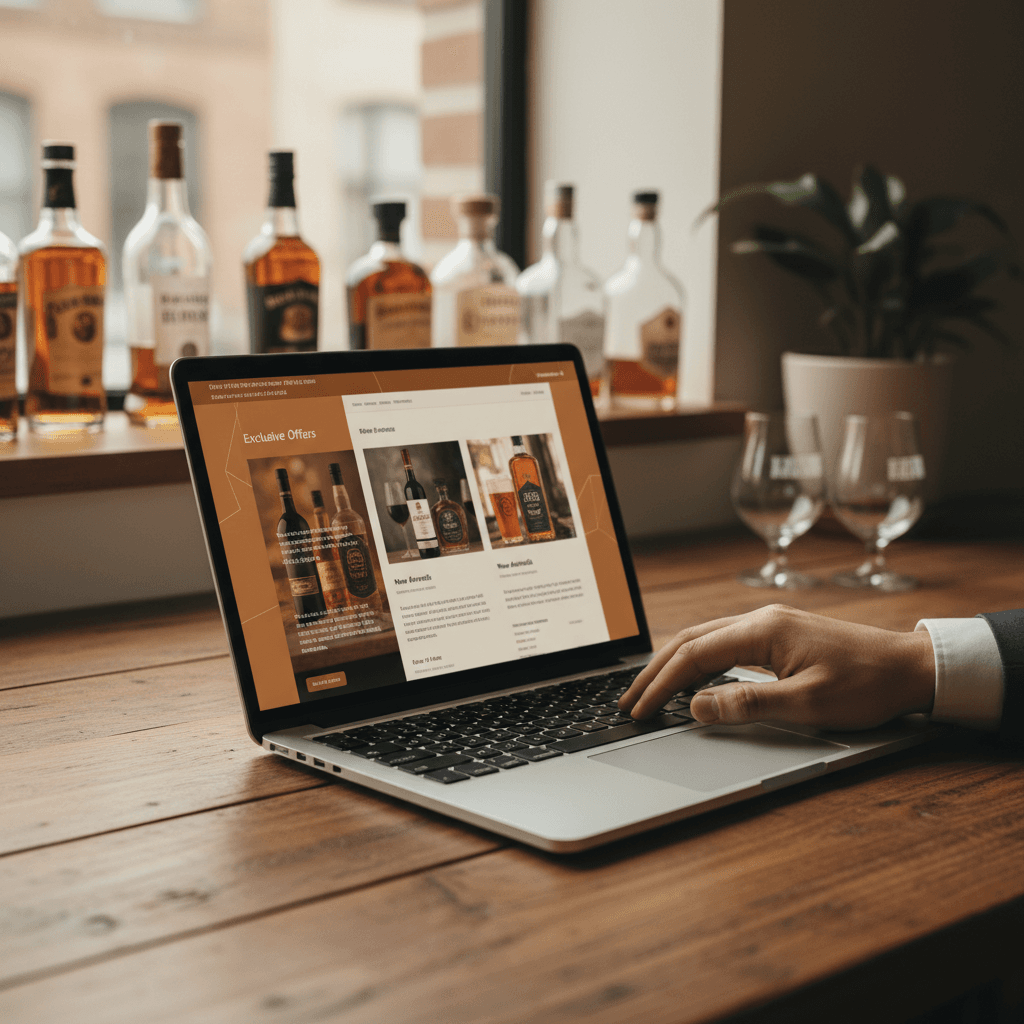
Email Marketing for Liquor Stores: How to Stay Compliant While Driving Repeat Sales
By Alden Morris44 min read
Listen to this article52:01
Schedule a free strategy call and Intentionally Creative will build a custom plan for you.
Schedule Your Free Strategy CallFree audit. No commitment.
Get a Free Audit. No commitment.
Learn how liquor stores can build compliant, high-ROI email marketing campaigns. Covers age verification, state regulations, segmentation strategies, and automation flows that drive repeat sales without crossing legal lines.
Every dollar you spend on email marketing can return forty-five.
That's not a typo. According to Mushroom Media and industry benchmarks ↗, email marketing yields up to $45 ROI per dollar spent for independent alcohol retailers — crushing social media, paid search, and print mailers combined. Yet walk into most neighborhood liquor stores and ask about their email strategy. You'll get a shrug.
Here's what changed. Your shop isn't just the place people grab a six-pack on the way home anymore. It's where a young couple discovers their first Amaro Montenegro. Where a home cook finds that high-acid Txakoli to pair with grilled shrimp. Where a spirits geek hunts down a single-barrel store pick. You've become a discovery hub — and email is how you keep that discovery going between visits.
But most store owners fall into one of two camps. They either skip email entirely, leaving thousands in repeat revenue on the table, or they blast out generic "10% OFF EVERYTHING" promos that train customers to wait for discounts and — worse — risk running afoul of state advertising regulations. Fines for violations range from a few hundred dollars to over $15,000 ↗, according to McDermott Will & Emery's 2026 enforcement outlook.
The real unlock: compliance and sales aren't opposing forces. Compliance is the sales strategy. Age-gating your list, respecting state-specific promotion rules, and segmenting by purchase history don't just keep you legal — they build a higher-quality subscriber base that actually opens your emails. Research from Bottlecapps ↗ shows personalized emails boost open rates by up to 26% and click-throughs by 14%. The stores treating compliance as a constraint are losing to the stores treating it as a filter.
This guide is built for independent liquor store owners, wine shop operators, and small chain managers who want more repeat business without legal exposure. If you've got a POS system, a customer list you've never emailed, and a vague worry about what you're allowed to say — keep reading.
Learn proven email marketing strategies for liquor stores that turn subscribers into loyal customers. Build your list...
Email marketing is the highest-returning digital channel available to independent liquor retailers, generating up to $45 in revenue for every $1 spent. With alcohol e-commerce growing from $73.91 billion in 2025 to a projected $86.56 billion in 2026, the customers walking through your door already expect to hear from you online. Personalized, segmented campaigns — organized by taste preference, purchase history, and price sensitivity — consistently outperform generic blast promotions, driving 26% higher open rates and 14% more click-throughs. Yet most liquor stores either ignore the channel entirely or send compliance-risky discount blasts that erode margins and invite regulatory scrutiny. The stores winning with email treat every send as both a sales opportunity and a compliance checkpoint, building subscriber trust while staying within their state's specific advertising and promotion rules.
We'll walk through the full playbook: the 50-state compliance patchwork you need to understand, how to build a permission-based list with proper age verification, the campaign types that drive the most repeat purchases, automation sequences that run while you're stocking shelves, and the metrics that actually matter. Enforcement is tightening in 2026 — Coalition Technologies reports ↗ average email open rates now hit 42.35% across industries, which means more eyes on every message you send, compliant or not.
Start with one goal: send your first segmented, compliant campaign within 30 days of finishing this guide. Everything here is designed to get you there.
Could a single email cost you your liquor license? That's not hyperbole — it's the reality facing store owners who treat alcohol email marketing like any other retail channel. The rules here are layered, unforgiving, and shifting fast. Getting this wrong doesn't just mean a slap on the wrist; fines can exceed $15,000 per violation, and license revocation pulls the plug on your entire business.
Liquor store email marketing operates under three simultaneous compliance frameworks: federal alcohol advertising rules enforced by the TTB (Alcohol and Tobacco Tax and Trade Bureau), the CAN-SPAM Act governing all commercial email, and individual state alcohol control board regulations that vary wildly across all 50 states. At the federal level, emails cannot contain misleading health claims, target minors, or omit responsible drinking messaging. CAN-SPAM requires a valid physical mailing address, a functioning unsubscribe mechanism, truthful subject lines, and non-deceptive sender headers. For stores selling online or shipping across borders, CCPA and GDPR add data privacy obligations including explicit consent requirements and the right to deletion. State-level rules layer on top with restrictions on price advertising, promotional language, and direct-to-consumer shipping that differ by jurisdiction. Email service providers like Klaviyo and Mailchimp impose their own acceptable use policies on alcohol content, and violating platform rules can trigger account suspension — even when your emails are fully legal. Every liquor store must satisfy all three layers simultaneously or face financial penalties and operational disruption.
Learn how to build a liquor store email marketing funnel with welcome sequences, smart segmentation, and promo cadenc...
The TTB doesn't care that your email "only goes to your loyalty club." If it promotes alcohol, TTB advertising regulations apply. That means no claims that your bourbon "improves heart health," no imagery designed to appeal to anyone under 21, and responsible messaging baked into every send. Think of CAN-SPAM as the bare minimum — the floor, not the ceiling. Alcohol layers obligations on top of it like a double-casked finish adds complexity to a whiskey.
Here are the five non-negotiable federal requirements for every email you send:
If you sell online and ship to customers in California or the EU, CCPA and GDPR pile on. You need explicit opt-in consent (not pre-checked boxes), clear data usage disclosures, and a real mechanism for customers to request deletion. According to Corporate Compliance Insights ↗, enforcement of digital alcohol advertising rules has intensified sharply as e-commerce alcohol revenue — growing from $73.91 billion in 2025 to a projected $86.56 billion in 2026 — draws more regulatory scrutiny.
Texas lets you advertise prices in email. Pennsylvania doesn't. Oregon allows direct-to-consumer wine shipments but restricts spirits. Utah's alcohol regulations read like they were written to discourage selling altogether. One email template blasted to your full list is a compliance grenade.
The critical variations that trip up store owners:
Learn how email segmentation for liquor stores drives repeat sales with a 4,200% ROI. List-building tactics, purchase...
The McDermott Will & Emery 2026 Outlook reports that digital monitoring of retail alcohol ads is accelerating, with fines ranging from a few hundred dollars to $15,000+ per offense. License revocation — the death sentence for any retailer — sits at the end of that enforcement spectrum.
Build a state-specific compliance matrix. Update it quarterly. If you ship to 12 states, you need 12 sets of rules governing what you can say, show, and sell. This is not optional paperwork — it's the cost of doing business in a regulated category.
Your emails might be legal in every state you serve and still get your account suspended. Mailchimp, Klaviyo, and Constant Contact each enforce their own acceptable use policies for alcohol-related content, and these policies don't always align with the law.
Klaviyo requires pre-approval for alcohol accounts. Mailchimp restricts certain promotional formats. Constant Contact flags aggressive discount language. Violate these platform-specific rules and you lose access to your entire subscriber list, your automation workflows, and your sending reputation — mid-campaign.
Before you commit to any ESP, read the AUP line by line. Switching platforms after you've built 50 automated flows and segmented 10,000 subscribers is expensive, disruptive, and — with email delivering up to $45 in ROI per dollar spent ↗ — a revenue hit you can't afford. The platform is your landlord. Know the lease before you move in.
The direct answer: compliance in liquor store email marketing isn't a single rule — it's a three-layer system. Federal rules set the baseline, state regulations add restrictions unique to each jurisdiction, and your email platform enforces its own policies on top. Master all three, or pick a different marketing channel.
A store owner in Austin lost her liquor license last year — not because she sold to a minor, but because her email marketing signup form used a single "I am 21+" checkbox and nothing else. The state auditor flagged it during a routine review, and the fine landed at $12,000. Her list of 8,000 subscribers? Worthless overnight, because she couldn't prove a single one had been properly age-verified. That's the nightmare scenario, and it's entirely preventable.
Liquor stores build a compliant email list by implementing multi-layered age verification at every subscriber touchpoint. The process starts with a date-of-birth gate on your signup form — not a checkbox, but an actual birthdate entry field that calculates age in real time. Layer two adds a legal acknowledgment where the subscriber confirms they meet your state's minimum purchase age and consent to receive alcohol marketing. Layer three integrates a third-party verification service like Veratad or AgeChecker directly into your signup flow, cross-referencing the submitted information against public records and returning audit-ready documentation. Every verification event should be timestamped and stored: the subscriber's confirmed date of birth, their IP address, the verification method used, and the result. This documentation becomes your shield during compliance reviews. According to Corporate Compliance Insights ↗, fines for non-compliant alcohol marketing range from hundreds to over $15,000, and regulators are scrutinizing digital channels harder each year. A robust verification stack costs a fraction of a single penalty.
Store your verification records for a minimum of three years. Link each record to the subscriber's email profile in your CRM so you can pull compliance proof in minutes, not days. This isn't overhead — it's insurance for your license.
Purchased email lists are a losing bet for liquor retailers. Beyond the compliance risk of marketing alcohol to unverified contacts, the performance numbers tell the real story: opt-in lists crush purchased lists in open rates, click-throughs, and deliverability. Research from Bottlecapps ↗ shows personalized emails boost open rates by up to 26% and click-throughs by 14% — gains you'll never see from a cold list of strangers who never asked to hear from you.
Most liquor store owners believe they need expensive marketing automation platforms to run personalized email campaigns. Wrong. The real bottleneck isn't software — it's the failure to segment at all. A staggering number of independent retailers still blast identical emails to every subscriber, whether that person buys $12 rosé or $200 allocated bourbon. According to Bottlecapps ↗, personalized emails boost open rates by up to 26% and click-throughs by 14%. That gap between a generic blast and a segmented send isn't marginal — it's the difference between an email program that pays for itself and one that trains your customers to ignore you.
Liquor stores should segment their email lists across four core dimensions to maximize repeat purchases and engagement. First, taste preference: separate wine buyers from spirits buyers from beer buyers, then go deeper — bourbon drinkers, natural wine enthusiasts, mezcal explorers. Second, purchase history and frequency: a customer who buys every week gets different messaging than someone who shops quarterly. Third, price sensitivity tier: your budget shoppers hunting deals under $15, your mid-range explorers in the $20–$50 sweet spot, and your premium collectors chasing allocated bottles at $100+. Fourth, buying occasion: personal consumption, gifting (spikes hard in November and December), and entertaining. Even a crude two-segment split — wine buyers versus spirits buyers — dramatically outperforms unsegmented sends. If you're emailing more than once a week without segmentation, you're burning list health and leaving revenue on the table.
The ROI math here is unambiguous. Research from Coalition Technologies ↗ reports average email open rates hitting 42.35% across industries in 2026, but segmented liquor store campaigns routinely exceed that benchmark because the content actually matches what the reader wants to buy. With email marketing delivering up to $45 in ROI per $1 spent according to industry benchmarks, segmentation isn't a nice-to-have — it's the single highest-leverage move you can make.
Picture this: a customer walks into your store, grabs a bottle of Woodford Reserve Double Oaked, and mentions they're new to bourbon. Your best employee doesn't just ring them up — they recommend a tasting flight, share the distillery's backstory, and invite them to next month's whiskey event. That's exactly what your automation flows should do, except at scale, around the clock, without paying overtime.
Three sequences form the backbone of every profitable liquor store email program: welcome, reorder, and win-back. Get these right, and you'll capture the lion's share of that $45 return on every $1 spent ↗ that makes email the single highest-ROI channel for independent retailers.
Your welcome sequence is a first impression you can't redo. Email one drops immediately after signup: confirm age verification, tell subscribers what to expect (frequency, content type), and deliver instant value. A seasonal cocktail recipe or a downloadable tasting guide works better than a coupon here — you're establishing expertise, not training discount-seekers.
Email two shifts to story. Why does your store exist? What makes your buyer's palate worth trusting? A family-owned shop in Austin that spotlights its sommelier's 15 years in Napa tells a fundamentally different story than a big-box chain pushing whatever's on deal that week. Lean into that gap.
Email three gets personal. If someone signed up through your bourbon landing page, recommend a bottle — something specific, with tasting notes. "Try the Elijah Craig Barrel Proof B524. Caramel, toasted oak, a long cinnamon finish. At $65, it drinks like a $120 pour. Buy two." Research from Bottlecapps ↗ confirms personalized emails like this boost open rates by up to 26% and click-throughs by 14%.
10+ years helping liquor retailers and beverage brands grow through data-driven digital marketing. Learn more
Double opt-in is your gold standard. The subscriber enters their email, completes age verification, then confirms via a follow-up email. Yes, you'll lose some signups in that second step. Good. Those are the people who would have tanked your deliverability score and never purchased anyway. Your collection points should be everywhere a verified customer interacts with your brand: POS prompts at checkout ("Want early access to our next bourbon allocation?"), a website popup with an integrated age gate, tasting event sign-in sheets, and loyalty program enrollment. For lead magnets, skip the generic discount code. Offer cocktail recipe cards featuring your current inventory, a seasonal tasting guide with your staff's honest picks, or — the single most effective magnet I've seen — exclusive first-access notifications for limited releases. A list of 500 verified bourbon enthusiasts who opted in for allocation alerts will outperform a purchased list of 50,000 every single time, and at $45 return per $1 spent on email marketing according to Mushroom Media benchmarks ↗, each qualified subscriber carries real revenue weight.
Most retailers bury their compliance language in size-8 footer text, treating it like an embarrassment. That's a missed opportunity worth real money. Flip the script: make your verification process a visible trust signal and lead with it. Your welcome email should open with something like, "We verified your age because we take our responsibility seriously — and that same standard applies to every bottle we recommend." That single line accomplishes three things: it explains why you asked for their birthdate, it positions your store as legitimate and trustworthy, and it sets a tone of curation over mass-market noise.
Premium spirits buyers — your highest lifetime-value segment — actively seek out retailers who demonstrate this kind of professionalism. They're spending $80-200 per bottle and choosing between your store and a dozen online alternatives. Visible compliance separates you from fly-by-night operations hawking grey-market spirits with zero accountability. With alcohol e-commerce growing from $73.91 billion in 2025 to $86.56 billion in 2026 according to industry projections ↗, the competition for those premium buyers intensifies every quarter. Trust isn't a soft metric — it's the conversion lever that turns a gift buyer into a repeat customer and a repeat customer into someone who drives across town to shop at your store instead of clicking "add to cart" somewhere else.
Every dollar you spend on email marketing returns roughly $45, according to Mushroom Media benchmarks ↗. Compare that to paid social, where you're lucky to see $8 back. The gap is staggering — yet most liquor store owners squander this channel by blasting the same tired 15%-off coupon to their entire list. That's not a strategy. That's a race to the bottom.
Here's the uncomfortable truth: discount-led emails train your customers to never pay full price. Every "Weekend Sale!" blast teaches your list to wait, to expect the markdown, to treat your curated shelf like a clearance bin. You cannot out-discount Total Wine. You cannot out-coupon Costco. Stop trying.
Alcohol is an experience product. Nobody buys a bottle of Lagavulin 16 the way they buy paper towels. The purchase carries emotional weight — anticipation, curiosity, a sense of occasion. Research on wine purchasing behavior consistently shows that storytelling and education increase willingness to pay. A customer who understands why a single-barrel bourbon from a specific rickhouse floor tastes different will pay $65 without blinking. A customer trained on discounts will balk at $50.
Education-first emails — tasting notes, food pairings, origin stories, distiller profiles — build lifetime value without sacrificing a cent of margin. Data from Bottlecapps ↗ confirms the payoff: personalized, content-rich emails boost open rates by up to 26% and click-throughs by 14% versus generic promotional blasts. You're not just preserving margin. You're building a customer who trusts your palate over an algorithm.
Liquor stores should send five core email types to drive repeat sales without relying on discounts: staff picks with personal tasting notes, seasonal pairing guides tied to holidays and events, limited release alerts for allocated products, origin stories that spotlight producers and regions, and loyalty milestone emails triggered by purchase behavior. Each template positions the store as a trusted curator rather than a commodity retailer, and each should include a clear call to action, compliant promotional language, and required responsible drinking disclosures in the footer. With alcohol e-commerce growing from $73.91 billion in 2025 to a projected $86.56 billion in 2026 according to industry reports ↗, stores that build a repeatable email program around these five formats capture more of that growth without eroding their margins on race-to-the-bottom promotions.
1. The Staff Pick. Your best salesperson's recommendation, delivered to the inbox. Keep it brief and opinionated: "Our beer buyer Jake has been obsessed with this Czech-style pilsner from Notch Brewing — dry, snappy, with a biscuit finish that makes you forget every macro lager you've ever tolerated." Include tasting notes and a personal story. This mimics the in-store experience digitally, which is your actual competitive advantage over big-box.
2. The Seasonal Pairing Guide. Cocktail recipes, food pairings, and hosting tips tied to what's coming next — Derby Day juleps, Thanksgiving amaro digestifs, summer rosé selections. Tie it to the calendar, not to a price cut.
3. The Limited Release Alert. Scarcity does what discounts pretend to do: it creates urgency. When you get six bottles of an allocated Pappy Van Winkle or a small-batch mezcal, that email writes itself. No discount needed. The constraint is the offer.
4. The Origin Story. Spotlight a producer, a region, a distilling process. A 200-word profile of a family-owned Armagnac house in Gascony does more for your brand than a hundred "10% OFF ALL BRANDY" subject lines. It positions you as a curator, not a shelf.
5. The Loyalty Milestone. Triggered by purchase count or spend threshold — "You've bought 12 bottles with us this year. Here's early access to our holiday reserve list." Reward engagement, not just transactions.
The line between compelling copy and a compliance violation is thinner than you think. Fines for marketing violations range from a few hundred dollars to over $15,000, according to McDermott Will & Emery's 2026 regulatory outlook ↗. That single email blast could cost you more than your entire quarter's marketing budget.
The rules are blunt. No health claims — you cannot suggest red wine improves heart health, even if you read it somewhere. No implied therapeutic benefits. No language suggesting alcohol enhances athletic performance or social status. Some states restrict urgency language that echoes "happy hour" pricing tactics; phrases like "drink more" or "stock up for the weekend" can trigger scrutiny from regulators.
Responsible drinking messaging belongs in every email — but not buried in 8-point font at the bottom. Weave it into your brand voice naturally. "Share this bottle with friends over a slow dinner" reads better and signals responsibility without sounding like a legal disclaimer.
One operational detail that most guides skip: sync your POS inventory to your website in real time. If your email promotes a bottle at $34.99 and the customer walks in to see $39.99 on the shelf, you've destroyed trust faster than any competitor could. Price mismatches between email offers and in-store reality are the silent killer of repeat purchase behavior. Send one to two emails per month — Mushroom Media recommends ↗ Tuesday or Thursday sends — and make every one count.
Intentionally Creative specializes in email marketing strategies that drive real results. Let us show you what's possible.
Schedule a CallForget the notion that personalization demands a six-figure Klaviyo contract. Most modern ESPs — Mailchimp, Drip, even Constant Contact — support dynamic content blocks. Use them. Show your bourbon segment that new Eagle Rare drop; show your wine segment the Willamette Valley Pinot allocation. Same email template, different product blocks. Simple.
Merge tags go far beyond first-name insertion. Reference the customer's last purchased product ("Loved that Clase Azul Reposado? Try this..."), their nearest store location, or their loyalty tier. These micro-signals tell the reader you actually know them, which collapses the distance between "promotional email" and "recommendation from my local shop."
Behavioral triggers seal the deal without manual effort:
What to do instead of blasting your whole list:
The stores getting this right aren't enterprise operations. They're independent shops with 2,000-subscriber lists running four segments and three automated triggers. That minimal setup — paired with real product knowledge and the kind of vivid, specific recommendations that make a subscriber taste the caramel and tobacco notes through the screen — creates an email program that competitors running 20,000-name unsegmented blasts can't touch. Skip the spray-and-pray. Build the segments. The data says you'll thank yourself.
Emails four and five introduce your loyalty program and layer in social proof — customer reviews, photos from your last tasting event, a quote from a regular. Every single email in this sequence must carry an unsubscribe link, your physical address, and responsible drinking messaging. Skip any of these and you're risking fines that run from hundreds to over $15,000 ↗.
Most regular buyers repurchase every two to four weeks. Your POS data knows this. Use it. When a customer bought a case of Vinho Verde three Saturdays ago, trigger a reorder reminder that references that exact product — "Ready for another round of Broadbent Vinho Verde?" — and pair it with a "you might also like" recommendation pulled from similar customer purchase patterns. Maybe customers who buy Vinho Verde also grab Albariño in the summer months.
Here's the critical discipline: don't lead with a discount. The reorder email sells convenience, not price. You're reminding someone to grab what they already love before the weekend hits. Train customers to wait for deals and you'll erode your margins permanently.
Trigger your win-back after 60–90 days of inactivity, calibrated to your store's typical purchase cycle. The first email leads with value: "Here's what you've missed" featuring three new arrivals or staff picks with vivid descriptions. Think "a single-village Mezcal with roasted agave, white pepper, and a smoke trail that lingers for days" — make them taste what they're missing.
Email two gets personal. A short note from the store owner or manager, written like a human, not a brand. "Hey, we noticed you haven't been in. Our new Japanese whisky selection is worth the trip."
The final email is the honest breakup: "Should we stop emailing you?" This isn't desperation — it's list hygiene. Subscribers who don't engage tank your deliverability scores, which means your emails to active customers land in spam. Before sending any win-back message, verify that lapsed subscribers haven't revoked consent during their absence. State regulations don't pause because someone went quiet.
Every liquor store should set up three core email automations: a welcome sequence that confirms age verification, introduces the store's expertise, and delivers a personalized product recommendation within the first week; a reorder reminder flow triggered by POS purchase data at two-to-four-week intervals that references specific past purchases and pairs them with curated suggestions; and a win-back sequence fired after 60–90 days of inactivity that re-engages lapsed buyers with new arrivals, a personal note from ownership, and a final opt-out request to maintain list health. These three flows run continuously without manual effort and, according to industry benchmarks compiled by Campaign Lake, generate up to $45 in revenue for every dollar invested — outperforming paid social and display advertising by a wide margin while keeping your store compliant through built-in age gates and mandatory unsubscribe mechanisms.
Pro tip: Build all three sequences in your ESP before you send a single broadcast campaign. Automations compound — every new subscriber enters the welcome flow, every buyer enters the reorder loop, and every quiet customer gets a structured path back. Set these once, refine quarterly, and watch your repeat purchase rate climb.
Before: A liquor store owner signs up for a popular email platform, spends three weeks building automations, imports 4,000 customer contacts — then gets a suspension notice. The platform's acceptable use policy prohibits alcohol sales. Three weeks of work, gone.
After: That same owner picks a platform built for alcohol retail, syncs it to their POS on day one, and launches a segmented campaign that pulls $45 back for every $1 spent (Mushroom Media / industry benchmarks ↗).
The difference? Fifteen minutes of due diligence on platform selection.
Your email platform needs to do more than send pretty newsletters. Here's the non-negotiable checklist:
The best email platforms for liquor stores are those that explicitly permit alcohol retail accounts and offer robust automation with POS integration. Klaviyo stands out for Shopify-integrated stores, offering deep segmentation and e-commerce tracking purpose-built for product-based retail. Drip delivers strong automation workflows ideal for multi-step nurture sequences tied to purchase behavior. Mailchimp remains widely supported, but you must review its acceptable use policy carefully — enforcement has flagged alcohol accounts before. For operators who want an all-in-one solution, industry-specific platforms like City Hive or Bottle POS bundle email marketing directly into their retail management stack, eliminating integration headaches entirely. With alcohol e-commerce growing from $73.91 billion in 2025 to a projected $86.56 billion in 2026 (industry reports via Perplexity synthesis ↗), picking the right platform now locks in a serious competitive advantage.
My verdict: if you run a single-location store with a Shopify storefront, Klaviyo is the best option — buy it and don't look back. If you're POS-first and e-commerce-second, City Hive or Bottle POS will save you months of integration pain.
"We emailed a Pappy Van Winkle promotion to 3,000 people and had two bottles in stock." That's a real story from a retailer who learned the hard way that email without inventory sync destroys trust faster than it builds revenue.
Real-time POS-to-email sync solves the single biggest credibility killer in alcohol retail: promoting a product that's out of stock or listed at a different price in-store. Your email says $29.99 for that Côtes du Rhône — your shelf tag says $34.99. The customer feels duped. You've lost them.
Here's what proper integration looks like:
Before you commit to any platform, evaluate API quality and native integrations hard. Middleware tools like Zapier or Make bridge gaps, but those costs compound fast for small retailers running tight margins. A $50/month Zapier plan on top of your email platform on top of your POS subscription eats into that $45-per-dollar ROI quickly. According to Coalition Technologies ↗, average email open rates hit 42.35% across industries in 2026 — but segmented, inventory-accurate liquor store campaigns routinely beat that number because every product in the email is something the customer can actually walk in and buy.
Skip platforms that treat integration as an afterthought. Native POS connections aren't a luxury feature — they're the foundation that makes everything else work.
Spring 2026 has brought a reckoning for liquor store owners who've been "doing email" without measuring what works. Alcohol e-commerce is growing from $73.91 billion to $86.56 billion this year alone, according to industry projections ↗, and the retailers capturing that growth aren't guessing — they're reading their dashboards like a sommelier reads a wine list.
Liquor stores should track six core email marketing KPIs: open rate (targeting 25–35% with good segmentation), click-through rate (2.5–4% for segmented sends), revenue per email sent, list growth rate (3–5% monthly net growth), unsubscribe rate (staying below 0.5% per send), and deliverability rate (95%+). Revenue per email sent matters most because it directly ties your campaign to the register. A store sending 5,000 emails that generates $2,000 in attributable sales earns $0.40 per email — a number you can benchmark monthly and optimize against. Open and click-through rates tell you how subscribers engage; revenue per email tells you whether it matters. Research from Bottlecapps ↗ confirms that personalized emails boost open rates by up to 26% and click-throughs by 14%, which means segmentation isn't a nice-to-have — it's the mechanism that moves every other metric on this list.
A quick definition: deliverability rate measures the percentage of your emails that actually reach an inbox rather than bouncing or landing in spam. For alcohol retailers, this metric carries extra weight. Email platforms flag alcohol-related content more aggressively, and a deliverability rate below 95% signals that your sender reputation is eroding. Send from a verified domain. Authenticate with SPF, DKIM, and DMARC. Skip the spammy subject lines about "FREE BOOZE" — your ESP will punish you before your subscribers do.
List growth rate deserves blunt honesty: if you're not adding 3–5% net new subscribers per month, your list is dying. Every list churns. People move, change emails, lose interest. A healthy list replaces that churn and then some. Your POS system, tasting events, and checkout prompts should all feed the funnel.
Low open rates don't mean your content is bad. They mean your subject lines are boring, your send time is wrong, or you're emailing too often. Fix the envelope before you rewrite the letter. Coalition Technologies reports ↗ average open rates hit 42.35% across industries in 2026 — segmented liquor campaigns with sharp subject lines can match or beat that number.
High opens paired with low clicks? That's a segmentation problem wearing a content mask. Your subscribers opened because the subject line promised something relevant, then the body didn't deliver. A craft beer enthusiast who opens "New Arrivals This Week" and finds nothing but Chardonnay promotions will click exactly zero times. Revisit your segments.
High unsubscribe rates — anything above 0.5% per send — scream one thing: you're either sending too frequently or blasting everyone the same message. Mushroom Media's benchmark research ↗ recommends 1–2 sends per month, ideally on Tuesday or Thursday, as the sweet spot that respects attention without surrendering mindshare.
The metric that separates serious operators from hobbyists? Tying email performance to in-store POS data. When a customer redeems a bourbon promotion you emailed on Tuesday, and your POS captures that transaction, you've closed the attribution loop. That's how you prove email generates $45 for every $1 spent — not by hoping, but by connecting the data. Heading into Q2, build your reporting stack around these six numbers, and let every campaign you send sharpen the next one.
One compliance failure can erase a decade of brand equity overnight. That's not hyperbole — it's the math of alcohol retail, where a single suspended license doesn't just pause your revenue; it kills it permanently.
1. Skipping age verification at signup. This isn't a "nice to have." It's the single fastest way to lose your license. Every email subscriber must pass through age-gating before they receive a single promotional message. No checkbox workaround counts. According to Corporate Compliance Insights ↗, multi-layered verification — online checks at signup plus adult signature at delivery — is now the regulatory baseline, not the gold standard.
2. Sending the same blast to your entire list. This is the primary failure mode in alcohol retail email. A customer who buys allocated bourbon doesn't want your rosé promotion. Research from Bottlecapps ↗ shows personalized emails boost open rates by up to 26% and click-throughs by 14%. Generic blasts leave that money on the table every single send.
3. Leading every email with a discount. You're training your best customers to wait for the sale. Worse, you're competing on price against Total Wine and Costco — a game you will lose. Lead with story, exclusivity, and access. Save discounts for strategic moments.
4. Ignoring state-specific promotional language restrictions. What flies in California gets you fined in Pennsylvania. Words like "free," "unlimited," and even specific happy hour references carry different legal weight in every state. If you ship across state lines, your copy needs legal review per destination.
5. Using a platform that doesn't explicitly permit alcohol accounts. Mailchimp, Constant Contact, Klaviyo — each has different policies on alcohol content. One customer complaint or automated flag and your account is suspended mid-campaign. Your entire list, your templates, your automation sequences: gone.
6. Failing to sync email promotions with real-time inventory. You blast 5,000 subscribers about a limited Blanton's drop. Forty people click through. It sold out in-store yesterday. Trust destroyed. Real-time POS-to-email sync isn't optional anymore — it's the difference between a sale and a reputation hit.
7. Treating compliance disclosures as invisible footer text. Burying your "drink responsibly" language and age disclaimers in 8pt gray-on-white doesn't satisfy regulators. If they can't find it easily during an audit, you don't get credit for including it.
The biggest email marketing mistakes liquor stores make fall into two categories: compliance failures and strategy failures, both equally destructive. Skipping age verification at signup tops the list as a direct license threat, followed closely by sending identical blast emails to unsegmented lists — a practice that tanks engagement and wastes the channel's potential $45 ROI per dollar spent. Leading every email with discounts trains customers to never pay full price, while ignoring state-specific promotional language restrictions creates legal exposure across every jurisdiction you serve. Using an email platform that prohibits alcohol accounts risks total data loss mid-campaign. Failing to sync promotions with live inventory destroys customer trust, and burying compliance disclosures in unreadable footer text satisfies no regulator. According to McDermott Will & Emery's 2026 enforcement outlook, fines for violations now range from hundreds of dollars to over $15,000 per incident — and digital monitoring has made detection nearly automatic.
Fines hit different when they're $15,000 per violation instead of a warning letter. Digital monitoring tools now flag promotional emails in real time — regulators don't need a tip from a competitor; they have crawlers. The enforcement environment has shifted from reactive to proactive.
License revocation remains the existential risk. Your lease, your staff, your inventory, your customer relationships — all of it depends on a piece of paper that one compliance failure can revoke. With alcohol e-commerce growing from $73.91 billion in 2025 to $86.56 billion in 2026, according to industry projections ↗, regulators are scaling enforcement to match the revenue.
Platform bans compound the damage. Lose your email service provider and you lose your subscriber list, your campaign history, your automations — everything you built over years, wiped in a terms-of-service violation.
The recommendation is blunt: audit your email program against all seven mistakes above before your next send. The cheapest compliance investment — a legal review, an age-gate plugin, a platform migration — will always cost less than the cheapest violation.
How many weeks of revenue have you already left on the table?
Every day without a compliant email program is a day your competitors capture the $45 return on every dollar spent in email marketing — money that should flow into your register. Alcohol e-commerce is surging from $73.91 billion in 2025 to $86.56 billion in 2026, according to industry projections synthesized by The Brandsmen ↗. Your customers will buy online. The question is whether they buy from you.
Here's your 30-day blueprint, broken into two sprints.
To get started with compliant email marketing for your liquor store, begin by auditing your state's alcohol advertising and shipping regulations, then select an email platform that supports age-gate verification and integrates with your point-of-sale system. Build an opt-in signup form requiring date-of-birth entry, not a simple checkbox, to create a defensible age-verification record. Draft a welcome sequence of three to five emails with language reviewed by an attorney familiar with your state's ABC laws. Import only subscribers who have given explicit consent, segment them by purchase history and taste preferences, and send your first campaign — a staff recommendation, not a blanket discount. Set a cadence of one to two emails per month, sent on Tuesdays or Thursdays per Mushroom Media's ↗ best-practice data, and track open rates, click-throughs, and revenue per send weekly. This framework keeps you compliant while building the repeat-purchase engine that drives $45 back for every $1 invested.
Every week you delay is a week your competitor builds the relationship with your customer. The compliance framework is here. The templates are here. The only thing missing is your decision to start. Email marketing for liquor stores isn't optional — it's the highest-ROI channel you're not using. Pick up the phone, call your attorney, and get your first welcome sequence live before the month ends.
Liquor store email marketing must comply with the CAN-SPAM Act, which requires accurate sender information, honest subject lines, clear identification of ads, a valid physical mailing address, and a working opt-out mechanism honored within 10 business days. Beyond CAN-SPAM, alcohol retailers face additional layers: the TTB (Alcohol and Tobacco Tax and Trade Bureau) regulates advertising claims, many states impose their own restrictions on promotional offers and pricing disclosures, and GDPR or CCPA may apply depending on where your subscribers live. You should also implement an age-verification gate — such as a date-of-birth checkbox or confirmation — at the point of email signup to demonstrate that you are not marketing alcohol to minors. When in doubt, consult a compliance attorney familiar with your state's liquor advertising laws, as penalties can include fines and license revocation.
Email is the connective tissue between your other marketing efforts — it lets you drive traffic to tastings and in-store events, reinforce your loyalty program, and promote your online storefront all from one owned channel. A well-segmented email list turns one-time buyers into repeat customers by surfacing personalized recommendations based on purchase history and preferences. Pair email with a points-based loyalty program and you can see repeat purchase rates increase by 20–30%, since subscribers who receive targeted offers spend measurably more per visit. Think of email not as a standalone tactic but as the engine that ties together customer profiles, seasonal promotions, and community events into a consistent brand experience.
Yes, but with significant restrictions that vary by state and platform. Most major email service providers (ESPs) allow alcohol marketing, though some — like Mailchimp — have acceptable-use policies that require you to include age-gating and avoid targeting minors. At the state level, rules differ widely: some states prohibit advertising specific discounts or prices, others restrict the use of certain promotional language, and a few require disclaimers like "Drink Responsibly" in every message. The safest approach is to gate your signup forms with an age-verification step, include required disclaimers, and review the advertising regulations for every state where your subscribers reside.
A frequency of one to two emails per month is a solid baseline for your full list — enough to stay top of mind without triggering unsubscribes, which tend to spike once you exceed weekly sends to unengaged contacts. However, segmentation changes the equation: highly engaged subscribers who regularly open and click can receive more frequent emails — such as weekly new-arrival alerts or flash-sale notices — without experiencing fatigue. Monitor your unsubscribe rate (aim to stay below 0.5% per send) and open rates as your guide. Seasonal peaks like the holidays, major sporting events, or local festivals are natural opportunities to increase cadence temporarily across your full list.
Klaviyo is the top choice for most alcohol retailers thanks to its deep POS integrations (including Square and Shopify), advanced segmentation based on purchase behavior, and no restrictions on alcohol content. Omnisend is a strong runner-up, offering built-in age-gate form options, SMS bundling, and competitive pricing for small to mid-size stores. Mailchimp remains popular for beginners due to its ease of use, but its acceptable-use policy requires strict compliance documentation for alcohol senders, and it lacks the granular purchase-based automation of Klaviyo. When evaluating platforms, prioritize three things: a clear alcohol-friendly policy, native integration with your point-of-sale system, and the ability to build age-verification into your signup forms without third-party workarounds.