Heineken's 'Clinker' and the Return of Experiential Beer Marketing: What Big-Brand Activation Trends Mean for Your In-Store Tasting Events
By Intentionally Creative11 min read
Listen to this article15:49
Schedule a free strategy call and Intentionally Creative will build a custom plan for you.
Schedule Your Free Strategy CallFree audit. No commitment.
Get a Free Audit. No commitment.
Experiential beer marketing is back in a big way. Here's what Heineken, Dogfish Head & other big-brand activations mean for your liquor store tasting events.
Something interesting is happening in beer marketing right now, and it has nothing to do with algorithms, programmatic ads, or influencer deals. The biggest brands in the world — Heineken, Dogfish Head, Tiger Beer, Garage Beer — are pouring millions into getting people together in the same room, handing them a drink, and letting the experience do the selling. Experiential beer marketing isn't a trend. It's a full-blown strategic pivot, and it's happening fast.
Here's why that matters if you run a liquor store: every dollar these brands spend on immersive activations generates data, case studies, and proven tactics that you can adapt without spending a dime on a Times Square pop-up. The playbook is being written in real time by companies with nine-figure marketing budgets — and the principles scale down to a 2,000-square-foot package store surprisingly well.
This post breaks down what the big brands are doing, why the data says it works, and exactly how to bring those same strategies into your store over the next 90 days. If you've been running the same folding-table tasting events for years — or worse, not running them at all — it's time to rethink.
Heineken didn't launch its latest global push with a Super Bowl spot or a flashy billboard. The Heineken Clinker campaign is built around something deceptively simple: getting people to clink bottles together, face to face, in real life. It's a multi-million-dollar bet that the most powerful marketing tool in beer isn't a screen — it's a shared moment.
Discover 7 proven Instagram content ideas for liquor stores that boost engagement and drive sales. Learn how to promo...
And Heineken isn't alone. Dogfish Head opened a pop-up in NYC designed around giving consumers "free time" — an insight-driven experiential concept tied to its 30 Minute Light IPA. Tiger Beer rolled out an immersive MONOPOLY campaign in 2025 specifically engineered to attract diverse drinkers across age groups. And Garage Beer won the public vote in Ad Age's 2025 Marketer of the Year poll — largely on the strength of its experiential campaigns.
This isn't a niche play. These big-brand activation trends represent a fundamental shift. The industry's heaviest hitters are reallocating budget away from traditional advertising and toward activations that put a drink in someone's hand and a story in their memory.
Here's the part that actually affects your bottom line: these campaigns aren't just spectacles for Times Square. They're a playbook. Every tactic — the sensory engagement, the social sharing, the community connection — can be adapted for in-store tasting events at your local level.
Avoid TTB violations and Google Ads suspension with this guide to alcohol advertising rules for liquor stores. Expert...
The data backs this up. According to AnyRoad, experiential marketing can boost customer retention by 25–95%. And if you're in Georgia, HB 879 already permits retail package stores up to 52 tasting events per calendar year. That's one every single week.
You don't have Heineken's budget. But you don't need it. You have something Heineken would kill for — a direct, trusted relationship with your local customers and a physical space they already walk into. What follows is how to use it.
Here's a number worth pinning above your register: experiential marketing can boost customer retention by 25–95%. We're not talking about a marginal lift — we're talking about customers who taste, smell, and engage with a product in your store becoming dramatically more likely to walk back through your door and buy again.
Discover the 7 essential marketing budget benchmarks for liquor stores. Learn how top performers allocate spend for m...
Compare that to what most liquor retailers default to: shelf talkers nobody reads and email blasts with a 20% open rate on a good day. Those passive tactics have their place, but they're not moving the needle on loyalty. In-person, interactive events are one of the highest-ROI plays available in alcohol retail right now.
Think about lifetime value. A one-time buyer who grabbed a six-pack because it was $2 off? That's maybe $40 a year. A customer who discovered a new favorite at one of your tasting events and comes back weekly? That's $2,000+ annually — and they're telling friends.
The operational support is scaling too. Staffing agencies specializing in alcohol promotions report sustained demand from major brands, which means more vendor-funded tasting reps, more co-op dollars, and more partnership opportunities are available to independent retailers than ever before. States are keeping pace — Georgia's HB 879, for example, now permits weekly tasting events for package stores.
The infrastructure is there. The data backs it up. The only question is whether you're using it.
The Heineken Clinker campaign grabbed headlines, but it's far from the only example of experiential beer marketing reshaping how brands connect with drinkers. Three other campaigns deserve your attention — not because you'll replicate them dollar-for-dollar, but because the principles behind them translate directly to your store.
Dogfish Head's NYC pop-up is built around a deceptively simple insight: people don't have enough free time. The activation ties to their 30 Minute Light IPA, but it's not really about the beer. It's about giving consumers an experience of reclaimed time — relaxation stations, decompression zones. The product is almost secondary.
The takeaway for your business? The best brand activations start with a consumer insight, not a product spec sheet. Nobody walks into a tasting event because they're dying to learn about hop varietals. They come because they want to feel something — discovery, relaxation, connection.
Tiger Beer's immersive MONOPOLY campaign was built with intentional range — specifically designed to attract drinkers across age groups using gamification and inclusivity as strategy, not gimmick. By layering interactivity over the drinking experience, Tiger pulled in consumers who might never attend a standard sampling event.
This matters because legal-drinking-age Gen Z responds to technology, creativity, and experiences over traditional advertising. If your in-store tasting events aren't creating some form of engagement beyond "here, try this," you're increasingly invisible to the next generation of buyers.
Here's something most store owners aren't paying enough attention to: the rules are changing in your favor.
Georgia's HB 879 now permits retail package stores to host up to 52 tasting events per calendar year. Think about that in the context of what Heineken, Garage Beer, and Tiger Beer are doing at the national level. The big brands are betting hard on in-person experiences. Georgia just handed independent retailers the framework to do the same.
And this isn't just a Georgia story. Multiple states have loosened tasting regulations recently, and the trend line points toward more flexibility, not less.
When the retention data is this strong, every unused event slot is lost revenue. If your state allows 52 in-store tasting events and you're running 6, you're leaving money and customer relationships on the table.
Your competitors — including grocery chains running weekly tasting programs — won't ignore that gap forever.
Check your state's current regulations. Call your state retail association. Then build a full event calendar. This is a competitive advantage with a deadline: the stores that move first win the loyal customers.
No theory. No fluff. Here's exactly how to bring experiential beer marketing into your store over the next three months.
10+ years helping liquor retailers and beverage brands grow through data-driven digital marketing. Learn more
Garage Beer's Ad Age recognition came largely through experiential campaigns that prioritized authentic connection over media spend. The pattern across all three brands is clear: immersive storytelling, multi-sensory engagement, and a decisive move beyond traditional product sampling. They're not letting people taste beer. They're creating moments.
So how do you take a million-dollar pop-up concept and translate it to a 2,000-square-foot liquor store? Easier than you think.
The big-brand campaigns we've covered aren't just spectacles for spectacle's sake. They're blueprints. And the trickle-down effect is real — you don't need Heineken's budget to borrow Heineken's thinking.
Passive sampling is dying. A folding table, some plastic cups, and a bored brand rep pouring whatever's new? That's not experiential beer marketing — that's a chore with alcohol.
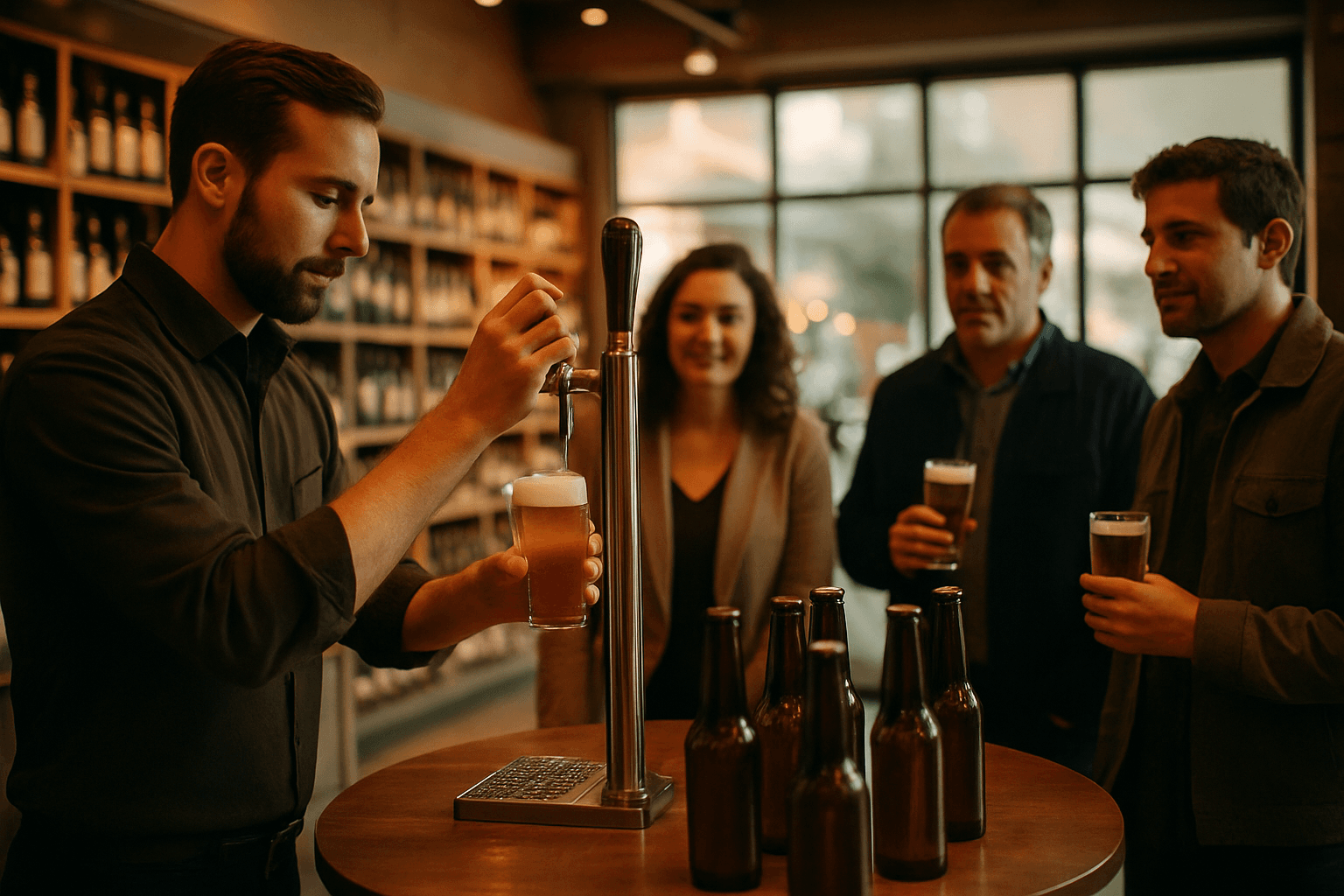
Think instead about formats that create genuine engagement: themed tasting flights (regional, seasonal, or style-based), blind taste challenges where customers vote for their favorite, food pairing stations, or a "build your own six-pack" guided experience. Add QR codes at each station linking to brewer stories or tasting notes, and suddenly you've got something people photograph, share, and come back for.
Total Wine is already evolving in-store tastings into choose-your-own-flavor-adventure formats. But here's your edge: independent stores do this with more authenticity. You know your customers.
Borrow a page from Dogfish Head's playbook. Their pop-up was built entirely around one consumer insight — people want "free time." What insight drives your event? Maybe your Friday crowd wants community. Maybe your Saturday shoppers want discovery. Build around that, not just around whatever showed up on the delivery truck.
Tiger Beer designed its MONOPOLY campaign to attract drinkers who'd never attend a standard sampling. Apply that locally — design events that welcome the craft-curious newcomer, not just the hop-obsessed regular.
Here's the budget hack most retailers underuse: ask your reps what's available. Many major brands have experiential budgets specifically earmarked for retail activations — POS materials, staffing support, co-op dollars. Brands want retail partners who'll activate creatively.
Make the call. You may be genuinely surprised by what's already on the table.
Intentionally Creative specializes in branding strategies that drive real results. Let us show you what's possible.
Schedule a CallHeineken spends millions on experiential. You can start with a Saturday afternoon, a good story, and a few cases of something your customers haven't tried yet. Your 90-day clock starts now.
Heineken's Clinker campaign, Garage Beer's Ad Age recognition, Tiger Beer's immersive MONOPOLY activation, Dogfish Head's insight-driven NYC pop-up — the biggest names in beer are betting heavily on face-to-face activations because they drive retention and sales better than almost any other tactic.
But here's what those brands can't replicate: your local relevance. Your regulars. Your neighborhood credibility. With states like Georgia now permitting weekly in-store tasting events, you have the infrastructure to run big-brand-caliber activations on an independent budget.
The retention data is compelling. The brands are spending millions to prove what you can prove with a Saturday afternoon and a solid plan. The regulations are opening up. The co-op dollars are there for the asking. The only thing standing between you and a packed, buzzing tasting event is the decision to start.
Need help building an event marketing strategy that actually drives repeat customers? Let's talk. ↗