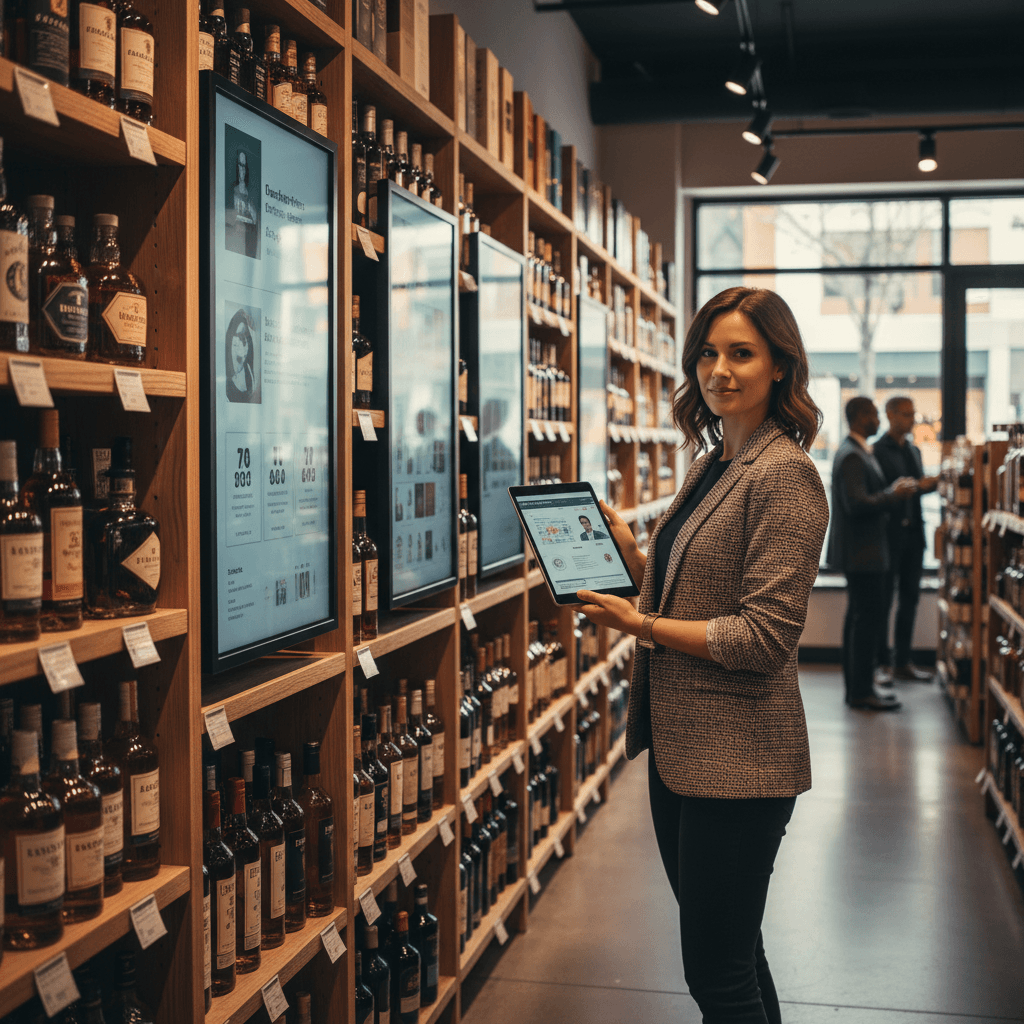
How AI is Transforming Liquor Store Marketing in 2026
By Alden Morris39 min read
Listen to this article50:36
Schedule a free strategy call and Intentionally Creative will build a custom plan for you.
Schedule Your Free Strategy CallFree audit. No commitment.
Get a Free Audit. No commitment.
Learn how independent liquor stores use AI for marketing in 2026 — from local SEO and email automation to compliance-safe advertising and dynamic pricing. A practical guide with tools, examples, and strategy.
A Saturday afternoon in late spring. A customer walks into your store looking for a mezcal she saw on Instagram — something smoky, something with a worm on the label, something under $45. She Googled "best mezcal near me" ten minutes ago. Your store didn't show up. She's standing in front of you anyway because a friend recommended the shop. Lucky break. But luck doesn't scale.
That moment — the gap between digital discovery and local purchase — is where 44,401 U.S. liquor stores either win or disappear. And AI is the only tool that closes it at speed.
Digital advertising now accounts for over 60% of alcohol ad spend ↗. If your store isn't showing up in local search, in targeted social ads, in a customer's inbox on Thursday before the weekend rush — you're invisible to the fastest-growing segment of alcohol buyers.
Discover the 7 essential marketing budget benchmarks for liquor stores. Learn how top performers allocate spend for m...
The $80.8 billion U.S. beer, wine, and liquor store market isn't shrinking because people stopped drinking. It posted a -1.4% CAGR from 2021–2026 because where and how people buy shifted underneath store owners who weren't watching. Spirits-based RTDs grew roughly 20%. Wine-based RTDs climbed 14%. Customers researched those products online, then bought them — somewhere.
Here's what the best independent shops have always known: you're not a warehouse with a register. You're a curator. The guy who says, "Skip the Caymus, try this Mendoza Malbec — half the price, twice the story." AI doesn't replace that instinct. It broadcasts it to 10,000 people in your zip code instead of just the twelve who walked in today.
Discover the 10 most costly alcohol marketing compliance mistakes liquor stores make and actionable strategies to mai...
AI liquor store marketing is the use of artificial intelligence tools — including machine learning, natural language processing, and predictive analytics — to automate, personalize, and optimize how independent liquor retailers attract, engage, and retain customers across digital channels. It spans email automation, local SEO, dynamic pricing, social media content, and ad targeting, all operating within alcohol advertising compliance guardrails. Unlike generic retail AI, liquor store applications must account for age-gating requirements, state-by-state advertising regulations, and TTB compliance — constraints that off-the-shelf marketing platforms routinely ignore. The omnichannel reality of 2026 means your in-store experience, mobile presence, and eCommerce catalog aren't separate strategies. They're one system. AI connects them by learning from customer behavior across every touchpoint, then delivering the right message, product suggestion, or promotion at the moment it matters most.
That's not hype. That's the baseline. In-store plus mobile plus eCommerce is table stakes now, according to industry analysis from Outshinery ↗.
10 wine club marketing tactics that reduce the 40% year-one cancellation rate and boost member spending at your liquo...
I've watched store owners spend money on AI-powered email tools while their Google Business Profile still lists the wrong hours. I've seen chatbots recommend wine pairings that would make a sommelier cry — because the AI hallucinated a "lovely Pinot Grigio with braised short ribs." I've fielded calls from retailers whose automated social posts nearly violated their state's advertising laws.
The limitations are real: hallucinated product knowledge, compliance risks with unsupervised content generation, customer resistance to chatbot interactions that feel robotic, and a learning curve that eats into already-thin margins.
So before you buy a single AI tool, fix the fundamentals. Update your Google Business Profile — today. Build an email list — even 200 names is a start. Get your event calendar online. These cost nothing and multiply the value of every AI investment you make later.
This guide won't sell you a fantasy. Every section ahead assumes you've done the groundwork — or that you're willing to. The stores that thrive in a $40 billion spirits market won't be the ones with the fanciest tech stack. They'll be the ones who paired smart tools with a strategy worth automating.
How many customers drove past your store last week because your Google Business Profile still lists last year's holiday hours and zero photos of that new craft bourbon wall?
Here's the math that matters: 90% or more of liquor purchases happen within a short drive of the buyer's home. That means local search intent — "liquor store near me," "best bourbon selection in [your city]" — is the single highest-ROI marketing channel you have. Not social media. Not email. Local search. And the hub of local search is your Google Business Profile (GBP), which functions as your storefront before anyone walks through your actual door. Yet across the 44,401 liquor store businesses in the U.S. (IBISWorld ↗), the majority of GBP listings are incomplete, stale, or flat-out wrong. That's not a minor oversight — it's revenue left on the counter.
Google's local pack — those three map results at the top of a search — captures the lion's share of clicks for purchase-intent queries. If your profile is thin, you don't show up. Period. And the gap between a well-optimized GBP and a neglected one compounds daily. Every unanswered review, every missing product photo, every week without a new post tells Google's algorithm your business is less relevant than the competitor two blocks away who's actually updating theirs.
AI changes the economics of this completely. What used to require a dedicated marketing hire — writing weekly GBP posts, responding to every review within hours, managing Q&A, optimizing photo metadata — now takes a fraction of the effort. The tools exist right now to automate 80% of GBP management while keeping your store's personality intact.
Here's exactly what an AI-powered GBP workflow looks like for a liquor store:
Over 60% of alcohol ad spend is now digital, according to Statista — yet most liquor store owners are still posting the same flat bottle photo with a price tag and calling it a social media strategy. That's not marketing. That's a digital flyer. The stores winning on social right now use AI to turn every post into a discovery moment, and they do it platform by platform with surgical precision.
Instagram remains the showcase shelf of your digital presence. AI photo enhancement tools like Outshinery can transform a quick iPhone snap of a new Côtes du Rhône into a studio-quality image with consistent lighting, branded backgrounds, and even suggested food pairings overlaid on the image. Pair that with AI caption generators trained on your brand voice, and you cut content creation time from 45 minutes to 10.
Build your feed around five content pillars: new arrivals, staff picks, food pairings, behind-the-scenes warehouse drops, and customer spotlights. Rotate them. Your Reels strategy should lean hard into short-form video — a 15-second blind taste test between a $12 and $40 Pinot Noir gets ten times the engagement of a static post. Film a staff member cracking a wax seal on a new allocated bourbon. Show, don't sell. And lock down your age-gated settings from day one; Instagram's alcohol advertising policies require age verification on your account, and a single compliance slip can get your page flagged or removed.
TikTok rewards one thing above all else: authenticity. Polished ads die here. A store owner in a branded t-shirt explaining how to read a whiskey label — mash bill, age statement, proof — outperforms a $5,000 produced video every time. AI tools like CapCut's auto-editing and trending audio matching let you crank out three to five pieces of content per week without a production team.
Most liquor store owners think dynamic pricing means slapping a discount on slow movers and calling it strategy. That's not pricing — that's panic. Real AI-driven pricing treats every SKU like a living asset with its own margin story, demand curve, and competitive context. And in an $80.8 billion U.S. beer, wine, and liquor store market (IBISWorld, 2026 ↗), the stores that master this will eat the ones that don't.
Your customers check Drizly, Total Wine's website, and the big-box down the street before they walk through your door. You should too — except AI does it faster and never sleeps. Tools built for retail price intelligence scrape competitor pricing from delivery apps, nearby store websites, and national chains, then serve you automated alerts the moment a competitor adjusts price on your top 50 SKUs.
Here's the decisive call: don't try to win every price war. You'll lose to Costco on Tito's every single time. AI gives you the data to know where to compete on price and where to compete on curation and experience. That $55 single-barrel store pick? Nobody's undercutting you. The handle of Jack Daniel's? Match the market or don't bother stocking it as a margin play.
AI-powered demand forecasting cuts stockouts and overstock — especially brutal problems with seasonal and imported goods. That allocated Japanese whisky sitting in your back room for six months represents dead capital. That craft IPA with a 90-day shelf life you over-ordered in October is heading for the dump bin. Forecasting models trained on your POS data, local events, weather patterns, and historical sell-through prevent both mistakes.
Dynamic pricing shines brightest on perishable inventory. Craft beer approaching its best-by date? Automatically trigger a price drop and pair it with a bundle recommendation — "grab three short-dated hazy IPAs and this bag of beer nuts for $18." That's AI analyzing purchase patterns and building upsell logic in real time, not a clerk eyeballing the cooler. Spirits-based RTDs are up roughly 20% year-over-year (NIQ data via Dimensional Insights ↗), so forecasting also tells you what to stock more of before your competitors catch the trend.
10+ years helping liquor retailers and beverage brands grow through data-driven digital marketing. Learn more
Your GBP gets people to your door. Your website content keeps Google sending them. The play here: neighborhood-specific landing pages built with AI assistance. "Best Bourbon Selection in Austin." "Top Wine Shop in Buckhead." "Craft Spirits Store Near Downtown Denver." Each page targets a specific local search cluster, and AI content tools can draft these at scale while you add the authentic, store-specific details that make them rank.
Build an AI-assisted content calendar tied to seasonal demand spikes. Holiday gifting guides in Q4. Summer RTD roundups when spirits-based ready-to-drink products are surging — NIQ data ↗ shows roughly 20% growth in spirits-based RTDs and 14% in wine-based RTDs. Football season cocktail kits in September. These aren't hypothetical content ideas; they're search volume patterns you can map and own before competitors even start writing.
RTD content is the biggest gap right now. Almost no independent liquor stores are creating dedicated content around this fast-growing category, which means the SEO competition is thin and the upside is massive. A single well-optimized landing page on "Best Canned Cocktails in [Your City]" could drive traffic for months.
This is the approach Intentionally Creative takes with its retail liquor clients: strategy-first local SEO, where AI handles the production workload and the human expertise shapes what gets produced and why. The stores that win local search in 2026 won't be the ones doing everything manually — they'll be the ones using AI to execute a smart plan, faster than anyone else in their market.
Picture this: a customer walks into your store every other Thursday, grabs a bottle of Malbec, maybe a six-pack of local IPA, and leaves. You know their name. You know their taste. But when they get home, your email hits their inbox with a generic "10% off everything this weekend!" blast — the same one you sent to the guy who only buys bourbon. That's not marketing. That's noise. And in an $80.8 billion U.S. beer, wine, and liquor store market (IBISWorld, 2026 ↗), noise is what gets you the unsubscribe.
AI-powered email and SMS platforms pull directly from your POS purchase data to build customer profiles that actually mean something. Your Malbec buyer? She gets a message the week a new Argentine arrival from Catena Zapata lands on your shelf — not a promo for White Claw. Your craft beer crowd gets alerted when that limited Hazy IPA drops. Your spirits collectors hear first about allocated bourbon releases. This is segmentation by behavior, not guesswork.
The automated flows run themselves once you set them up: a welcome series for new loyalty members, restock reminders timed to purchase frequency, birthday offers that feel thoughtful instead of robotic, and post-tasting follow-ups that convert a Saturday afternoon sip into a case sale. Loyalty here is emotional, not transactional. AI gives you the memory of a great bartender at the scale of 2,000 customers.
Text messages sit at a 98% open rate. Email wishes it could compete. AI optimizes both send times and message copy — testing whether "New allocation just dropped" outperforms "Limited bourbon, first come first served" for your whiskey segment. For tasting events, automated RSVP sequences handle sign-ups, send reminders, and trigger a follow-up text the next day: "Loved having you last night. That Barolo is 15% off through Sunday."
One hard rule: alcohol SMS marketing carries strict age-verification and opt-in compliance requirements. You need confirmed 21+ status and explicit consent before a single text goes out. Platforms built for this space handle the guardrails so you don't have to sweat a violation. Keep texts short, valuable, and infrequent — two to four per month, max. Every message should feel like a tip from a friend, not spam from a brand.
Not every email platform plays nice with alcohol. Klaviyo and Postscript both have alcohol-friendly policies and deep Shopify/POS integrations that sync purchase data in real time. Mailchimp works for email but lacks the SMS sophistication you need for flash sale triggers and event sequences. The best setup pulls live transaction data from your POS — City Hive, Square, or Lightspeed — directly into your marketing platform so segments update automatically with every purchase.
For the 44,401 liquor store businesses across the U.S. that don't have a dedicated marketing person on staff, this is where Intentionally Creative ↗ steps in. Full-service setup and ongoing management — from building the flows to writing the copy to monitoring deliverability — so you focus on running your store while your marketing runs itself. The technology exists. The gap is execution. And that gap is where independent stores either compete or get buried.
Intentionally Creative specializes in digital marketing strategies that drive real results. Let us show you what's possible.
Schedule a CallThe formats that work: "store owner reacts" to celebrity spirits, myth-busting (no, expensive tequila doesn't mean no hangover), blind taste tests between budget and premium bottles, and educational deep dives. What flops: hard sells, discount announcements, anything that feels like a commercial. TikTok's alcohol policies require creators to restrict content to 21+ audiences and prohibit showing actual consumption in many contexts — use AI compliance checkers to flag issues before you post.
Facebook isn't dead for liquor stores — it's just different now. Facebook Groups built around your local community ("Austin Whiskey Lovers" or "Brooklyn Wine Club") drive event attendance and create a loyalty loop that no ad can replicate. Promote your in-store tastings, new allocation drops, and holiday gift guides here. AI-driven audience targeting for paid social lets you serve ads to adults 25–54 within a 10-mile radius who've shown purchase intent for wine or spirits — precision that was impossible five years ago.
YouTube is your evergreen play. A well-optimized 8-minute video reviewing the best bourbons under $30 will generate traffic for years. AI tools handle video captioning, thumbnail generation with click-optimized text overlays, and SEO descriptions packed with long-tail keywords. According to Hangar-12's 2026 marketing analysis ↗, brands investing in AI-driven content personalization see measurably higher engagement rates across every platform.
One non-negotiable: state-level pricing regulations. Several states enforce minimum pricing laws or post-and-hold requirements. Your AI system must operate within these guardrails or you're writing checks to your state liquor authority instead of your distributor.
Forget store-wide dynamic pricing on day one. Here's what to do instead:
Liquor stores can use AI for pricing strategy and competitive price monitoring by deploying retail intelligence tools that automatically track competitor prices across delivery apps, nearby store websites, and national chain listings, then flag changes on high-volume SKUs in real time. These systems pair external price data with internal POS sales history to recommend optimal price points that protect margins without losing customers. AI demand forecasting models analyze seasonality, local events, and historical sell-through rates to predict which products need price adjustments and when — preventing both stockouts on trending items like spirits-based RTDs and markdowns on aging craft beer inventory. For the 44,401 U.S. liquor store businesses competing in a market with a -1.4% revenue CAGR, AI-powered pricing shifts the strategy from reactive discounting to proactive margin management, turning pricing from a gut call into a data-backed discipline.
The stores that treat AI pricing as a scalpel — precise, targeted, transparent — will outperform the ones swinging a sledgehammer of blanket discounts. Start small, stay compliant, and let the data sharpen your instincts.
Picture this: you just let an AI tool auto-publish a Facebook ad promoting 20% off all bourbon — and you operate in Pennsylvania. Congratulations, you may have just violated state liquor advertising regulations. The AI didn't know. You didn't check. And the PLCB doesn't care whose fault it is.
With over 60% of alcohol ad spend now flowing through digital channels (Statista 2025), AI-powered marketing isn't optional for liquor stores competing in an $80.8 billion market. But the speed that makes AI valuable is the same speed that gets you fined. Here's how to stay on the right side of every rule that matters.
The Alcohol and Tobacco Tax and Trade Bureau (TTB) governs what you can and cannot say when advertising beverage alcohol. Mandatory disclaimers, prohibited health claims, restrictions on misleading statements about origin or age — these rules apply whether a human copywriter or ChatGPT wrote your Instagram caption.
The FTC layers on truthfulness requirements. That AI-generated email claiming your store has "the lowest prices in the city"? You better have the receipts. The FTC's Endorsement Guides, updated to address AI-generated content ↗, make clear: automated content carries the same legal weight as anything your team writes manually.
Federal rules are the floor. State regulations are where things get genuinely treacherous.
Texas prohibits retailers from advertising specific product prices in certain contexts. California has strict rules around tied-house restrictions that affect how you can promote supplier-funded events. New York requires your license number in digital advertisements. Pennsylvania — where the state controls liquor sales — has an entirely separate compliance universe.
And that's just four states. Multiply this across every jurisdiction where your ads reach consumers (yes, digital ads cross state lines), and you've got a compliance nightmare that generic AI tools are utterly unprepared to handle.
Practical move: build a compliance checklist for every state where you advertise. Pin it to your marketing workflow. Run every AI-generated asset against it before publication. At Intentionally Creative, this kind of compliance review is baked into every managed marketing engagement we run for retail liquor clients — because we've seen what happens when it isn't.
Every digital channel you use for alcohol marketing carries age-verification obligations. Email and SMS campaigns need confirmed age data in your subscriber lists. Your website needs age-gate functionality. And each social platform enforces its own alcohol advertising policies on top of federal and state law.
Meta requires age-targeting set to 21+ on all alcohol ads and restricts alcohol content from appearing in Reels ads in certain formats. Google demands LDA (legal drinking age) targeting and prohibits promotion of excessive consumption. TikTok? They ban alcohol ads entirely in the U.S. — so that AI-generated TikTok campaign your intern suggested? Kill it.
The riskiest blind spot: AI chatbots. If you deploy a chatbot on your website or through SMS that recommends products without first verifying the user's age, you're potentially liable. According to research from Outshinery ↗, brands integrating AI into customer-facing interactions must treat age verification as a non-negotiable first step, not an afterthought.
Stop thinking about compliance as a checkpoint and start thinking about it as architecture. The goal: build a workflow where non-compliant content physically cannot reach your audience.
Step one: human-in-the-loop review. No exceptions. Never let AI publish alcohol marketing content without a human approving it. Automation handles the drafting and scheduling. A trained human handles the "does this violate anything" question.
Step two: pre-loaded prompt templates. Create AI prompt templates that already contain your compliance constraints. Instead of prompting "write a Memorial Day sale email," your template should include: "Write a Memorial Day sale email. Do not reference happy hour pricing. Include license number [X]. Do not make health claims. Target audience is confirmed 21+." Front-load the guardrails so the AI starts inside the lines.
Step three: quarterly audits. Every 90 days, pull all automated marketing content — emails, SMS, social posts, ad copy — and review against current federal and state regulations. Rules change. Your AI doesn't know that unless you tell it.
Step four: get a beverage alcohol attorney on speed dial. This is a $40 billion spirits market with regulators who take enforcement seriously. A $500 legal consultation is cheap compared to a suspended license. When in doubt — and you will have doubt — pick up the phone.
The liquor stores that win with AI marketing won't be the ones who move fastest. They'll be the ones who move fastest without breaking anything. That's the difference between using AI as a competitive weapon and using it as a liability generator.
Before: You're posting to Instagram when you remember, your email list is a dusty spreadsheet from 2019, and your Google Business Profile still shows last year's holiday hours. You're spending money on boosted posts that disappear into the algorithm. Customers walk past your store to the chain down the street — not because their selection is better, but because they showed up first in a Google search.
After: Six weeks from now, your welcome email series converts new subscribers at 22%, your Google Business Profile drives 3x more direction requests, and an AI-drafted social post about your new mezcal endcap pulls more engagement than anything you've posted all year. The difference isn't a massive budget. It's a system.
Here's the exact playbook.
I'll say this once: do not download a single AI tool until your foundation is solid. Strategy first, tools second. I've watched store owners blow two months playing with ChatGPT prompts while their Google Business Profile listed the wrong phone number. That's malpractice.
Your first week has four non-negotiable tasks:
Here's the starter stack I recommend to every independent store owner:
Start on free tiers. Upgrade when — and only when — you see results that justify the spend. At roughly $60–80/month total for the paid versions, this stack punches miles above its price point. That's a revelation compared to hiring a generalist freelancer at $2,000/month who doesn't know TTB regulations from a hole in the ground.
The single most valuable integration: connect your POS system to Klaviyo. Purchase history powers everything — personalized recommendations, restock reminders, VIP segmentation. This is how AI bridges the discovery-to-purchase gap that kills most liquor store marketing efforts.
Two or three tools used daily beat ten collecting digital dust. Avoid tool overload like you'd avoid a pallet of white-label vodka.
Now the AI earns its keep.
Create prompt templates specific to your store's voice. Don't just type "write me a social media post about bourbon." Build a reusable prompt: "You are a knowledgeable, slightly irreverent spirits advisor for [Store Name] in [City]. Write a 100-word Instagram caption for [product] at [$price]. Mention one food pairing. Include a call to action to visit this weekend." Save these. Reuse them. Refine them.
Launch a 3-email welcome series for new subscribers. Email one: who you are and what makes you different. Email two: your staff's current top picks (with tasting notes that make readers smell the vanilla and char). Email three: an exclusive offer that drives a first or return visit. This automated flow works while you sleep.
Run one focused social campaign tied to something specific — a spirits-based RTD tasting event (that category grew ~20% last year per NIQ data), a new allocated bourbon drop, a summer rosé preview. One campaign. Measure it. Learn from it.
Before anything goes live, run a compliance check. Every AI-generated post, email, and product description gets reviewed for age-gating language, no health claims, proper disclosures. Build a simple checklist and never skip it.
To set up an AI marketing campaign for your liquor store, start with a two-week foundation phase: optimize your Google Business Profile completely, build a compliant email list with age verification, and define your store's unique positioning. In week three, adopt a lean AI tool stack — one content drafting tool like ChatGPT or Claude, one email platform like Klaviyo connected to your POS, and one design tool like Canva AI. During weeks four through six, create reusable AI prompt templates matching your brand voice, launch a three-email automated welcome series, and run one targeted social media campaign tied to a specific product or event. Every piece of AI-generated content must pass a compliance review before publishing. From that point forward, track email open rates, Google Business Profile actions, social engagement, and in-store attribution monthly, then scale what performs and cut what doesn't.
Track these metrics or don't bother:
Run a monthly AI audit. Read every automated email and scheduled post. Check for hallucinated product details (AI loves inventing tasting notes), compliance violations, and tone drift. Your store's voice should sound like your best employee, not a corporate press release.
Ask your regulars directly: "Have you seen our emails? Our Instagram?" Their honest reactions tell you more than any analytics dashboard.
The stores that win aren't the ones using the most technology. They're the ones using the right technology to amplify what already makes them special.
— Alden Morris, founder of Intentionally Creative and a veteran of all three tiers of the beverage alcohol system
AI makes testing cheap and iteration fast. A/B test subject lines in minutes instead of days. Generate five versions of a product description and run the best one. Kill underperforming campaigns without guilt — the data doesn't lie, and creating the next version costs you fifteen minutes, not fifteen hundred dollars.
The goal across all four phases: move your store from transactional retail to experiential retail, where every digital touchpoint feels as curated as your top shelf.
Spring 2026 is already here, and the liquor stores investing in AI-powered marketing six months ago are now sitting on cleaner data, sharper campaigns, and stronger customer loyalty than the ones still "thinking about it." That gap widens every single week.
Here's the math that should keep you up at night. The U.S. beer, wine, and liquor store market hit $80.8 billion in 2026 (IBISWorld ↗), but the industry just crawled through a -1.4% CAGR from 2021 to 2026 before a modest 1.1% uptick. A shrinking pie with 44,401 stores fighting over it. Every month you run your Google Business Profile without AI-optimized local SEO, a competitor three miles away climbs above you in the map pack. That's not theory — that's how the algorithm works.
The transformation happening right now is structural. Liquor retail is shifting from transactional ("ring it up, bag it, next") to experiential — curated tastings, personalized recommendations, community-driven discovery. AI is the engine behind that shift. It bridges the discovery-to-purchase gap that has plagued alcohol retail for years: a customer sees a bourbon on Instagram, walks into your store, and your AI-driven system already knows to surface that bottle, suggest a complementary bitters, and trigger a follow-up SMS with a cocktail recipe three days later.
You don't need a perfect system. You need a running system. The learning curve is real — expect 30 to 60 days of awkward iteration — but it's dramatically shorter than most owners fear, especially with guided implementation. The stores winning right now aren't the most tech-savvy. They're the ones who started.
Pick one channel from this guide. Just one. If your Google Business Profile hasn't been touched in 90 days, start there — it's the highest-ROI move for local visibility. If you already have a decent GBP, build a 30-day SMS campaign around your next tasting event. Commit to it for a full month before judging results.
If you want this done for you — strategy, execution, optimization, all of it — Intentionally Creative ↗ is the only agency in the U.S. built exclusively for independent liquor stores, with expertise across all three tiers of the beverage alcohol system. We don't do cookie-cutter. We build AI-powered marketing systems designed around your store, your community, your inventory.
The best liquor stores have always evolved with their communities. AI is how you do it in 2026.
Liquor store owners ask us these four questions more than any others. Here are the straight answers.
The most common questions about AI marketing for liquor stores center on cost, legality, staffing, and strategy. Cost ranges from zero — tools like ChatGPT and Google Business Profile are free — to $100–$500/month for a paid stack at a single location. AI-generated alcohol advertising is legal, but you carry full liability for every piece of content, AI-created or not, under TTB, FTC, and state regulations. AI does not replace your marketing team or your agency; it amplifies human strategy with machine-speed execution. The biggest mistake stores make? Grabbing shiny tools before defining a strategy. In an $80.8 billion U.S. market with 44,401 competing stores (IBISWorld ↗), you cannot afford to automate chaos. Start with one channel, nail compliance review, and scale from there — or partner with a specialist agency like Intentionally Creative that already has the playbook built.
Here's the bottom line. The liquor retail industry posted a -1.4% CAGR from 2021–2026 before a projected 1.1% uptick (IBISWorld ↗). The stores that will capture that rebound are the ones using AI liquor store marketing to bridge the gap between discovery and purchase — turning browsers into buyers with personalized recommendations, smart inventory forecasting, and automated outreach that still feels human.
You don't need to overhaul everything today. You need to start one thing today.
Step 1: Optimize your Google Business Profile with AI-assisted descriptions and posts. Step 2: Launch one automated email sequence tied to purchase history. Step 3: Book a call with Intentionally Creative ↗ when you're ready to stop figuring it out alone.
The tools exist. The data is clear. The only question left is whether you'll act on it — or watch the store down the street do it first.
With a 7x ROAS engine and category-level product ranking strategy, Uncorkit expanded its local and national visibility — translating digital dominance into measurable in-store revenue growth.