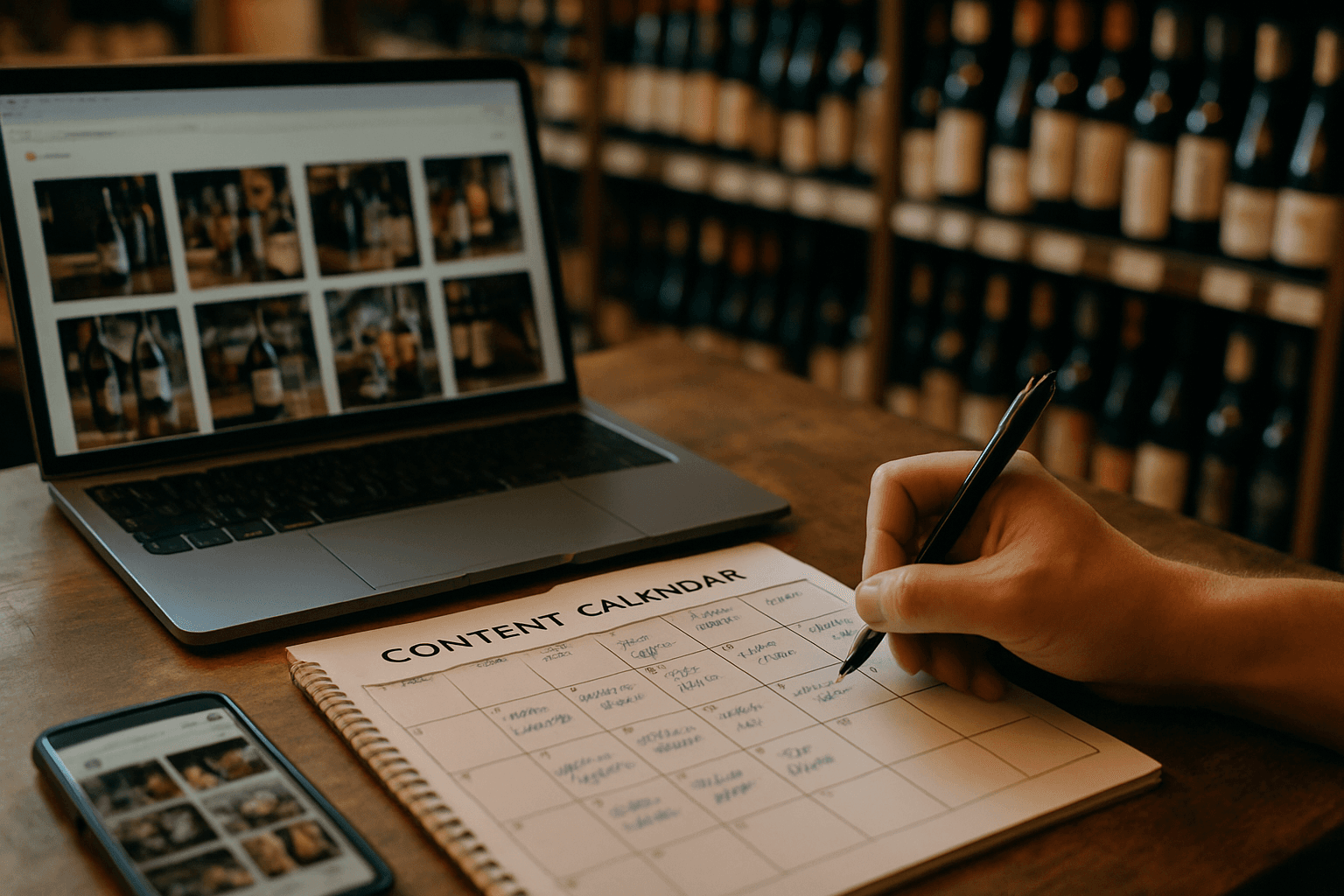
How to Build a Content Calendar for Your Liquor Store's Social Media (Template Included)
By Intentionally Creative13 min read
Listen to this article16:59
Schedule a free strategy call and Intentionally Creative will build a custom plan for you.
Schedule Your Free Strategy CallFree audit. No commitment.
Get a Free Audit. No commitment.
Learn how to build a liquor store social media content calendar that drives foot traffic and engagement. Free template included for independent retailers.
You already know social media matters. You've seen the craft cocktail bar down the street pull a crowd off one Instagram Reel, or watched a competitor's "New Arrival Friday" post rack up shares while your last upload was… three Thursdays ago. The problem was never awareness. It was execution.
Here's what we've seen working with independent retailers: the stores that win on social media aren't the ones with the best photography or the wittiest captions. They're the ones that show up regularly — with a plan. And the tool that makes that possible is a liquor store social media content calendar: a simple, structured system that tells you what to post, when to post it, and why it matters for your bottom line.
This guide walks you through building one from scratch — in five concrete steps, no marketing degree required. We'll cover how to set up your content hub, define the categories that keep your feed interesting, map out the dates that actually drive sales, choose the right platforms, and batch-create a full month of content in about two hours. There's a free, ready-to-use Google Sheets template at the end. Let's get into it.
Let's be honest: most independent liquor stores treat social media like an afterthought. A bottle photo here, a holiday post there, then radio silence for three weeks. Sound familiar?
Here's the thing — regular, consistent posting is one of the most reliable social media strategies for liquor stores, right alongside choosing the right platforms, strengthening brand identity, diversifying content, and engaging with your community. Yet most independent retailers are winging it at best.
Discover the 7 essential marketing budget benchmarks for liquor stores. Learn how top performers allocate spend for m...
That gap between knowing you should post and actually posting consistently? That's exactly what a structured content calendar solves.
Every week you go quiet on social media, you're handing visibility to competitors — including the big-box chains with dedicated marketing teams. Worse, you're invisible to the customers who matter most for your future: Gen Z and younger millennials now discover new brands and stores through social-first channels like Reels, TikToks, and Stories. No consistent presence means no place in their consideration set.
A content calendar isn't an arts-and-crafts project. It's a business tool. It eliminates the daily "what should we post?" panic and replaces it with a structured, repeatable system — one that drives foot traffic, promotes tastings and events, and keeps your store top-of-mind between visits.
You can organize posts around core pillars — events, holidays, national celebration days, product education, food pairings, and more — so your social media actually works strategically, not randomly.
Discover the 10 most costly alcohol marketing compliance mistakes liquor stores make and actionable strategies to mai...
Think of it this way: a content calendar turns 20 minutes of daily stress into 90 minutes of monthly planning. That's a trade every time-strapped store owner should make.
Now let's build yours — starting with the foundation everything else sits on.
Before you start picking post dates or brainstorming captions, you need one thing: a home base for all your content. This is the step most liquor store owners skip — and it's exactly why they end up scrambling at 9 PM to find that bottle photo they know they took last Tuesday.
A content repository is simply a centralized place where every piece of content lives alongside its key details. Think of it as the foundation of your entire calendar. Without it, you're building on sand.
10 proven liquor store social media content ideas to connect with customers, boost brand visibility, and drive both i...
Every entry should track five things: title, content type, platform, scheduled date, and status. Your repository should make it easy to tag and sort across all your content categories — events, holidays, national days, products, food pairings, education, and more.
This structure prevents duplicated posts, surfaces gaps in your posting schedule, and keeps seasonal promotions from sneaking up on you.
You don't need expensive software. Three free tools cover everything:
The downloadable template linked later in this post combines repository and calendar into one streamlined sheet — built specifically for liquor retail operators who need a real social media strategy without the complexity.
With your home base set up, the next question is obvious: what are you actually going to put in it?
Here's where most liquor store social media strategies fall apart: you sit down to post, stare at your phone, and default to "Hey, we've got a sale on Tito's." Again.
A pillar system fixes that. Instead of reinventing the wheel every day, you build your liquor store social media content calendar around six proven content categories — then rotate through them.
These six pillars — adapted from frameworks used by successful beverage retailers like NC Wine Guys ↗ — cover everything a liquor store needs:
Selecting the right platforms is the single most important decision in your social media strategy — and it's where many store owners go wrong. Spreading yourself across every platform is the fastest path to burnout and mediocre results.
For most independent liquor stores, Instagram and Facebook are your primary channels.
Here's how they break down:
Pick two platforms. Do them well. Expand later.
Here's a sustainable posting frequency that works for a one-person or small team:
Consistent beats prolific every time.
Here's the truth: your content calendar will die within two weeks if you're creating posts day-by-day. You don't have time for that. Nobody does.
Batching is the fix.
Block two hours on your calendar — one session, once a month. Here's how to spend them:
First 30 minutes: Shoot 15–20 product photos. Grab bottles, set up a few lifestyle shots (think: bourbon next to a charcuterie board), vary your angles, and knock them all out at once. Natural light near a window works great.
Next 30 minutes: Write all your captions in one sitting. When you're in writing mode, you stay in writing mode. Reference real questions customers ask in-store — focusing on individual customers and authentic conversations drives stronger engagement than polished billboard-style posts.
Final 60 minutes: Schedule everything using a free tool like Meta Business Suite or Later. Four weeks of content, done.
Here's your cheat sheet for high-performing liquor store social content:
10+ years helping liquor retailers and beverage brands grow through data-driven digital marketing. Learn more
With this framework, you'll never scramble for ideas again. Your calendar stays full without constant creative brainstorming.
Here's a ratio that works well for most retailers: roughly 70% value-driven content (education, recipes, lifestyle stories) and 30% promotional (sales, new arrivals, events).
Effective social media for liquor stores should build connections, stay authentic, and think long-term — not just push products. The pillar system naturally prevents the "buy this" trap because four of your six categories aren't asking for a sale at all. They're building the kind of trust that makes the promotional posts actually convert when they do show up.
That's the difference between a feed people scroll past and one they follow.
You've got your content categories locked in. Now it's time to anchor them to the dates that actually move the needle.
Here's where your liquor store social media content calendar starts to take real shape. Before you write a single caption, you need to know when your content matters most.
Start with the non-negotiables — the dates that drive your biggest revenue: New Year's Eve, Super Bowl Sunday, St. Patrick's Day, Memorial Day, Fourth of July, Labor Day, Halloween, Thanksgiving, and Christmas. These aren't optional. They belong on your calendar right now, with content planned weeks in advance.
Next, layer in the "fun" national days that consistently drive engagement. Think National Margarita Day (February 22), National Wine Day (May 25), National Bourbon Day (June 14), and National Tequila Day (July 24). These smaller moments fill gaps between major holidays and keep your feed active without feeling forced.
Your most powerful content drivers aren't on any national calendar — they're your own tastings, product launches, anniversary sales, and local partnerships. These boost foot traffic and social engagement simultaneously, which is the sweet spot of any liquor store social media strategy.
Here's the real unlock: plan content in reverse from each event. If your bourbon tasting is Saturday, you need a teaser post Monday, a reminder Wednesday, a Stories countdown Friday, event photos Saturday, and a recap Sunday. One event just became five pieces of content.
You're not creating more events — you're extracting more value from the ones you already have.
With your key dates mapped, the next decision is where all this content is going to live online — and how often.
Intentionally Creative specializes in social media strategies that drive real results. Let us show you what's possible.
Schedule a CallTiming matters too. Generally, mid-morning (10–11am) and early evening (5–7pm) perform well for liquor retail — but check your own Instagram Insights for your audience's specific active hours.
One thing most calendars miss: engagement time. Responding to comments, sharing tagged posts, and commenting on local business pages is as important as posting itself. Build 10 minutes of community engagement into your daily routine. It compounds faster than you'd expect.
Now for the part that makes all of this sustainable long-term — because a plan you can't maintain is just a prettier version of winging it.
One more power move: host a virtual tasting or go live for 20 minutes. That single session becomes a full replay post, 3–4 short clips, and several still images. This kind of content diversification — combined with consistent posting — is what separates stores that grow online from stores that ghost after a month.
Two hours. One batch. A full month of content. That's a sustainable system.
All that's left? Grabbing the template that puts everything in one place.
You've got the strategy. You've got the content pillars. Now let's make it stupid easy to execute.
We built a free liquor store social media content calendar in Google Sheets so you can stop guessing what to post and start showing up consistently.
This isn't a blank spreadsheet with your name on it. It comes pre-loaded with:
No more staring at a blank screen on Tuesday morning wondering what to post.
The template works out of the box, but it works better when you make it yours:
Add your store's specific events. Tastings, new product drops, local partnerships, anniversary sales — plug them in first. These are your easiest, highest-engagement posts because they're uniquely yours. As MarketingProfs notes ↗, authenticity and focusing on your individual customers are core principles of effective social media — and nobody can copy your local events.
Adjust posting frequency to match your capacity. If five posts a week feels like a stretch, start with three. Posting regularly matters more than posting constantly. Consistency beats volume every time.
Color-code by content pillar. This gives you an instant visual read on whether your calendar is balanced or leaning too hard on one type of content. If everything's the same color, mix it up.
Share it with your team. If a staff member takes photos, a manager approves captions, or a partner handles posting — give them access. A shared calendar turns your social media strategy from a one-person headache into a team effort.
You just walked through the entire system: repository, pillars, key dates, platforms, and batching. None of it is complicated. All of it works. The only thing standing between you and a consistent social media presence is actually starting — and the template makes that the easy part.
Here's your move this week:
No 47-step process. No agency retainer required.
A liquor store social media content calendar isn't about being perfect — it's about being present, consistent, and intentional. And honestly? That alone puts you ahead of most of your competitors, who are still posting a blurry bottle photo whenever they remember to.
You don't need to win social media. You just need to show up like you mean it.