How to Build a Google Ads Remarketing Funnel for Your Liquor Store's E-Commerce Site (Even With Google's Alcohol Ad Restrictions)
By Intentionally Creative11 min read
Listen to this article13:23
Schedule a free strategy call and Intentionally Creative will build a custom plan for you.
Schedule Your Free Strategy CallFree audit. No commitment.
Get a Free Audit. No commitment.
Learn how to build a Google Ads remarketing funnel for your liquor store despite alcohol ad restrictions. Real strategies that drive e-commerce sales.
You've built your e-commerce site. You're running Google Ads. People are landing on your product pages, browsing your bourbon selection, maybe even adding a bottle or two to their cart. And then — they leave. No purchase. No way to bring them back.
If you've tried to set up a Google Ads remarketing funnel for your liquor store, you already know the problem. Google won't let you do it the way every other e-commerce retailer does. No display remarketing. No dynamic product ads chasing shoppers across the web. The standard playbook that works for every other online store? It's off the table for you.
But here's what most liquor store owners don't realize: the restriction only blocks one remarketing method. There's an entire system of compliant strategies — some inside Google, some outside it — that can recover those lost sales and build a funnel that actually converts. This post is your blueprint.
Let's get the bad news out of the way first.
Google Ads explicitly prohibits standard display remarketing for alcohol products. Full stop. You cannot drop a pixel on your e-commerce site, build an audience of past visitors, and serve them display ads reminding them about that bottle of Blanton's they left in their cart.
10 proven liquor store social media content ideas to connect with customers, boost brand visibility, and drive both i...
This isn't a gray area. It's not something you can finesse with clever ad copy or category workarounds. Violating this policy risks account suspension — and once Google shuts you down, getting back in is a nightmare you don't have time for.
Industry-wide, cart abandonment rates hover around 70%. For alcohol e-commerce, where age verification steps and shipping restrictions add extra friction, that number can climb even higher. [VERIFY: No published industry-specific data confirms higher abandonment rates for alcohol e-commerce specifically — consider softening to "anecdotal reports suggest" or sourcing.]
And unlike virtually every other e-commerce category, there's no native Google Ads remarketing solution to bring those shoppers back. Your competitors selling candles and sneakers get to chase abandoned carts with display ads across millions of websites. You don't.
That's a massive gap — and if you're not addressing it, you're leaving real money on the table every single day.
Discover 7 proven TikTok marketing strategies for liquor stores that build real engagement and bring customers throug...
But this doesn't mean you're out of options.
It means you need a smarter, compliant funnel — one that combines Google's tools where they are allowed with alternative re-engagement channels that pick up the slack. That's exactly what we're building in this post.
In most industries, a full-funnel Google Ads system works beautifully. You layer Search campaigns (to capture intent), Shopping ads (to showcase products), and Remarketing Lists (to bring back window shoppers). Those three layers work together to move someone from "just browsing" to "just bought."
But if you sell alcohol, that third layer gets ripped out. No following shoppers around the web with banner ads. No dynamic product ads reminding someone about the wine they left in their cart.
Discover how to promote your liquor store on Instagram with proven strategies. Learn to create engaging content that ...
So you need a modified approach.
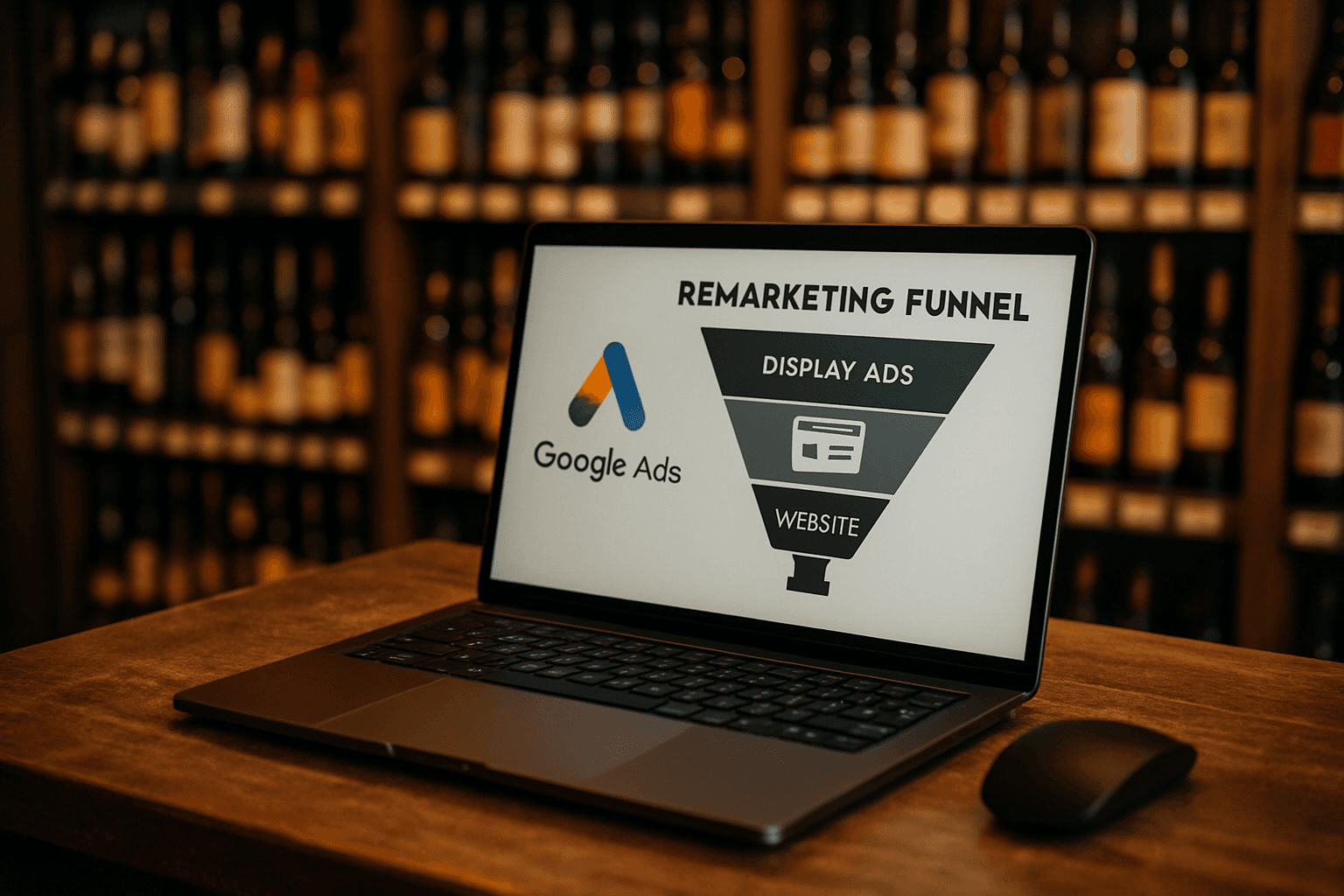
Picture a simple three-stage funnel:
One critical note: don't launch all channels simultaneously. A phased 90-day approach works best. Start with Search and Shopping, layer in data capture by week three, then build your re-engagement channels over months two and three. We'll map this out in detail later.
Before you can remarket to anyone, you need the right people landing on your site in the first place. Not just any traffic — qualified, ready-to-buy traffic. This stage is your foundation.
Start with high-intent local search campaigns. Target keywords like "buy whiskey online [your city]," "liquor delivery near me," or "order craft beer [neighborhood]." These searchers aren't browsing — they're buying.
But compliance isn't optional from day one. You need proper age-gating on your landing pages (a verified age gate before any product content loads) and tight geo-targeting limited to areas where you're legally licensed to sell and deliver. Skip this, and Google will reject your ads — or worse, approve them and then suspend your account weeks later.
Pro tip: Segment your campaigns by product category (spirits, wine, beer) and price tier from the start. This structure pays dividends later when you build your re-engagement strategy, because you'll be able to target shoppers around your highest-margin products specifically.
Google Shopping campaigns can be a powerhouse — but your product feed needs to be airtight. Categorize every product correctly using Google's taxonomy (Food, Beverages & Tobacco > Beverages > Alcoholic Beverages > [specific type]). Incorrect categorization is the fastest way to get your feed disapproved.
Scale in phases:
You've got the traffic. You've got the data. Now it's time for the payoff — bringing those lost shoppers back to complete the purchase.
RLSA is your best friend here. Let me explain it in plain language:
If someone visited your bourbon page last week and then Googles "bourbon delivery near me" today, you can bid more aggressively to show up first. You're not showing them banner ads — you're just being smarter about search.
You're layering audience data on top of search intent. Google allows this because the ad itself is still a standard search ad triggered by a keyword — not a display ad following someone around the internet. It's a legitimate, policy-compliant remarketing strategy.
Set up RLSA audiences for key segments: cart abandoners, product page viewers, and past purchasers. Then increase your bids 30–50% when these users search relevant terms. You'll pay more per click, but your conversion rate will be significantly higher because these people already know you.
Email fills the gap that Google's restrictions create, and it's arguably your highest-ROI re-engagement tool. Build three automated sequences:
No Google restrictions. No ad approval headaches. You own the channel.
You don't need to launch everything at once. In fact, you shouldn't. A phased approach prevents overwhelm and lets each channel inform the next.
Launch compliant Search and Shopping campaigns with proper geo-targeting and age-gating on every landing page. Simultaneously, build your data infrastructure: add email capture pop-ups, create customer account prompts, and get a loyalty program signup live on your site. This month is about driving qualified traffic and capturing the data you'll need later.
Put that data to work. Build RLSA audiences in Google Ads — they need time to populate, so starting in Month 2 means they're ready when you need them. Launch automated email sequences for abandoned carts and browse abandonment. Start segmenting customers by purchase behavior for smarter targeting.
Layer in paid social retargeting on Meta and Instagram. Optimize Google campaigns using 60 days of real performance data. Test seasonal promotions and cross-sell campaigns through email. Review full-funnel metrics across all channels.
This phased build — Search, Shopping, email, social — gives your Google Ads remarketing funnel for your liquor store the structure it needs to actually drive results.
10+ years helping liquor retailers and beverage brands grow through data-driven digital marketing. Learn more
Nail these before chasing anything advanced. The qualified traffic you drive now becomes the audience pool your entire remarketing funnel depends on.
This is the step most liquor retailers skip — and it's the one that makes or breaks everything that follows.
Since you can't follow visitors around the web with display ads, your Google Ads remarketing funnel for your liquor store needs a workaround. It starts with capturing visitor information while they're still on your site. Every email address you collect is a person you can re-engage for free — or near-free — unlike paid remarketing clicks that cost you every single time.
Customer accounts and loyalty programs are your first-party data engine. They power remarketing-like re-engagement without touching Google's alcohol ad restrictions.
Two moves to make right now:
Generic "subscribe to our newsletter" popups get ignored. These don't:
Capture the data now, and you'll have a re-engagement channel that no Google policy can take away from you.
Intentionally Creative specializes in google ads strategies that drive real results. Let us show you what's possible.
Schedule a CallMeta and Instagram have their own alcohol advertising policies, but they do permit retargeting site visitors with product ads — provided you have proper age-gating in place and comply with local regulations. (Rules vary by country, so check Meta's alcohol ad policies for your specific market before launching.)
This makes paid social an essential parallel channel in your remarketing mix. And don't overlook loyalty program push notifications and SMS marketing. These channels bypass Google's restrictions entirely, letting you re-engage shoppers on your terms.
Google's alcohol remarketing restriction is a wall, but it's the same wall every liquor retailer hits. Most give up right there. That's your opening.
The stores winning at e-commerce aren't waiting for Google to change its policies. They're building compliant funnels that combine strong Search and Shopping campaigns with aggressive first-party data collection and multi-channel re-engagement. They're solving the cart abandonment problem outside Google's display network — and it's working.
Your e-commerce remarketing strategy doesn't need to be complicated. It needs to be intentional.
If building this funnel sounds like more than you have time for, Intentionally Creative ↗ specializes in compliant digital advertising strategies for liquor retailers. Let's talk about what this looks like for your store.