How to Host In-Store Tastings That Drive Sales Without Breaking Compliance Rules
By Alden Morris35 min read
Listen to this article41:06
Schedule a free strategy call and Intentionally Creative will build a custom plan for you.
Schedule Your Free Strategy CallFree audit. No commitment.
Get a Free Audit. No commitment.
Learn how to plan, permit, and execute in-store tastings that maximize sales while staying fully compliant. Step-by-step guide covering federal, state, and local regulations, execution best practices, and ROI measurement.
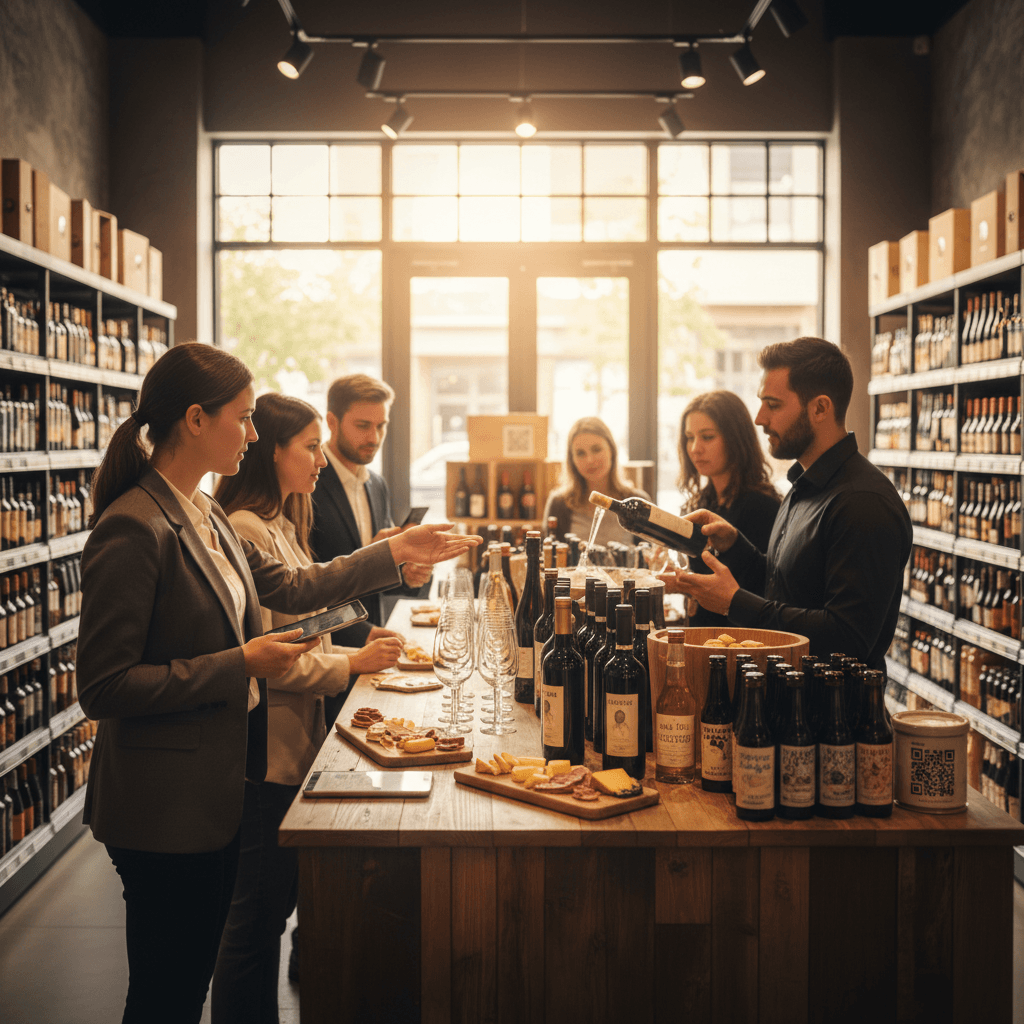
A Saturday afternoon at Pearl Wine Co. in New Orleans looks like this: a dozen customers clustered around a folding table, swirling glasses of Côtes du Rhône, debating whether it pairs better with lamb merguez or a simple roast chicken. By closing time, those customers have bought cases — not bottles. That weekly ritual accounts for 20–25% of the store's total sales.
That number deserves a second look. A single recurring tasting program, run consistently, generating a quarter of revenue. No paid ads. No influencer deals. Just wine in a glass and a conversation.
Tasting rooms drive 53% of average winery sales nationally, according to Silicon Valley Bank's annual wine report ↗. For wineries east of the Rockies, that figure climbs to 70% of all direct-to-consumer revenue. Retailers who build their own version of this dynamic — structured, recurring, educational — tap into the same psychology that makes the tasting room a winery's most valuable square footage.
The data from top performers tells a sharp story. Farm Credit East's 2025 industry analysis ↗ found that top-quartile wineries leveraging DtC channels (including tastings) posted 8% sales growth and 11.9% operating income. Bottom-quartile producers? A 10.2% sales decline. The gap between those who invest in experiential selling and those who don't isn't marginal — it's existential.
In-store tastings are effective for driving retail sales because they collapse the entire purchase funnel into a single moment. A customer samples a wine, hears its story, asks a question, and walks to the register — all within minutes. Research from the International Wine Challenge ↗ confirms that experiential education makes customers more willing to trade up to premium bottles, lifting average transaction values well beyond what shelf talkers or point scores achieve alone. One estate attributed 18% of its annual depletions to cellar door and tasting sales, with those purchases skewing disproportionately toward higher-margin wines. Small producers under 1,000 cases saw 14% growth by leaning into this model. The tasting table does what no algorithm can: it builds trust, answers objections in real time, and turns a browser into a buyer before they reach the parking lot.
The playbook works at every scale. A $10 tasting ticket convertible to purchase credit yields numerous same-day sales while filtering for serious buyers. Themed weekly pours — "Sicilian Reds," "Under $15 Fridays" — create appointment shopping. Ten guests feels intimate and drives deep engagement; quarterly events of 100–250 people generate buzz and new customer acquisition.
Here's the tension every retailer feels but few discuss openly: tastings are your best revenue tool, and they're also the fastest way to lose your license.
Local regulations on in-store sampling vary wildly by state, county, and municipality. Permit requirements, pour limits, hours of service, signage rules, supplier participation restrictions — the patchwork is dense and unforgiving. A single violation can trigger license suspension or revocation, a consequence that dwarfs the revenue from any individual event.
States are tightening enforcement. The era of "just pop open a few bottles on a Saturday" is ending. Regulators are auditing more frequently, and competitors do file complaints.
This article won't treat compliance as the obstacle standing between you and profitable tastings. Compliance is the foundation. Every strategy that follows — from event structure to supplier partnerships to ticket pricing — builds on a framework designed to keep your license secure while maximizing every pour. Start there, and the sales follow.
Why do the most profitable tasting programs in American retail start with a compliance manual instead of a wine list?
That question separates stores banking 20-25% of total revenue from tastings — like Pearl Wine Co., which attributes that share directly to its free weekly sampling events — from stores scrambling to recover after a state enforcement action shuts them down for six months.
An in-store tasting is a licensed, on-premises sampling event where a retailer or supplier pours limited quantities of beer, wine, or spirits to legal-age customers for promotional purposes. Compliance requirements vary by state but typically govern permits, pour limits, event frequency, hours of service, and record-keeping — and violations can result in fines, license suspension, or revocation.
That definition sounds simple. The execution is anything but, because the American alcohol industry operates under the three-tier system — a post-Prohibition structure that separates producers, distributors, and retailers into distinct legal roles. Each tier carries its own rules about who can pour, who can pay for the product being poured, and who can promote the event. Federal law sets the baseline. State law adds specificity. Local ordinances layer on top.
This means three distinct event models exist, each with different compliance exposure:
According to Farm Credit East's 2025 industry report ↗, tasting rooms and clubs account for 53% of average winery sales nationally, climbing to 70% of direct-to-consumer sales for East of Rockies wineries. Those numbers tell you something critical: tastings aren't a marketing nice-to-have. They're a revenue engine — but only when the engine runs legally.
The conventional wisdom treats compliance like a tax. File the permits, check the boxes, get back to the fun stuff. That thinking is precisely backwards — and it's costing retailers money.
Here's the contrarian reality: compliance constraints make your tasting program more profitable, not less.
Pour limits — commonly 1-2 oz for spirits, 2-3 oz for wine — force you to stop wasting product on over-generous pours that numb palates and drain margins. A 750ml bottle of a $40 Willamette Valley Pinot yields roughly twelve 2-oz pours. That's twelve potential conversions instead of six sloppy ones. The math is blunt: discipline pays.
Frequency caps create scarcity. States that limit you to, say, two tastings per month per location hand you a gift disguised as a restriction. Your customers actually show up because the event feels like an occasion, not background noise. Research from Silicon Valley Bank's annual wine report ↗ confirms that small producers under 5,000 cases grew more than 2% — and tiny producers under 1,000 cases grew 14% — partly because scarcity and direct engagement drive premium purchasing behavior.
Required record-keeping builds your customer database automatically. Every sign-in sheet verifying legal drinking age doubles as a marketing lead. Every purchase log required by your ABC board becomes sales data you'd otherwise pay a POS consultant to compile. You get compliance and CRM in one motion.
The stores getting fined or losing licenses? They treated compliance as the last step. The stores posting 8% sales growth and 11.9% operating margins — top-quartile performers tracked by industry benchmarks — built their programs around the rules from day one.
Compliance for hosting in-store alcohol tastings operates on three simultaneous regulatory levels, and you must satisfy all of them — the most restrictive rule always wins. At the federal level, the Alcohol and Tobacco Tax and Trade Bureau (TTB) sets tied-house regulations that limit how suppliers can participate in retail-level events, restricting gifts, services, and financial inducements that could compromise retailer independence. State alcohol control boards add the operational specifics: the permit type you need (often a separate tasting permit beyond your retail license), exact pour limits, caps on how many events you can hold per week or month, restricted hours, and mandatory record-keeping. Local municipalities then layer on their own requirements — zoning approval for events, health department clearances, noise ordinances that dictate when your outdoor patio tasting must end, and crowd-size limits that shape whether you plan for 10 guests or 100.
Miss any single layer and you're exposed. A retailer fully compliant with TTB rules and state permits can still face action from a local health inspector who never received the required event notification. Think of it as three locks on one door — you need all three keys.
According to International Wine Challenge's DTC growth analysis ↗, East of Rockies wineries saw a 6% DTC sales volume increase in 2024 — growth fueled substantially by tasting-room interactions where compliance frameworks were already baked into operations. That's not a coincidence. Structured programs produce structured growth.
The answer to whether compliance limits your tasting program is unequivocal: no. Compliance is your tasting program. The permits define your calendar. The pour limits define your product selection. The record-keeping defines your customer intelligence. Build from those constraints outward, and you'll run events that sell more bottles, at higher margins, with zero risk of a knock on the door from your state enforcement officer.
A store owner in Virginia once told me she lost her tasting permit — and $4,200 in potential weekend sales — because a staff member poured samples on a Saturday when her license only covered Friday events. The violation took ten minutes. The reinstatement process took eleven weeks. Her story isn't unusual. It's the rule. Planning a tasting event that drives revenue without triggering compliance problems requires a ruthless, phased checklist — and the discipline to follow it.
Start here or don't start at all. Step one: pull your retail license and read the fine print. Many off-premise licenses don't include tasting or sampling privileges by default — you need an endorsement, a supplemental permit, or in some states, a completely separate license class. Assume nothing. Step two: apply for your tasting permit. Some states issue annual permits; others require a per-event application with lead times of 30–45 days. Miss the window and you're dead in the water. Step three: get supplier and distributor participation locked down in writing. Tied-house laws govern what a distributor can provide, fund, or staff at your event, and these rules shift dramatically state to state. A handshake deal that works in California will get you cited in Pennsylvania. Step four: check your municipality's requirements. Certain cities and counties require advance notice filings or additional local permits on top of state requirements. Step five: call your insurance carrier. Your general liability policy must explicitly cover tasting events — alcohol service, slip-and-fall, the works. If your carrier hesitates, switch carriers before you pour a single ounce.
Planning an in-store tasting event step by step begins with securing your tasting permit and confirming insurance coverage six to eight weeks before the event date. Three to four weeks out, analyze your target audience — their knowledge level, price sensitivity, and community size — then select a focused theme such as a regional spotlight or varietal deep-dive and curate four to six products maximum. Negotiate with distributors for donated bottles to minimize overhead. Two weeks before the event, prepare your ID-checking protocol, calculate state-legal pour volumes, install required signage, and launch promotion through email, in-store displays, and social media. Set a $10 ticket fee convertible to purchase credit to guarantee same-day conversions. One week out, brief every staff member on compliance rules, prepare your attendee log, and confirm record-keeping systems for products poured, quantities served, and event timing.
Most store owners obsess over the wrong number. They count heads at the door, tally Instagram likes, and call a packed room a success. That's how you lose money while feeling good about it. Attendance is a vanity metric — it tells you nothing about whether your tasting event actually moved product or built lasting customer relationships.
The real measure is simpler and more brutal: did the event generate more profit than it cost?
Strip your post-event analysis down to four numbers. Everything else is noise.
1. Per-attendee revenue. Total sales attributed to the tasting divided by number of attendees. This is your single most important figure. A 12-person event generating $1,800 in sales ($150/head) crushes a 200-person event generating $4,000 ($20/head) — because your costs scale with crowd size, but your per-head revenue determines actual margin.
2. Conversion rate. What percentage of attendees bought something? Well-run intimate events — around 10 participants — should hit 60–80% conversion. If you're below 50%, your product selection doesn't match your audience, or your staff isn't closing.
3. Average transaction lift. Compare the average basket size of tasting attendees against regular customers that same day. According to Farm Credit East's industry analysis ↗, top-quartile wineries achieve 8% sales growth and 11.9% operating income — they get there by tracking exactly this kind of granular data. Your tasting attendees should spend 2–3x your normal average ticket.
4. 30-day repeat rate. Track how many tasting attendees return within a month. This separates genuine customer acquisition from impulse buys. Capture emails or phone numbers at check-in (you need them for compliance documentation anyway) and match against your POS data.
Last month, a retailer in Virginia poured a stunning 2021 Willamette Valley Pinot Noir at a Friday tasting — rich dark cherry, forest floor, silky tannins, a steal at $28. The event drew 40 people. Sales were strong. Then the ABC board showed up Monday morning. The store had been operating on its standard retail license without the required tasting permit. The fine wiped out three months of tasting profits in a single envelope.
That story repeats across the country every week. And the compliance violation is rarely the only mistake happening.
The five fastest ways to get fined, shut down, or lose your license are deceptively simple — and every one of them stems from assumptions rather than verified knowledge.
The most common compliance mistakes at in-store tasting events fall into five categories: operating without a dedicated tasting permit (a standard retail license does not authorize sampling events in most states), exceeding state-mandated pour limits (which vary from 0.5 oz for spirits to 2 oz for wine depending on jurisdiction), failing to verify age for every single attendee regardless of apparent age, allowing supplier representatives to pour or serve without proper tied-house authorizations, and maintaining zero documentation of event compliance. According to Farm Credit East's 2025 wine industry analysis ↗, top-quartile wineries achieved 8% sales growth and 11.9% operating income — margins that evaporate instantly under regulatory penalties. A single tied-house violation in states like California, New York, or Texas can trigger license suspension, and "I didn't know" has never been a successful defense.
Stop calling a heavy-handed pour "generous." Call it what your state regulator calls it: a violation. Measure every pour. Use marked cups. Train every employee who touches a bottle during an event.
10+ years helping liquor retailers and beverage brands grow through data-driven digital marketing. Learn more
Theme-driven events outsell random assortments every time. A "Willamette Valley Pinot Noir Under $30" tasting gives your customers a story, a framework for comparison, and a reason to buy. A table of seven unrelated bottles gives them confusion. Cap your pour list at four to six products. Beyond that, palate fatigue sets in and your selling focus fractures across too many SKUs. The goal isn't to showcase your entire inventory — it's to move specific cases off the floor.
Here's where margins get interesting: negotiate with your distributors for donated bottles. Most will provide product at no cost for a well-promoted event because their sales reps need depletions just as badly as you need revenue. Your overhead drops to near zero. Then layer on a $10 ticket fee that converts to purchase credit. This model consistently drives same-day sales because attendees arrive with money already committed to buying. According to Wine Business Monthly ↗, tasting rooms account for 53% of average winery sales nationally — and that conversion power translates directly to retail when you structure events with purchase incentives. Keep groups around ten for intimate tastings where staff can hand-sell effectively. Reserve the 100-plus format for quarterly showcase events.
Designate one trained staff member as your ID checkpoint. Not "whoever's near the door" — a specific person with a specific protocol. Every attendee gets checked, no exceptions, no shortcuts. Calculate your maximum pour volumes per person based on your state's statute and pre-measure servings using marked pour spouts or pre-portioned cups. Guessing pours is how you end up over-serving and over-regulated.
Signage matters more than you think. Many states mandate specific posted notices during tasting events — warnings about alcohol content, pregnancy risks, or driving impairment. Missing a required sign is a citable offense. Set up a record-keeping system that logs attendee names, products poured, quantities served, and precise start and end times. This documentation protects you during an audit and proves your operation runs clean. Brief every employee working the event — not just the one pouring. As Farm Credit East's industry report ↗ documents, East of Rockies wineries now derive 70% of their direct-to-consumer sales from tasting room interactions, and small producers under 1,000 cases grew volume by 14%. The opportunity is massive, but one untrained employee pouring past legal limits or serving a minor can trigger violations that shut down your program entirely.
Your email list is your best channel — but check state regulations before you hit send. Several states restrict how you can advertise tastings, particularly around language implying "free" alcohol. Use phrases like "complimentary guided tasting with purchase" if your state flags the word "free." Post to social media with supplier co-branding where permitted, and hang in-store signage at the register and near the category you're featuring.
Create urgency with limited spots. A tasting capped at twelve seats sells out faster and converts better than an open-door event with fifty wanderers. Scarcity isn't a gimmick here — it's operational. Smaller groups mean deeper engagement, better hand-selling, and tighter compliance control. The stores winning right now treat tastings as curated experiences, not loss-leader traffic plays. Pearl Wine Co. attributes 20–25% of total sales to their free weekly tastings, proof that consistency and structure beat scale every single time.
Small producers making fewer than 1,000 cases grew 14% last year while the broader market contracted. That number should stop every retailer mid-planning. The producers winning aren't throwing massive grand tastings — they're building intimate, high-conversion experiences with small groups.
The industry keeps celebrating 200-person blowout events. One widely cited playbook recommends targeting 100+ attendees per tasting, then quietly admits "it is far more important to have the correct attendees rather than more of them." That contradiction deserves a direct call-out: you can't curate a crowd of 200. You can curate a room of 12.
Large events optimize for buzz. Small events optimize for sales. A retailer hosting weekly 12-person tastings — 624 guests annually — will outsell the shop running quarterly 200-person events reaching 800 people total. The math favors frequency and intimacy over spectacle. Pearl Wine Co. attributes 20–25% of total sales ↗ to free weekly tastings, not occasional mega-events.
The compliance case seals it. Verifying IDs, controlling pour sizes, and monitoring intoxication with 200 guests requires a staffing ratio most independent retailers can't afford. With 12 guests, one trained employee handles it all. Risk scales with crowd size — and so do the fines.
The most profitable in-store tastings follow a deliberate structure: start accessible, finish premium, and make purchasing frictionless. Seat eight to fifteen guests. Pour four to six selections arranged from lightest and most familiar to boldest and highest-margin. The final pour should be your best bottle at the highest price point — recency bias means that last taste lingers when guests reach for their wallets. Train staff to tell the story behind each pour: the producer's vineyard practices, the vintage conditions, a specific food pairing that transforms the wine. Experiential education — not a lecture, but a conversation — makes a $45 bottle feel like a discovery rather than a splurge. According to SVB's annual wine report ↗, tasting rooms and clubs account for 53% of average winery sales nationally, proving that guided, face-to-face selling converts at rates no shelf talker or end cap can match. Stock every featured product within arm's reach, clearly priced. The gap between "I love this" and "I'll buy it" should be three steps, not a trip to another aisle.
Read the room. A guest who asks about vineyard elevation is telling you they'll trade up. A guest who says "this is smooth" wants a case of exactly that bottle at $18. Train your team to distinguish education mode from closing mode — and transition between them without a sales pitch tone.
Use pre-measured pourers or dedicated tasting glasses with a fill line. This removes the awkward moment where a guest pushes their glass forward for more and your staff has to play bouncer. A standard tasting pour is one ounce. Standardize it mechanically so your team never has to eyeball it.
Cut off alcohol service at your jurisdiction's mandated time limit — and have a plan for the remaining event time. Transition to food pairings, a Q&A with the rep, or dedicated shopping time. An abrupt "we're done pouring" kills the mood. A planned pivot to "let's talk about pairing these with what you're cooking this weekend" keeps energy high and wallets open.
You carry the same responsible service obligations as a bar. Monitor guests for signs of intoxication. One over-served attendee at a Saturday tasting creates the same liability as one at your bar rail on a Friday night.
Keep real-time documentation accessible. If a state inspector walks in at 3 p.m., you produce your permit, attendee log, and pour records immediately — not after a frantic search through a back office filing cabinet. Digital check-in tools solve this cleanly.
Minors don't taste. Full stop. Even in states permitting parental-consent consumption in private settings, tasting events at retail locations typically fall outside those exceptions.
Research from Farm Credit East ↗ shows East of Rockies wineries drive 70% of direct-to-consumer sales through tasting rooms — yet east wineries ship only 7% of club allotments from those same tastings. That gap is a revenue channel most retailers haven't touched.
Build your loyalty program directly into the tasting experience. Offer a tasting-exclusive bundle: three bottles from tonight's lineup at 15% off, available only before you leave. Create a case discount that expires at closing time. Scarcity and immediacy convert browsers into buyers faster than any follow-up email.
Your compliance-required attendee log — the one you're already keeping — doubles as CRM intake. Capture an email address and one preference data point at check-in: "red or white?" or "weeknight dinner wine or special occasion?" That single field fuels targeted follow-up that feels personal, not automated. Top-quartile wineries posting 8% sales growth and 11.9% operating income aren't guessing at customer preferences. They're tracking them from first pour to fifth purchase.
Intentionally Creative specializes in digital marketing strategies that drive real results. Let us show you what's possible.
Schedule a CallWhat to do instead of chasing vanity metrics:
Your cost calculation needs to be honest, or your ROI is fiction.
Product cost — net of distributor contributions. Smart operators get this close to zero. Your distributor rep wants shelf placement and brand exposure; make them contribute bottles. If they won't donate product for a 10-person curated tasting, find a distributor who will.
Staff time — the most underestimated line item. Include setup, the event itself, breakdown, and cleanup. A "two-hour tasting" realistically burns four to five hours of labor when you count everything.
Permits and incremental insurance. Your state may require event-specific licensing or temporary permits. Price these per-event, not annually.
Marketing and promotion spend. Email costs nearly nothing. Printed materials, paid social ads, or signage — track it all.
Opportunity cost. Your floor space and staff attention have a baseline revenue rate during those hours. A tasting that generates $500 but displaces $400 in normal sales only netted you $100.
Here's the math for a 12-person tasting — the format backed by data showing small producers (under 1,000 cases) grew 14% while the broader market contracted, per the International Wine Challenge's DtC analysis ↗.
Costs:
Revenue:
ROI: ($915 – $200) / $200 = 357%
Now run the same math for a 200-person event: product costs jump to $400+, you need three extra staff ($600), a temporary event permit ($150), printed materials ($200), paid promotion ($300). Total cost: $1,650+. Even at a respectable 40% conversion with $50 average baskets, you generate $4,000 — an ROI of 142%. Less than half the intimate event's return.
The formula you can steal:
Tasting ROI = (Total Attributed Revenue – Total Event Cost) / Total Event Cost × 100
To measure the ROI of an in-store tasting event, track total attributed revenue (every sale made to an attendee during and immediately after the event) against fully loaded costs including product, labor, permits, marketing, and opportunity cost of floor space. Divide net profit by total cost and multiply by 100 for your ROI percentage. The critical metric most operators miss is per-attendee revenue — total attributed sales divided by headcount — which reveals whether your event format actually drives profitable purchasing behavior or just attracts freeloaders. Research shows tasting rooms drive 53% of average winery sales nationally, and stores like Pearl Wine Co. attribute 20–25% of total sales to their free weekly tastings. A well-structured 12-person event with distributor-donated product routinely delivers 300%+ ROI, while large-scale events with higher overhead typically return under 150%. Track 30-day repeat purchase rates to distinguish real customer acquisition from one-time impulse buys.
Here's a question worth $50,000 a year: are your tastings selling wine, or are you running a free bar?
Pearl Wine Co. attributes 20-25% of total store sales to their free weekly tastings. That number doesn't happen by accident. It happens because every tasting has a selling strategy baked into the format — guided flavor progressions, shelf talkers on every featured bottle, and staff trained to close with a specific recommendation. "You loved that Albariño? Grab two — it won't last through the weekend." That's not pushy. That's service.
Pour more than six products and you've created palate fatigue and decision paralysis. Your customer's tongue is done after five or six wines. Their brain checked out after four options. Pick your lineup with surgical precision: a theme, a region, a grape, a price tier. Tell a story with each pour.
The bottles your customers just tasted need to be within arm's reach. Not in aisle seven. Not behind the counter. Right there, stacked at the tasting table, with pricing visible. And if you're not collecting names and emails at a sign-in sheet, you're pouring profits down the drain. Every tasting without a CRM capture point is a one-night stand when it should be the start of a relationship. Follow up within 48 hours. The 30-day window after a tasting is when you either build a repeat buyer or lose them to the grocery store down the road.
Do the math on overpouring. A 2 oz pour instead of a 1 oz pour across six wines and 50 attendees burns through an extra six bottles — roughly $90-$180 in product cost per event. Run weekly tastings and that's $5,000-$9,000 annually in waste from a half-ounce of laziness.
One person cannot pour, educate, sell, check IDs, and manage compliance at the same time. You need a minimum of two staff for events under 25 people. Period. Understaffing doesn't save money; it costs sales.
Stop paying full wholesale for tasting product. Your distributor reps want shelf placement and brand visibility. That's exactly what a tasting delivers. Negotiate co-op dollars, sample bottles, or promotional pricing. Research from Silicon Valley Bank's annual wine report ↗ confirms that small producers under 5,000 cases grew over 2% last year — those brands are hungry for retail exposure and will invest in your events if you ask.
Your practical takeaway: Build a pre-event checklist that covers permits, pour measurements, ID verification protocol, staffing assignments, product placement, sign-in sheets, and distributor cost-sharing agreements. Run through it 48 hours before every event. The retailers who treat tastings like a professional sales channel — not a casual Friday afternoon hangout — are the ones converting a $200 product investment into $2,000 in weekly revenue.
Before: You're reading articles about tastings, bookmarking ideas, telling yourself you'll "figure out the compliance stuff later." Meanwhile, the shop two miles away just converted 20% of Saturday's tasting guests into case buyers.
After: You have a 30-day launch plan, a compliance checklist pinned to your office wall, and your first 12-person tasting on the calendar — fully permitted, staff trained, selling strategy locked.
The gap between those two scenarios? Four weeks of focused execution.
Grab the state-by-state compliance checklist template linked below this article. It covers seven categories: permits and licensing, pour limits, frequency restrictions, signage requirements, record-keeping obligations, advertising rules, and supplier participation rules.
A hard truth: this checklist is a starting framework, not a finished answer. Regulations vary wildly between states — and sometimes between counties. Farm Credit East's industry analysis ↗ notes that small producers under 5,000 cases grew over 2% while tiny producers under 1,000 cases surged 14%, largely through direct-to-consumer channels like tastings. Those gains only stick if your program survives regulatory scrutiny. Verify every line item against your specific jurisdiction. And if your situation involves multi-state distribution, shared retail spaces, or restaurant-retail hybrid licenses — call a beverage attorney. This article is educational, not legal advice.
"Every week without a tasting program is a week your competitor is building customer relationships you'll never get back."
To build a compliant in-store tasting program from scratch, start by contacting your state ABC board to identify all applicable regulations — pour limits, permit requirements, frequency restrictions, and signage rules. Spend your first week on this regulatory audit alone. Then build your compliance infrastructure: permits, documentation templates, and staff training protocols. Design your inaugural event small — around 12 participants — with a clear theme, distributor support, and a defined selling strategy. Execute in week four while tracking conversion rates, average ticket size, and per-SKU movement. Tasting rooms drive 53% of average winery sales nationally, and East of Rockies wineries pull 70% of direct-to-consumer revenue from tasting experiences, according to research from the International Wine Challenge ↗. The retailers who sustain these results run disciplined, permitted, measured programs — not one-off parties.
The stores winning right now aren't throwing the biggest events. They're running tight, compliant, sales-focused programs every single week. East of Rockies wineries saw a 6% DtC sales volume increase in 2024 while bottom-quartile operations suffered a 10.2% sales decline. The difference isn't luck or location — it's execution consistency.
Compliance isn't your burden. It's your competitive moat. The retailers who treat regulations seriously will still be pouring samples five years from now. The ones cutting corners will be explaining to their landlord why the ABC board pulled their license.
Your move: Download the checklist. Call your ABC board Monday morning. Book your first 12-person tasting within 30 days. The data says in-store tastings drive sales. The only variable left is whether you'll be the store running them — or the one losing customers to the store that does.
Requirements vary by state, but most jurisdictions require you to hold a valid retail liquor license along with a separate tasting permit or event authorization. Some states, like California and Texas, offer specific "tasting licenses" that can be added to your existing retail permit for a modest annual fee. Contact your state's Alcohol Beverage Control (ABC) board directly to confirm exactly which permits apply to your location, as county and municipal governments may impose additional requirements.
If you're launching a new retail location with tastings in mind, build permit timelines into your business plan from day one. Beyond your standard retail liquor license, apply for your tasting permit concurrently to avoid delays — processing can take anywhere from 30 days to six months depending on the state. Many states also require a separate food service or health department clearance if you plan to serve any accompaniments alongside poured samples.
Most states cap individual pours between 0.5 and 1.5 ounces for spirits and 2 to 3 ounces for wine, with a per-person daily limit. For example, Texas limits wine tastings to 1.5 ounces per pour and no more than four samples per customer per day. Always post your state's serving limits visibly at the tasting station, and train staff to measure pours consistently — using pre-measured pour spouts is one of the simplest ways to stay compliant.
This is one of the most commonly misunderstood compliance areas. Some states allow distributor or brand representatives to pour and present products in-store, while others — such as Pennsylvania and several control states — require that only the retailer's licensed employees handle the pouring. Even in states that permit rep-led tastings, the retailer typically remains legally responsible for compliance, so make sure any visiting rep is briefed on your pour limits, ID-checking procedures, and cutoff policies before the event begins.
Frequency limits differ significantly by jurisdiction. States like California allow tastings on any day the store is open for business, while others may restrict events to a set number per month or per quarter. Beyond legal limits, a practical sweet spot for most independent retailers is one to two tastings per week — frequent enough to build a loyal following and lift weekend foot traffic, but manageable enough to keep staffing and product costs under control. Check your permit's specific conditions, as exceeding the allowed frequency can result in fines or permit suspension.