How to Run a Cause Marketing Campaign for Your Liquor Store: Lessons From Distilleries Supporting Nonprofits on Purple Day and Beyond
By Intentionally Creative12 min read
Listen to this article15:09
Schedule a free strategy call and Intentionally Creative will build a custom plan for you.
Schedule Your Free Strategy CallFree audit. No commitment.
Get a Free Audit. No commitment.
Learn how to run a cause marketing campaign for your liquor store with proven tactics from distillery-nonprofit partnerships. Boost sales & community trust.
Most liquor stores compete on price, selection, or location. But there's a fourth lever that almost nobody in independent retail is pulling — and it might be the most powerful one: purpose. A well-run cause marketing campaign for your liquor store can do what another 10%-off sale never will. It can make people choose you, talk about you, and come back because of what you stand for, not just what you stock.
The playbook isn't theoretical. Distilleries and beverage brands are already running cause marketing campaigns that raise real money, move real product, and build the kind of community trust that compounds over years. From Purple Day epilepsy awareness drives to per-bottle donation models, the proof points are stacking up. And the best part? None of this requires a big budget. It requires a good partner, a clear plan, and the willingness to actually follow through.
This guide breaks down exactly how to do it — from choosing the right cause and structuring your campaign to promoting it, tracking results, and avoiding the mistakes that make customers roll their eyes instead of opening their wallets. Whether you've never run a cause campaign or you've tried one that fizzled, here's how to get it right.
Here's the short version: cause marketing is when you align your store with a charitable cause in a way that drives both social impact and business results. It's not just writing a check to a local nonprofit and posting a photo on Facebook. It's building a campaign — a real one — where doing good and doing well happen at the same time.
Think of it this way: One Water Foundation built their entire model around donating a portion of every bottle sold. By 2024, they'd funded clean water projects across multiple countries, scaling a simple per-bottle donation into a global operation [VERIFY: confirm specific 2024 milestone via BeverageDaily]. That's cause marketing at its most elegant — baked into the transaction, not bolted on as an afterthought. And the models are everywhere. Double the Donation documents over 14 proven cause marketing campaign formats, from round-up-at-register programs to co-branded product launches. The playbook is wide open.
Discover 7 proven Instagram content ideas for liquor stores that boost engagement and drive sales. Learn how to promo...
You don't need a massive budget to make this work. You need intention, a good partner, and a willingness to show your community what you stand for.
Let's address the elephant in the room. The WHO estimates that harmful alcohol use contributes to more than 3 million deaths globally each year [VERIFY: confirm current WHO figure]. That's the reality our industry operates in. Purpose-driven marketing isn't just a nice look — it signals responsibility and builds genuine trust with increasingly values-conscious consumers.
This is also why cause marketing for beverage brands carries more weight than it might in other retail categories. When products on the shelf often look and feel similar, distillery nonprofit partnerships and store-level cause campaigns become powerful differentiators. You're not competing on price anymore. You're competing on meaning.
And this isn't a fringe idea. Women of the Vine & Spirits Foundation actively promotes cause-related marketing as a strategy for the beverage alcohol industry. Community engagement consistently ranks among the top liquor store marketing ideas — and cause marketing is its most compelling, shareable form.
10 wine club marketing tactics that reduce the 40% year-one cancellation rate and boost member spending at your liquo...
The industry is moving. The question is whether your store moves with it.
So what does this look like in practice? Let's look at the brands and distilleries that are already doing it well — and what you can borrow from them.
You don't need a creative agency on retainer to pull this off. You just need a model that works — and plenty already exist.
One Water Foundation nailed this. Their structure is dead simple: every bottle sold triggers a donation. No complicated tiers, no fine print. That straightforward approach is what allowed them to scale from a single product into a global charitable operation — proof that transactional cause marketing works when you remove friction and commit to consistency.
10 proven liquor store grand opening marketing ideas to attract customers, build loyalty, and set your new store up f...
Liquor stores can adapt this tomorrow. Partner with brands that already have give-back programs baked in (there are more than you think), or create your own per-bottle donation structure with a local nonprofit. Even $0.25 per bottle adds up fast when you're moving volume.
Here's where the bar is rising for cause marketing in beverage brands: customers can smell performative giving from across the store. Distillery nonprofit partnerships work best when the commitment is real, not seasonal window dressing.
Look at what's already happening:
Each of these is something an independent liquor store can replicate or participate in. The best liquor store marketing ideas aren't invented — they're adapted from what's already proven. Find a distillery partner whose values align with yours, pick a model, and run it.
Now that you've seen the models, the next question is obvious: which cause do you pick, and when do you run it? The answer matters more than you might think.
You already know that seasonal and themed promotions move product. But here's what a lot of store owners miss: awareness days work just as well as holidays — sometimes better — because the competition isn't paying attention.
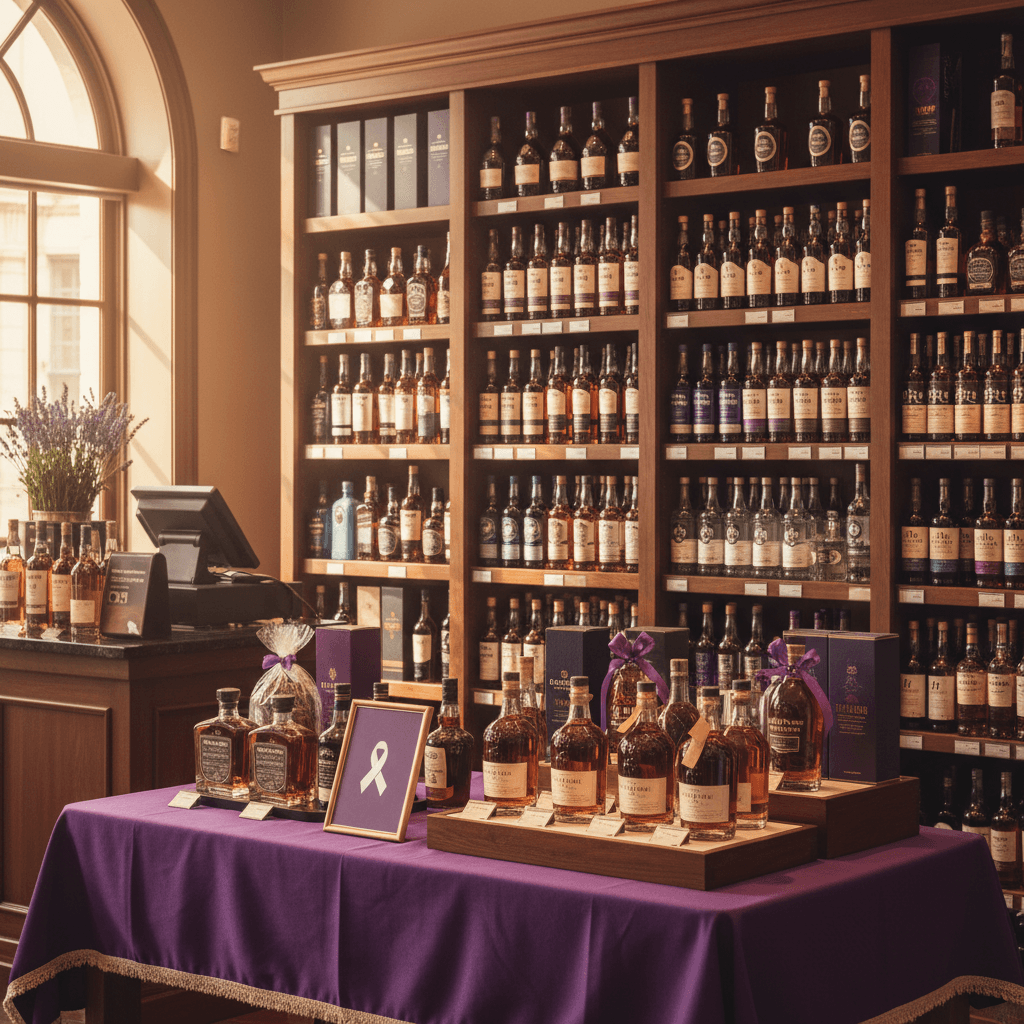
Purple Day (March 26, Epilepsy Awareness) is a prime example. It gives you a ready-made hook, a fixed date on the calendar, and a visual identity that's ridiculously easy to merchandise around. Purple shelf talkers, purple-labeled spirits, a purple endcap — your cause marketing campaign liquor store display practically builds itself. And because most retailers ignore it entirely, you get a real chance to stand out.
Epilepsy affects roughly 1 in 26 Americans at some point in their lives [VERIFY: confirm current Epilepsy Foundation statistic]. That means it's personal to more of your customers and staff than you'd guess. It's underrepresented in retail marketing, which makes your effort feel genuine rather than bandwagon-y.
Awareness days come with existing social media buzz, nonprofit resources, and community energy you can tap into — no need to manufacture momentum from scratch. The infrastructure is there. You just have to show up.
Not every cause fits every store. Use this framework: Does it have local relevance? Is there a personal connection to ownership or staff? Does it align with your customer demographics? Can you find a credible nonprofit partner to work with?
One more thing — resist the urge to cause-hop. Picking a different charity every month dilutes your impact and, frankly, looks performative. Commit to one or two causes per year. That's how you build deeper storytelling, stronger distillery nonprofit partnerships, and results that actually compound over time.
Your loyalty program isn't just a discount delivery system — it's the backbone of every cause marketing campaign liquor store owners should be running. Use customer profiles to track exactly who participated, which products moved, and how much you raised. This data turns a feel-good moment into a repeatable business strategy.
After your campaign wraps, segment participants and send a personalized follow-up: "Together we raised $1,200 for [Cause]. Here's what that means for our community." This builds emotional loyalty that generic 10%-off emails can't touch.
Apply the same compounding logic that makes per-bottle donation models work at scale: each campaign builds on the last, deepening community ties and giving you fresh stories to tell year-round. With 14+ proven cause marketing models ↗ documented by Double the Donation, there's no shortage of formats to adapt next quarter.
Track these after every campaign:
Position cause marketing as a strategy, not a stunt. The data will make the case for you.
Of course, even the best strategy falls flat if the execution trips over avoidable mistakes. Here's what to watch out for.
Your customers have built-in BS detectors. They've seen "we care" plastered on everything from fast food cups to gas pumps. So when you launch a cause marketing campaign for your liquor store, they're already evaluating whether you mean it.
Here's the good news: authenticity isn't complicated. It just requires specificity and follow-through.
Vague commitments. "A portion of proceeds" means nothing. Say "$1 from every bottle" or "10% of Saturday's sales." One Water Foundation built trust by tying donations to every single bottle sold — a model so transparent it scaled globally. You can do the same at a local level.
No storytelling. A logo on a shelf talker isn't a campaign. It's wallpaper. Without narrative, there's no emotional reason to buy from you instead of the store down the street.
No follow-up. Run a campaign, never share results, and you've wasted the relationship-building opportunity entirely. Close the loop publicly.
Choosing a cause for optics. Your staff should be able to explain why this matters without a script. If they can't, customers will sense it.
Overcomplicating it. The best campaigns are simple enough to explain in one sentence at the register. If your cashier needs a flowchart, start over.
A cause marketing campaign for your liquor store isn't charity — it's strategy. It builds community engagement, differentiates your brand, and drives measurable sales lift. The distilleries and beverage brands leading the way have proven that purpose and profit aren't at odds — they're multipliers.
10+ years helping liquor retailers and beverage brands grow through data-driven digital marketing. Learn more
You've got the cause. You've got the timing. Now let's get into the mechanics — the step-by-step process that turns a good idea into a campaign that actually runs.
Here's the truth: this doesn't require an agency or a five-figure budget. It requires intentionality and follow-through. That's it. Let's break it down.
Start by identifying a nonprofit — local or national — that genuinely aligns with a cause you care about. Authenticity matters here. Your customers will sense a forced partnership from a mile away.
Next, call your distillery and brand reps. Ask them directly: "Do you have any existing cause marketing programs we can plug into?" You'd be surprised how many do. Distillery nonprofit partnerships with built-in donation structures are increasingly common — and they're designed for retailers like you to activate locally.
Co-branded campaigns split the effort and double the credibility. You bring the customers; the brand brings assets and matching funds. Everyone wins.
This is where most campaigns succeed or fail. You need more than a donation mechanism — you need a compelling narrative. Story and creative communication are paramount in beverage alcohol marketing, and your cause campaign is no exception.
Craft something simple and emotional: who benefits, why your store cares, and what the customer's purchase actually does.
Example: "Every bottle of [Brand X] sold this week sends $1 to [Local Epilepsy Foundation]. Here's why that matters to us."
Given the health realities of the products we sell, purpose-driven marketing isn't just good business for liquor retailers — it's responsible business. That's a story worth telling.
You don't need new channels. You need to activate the ones you have:
Here's your secret weapon: use your existing customer profiles and loyalty program data to target shoppers who've already purchased the featured brand. They're your most likely participants and your highest-conversion audience.
Your Simple Campaign Timeline:
| Timeframe | Action |
|---|---|
| 4 weeks out | Secure nonprofit and brand partners; agree on donation structure |
| 2 weeks out | Create signage, social assets, and email copy; brief your staff so they can tell the story |
| Launch week | Go live across all channels; post daily on social; engage with customer responses |
| Post-campaign | Share results publicly, thank customers by name (with permission), and send the nonprofit a check — on camera |
That last step? It's the one most stores skip, and it's the one that builds lasting trust. Few liquor store marketing ideas generate as much goodwill — and repeat business — as showing your community exactly where their dollars went.
Once the campaign wraps, the real opportunity begins. This is where your loyalty program turns a one-time effort into a long-term growth engine.
Intentionally Creative specializes in digital marketing strategies that drive real results. Let us show you what's possible.
Schedule a CallHere's your 3-step play: Pick one awareness day in the next 90 days. Identify one nonprofit partner. Run one simple campaign using the playbook above.
That's it. One campaign can change how your community sees your store.
Ready to build your cause marketing strategy, create campaign assets, or find the right distillery nonprofit partnerships? Let's build your first campaign → ↗