How to Use Customer Purchase Data to Build Personalized Product Recommendations in Your Liquor Store
By Intentionally Creative14 min read
Listen to this article18:22
Schedule a free strategy call and Intentionally Creative will build a custom plan for you.
Schedule Your Free Strategy CallFree audit. No commitment.
Get a Free Audit. No commitment.
Learn how to use POS insights, shelf talkers, and digital follow-up to create liquor store personalized product recommendations that drive sales and loyalty.
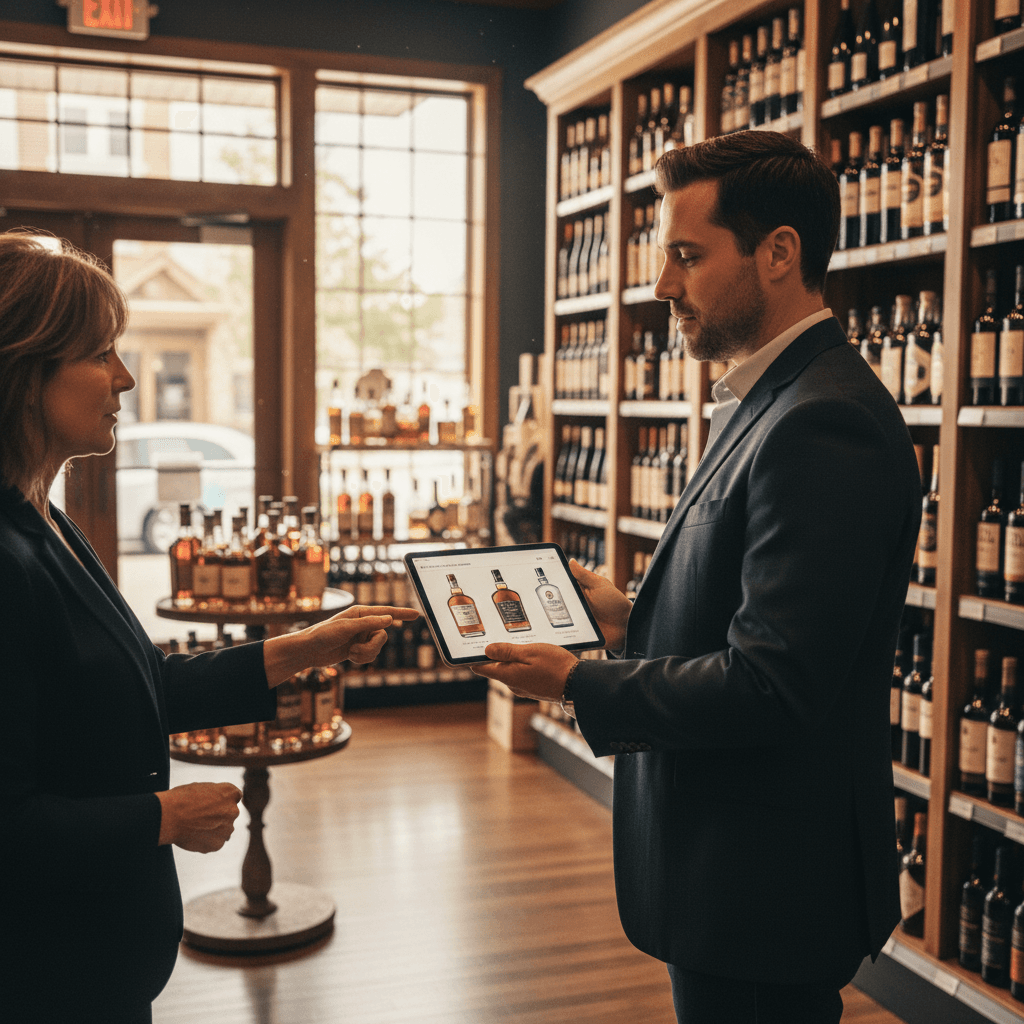
Your regulars don't need to tell you their names anymore. The Friday bourbon guy, the Wednesday craft beer couple, the woman who stocks up on rosé every May like clockwork — you know them. But here's the question: are you actually using what you know about them to sell smarter? Because right now, buried inside your POS system, there's a detailed map of what your customers want next. And if you're not reading it, someone else — probably someone with a warehouse and a shipping label — will.
The liquor retail landscape is splitting into two camps: stores that treat every customer like a stranger, and stores that build personalized product recommendations into every interaction. The second camp is winning. Not because they have bigger budgets or fancier technology, but because they've figured out how to connect three simple touchpoints — POS data, shelf talkers, and digital follow-up — into a loop that turns one-time buyers into lifelong customers.
This post is your playbook. We're going to walk through each of those three touchpoints step by step, show you exactly how to extract insights from data you already own, and give you templates you can put to work this week. No enterprise software required. No data science degree needed. Just a willingness to stop leaving money on the table.
Every transaction in your POS system is a breadcrumb. A customer who buys Espolòn Blanco every other Friday, grabs a six-pack of craft IPA on Wednesdays, and splurges on single malt around the holidays — that's not random. That's a profile. And it's the foundation for liquor store personalized product recommendations that actually move product.
Amazon's Rufus AI assistant now lets shoppers search for products by activity, event, and purpose — not just by brand or category. Someone types "hosting a backyard cookout" and gets curated drink suggestions. That's the new consumer expectation, and it doesn't stay contained to Amazon. Your customers walk into your store with that same expectation baked in.
Learn how email segmentation for liquor stores drives repeat sales with a 4,200% ROI. List-building tactics, purchase...
Here's the good news: you don't need a billion-dollar AI to compete. Platforms like BottleCapps ↗ are already helping alcohol retailers deliver personalized recommendations that drive stronger conversions and repeat visits. The tools exist. The data exists — it's sitting inside your POS system right now.
NIQ's 2024 report on the US liquor channel shows clear winners and losers across alcohol categories. Knowing which segments are growing matters, but knowing which segments your specific customers are gravitating toward? That's the real insight big-box competitors can't replicate.
Independent liquor stores have something Amazon doesn't: direct relationships and purchase data you can act on today.
This post walks you through a practical three-touchpoint personalization loop — POS insights, shelf talkers, and digital follow-up — that any store can implement without an enterprise budget.
Wine shops are becoming experience destinations by adding tastings, classes, and events. See how real retailers are d...
Here's the thing most liquor store owners don't realize: you're already sitting on a goldmine of customer intelligence. You just haven't dug it up yet.
Let's define "customer purchase data" in plain terms. It's the record of what each customer buys, when they buy it, how much they spend, and how often they come back. That's it. Nothing exotic. Your POS system captures all of this every time someone checks out.
The challenge? Most stores treat this data as accounting information. They use it for inventory counts and tax reporting, then ignore the rest. That's like owning a sports car and only driving it to the mailbox.
If you have a loyalty program integrated with your POS system, you can tie purchases to individual customers — and that's where the real power lives. Don't have one? Even a simple points program unlocks this entire strategy. It doesn't need to be complicated. It just needs to connect a name to a receipt.
Learn how to run compliant, high-performing Google Ads for liquor stores. Covers campaign setup, bidding strategies, ...
When you pull customer purchase data from your POS, focus on these four insights:
NIQ's 2024 data highlights that categories like mezcal and premium tequila continue gaining momentum while some traditional segments flatten. If your POS data shows a customer regularly buying tequila, recommending a trending mezcal is a natural, data-backed move — real behavior, not guesswork.
The good news? You don't need fancy AI to start. A weekly export of your top 50 customers and their purchase histories is enough to begin building recommendation logic manually. Open a spreadsheet, sort by category and spend, and you'll see patterns within minutes.
That's your starting point. The data is already there — you just need to start reading it.
Now let's talk about what to do with those patterns once you've found them — starting with the most underused piece of real estate in your store.
You've got the data. Now let's put it where it matters most — right next to the bottle, right when the customer is deciding.
If you're not familiar with the term, shelf talkers are those small signs attached to or placed near products on your shelves. Think of them as your in-store sales team when your actual team is busy ringing up customers, stocking shelves, or helping someone else find the mezcal section.
Here's the problem: most shelf talkers are wasted real estate. They either shout a price in bold red font or parrot a distributor's generic tasting note — "hints of vanilla and oak with a smooth finish." That describes roughly 80% of the bourbon wall, and your customer knows it.
Your shelf talkers should function as personal guides. When a customer is standing in front of 200 bourbon options experiencing full-blown decision fatigue, a well-written shelf talker cuts through the noise and nudges them toward a confident purchase. That's personalized recommendation in its simplest, most cost-effective form.
This is where your customer purchase data becomes a marketing strategy you can see and touch.
Pull up your POS data and look for three things:
If a category like Japanese whisky or premium tequila is surging nationally and in your store, that's a shelf talker waiting to happen.
Think of personalized recommendations not as a single tactic, but as a loop — one that gets smarter and more valuable every time a customer walks through your door.
Here's the framework: POS data collection → in-store shelf talkers → digital follow-up. Each touchpoint feeds the next, and together they build a relationship that keeps customers coming back.
Let's make this concrete.
A customer buys Woodford Reserve on Saturday. Your POS captures it — that's touchpoint one.
Next visit, they're browsing the bourbon aisle. A shelf talker near the Woodford says: "If you love this, try Angel's Envy — our #2 bourbon this month." That's touchpoint two.
Three days later, they get a text: "New allocation just arrived: Woodford Double Oaked. Want us to hold a bottle?" Touchpoint three.
That text drives them back into the store, where they buy the Double Oaked and notice a shelf talker for a new rye. The loop continues — each cycle generating more data, more relevance, and more loyalty.
This isn't theoretical. This is how the smartest independent retailers are competing right now. And the store owners building this loop today are the ones capturing disproportionate loyalty tomorrow.
If this all sounds great in theory but you're already thinking of reasons it won't work for your store — let's talk about that.
We hear these from store owners all the time. Let's knock them down.
It probably can — more than you think. Most modern POS systems, even mid-tier ones, can export customer purchase data. You don't need a fully integrated AI platform to start. A spreadsheet and 30 minutes a week gets you 80% of the way there. Pull your data into a simple CSV, sort by customer, and you're already ahead of most independents.
Then start absurdly small. Pick your top 20 customers, look at their last 5 purchases, and send one personalized recommendation email this week. That's your minimum viable version. One touchpoint. Twenty minutes. Real results.
There's a difference between spam and service. A recommendation based on what someone actually buys feels helpful, not pushy — like a knowledgeable staff member saying, "I set this aside for you."
Consumers are increasingly trained to expect personalization from every retailer they interact with. The real risk isn't doing too much — it's doing nothing while big-box competitors build personalization into every interaction.
You don't need a six-figure tech stack to start offering liquor store personalized product recommendations. You need a POS system, some curiosity, and about two hours this week.
Here's the three-touchpoint framework we've walked through:
10+ years helping liquor retailers and beverage brands grow through data-driven digital marketing. Learn more
Now, instead of writing generic copy, write shelf talkers rooted in what your customers are actually doing. Here are four templates you can steal and adapt today:
🏆 The Bestseller
"Our #1 selling bourbon under $35 this month. Over [X] bottles sold — grab yours before the shelf clears."
📈 The Trending Pick
"This one's climbing fast. Sales up 40% in our store this quarter. Early adopters, you know who you are."
🛒 The Paired Purchase
"Customers who love Buffalo Trace are picking this up. Try [Product Name] — same profile, new favorite."
👤 The Staff Pick (Backed by Data)
"Jake's pick this month — and our sales data agrees. Top 5 in the category and a repeat-buy favorite with our regulars."
Notice what each of these does: it borrows credibility from real customer behavior instead of asking shoppers to trust a faceless tasting note. That's the difference between a shelf talker that decorates your shelf and one that actually sells.
The best part? You already have everything you need. Your POS data tells you what's selling, what's pairing, and what's trending. You just need to translate that into six to ten words on a small sign — and let it do the selling for you.
Of course, shelf talkers only work when someone's standing in your store. What about the other six days of the week when they're not? That's where the third touchpoint comes in.
The sale doesn't end at the register. It starts there.
You've already done the hard work — collecting customer purchase data through your POS system. But if that data just sits in a spreadsheet or dashboard gathering dust, you're leaving repeat revenue on the table.
Consumers now expect personalized product discovery everywhere they shop. You don't need Amazon's budget, but you do need to show up after the sale with something relevant.
Digital follow-up — email, SMS, or app push notifications — is where you turn liquor store personalized product recommendations from a nice idea into a revenue engine.
Sequence 1: "You Might Also Like" — Send this 5–7 days after purchase. Customer bought a rye whiskey? Recommend a specific bitters that pairs well, or a similar rye at a higher price point. Lean into trending categories when building cross-sell suggestions — if mezcal or RTDs are gaining steam in your store, those make natural "try next" recommendations.
Sequence 2: The Reorder Reminder — Time this based on average purchase frequency. "It's been 3 weeks since you grabbed that Sauvignon Blanc — we just restocked." Simple. Effective. Driven entirely by data you already have.
Sequence 3: Seasonal or Occasion-Based Picks — Triggered by calendar events, informed by category preferences. "Hosting for the holidays? Based on your taste, here are 3 bottles your guests will love."
Platforms like BottleCapps ↗ are already enabling this kind of personalized digital follow-up for alcohol retailers, and the technology is more accessible than most store owners assume. The model works.
One rule: keep messages short, useful, and non-spammy. One personalized recommendation beats a generic "check out our weekly deals" blast every single time.
Now that you've seen each touchpoint in action, let's zoom out and look at how they work together — because the real magic isn't in any single step. It's in the loop.
Intentionally Creative specializes in digital marketing strategies that drive real results. Let us show you what's possible.
Schedule a Call(1) Extract and analyze customer purchase data from your POS to understand what's actually selling and to whom.
(2) Create data-informed shelf talkers for your top categories — start with the segments showing the strongest growth in your store and nationally.
(3) Launch at least one digital follow-up sequence based on purchase history, because your customers already expect you to know what they like.
That's it. Four moves that put your customer purchase data to work.
Scaling this — especially the data analysis and digital follow-up — is where things get time-intensive fast. Building the engine yourself means late nights and lost weekends.
If you want help connecting your POS insights, in-store experience, and digital follow-up into a personalization strategy that actually runs without you — that's exactly what we do at Intentionally Creative ↗.
The data is already in your system. Your customers are already telling you what they want through every transaction, every repeat visit, every seasonal splurge. The only question is whether you'll use it.
Liquor store personalized product recommendations aren't a future trend — they're a present-tense competitive advantage. The stores that connect POS insights to shelf talkers to digital follow-up are building something that no big-box retailer or online giant can easily replicate: a personalized relationship at scale, rooted in local knowledge and real customer behavior.
You don't need to do everything at once. You just need to start. Pull the data this week. Write three shelf talkers. Send one personalized message. Then do it again next week, and the week after that. The loop builds on itself — and so does the loyalty.
Ready to turn your customer data into a personalization engine? Get in touch with Intentionally Creative ↗ and let's build the strategy together.