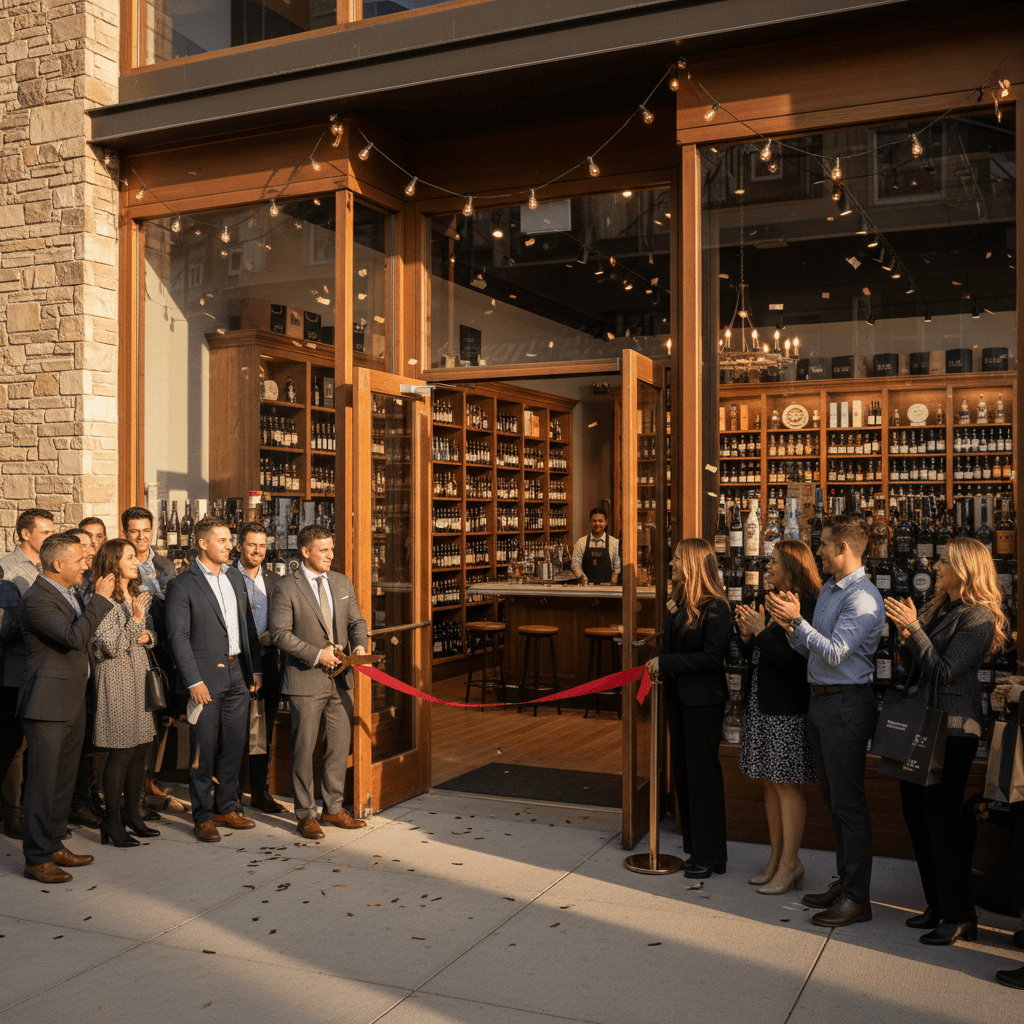
Launching a New Liquor Store? Your 90-Day Grand Opening Marketing Plan
By Alden Morris, Founder & Principal Strategist37 min read
Listen to this article48:17
Schedule a free strategy call and Intentionally Creative will build a custom plan for you.
Schedule Your Free Strategy CallFree audit. No commitment.
Get a Free Audit. No commitment.
A complete 90-day grand opening marketing plan for new liquor store owners. From pre-launch buzz to post-opening retention, learn how to maximize foot traffic, build community, and drive lasting revenue.
Your grand opening isn't a party. It's a customer acquisition engine, and you only get one shot at it.
Retail research consistently shows that first impressions are statistically resistant to reversal. According to IBISWorld's industry data on U.S. beer, wine, and liquor stores, the sector generates over $60 billion annually, meaning your new store enters a market where established competitors already own customer habits. Breaking those habits requires a concentrated, high-impact entry.
The grand opening window carries your lowest customer acquisition cost of all time. You have novelty, local press interest, word-of-mouth momentum, and community curiosity working simultaneously. That combination never repeats.
Discover 7 proven Instagram content ideas for liquor stores that boost engagement and drive sales. Learn how to promo...
This guide is built around a phased 90-day plan: pre-launch (Days 1–30), launch week (Days 31–37), and post-opening growth (Days 38–90). Each phase has a distinct objective, specific tactics, and measurable outcomes. No theory. No vague advice. A working roadmap.
Eight phases. One goal: turn your opening into a long-term customer base.
Avoid TTB violations and Google Ads suspension with this guide to alcohol advertising rules for liquor stores. Expert...
This guide walks independent liquor store owners, franchise operators, and retail managers through every stage of a modern grand opening, from building your digital presence before you unlock the doors, to converting first-time visitors into loyal regulars weeks after the ribbon cutting. Digital marketing strategy runs through every phase because foot traffic alone doesn't build a sustainable business anymore.
You'll find tactical guidance on local SEO, email capture, social media execution, influencer partnerships, loyalty program setup, and paid advertising, all sequenced to compound on each other.
Discover the 7 essential marketing budget benchmarks for liquor stores. Learn how top performers allocate spend for m...
A liquor store grand opening is the single highest-leverage marketing moment in the store's entire lifespan. The concentration of novelty, community attention, and earned media creates a customer acquisition window that simply doesn't exist again at the same cost or scale. Research from IBISWorld confirms the liquor retail sector's intensity, over 40,000 stores compete for wallet share across the U.S. Stores that open with a structured, multi-channel strategy capture early customers, build email lists, and establish brand identity before competitors can counter-position. Stores that open without one spend the next two years trying to undo a weak first impression. Consumer psychology research shows it takes five to seven positive experiences to overcome one negative first impression in retail settings. The 90-day post-opening window determines whether your store builds momentum or stalls. Every decision made in that window, digital, in-store, promotional, either compounds into long-term retention or dissipates into wasted spend.
Here's what actually happens when you skip brand identity and go straight to marketing: you spend money attracting customers who have no reason to come back. Your grand opening becomes a one-day event instead of the launch of a loyal customer base. Brand identity isn't decoration, it's the operating system everything else runs on.
Does your store have a reason to exist beyond being the closest option?
That's the question every liquor store owner needs to answer before printing a single flyer or posting a single reel. Your market position isn't a tagline, it's a strategic decision that determines which customers you attract, what you stock, and how you price.
Start by mapping your primary customer segments. Casual shoppers want convenience and value. Enthusiasts want curation and discovery. Gift buyers want guidance and presentation. Event planners want volume, variety, and reliability. You can serve all four, but you need to know which one anchors your identity.
Run a competitive analysis on every store within a five-mile radius. Walk their aisles. Check their Google reviews. Look for the recurring complaint, "limited selection," "no staff knowledge," "nothing local", and own the gap they're leaving open.
Then choose your brand personality from four archetypes:
Here's what actually happens when you open your doors without a structured week-long plan: you get one big day, a decent weekend, and then silence. The stores that build lasting customer bases treat grand opening week like a seven-day campaign, not a single event.
Retail research consistently shows that customers who visit a store three or more times in their first 30 days have a 70% higher retention rate than one-time visitors. That's the science behind a multi-day structure. Frequency builds familiarity. Familiarity builds loyalty.
Day 1 is not for the public. It's for your VIPs, email subscribers, local press, neighborhood business owners, and distributor reps. An exclusive preview creates social proof before the doors open to everyone else. Think of it as a controlled detonation: you're generating content, word-of-mouth, and buzz before the general public ever steps inside.
Day 2 and 3 are your maximum-traffic days. Staff accordingly. Run your highest-value promotions here. Then Days 4–7 are where most stores drop the ball, and where you can separate yourself.
Daily themed promotions sustain momentum without requiring a full event budget each day:
Each theme gives customers a reason to return. That's the actual goal.
Here's what actually happens when you don't have a retention plan after your grand opening: you spend $15,000 building foot traffic, and 70% of those customers never come back.
That's not a pessimistic projection. That's the default outcome when a liquor store treats opening week as the finish line instead of the starting gun. The myth worth debunking here is that a great grand opening creates loyal customers. It doesn't. It creates opportunities for loyal customers. What you do in days 38–60 determines whether those opportunities convert.
How do you turn grand opening customers into loyal liquor store regulars?
Converting grand opening visitors into loyal regulars requires a structured, multi-channel retention system activated within 30 days of opening. Start by enrolling every customer into a loyalty program at point of sale, platforms like Springbig or Square Loyalty make this frictionless. Simultaneously, trigger a 3-email welcome sequence: email one delivers your brand story, email two highlights your best product categories, and email three delivers a first-purchase incentive. On social, shift from hype content to value content, cocktail recipes, staff picks, pairing guides, so customers have a reason to follow you beyond the opening buzz. Segment your email list by purchase behavior early: wine buyers, spirits enthusiasts, and craft beer drinkers respond to completely different messaging. According to research from BottlePos, personalized retail communication significantly outperforms generic broadcast messaging in driving repeat visits. Retention is a system, not a single touchpoint.
Most stores set up a loyalty program and then forget to sell it. That's the real failure point, not the platform choice.
For retail liquor, three platforms dominate: Springbig (built specifically for regulated retail, strong compliance features), Fivestars (strong for neighborhood stores with walk-in traffic), and Square Loyalty (best if you're already running Square POS). Each handles points differently, so match the model to your customer behavior:
Founder and Principal Strategist at Intentionally Creative. 10+ years in three-tier beverage industry marketing, 3 patents pending, CityHive partner. Runs growth for independent liquor retailers and DTC brands.
Once you've chosen, document your USP in one sentence. Not a paragraph. One sentence. That sentence becomes the filter for every marketing decision you make for the next 12 months.
Visual inconsistency is a trust signal, and not a good one.
A customer sees your Instagram post, then your storefront sign, then your bag, and they all look like they came from three different businesses. That inconsistency registers subconsciously as disorganization. According to research cited by IBISWorld, the U.S. beer, wine, and liquor retail sector generates over $67 billion annually, the stores that capture repeat business are the ones that feel established from day one, even when they're brand new.
Your minimum brand asset checklist before you open:
Budget-wise, you have three realistic paths. Canva Pro ($15/month) works if you have design instincts and time. A local designer runs $500, $2,500 for a complete brand kit and gives you professional polish without agency overhead. A full-service agency like Intentionally Creative builds integrated, digital-first brand systems specifically for retail liquor, meaning your identity is built to perform on Google, Meta, and in-store simultaneously, not adapted after the fact.
The difference between the first two options and the third isn't just aesthetics. It's strategy baked into the design from the start.
Your Google Business Profile will drive more foot traffic in your first 90 days than any paid ad you run. Claim it before you open. Fill every field, hours, categories (use "Liquor Store" as primary), photos, description, and your service area. An incomplete profile tells Google you're not serious. Google responds by ranking you lower.
Then lock down your handles. Check Instagram, Facebook, and TikTok simultaneously using a tool like Namecheckr. Consistency matters, @TheCorkRoom on Instagram and @TheCorkRoomLiquor on TikTok creates friction in brand recall. Get the same handle everywhere, even on platforms you won't use immediately.
Your digital real estate checklist for Days 1–14:
That last point is where most new stores leave money on the table. Every visitor to your pre-launch page is a potential retargeting audience. By the time you run your first Facebook ad for the grand opening, you're not starting cold, you're talking to people who already raised their hand.
What branding steps should a liquor store complete before its grand opening? Before opening day, a liquor store should complete six foundational branding steps. First, define a clear market position and document a single-sentence USP that distinguishes the store from nearby competitors. Second, develop a minimum brand asset kit, primary logo, horizontal logo, color palette, typography, and photography style. Third, claim and fully optimize a Google Business Profile, which drives organic foot traffic faster than most paid channels. Fourth, register consistent social handles across Instagram, Facebook, and TikTok. Fifth, purchase a domain and launch a pre-opening landing page with email capture to begin building an audience before the doors open. Sixth, install Google Analytics 4 and Meta Pixel from day one to collect audience data that powers smarter paid advertising at launch. Stores that complete these steps before opening outperform those that treat branding as an afterthought.
Try this yourself: write your USP sentence, then hand it to someone outside the industry and ask them what kind of store it describes. If they can't answer in five seconds, rewrite it. Clarity at this stage is the highest-leverage work you'll do before your grand opening.
Here's what actually happens when you go dark on social media during your store build-out: customers drive past your signage, feel nothing, and mentally file you under "coming soon, maybe someday." The stores that open to a line out the door didn't get lucky, they spent 30 days engineering anticipation before a single bottle hit the shelf.
To market a liquor store before it officially opens, start building your audience 30 days out using a four-channel approach: a 'Coming Soon' social media campaign with daily countdown content, an email list anchored by a VIP grand opening offer, targeted local PR outreach, and geo-fenced paid digital advertising. On Instagram and Facebook, post behind-the-scenes setup content, staff introductions, and sneak peeks of premium inventory, this type of organic content consistently outperforms polished promotional posts. Collect emails through a dedicated landing page and in-person at community events, then deploy a three-email pre-opening sequence. Distribute a press release to local newspapers and neighborhood blogs, and contact your Chamber of Commerce for ribbon-cutting coverage. Run geo-targeted Facebook and Instagram ads within a 5-mile radius, and activate Google Local Search Ads immediately to capture "liquor store near me" queries. Allocate roughly 60% of your pre-launch ad budget to awareness and 40% to conversion and list-building.
Your Instagram feed is your storefront before your storefront exists. Post a countdown series, 30 days, 20 days, 10 days, and fill each post with content that makes people feel like insiders. A time-lapse of shelves being stocked. A close-up of a rare Japanese whisky you're carrying. A quick intro video from your floor manager. This isn't just content strategy; it's social proof in real time. People follow stores they feel connected to before they've ever walked in. Pair every post with a layered hashtag strategy: local geo-tags like #AustinLiquorStore alongside category tags like #craftspirits and #localwineshop. Offer an exclusive 10% grand opening discount for anyone who follows before opening day, this converts passive scrollers into committed first-day customers.
An email list is the only audience you actually own. Social platforms change their algorithms; your list doesn't. Set up a simple landing page, tools like Klaviyo or Mailchimp work well for this, with a single, clear lead magnet: "Join our VIP list for exclusive grand opening deals." Collect emails offline too: farmers markets, neighborhood association meetings, local pop-up events. Segment from day one. Bourbon enthusiasts want different messaging than someone buying wine for a dinner party. Build a three-email pre-opening sequence: an announcement email ("We're opening in 30 days"), a countdown email with your event details, and a "doors open tomorrow" email with your hours, address, and opening day specials.
A well-written press release sent to your local newspaper, neighborhood blogs, and community Facebook groups costs nothing and can generate coverage that paid ads can't replicate. Lead with the community angle, local ownership, curated local craft selections, a new gathering spot for the neighborhood. Reach out to nearby restaurants and bars about cross-promotional partnerships; they need reliable retail recommendations for their customers. Your local Chamber of Commerce is an underused asset, many offer ribbon-cutting ceremonies with press coverage built in. Identify three to five local micro-influencers in the food, lifestyle, or nightlife space. Micro-influencers, typically 5,000 to 50,000 followers, drive higher engagement rates than larger accounts, according to research consistently cited across retail marketing platforms.
Geo-targeted ads are your sharpest pre-opening tool. On Meta, build a campaign targeting a 5-mile radius around your store address, using interest-based layering: wine enthusiasts, cocktail culture, local events. On Google, activate Local Search Ads immediately, you want to own the "liquor store near me" query from the moment someone in your zip code searches it. Budget 60% of your pre-launch spend toward awareness (reach and video views) and 40% toward conversion (email sign-ups, event RSVPs). One critical note: both Meta and Google enforce strict alcohol advertising compliance policies, including age-gating and prohibition on targeting users under 21. Build those parameters in before your first ad goes live, not after a disapproval.
Try this yourself: map out your 30-day pre-opening calendar this week with one social post, one email touchpoint, and one community outreach action per week. Concrete scheduling is the difference between a strategy and a plan.
Intentionally Creative specializes in digital marketing strategies that drive real results. Let us show you what's possible.
Schedule a CallFree tasting stations are the single highest-ROI activation you can run during opening week, and they don't have to cost you much. Most distributors will co-sponsor tasting events in exchange for shelf placement and visibility. Call your reps before opening week and lock in at least three brand activations across different days.
Pair that with a raffle or giveaway tied to loyalty sign-ups at the door. Collect the email. Every address you capture on Day 1 is worth an estimated $5, $15 in lifetime email marketing revenue if you work it correctly.
The Instagrammable moment matters more than most operators think. A neon sign with your store name, a curated spirits wall, or a branded photo backdrop turns every customer into a content creator. User-generated content from a grand opening weekend reaches audiences your paid ads never will.
Live music or a local food truck extends dwell time. Longer dwell time means larger basket sizes. The math is simple.
A liquor store grand opening week should follow a structured, multi-day event plan that front-loads urgency and sustains foot traffic across seven days. Day 1 should be a VIP-only preview for email subscribers, influencers, and community partners. Days 2–3 serve as the public grand opening with maximum programming. Days 4–7 use daily themed promotions, Whiskey Wednesday, Wine Thursday, Craft Beer Friday, to keep customers returning. In-store activations like distributor-sponsored tastings, loyalty sign-up raffles, and Instagrammable displays drive word-of-mouth beyond your ad spend. Opening week discounts should be tiered: 10% off on Day 1, 5% off Days 2–7, creating urgency to visit early. Bundle deals like a "Grand Opening Gift Set" increase average transaction value. Every promotion must comply with your state's alcohol promotion regulations before launch, what's legal in Texas may be prohibited in Pennsylvania.
Tiered discounting is the framework: 10% off on Day 1 rewards early adopters and creates urgency. 5% off Days 2–7 keeps the offer alive without cannibalizing your margin long-term. The contrast matters, a flat week-long discount trains customers to wait. A declining discount rewards action.
Bundle deals work because they increase average transaction value while making the customer feel like they're getting something curated. "Grand Opening Six-Pack" or a "Welcome Gift Set" at a promotional price moves volume and introduces customers to SKUs they wouldn't have grabbed on their own.
Loyalty enrollment on opening day should come with a tangible incentive, double points, a welcome bonus, or a small gift with sign-up. According to data from BottlePos, stores with active loyalty programs see repeat visit rates 40% higher than those without one. Opening week is your best single opportunity to build that base fast.
One critical note: every promotion you run must clear your state's alcohol promotion regulations before it goes live. Tie-in offers, sweepstakes, and discount structures are regulated differently across states. Run your plan by your compliance counsel or licensing authority first. The fine isn't worth the foot traffic.
Try this yourself: Map out all seven days on a single planning sheet before opening week. Assign a theme, a promotion, a tasting activation, and a social post to each day. When you can see the full week at a glance, the gaps become obvious, and fixable, before you're already in it.
Set a 30-day enrollment goal from opening week. If 500 people walked through your doors during the grand opening, aim for a 40% enrollment rate, 200 loyalty members, within the first month. Track that conversion rate weekly.
What to do instead of passive signage:
Email is still the highest-ROI retention channel in retail, and most liquor stores either ignore it or send one generic blast per month. Neither works.
Build a 3-email welcome sequence that runs automatically after signup:
After purchase, send a thank-you email within 24 hours. Include a "you might also like" recommendation based on what they bought. A customer who bought Casamigos gets a suggestion for Clase Azul. A customer who bought a Chardonnay gets a food pairing guide.
Segment your list from day one. Wine buyers, spirits enthusiasts, and beer drinkers have almost nothing in common in terms of content interest. Sending a bourbon barrel-aging deep-dive to your Sauvignon Blanc customer is noise. Tailor accordingly.
The grand opening content, countdown timers, ribbon-cutting photos, opening day chaos, has a shelf life of about two weeks. After that, if you keep posting hype content, your engagement craters and your algorithm reach collapses.
Weeks 5–8 require a deliberate pivot to value content. Education. Expertise. Entertainment.
Build recurring content series your audience can anticipate:
User-generated content (UGC) is your cheapest and most credible content source. Create a branded hashtag during the grand opening and actively repost customer photos. Run a photo contest, "Show us your home bar setup featuring a bottle from [Your Store Name]", with a $50 store credit prize. The cost is negligible. The authentic content value is significant.
For algorithmic reach, use native engagement mechanics: Instagram polls ("Rye or Bourbon, which are you mixing this weekend?"), Q&A stickers on Stories, and "guess the spirit" blind-tasting games. These features signal active community to the algorithm, which expands your organic reach without paid spend.
What to do instead of winging your content:
The stores that sustain grand opening momentum aren't the ones with the biggest budgets. They're the ones with the most consistent systems. Build the system now.
Here's what actually happens when you open a liquor store and skip local SEO: Google doesn't know you exist, and neither does anyone searching "liquor store near me" at 6 PM on a Friday.
That's not a small problem. That's your highest-intent customer going to your competitor.
Start with your Google Business Profile the same week you open, not after. Set your primary category to "Liquor Store" (not "Wine Shop," not "Beverage Store"). Upload 10–20 photos immediately: exterior shots, your craft spirits wall, your cooler layout, your staff. Google's own data shows that businesses with photos receive 42% more requests for directions. Add your first Google Post within seven days announcing your opening. Enable messaging. When a customer asks a question in your Q&A section, answer it within 24 hours, every time.
Train your staff to ask for reviews naturally. Not robotically. Something like: "If you enjoyed the experience, we'd love a Google review, it really helps us out." Then send a post-visit email with a direct review link. Respond to every review, positive and negative, within 48 hours. Target 25 Google reviews in your first 60 days. That threshold matters for local search authority.
A new liquor store should optimize for local SEO immediately after opening by fully completing its Google Business Profile with accurate NAP (Name, Address, Phone) information, uploading high-quality photos, and selecting the correct primary business category. The store should actively generate Google reviews, targeting at least 25 within the first 60 days, by training staff to make natural asks at the point of sale and following up via email with a direct review link. The store's website should target long-tail keywords like "craft whiskey store in [city]" or "best wine selection in [neighborhood]" and include a blog covering cocktail recipes, spirit guides, and pairing suggestions to drive organic traffic. Local citations across Yelp, Foursquare, Yellow Pages, and Nextdoor must reflect consistent NAP data. According to research from IBISWorld, the beer, wine, and liquor store sector remains highly localized, meaning local search visibility directly drives foot traffic.
If you serve multiple neighborhoods, build separate landing pages for each. Publish content, cocktail recipes, spirit guides, pairing suggestions, that answers questions your customers are already Googling. And lock down your citations: Yelp, Yellow Pages, Foursquare, Nextdoor. Your NAP must match exactly across every platform.
Try this yourself: Search "[your city] liquor store" right now. If you're not on the first page within 60 days of opening, your GBP and citation consistency are the first things to audit.
Here's what actually happens when you stop running grand opening ads after week one: your foot traffic drops, your cost per new customer spikes, and the momentum you paid to build evaporates. The stores that sustain growth past day 30 treat paid advertising as a system, not a sprint.
Before: Your ad budget went toward awareness, reach campaigns, event promotions, "we're open" messaging. That was right for the moment.
After day 60: Every dollar should chase conversion. Someone who visited your website but didn't buy is worth more to you than a cold audience. Retarget them. Someone who searched "buy bourbon near me" at 7pm on a Friday is ready to spend. Capture them.
Shift your Google Ads budget from broad awareness campaigns to high-intent, conversion-focused keywords. The search terms that actually move product: "liquor store open now," "wine delivery [your city]," "buy bourbon near me." These aren't browsers, these are buyers with their wallet already out.
If your POS system supports product feed integration (Bottle POS and City Hive both do), activate Google Local Inventory Ads. This surfaces your actual in-stock products directly in search results, a significant edge over competitors running generic store ads.
Set up call tracking from day one. A surprising number of liquor store conversions happen via phone, customers calling to check stock before driving over. Without call tracking, you're flying blind on a meaningful chunk of your ROI.
Meta retargeting is where your email list becomes a media asset. Upload your customer list, build a lookalike audience, and you're targeting people who statistically behave like your best customers, before they've ever walked through your door.
For retargeting, the playbook is simple:
One compliance note that trips up new stores: Meta's alcohol advertising policies require age-gating, prohibit health-related claims, and restrict certain content types. Build this into your creative review process before you spend a dollar. A disapproved ad during a holiday push costs you more than the fine print is worth.
What paid advertising strategies work best for a new liquor store?
New liquor stores get the best return from a two-channel paid strategy: Google Search ads targeting high-intent local keywords and Meta retargeting campaigns aimed at website visitors and lookalike audiences built from customer email lists. Google captures active demand, people searching for a store right now, while Meta re-engages warm prospects and expands reach to high-value new customers. Set a 90-day benchmark of 3:1 ROAS minimum before scaling any campaign. Track cost per click, cost per acquisition, and in-store visit attribution using UTM parameters on every digital link. According to IBISWorld's retail sector data, beer, wine, and liquor stores operate on thin margins, which means ad spend without attribution tracking is a fast way to erode profit. Run a monthly audit: review performance, cut underperformers, and reallocate budget to what's converting.
Key metrics to track monthly:
Use UTM parameters on every link, email, social, paid, organic. Without them, Google Analytics lumps traffic into "direct," and you lose the data you need to make smart budget decisions.
"The stores that win long-term aren't the ones with the biggest ad budgets. They're the ones who know exactly which dollar drove which sale."
— Alden Morris, Intentionally Creative
Try this yourself: Pull your last 30 days of Google Ads data and filter by conversion rate at the keyword level. Kill anything below 2%. Reallocate that budget to your top three converting terms and watch your CPA drop within two weeks.
Here's what actually happens when you host your first in-store tasting event: foot traffic converts into email subscribers, and email subscribers convert into regulars. That's the compounding loop most new liquor store owners miss entirely in their first 90 days.
Post-grand opening momentum fades fast, usually within two to three weeks. A structured monthly event calendar is what keeps customers coming back after the ribbon-cutting buzz dies down.
The highest-performing event formats for retail liquor stores are tasting nights, distillery rep visits, cocktail classes, and wine clubs. Here's the operational reality most store owners don't know: your distributor reps and brand ambassadors will often supply the product, pour staff, and co-marketing materials at zero cost to you. That's not a small thing. A well-executed whiskey tasting night with a brand rep can run with almost no out-of-pocket expense on your end.
Promote every event across email, social media, Eventbrite, and Facebook Events simultaneously. Eventbrite alone surfaces your events to people actively searching for things to do locally, that's cold audience reach you're not paying for.
Capture emails at every single event. Use a tablet sign-up at the door or a QR code on the table. Your email list is the most valuable long-term marketing asset your store owns. Social algorithms change. Email doesn't.
Try this yourself: After your next tasting event, send a 48-hour follow-up email to every attendee with a featured product from that night and a limited discount. Track conversions. You'll see why in-store events are your best email acquisition channel.
A new liquor store that partners strategically with the right local businesses can effectively double its marketing reach without doubling its budget.
Start with complementary businesses: steakhouses, cigar lounges, specialty food shops, event venues, and upscale restaurants. These businesses already serve your ideal customer. Cross-promotional tactics that actually work include co-branded social posts, referral discount cards left at the host stand, and joint event hosting, a wine-pairing dinner with a local restaurant, for example, splits the cost and doubles the audience.
Don't overlook local hotels. Approach the concierge desk directly and make the case for becoming their go-to recommendation for guests. Hotel guests are high-intent buyers who want a curated experience, not a generic chain store. Position your shop as the local expert.
Sponsoring neighborhood events, charity fundraisers, food festivals, local sports leagues, builds brand visibility in a way that paid ads can't replicate. According to IBISWorld's analysis of the U.S. beer, wine, and liquor store sector, independent retailers who differentiate through community presence consistently outperform on customer retention metrics compared to stores competing on price alone.
A new liquor store can use community events and partnerships to grow by creating consistent, recurring reasons for customers to visit beyond routine purchases. Monthly tasting nights, cocktail classes, and distillery rep events drive traffic while capturing email addresses, your most durable marketing channel. Local business partnerships with restaurants, hotels, and event venues extend your reach into audiences you'd otherwise pay to access. Brand reps and distributors often co-fund events with product and staff support, reducing your cost to near zero. Sponsoring local events builds goodwill that compounds over time into word-of-mouth referrals. Stores that execute this consistently in their first 90 days establish a community identity that's very difficult for competitors to replicate.
The stores that will dominate their local market in 2026 and beyond aren't just the ones with the best selection. They're the ones that made themselves part of the neighborhood before the competition figured out what was happening.
What gets measured gets managed. What gets ignored gets expensive.
Here's what actually happens when you skip the scorecard after a grand opening: you spend 90 days executing, then have no idea what actually moved the needle. You'll repeat what felt good instead of what worked.
Split your KPIs into three buckets, revenue, marketing, and customer behavior.
Revenue KPIs tell you if the opening generated real business: total sales, average transaction value, and category-level breakdown across spirits, wine, and beer. A strong opening week means nothing if your average basket size is $18.
Marketing KPIs measure your audience-building progress. Track email list size, social media followers, Google review count, and website traffic weekly. Your Day 90 benchmarks: 500 email subscribers, 25+ Google reviews, and 1,000 social followers. These aren't vanity metrics, they're the distribution channels you'll rely on for every future promotion.
Customer KPIs are where most new stores go blind. Loyalty program enrollment rate, repeat visit rate, and customer acquisition cost tell you whether you're building a customer base or just a one-time crowd. According to research from BottlePos, repeat customers spend up to 67% more than first-time buyers, which means your loyalty enrollment rate at Day 30 is a leading indicator of your Year 1 revenue trajectory.
You don't need a $500/month analytics platform. You need four tools wired together.
The recommended stack: Google Analytics 4 for web traffic, Meta Business Suite for social performance, Mailchimp or Klaviyo for email metrics, and your POS analytics for sales data. Most modern POS systems, including those integrated with City Hive, surface category-level sales data you can pull weekly without a spreadsheet nightmare.
Build a single weekly marketing dashboard in Google Sheets or Looker Studio. Pull the six numbers that matter most: email subscribers, Google reviews, social followers, website sessions, total weekly revenue, and loyalty enrollments. The whole thing should take 20 minutes to update.
Schedule a monthly marketing review, not a vibe check, a structured debrief. What drove traffic? Which promotions converted? Where did you spend time or money that didn't return? That discipline in Month 1 compounds hard by Month 6.
How to measure the success of a liquor store grand opening marketing plan: Measure success across three KPI categories tracked over a 90-day window. Revenue KPIs, total sales, average transaction value, and category-level performance across spirits, wine, and beer, confirm whether the opening drove real business. Marketing KPIs, email list growth, social media followers, Google review count, and website traffic, measure the audience assets you're building for long-term promotions. Customer KPIs, loyalty enrollment rate, repeat visit rate, and customer acquisition cost, reveal whether you're converting first-time visitors into regulars. Target benchmarks by Day 90: 500 email subscribers, 25+ Google reviews, and 1,000 social followers. Track these weekly using Google Analytics 4, Meta Business Suite, Mailchimp or Klaviyo, and your POS system. Build a simple dashboard in Google Sheets or Looker Studio and run a structured monthly review to identify what's working and where to reallocate effort.
The specific recommendation: At Intentionally Creative, we build this 90-day scorecard into every grand opening engagement for retail liquor clients, because the data you collect in the first three months shapes every marketing decision for the next three years. If you want a pre-built dashboard template and monthly strategy support, that's exactly what our ongoing retail program delivers. Try this yourself: pull your Day 1 baseline numbers today, set your Day 90 targets, and review them every Friday morning before you do anything else.
What separates a liquor store that survives its first year from one that becomes a neighborhood institution?
The answer isn't inventory depth or square footage. It's intentionality, applied consistently, long after the ribbon-cutting photos fade from your Instagram grid.
Your 90-day grand opening plan built something more valuable than opening-week foot traffic. It built:
The best liquor stores become cultural anchors. Think of the shop where the owner remembers your go-to bourbon, where the staff actually knows the difference between a Côtes du Rhône and a Châteauneuf-du-Pape, where the holiday display feels curated rather than chaotic. Those stores didn't happen by accident.
Keep learning. Attend trade shows like WSWA Access Live. Follow what IBISWorld and MarketWatch are tracking in retail-tier resets heading into 2026. Invest in staff education, a certified specialist behind the counter converts browsers into buyers. Consistent, intentional marketing, not one-time campaigns, is what separates thriving stores from struggling ones.
You've built the plan. Now comes the part that actually matters: execution.
What comes after a successful liquor store grand opening? A successful grand opening marks the start of a longer brand-building process, not the finish line. The 90 days following your launch should focus on converting first-time visitors into loyal regulars through email marketing, a refined loyalty program, and consistent social media content that reflects your store's personality. According to IBISWorld, the U.S. beer, wine, and liquor store industry generates over $80 billion annually, but individual store success depends heavily on repeat customer rates and community reputation, not opening-week volume alone. Owners should track which promotions drove the highest basket size, double down on the channels that delivered real foot traffic, and build a content calendar that keeps the store top-of-mind between visits. The stores that thrive long-term treat marketing as an ongoing investment, not a launch expense.
Your 90-day roadmap covered pre-opening buzz, launch-week execution, and post-opening retention, three phases that work together to transform a new address into a known destination. Now it's time to put it into motion.
Download the free 90-Day Grand Opening Checklist and walk into your opening with a plan your competitors won't have.
And if you want a team that lives and breathes retail liquor marketing, one that understands the three-tier system from supplier to shelf, Intentionally Creative ↗ works exclusively with stores like yours. Not as a vendor. As a partner who's invested in your growth.
The store you open today has the potential to become a beloved institution, if you market it with the same care you curate your shelves.
With a 7x ROAS engine and category-level product ranking strategy, Uncorkit expanded its local and national visibility, translating digital dominance into measurable in-store revenue growth.