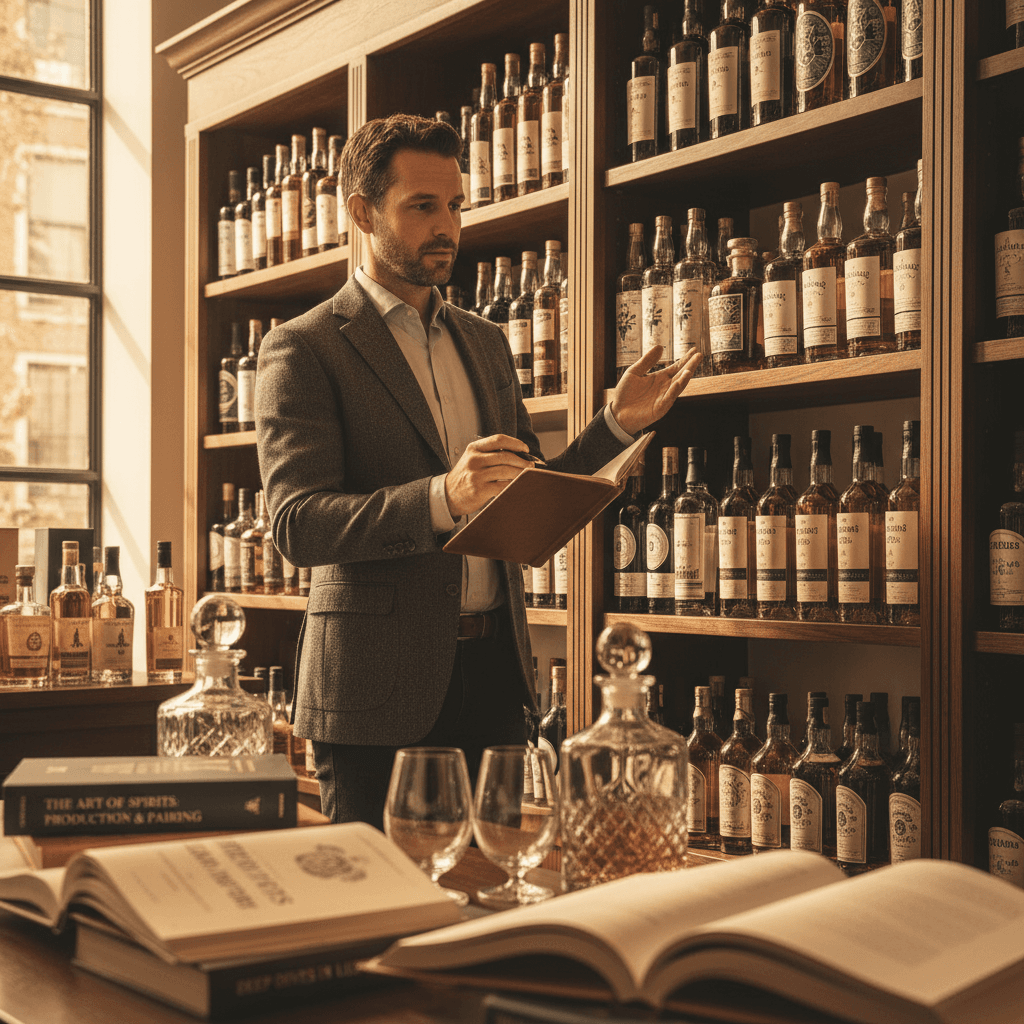
Our Content Philosophy: Why We Don't Create "5 Fun Cocktail Recipes for Summer"
By Alden Morris, Founder & Principal Strategist36 min read
Listen to this article46:39
Schedule a free strategy call and Intentionally Creative will build a custom plan for you.
Schedule Your Free Strategy CallFree audit. No commitment.
Get a Free Audit. No commitment.
Discover why strategic liquor store content outperforms generic cocktail recipes. Intentionally Creative's manifesto on business-focused digital marketing that drives real revenue for retail liquor stores.
Most liquor store content is indistinguishable from a Pinterest board. Scroll through a dozen liquor store Instagram accounts and you'll find the same Aperol Spritz recipe, the same "perfect summer cocktail" caption, the same stock photo of a copper mule mug. Different stores. Same content.
Cocktail recipes feel safe. They're shareable, seasonal, and easy to produce. Nobody gets fired for posting a Moscow Mule recipe in July.
But safe content and strategic liquor store content are not the same thing. One fills your feed. The other fills your register.
Discover 7 proven Instagram content ideas for liquor stores that boost engagement and drive sales. Learn how to promo...
This is not a checklist. There are no "5 Easy Steps" here.
This is a philosophy document for liquor store owners and managers who sense something is off with their content, engagement feels hollow, posts get likes but not foot traffic, and the social media calendar feels like a chore rather than a competitive advantage. You can't quite name the problem. This piece names it for you.
Avoid TTB violations and Google Ads suspension with this guide to alcohol advertising rules for liquor stores. Expert...
We will challenge comfortable assumptions about what "good" content looks like. That includes cocktail recipes, seasonal promotions, and the kind of social media marketing that looks productive but generates zero measurable return.
According to IBISWorld, the U.S. beer, wine, and liquor store industry generates over $69 billion in annual revenue, yet most independent retailers rely on content strategies borrowed from food bloggers and lifestyle brands with zero overlap in customer intent. The gap between what stores post and what actually drives purchase decisions is wide. And largely ignored.
10 wine club marketing tactics that reduce the 40% year-one cancellation rate and boost member spending at your liquo...
Start here: ask yourself when your content last caused someone to walk through your door.
Generic cocktail content fails liquor store marketing because it attracts the wrong audience at the wrong moment in the buying journey. A customer searching for a Moscow Mule recipe wants a drink, not a store. They'll find the recipe, make the cocktail with whatever vodka they already have, and never visit your location. Content Diversification as a marketing concept exists precisely because single-format content, especially recipe-based posts, collapses the entire marketing funnel into one low-intent interaction. Platforms like Cheers POS and Cloud Retailer track purchase behavior at the SKU level, and that data consistently shows that recipe content does not correlate with basket size or repeat visits. Research from Brandmovers confirms that emotionally resonant, education-first content outperforms lifestyle content in driving customer loyalty for beverage alcohol retailers. Generic cocktail posts aren't just ineffective, they actively train your audience to see your store as a recipe source rather than a trusted destination.
Here's what actually happens when you post content without a strategy: you get busy, not better.
Most liquor store owners treat content like a chore. Post a cocktail recipe on Tuesday. Share a supplier promo on Friday. Repeat until it feels pointless, because it is. That's not a content strategy. That's digital busywork.
Strategic liquor store content is digital content, blog posts, social media, email, video, deliberately engineered to serve a measurable business objective for a retail alcohol store. The word "strategic" does real work here. It means every piece of content connects to an outcome: foot traffic, average transaction value, customer retention, local SEO ranking, or email list growth.
Strategic liquor store content is digital content, including blog posts, social media posts, email campaigns, and video, deliberately designed to serve a measurable business objective for a retail alcohol store. It connects every piece of content output to a specific, trackable outcome: foot traffic, average transaction value, customer retention, local SEO ranking, or email list growth. Strategic content is built on three pillars, business alignment (every piece maps to a revenue or retention goal), audience specificity (content speaks to your actual buyer personas, not a generic "alcohol enthusiast"), and measurability (success is defined before the content is created, not rationalized after). It stands in direct contrast to lifestyle content like seasonal cocktail posts, which generate ambient awareness at best but rarely compound into searchable authority or purchase decisions. Strategic content is infrastructure. Everything else is decoration.
Here's what actually happens when someone picks up their phone to find a bottle: they don't search for "alcohol retailer." They search for exactly what they want, right now, in language that tells you precisely where they are in the buying process. According to IBISWorld, the U.S. beer, wine, and liquor store industry generates over $67 billion in annual revenue, and a significant portion of that starts with a Google search. The stores capturing that revenue understand search intent. The ones losing ground don't.
What do liquor store customers search for online before visiting a store?
Liquor store customers search in three distinct patterns before visiting a store. First, high-intent local searches, "liquor store near me open now" or "where to buy Blanton's in Chicago", signal immediate purchase readiness. Second, product education searches, "difference between rye and bourbon" or "best whiskey under $50", indicate buyers actively comparing options before spending. Third, occasion-driven searches, "best champagne for New Year's under $30" or "whiskey gift sets", reflect shoppers with a purchase trigger already in place who just need a trusted recommendation. Each search type represents a different moment in the customer journey, but all three share one thing: the person is about to spend money. A liquor store with content that answers these questions across all three categories captures customers at every stage, not just the ones who already know exactly what they want.
"Liquor store near me open now." That single phrase is worth understanding deeply. It carries location, urgency, and purchase intent in five words. A shopper typing that isn't browsing, they're ready to walk out the door with a bottle. The difference between ranking for that search and not ranking is a sale you either capture or hand to a competitor two blocks away.
Winning these searches requires two things working together: a fully optimized Google Business Profile and location-specific landing pages. Your GBP needs accurate hours, updated inventory categories, recent photos, and active review responses. Local landing pages, think "bourbon selection in Denver" or "Japanese whisky in Austin", give Google a content signal that matches what searchers are asking. Location-based targeting through platforms like Google Ads amplifies this further for competitive metro markets. This is table stakes, not advanced strategy.
Here's what actually happens when you publish content without a business objective attached to it: you generate traffic that doesn't convert, followers who don't buy, and a content calendar that feels productive but moves zero needles.
Most liquor store owners assume content marketing means posting consistently and hoping awareness eventually turns into sales. That's not a strategy. That's a lottery ticket.
The myth worth dismantling first: Content success is measured by reach. It isn't. A store with 200 monthly blog visitors who convert at 8% outperforms a store with 20,000 Instagram followers who never walk through the door. Reach without intent is noise.
What business goals should liquor store content be designed to achieve?
Liquor store content should be designed to achieve four measurable business objectives: local search visibility, higher average transaction value, customer retention, and category authority. Local search content, location-specific landing pages, "near me" FAQs, and Google Business Profile posts, drives high-intent foot traffic from customers already ready to buy. Premium product spotlights and "worth the upgrade" comparisons raise the ceiling on what customers feel confident spending. Email and SMS marketing builds the habit of returning to your store, reducing customer acquisition costs over time. Authority content, producer profiles, educational series, deep dives into bourbon or natural wine, earns word-of-mouth referrals and compounds in Google's trust signals the more consistently you publish. According to IBISWorld, the U.S. beer, wine, and liquor store industry generates over $67 billion annually, and the stores capturing disproportionate share aren't the loudest, they're the most findable and trusted locally.
Founder and Principal Strategist at Intentionally Creative. 10+ years in three-tier beverage industry marketing, 3 patents pending, CityHive partner. Runs growth for independent liquor retailers and DTC brands.
Think of strategic content as a three-legged structure. Pull one leg and the whole thing collapses:
Lifestyle content, cocktail recipes, "drink of the season" posts, supplier-provided graphics, isn't worthless. But it builds ambient brand awareness at best. It doesn't compound. A recipe post from eight months ago isn't driving search traffic today.
Strategic content builds searchable authority, drives purchase decisions, and gets stronger over time. A well-structured blog post targeting "best bourbon under $50 near [city]" captures local search intent through Location-Based Targeting and pulls buyers off Google directly into your store. That's infrastructure. A pretty cocktail photo is decoration.
The difference is intent, and intent determines results. Try this yourself: audit your last 10 pieces of content and ask one question for each: What specific business outcome was this designed to drive? If you can't answer that in one sentence, you weren't creating strategy. You were filling space.
Here's what actually happens when a liquor store publishes a cocktail recipe post: it quietly disappears. Not because the writing was bad or the recipe was wrong, but because the content entered a fight it was never going to win.
Picture a store owner spending three hours crafting "5 Fun Cocktail Recipes for Summer." They find the right photos, format the ingredients list, hit publish. Then they wait. What they don't see is that the same search query is being answered by Food Network, Bon Appétit, Difford's Guide, and roughly 40,000 lifestyle bloggers, all with stronger domain authority, larger content teams, and years of topical signals built into their URLs. Google's algorithm doesn't reward effort. It rewards authority. A retail store has zero topical authority in the recipe space, and no amount of well-intentioned content will change that without a fundamental shift in strategy.
This isn't a creative problem. It's a structural one. Generic recipe content places your store in direct competition with publishers who produce dozens of pieces per week, have dedicated SEO teams, and have accumulated domain authority over decades. According to IBISWorld, the U.S. beer, wine, and liquor store industry generates over $67 billion in annual revenue, but the stores capturing digital share aren't doing it by out-writing Bon Appétit. They're doing it by owning content categories no national publisher touches: local inventory depth, regional spirits knowledge, and hyper-specific product education.
Someone searching "summer cocktail recipes" is not standing at a purchase decision. They may already own every ingredient. They're in inspiration mode, not buying mode. Content strategy built around purchase intent or local discovery intent, think "best bourbon selection near [city]" or "where to buy Japanese whisky in [neighborhood]", pulls a fundamentally different searcher. That searcher has a wallet open. Traffic without conversion intent is a vanity metric, and vanity metrics don't pay for your next case order.
A Margarita recipe carries zero local identity. It could come from Total Wine, a Marriott hotel blog, or a content farm in Eastern Europe. Strategic content should make a reader feel they are reading something only your store could have written, your buyer's take on an emerging mezcal producer, your staff's honest breakdown of why a certain rye overdelivers at its price point. That's differentiation. Platforms like Cloud Retailer and data-driven marketing frameworks both emphasize that content differentiation is a strategy problem before it's a branding problem. You can't design your way out of a positioning gap.
Cocktail recipe posts don't just underperform, they consume resources that could go somewhere with real return. Every hour spent on a generic recipe is an hour not spent on a local SEO landing page, a product education post that answers a high-intent FAQ, or an email and SMS marketing sequence tied to seasonal inventory. Content budgets are finite. Misallocation compounds over time, and the stores that win in search over the next three years will be the ones that treated content as a resource allocation decision, not a creative exercise.
Cocktail recipe posts fail liquor store marketing because they compete in a content category dominated by publishers with vastly superior domain authority, topical depth, and production resources, and they attract the wrong audience entirely. Someone searching for summer cocktail recipes is likely in an inspiration mindset, not a buying one. They may already own the ingredients. The content generates traffic with no conversion intent, which is a vanity metric dressed up as marketing. Generic recipes also carry zero local identity, a Margarita tutorial could come from any brand, any store, any website. It does nothing to establish why a shopper should choose your store. According to IBISWorld's industry data, liquor retail is a $67B+ market, but digital share goes to stores that own specific, local, high-intent content, not to those chasing recipe traffic they'll never capture from Food Network or Difford's Guide.
Try this yourself: pull the last five content pieces your store published and ask one question for each, "Could Total Wine have written this?" If the answer is yes, you've identified exactly where your content strategy is leaking.
Intentionally Creative specializes in digital marketing strategies that drive real results. Let us show you what's possible.
Schedule a Call"What's the difference between rye and bourbon?" That question gets searched thousands of times per month. The person asking it is not a casual browser, they're standing in a store aisle, or sitting on their couch about to order online. They're in the consideration phase, and they're about to spend $40 to $80.
A liquor store that publishes a clear, honest answer to that question becomes the trusted advisor. Not just a transaction point. This is where content diversification pays off. Blog posts, buying guides, short comparison videos, these aren't vanity content. They're conversion tools. Searches like "best scotch for someone who likes bourbon" or "what to buy someone who drinks whiskey" are gift-purchase queries with high average order values. Answer them, and you earn the sale. Ignore them, and a media outlet or competitor does.
"Best champagne for New Year's under $30." The decision is already made. The buyer knows they need champagne. They know their budget. They just need someone to point them to the right bottle with confidence.
Seasonal and holiday promotions built around these search moments convert at a higher rate than almost any other content type, because the reader arrives pre-qualified. Content targeting "wine to bring to a dinner party" or "whiskey gift sets under $100" captures buyers who have a hard deadline and a social obligation. These aren't impulse searches. They're mission-driven. Data-driven marketing strategies that map content calendars to seasonal search spikes, Valentine's Day, Thanksgiving, New Year's, put your store in front of these buyers at exactly the right moment. Build the content before the season, not during it.
Try this yourself: Pull your Google Search Console data and filter for queries containing "gift," "party," "dinner," or a holiday name. Whatever shows up, build a dedicated page around it before the next relevant occasion hits.
This is the highest-ROI content objective for most retail liquor stores, and it's the one most owners underinvest in because it's less glamorous than social media.
Location-specific landing pages, FAQ content optimized for "near me" searches, and consistent Google Business Profile posts work together to capture demand that already exists. Someone searching "best bourbon selection near downtown Austin" has their wallet out. You either show up or you don't.
A store that ranks #1 locally for high-intent searches doesn't need to go viral. It needs to be findable at the exact moment a customer decides to buy. Location-based targeting through content costs a fraction of paid search and compounds over time in ways ad spend never does.
Product Bundling and premium product content are underused sales tools in retail liquor. A customer who reads a well-written guide comparing a $28 bourbon to a $55 bottle, with specific tasting notes, cocktail applications, and honest context, walks into your store with permission to spend more.
Curated collection guides, food pairing content, and gift set recommendations serve this objective directly. This is content functioning as a sales floor conversation, not a branding exercise. The goal is confidence, not clicks.
A loyal customer who opens every email is worth more than 1,000 recipe blog readers who never visit. Email and SMS marketing, new arrival announcements, exclusive member content, VIP Loyalty Programs with early access perks, builds the habit of returning to your store specifically.
Retention content reduces customer acquisition cost over time. That math compounds fast in a category where margin pressure is real and competition from big-box retailers is constant.
Pick a lane. A store known as the local expert in Japanese whisky, natural wine, or craft mezcal earns something paid advertising can't buy: reputation. Authority content, deep producer profiles, educational series, blind tasting breakdowns, builds that reputation systematically. According to research from Hangar-12's 2026 beverage marketing analysis, brands and retailers that invest in education-forward content consistently outperform on customer lifetime value metrics.
Authority compounds. The more you publish with depth and specificity, the more Google and your community treat you as the default resource.
What to do instead of publishing without a purpose:
Content without an objective is just publishing. Content tied to a business goal is infrastructure.
Here's what actually happens when you publish a random Instagram post about a new whiskey arrival, nothing. Maybe a handful of likes from regulars. No new customers. No sales spike. No lasting value. The post disappears in 48 hours and you're back to square one.
The content formats below don't work that way. They compound.
Start with something like a dedicated page titled "Best Bourbon Selection in Austin, TX." That page, built with a keyword-rich headline, inventory highlights, your store's differentiators, an embedded Google Map, and real customer reviews, becomes a permanent asset. It doesn't expire. It doesn't get buried by an algorithm update. Every month it sits on your site, it accumulates authority and intercepts purchase-ready customers who are actively searching for exactly what you sell.
This is location-based targeting working at its highest level. A customer searching "best bourbon selection near me" isn't browsing. They're buying. Your landing page either captures that moment or your competitor does.
Pick the category your store dominates. Japanese whisky? Mezcal? Natural wine? Write the definitive beginner's guide to it. "Understanding Mezcal vs. Tequila" doesn't just rank for mid-funnel educational searches, it positions your store as the expert resource in your market.
Here's the multiplier effect most stores miss: that same blog post becomes sales floor training material for your staff and a ready-made email content asset. One piece of content. Three jobs. That's data-driven marketing working efficiently.
"The Best Whiskey Gifts Under $75." "What to Buy for a Wine Lover Who Has Everything." These guides intercept high-intent gift searches at exactly the right moment, and they directly recommend products you actually have in stock.
Buying guides consistently rank among the highest-converting content formats in retail because they eliminate decision fatigue. The customer doesn't know what to buy. You tell them. They buy it. According to research from Brandmovers, purchase-intent content that solves a specific customer problem outperforms general promotional content significantly in conversion rate.
Email & SMS marketing remains the only channel your store owns outright. Google can change its algorithm. Meta can throttle your reach. Your email list? That's yours.
But the operative word is architecture. Not a monthly "here's what's new" blast, a structured communication with a single, clear call to action. Segment it: new arrivals for enthusiasts, weekly deals for value buyers, event invitations for community members. Each segment gets a message built for their motivation, not a generic dump.
The standalone answer your customers are actually searching for:
The content formats that work best for liquor store digital marketing are local SEO landing pages, product education blog posts, curated buying guides, and segmented email newsletters. Local SEO pages targeting city-plus-category keywords like "best bourbon selection in Austin, TX" permanently intercept purchase-ready customers and compound in authority over time. Product education posts, guides on Japanese whisky, mezcal versus tequila, or natural wine, establish expert positioning and rank for mid-funnel searches. Buying guides built around occasions and budgets, such as "best whiskey gifts under $75," are among the highest-converting retail content formats because they solve decision fatigue and recommend in-stock products directly. Email newsletters, when structured with audience segments and clear calls to action rather than generic announcements, operate as owned-channel assets immune to algorithm changes. Each format serves a distinct stage of the customer journey.
Practical payoff, try this yourself: Audit your current content against these four formats. If everything you've published in the last 90 days has a shelf life under one week, you don't have a content strategy. You have a content treadmill. Pick one local SEO landing page, write it this month, and watch what happens to your organic traffic over the next quarter. The compounding starts the day you publish.
Here's what actually happens when a liquor store hires a digital marketing agency without a defined process: you get a content calendar full of cocktail recipes, a few Instagram posts about National Bourbon Day, and zero movement in organic search rankings. The store looks busy online. Revenue doesn't change.
The Intentionally Creative process is built to prevent exactly that.
Before: A regional liquor store publishes two blog posts a month with no keyword targeting, no defined audience, and no connection to actual business goals. Traffic flatlines. Email list stagnates.
After: The same store, 90 days into a structured content strategy, ranks on page one for "best rye whiskey under $50 [city]" and has grown its email list by 340 subscribers, all from content mapped to specific revenue objectives.
Here's how that transformation actually happens.
Content strategy without business objectives is just publishing. Before a single word gets written, we identify the store's top two or three revenue priorities for the quarter.
Common priorities look like this:
The strategy gets reverse-engineered from those goals. Not from a generic editorial calendar template. Not from what competitors are posting. From what your store actually needs to earn more money this quarter.
Most agencies hand you a content plan that could belong to any liquor store in America. We build one that only works for yours.
— Alden Morris, Founder, Intentionally Creative
Knowing your customer segments is table stakes. Knowing exactly how they search, and where your store is invisible to them, is where strategy actually starts.
We pull data from Google Search Console, keyword research tools, and Google Business Profile insights to build a clear picture of search behavior. We synthesize customer interview data when available. The output is a content opportunity map: a prioritized list of high-intent searches your store isn't currently ranking for.
This is Data-Driven Marketing applied at the SKU level. A store that sells a strong selection of mezcal needs to rank for "best mezcal bottles under $40" and "mezcal for beginners", not just "liquor store [city]." The difference between those two targeting approaches is the difference between attracting a casual browser and a ready-to-buy customer.
According to IBISWorld, the U.S. beer, wine, and liquor store industry generates over $90 billion in annual revenue, and local search is one of the primary discovery channels driving that volume. Stores that don't map search intent to content are leaving that traffic for someone else to capture.
A single blog post doesn't build authority. A content hierarchy does.
We design a three-layer structure:
Every piece gets assigned a primary objective, a target keyword, and a success metric before writing begins. This is content as infrastructure, designed to compound over time, not expire after a week like a social post.
A standalone answer for search:
A digital marketing agency builds a content strategy for a retail liquor store by starting with a business objective audit, identifying the store's top revenue priorities for the quarter, then mapping customer search behavior using tools like Google Search Console and Google Business Profile insights. From there, the agency designs a content architecture with cornerstone authority pages, supporting cluster content, and conversion-focused landing pages, each assigned a target keyword and success metric before writing begins. Monthly performance reviews track organic traffic growth, local search ranking changes, and Email & SMS Marketing engagement rates. Content that underperforms gets diagnosed and revised based on real data, not discarded and replaced with another generic cocktail recipe. This process treats content as compounding infrastructure, not disposable publishing.
Monthly, we review every content asset against its defined objective. Metrics we track:
Content that underperforms doesn't get abandoned. It gets diagnosed. Was the keyword too competitive? Was the intent misread? Was the call-to-action buried? We revise based on data, not assumptions.
Key takeaways from the Intentionally Creative process:
Try this yourself: pull your Google Search Console data right now and filter for queries with 50+ impressions and a click-through rate below 2%. That list is your immediate content opportunity map. Those are searches where Google is already showing your store, and customers are choosing someone else.
Here's what actually happens when you build your content strategy around what's trending: you get on a treadmill and you can never step off.
A "Summer Cocktail Recipes" post peaks in June. By September, it's dead weight. The traffic evaporates, the conversions stop, and you're left with content that requires full reinvestment just to replicate what it did three months ago. That's not a content strategy, that's a content habit. Seasonal & Holiday Promotions have their place in the marketing mix, but when they become your primary content engine, you're trading long-term equity for short-term spikes. The labor cost recurs every cycle. The return does not.
A well-optimized local SEO page, think "best bourbon selection in [your city]", works differently. It accumulates backlinks, engagement signals, and search impressions over months. Its authority grows without additional investment. Data-Driven Marketing frameworks treat this kind of content as a balance sheet asset, not an income statement expense. Cloud Retailer and similar retail consulting organizations have documented this pattern repeatedly: stores that invest in product education guides and location-based content pages see compounding traffic curves that trend-based content simply cannot replicate.
Does strategic content outperform trend-based content for liquor stores over time?
Yes, strategic content consistently outperforms trend-based content when measured beyond a 90-day window. A trend post generates a spike, then decays to near-zero traffic within one to two seasons. A well-built local SEO page or product education guide, by contrast, accumulates domain authority, earns organic backlinks, and improves in search ranking over months without additional spend. According to IBISWorld, the U.S. beer, wine, and liquor store industry generates over $69 billion in annual revenue, and stores competing for that revenue in local search need durable content assets, not disposable ones. Strategic content compounds because search engines reward consistency, relevance, and authority, three things a "Summer Cocktail Recipes" post stops delivering the moment Labor Day passes.
The math is straightforward. Months one through three: your strategic content shows modest traction while trend content spikes. Months four through six: your local SEO pages begin ranking; the trend content has already decayed. Months seven through twelve: strategic content drives consistent, growing traffic and conversions while trend content demands full reinvestment just to recreate its earlier spike.
The compounding curve always favors the strategic approach. Build content that earns authority while you sleep, not content that expires like a seasonal promotion.
Here's what actually happens when you defend a content strategy that isn't working: you get better at defending it instead of fixing it.
These objections come up constantly. They're not bad-faith arguments. Store owners genuinely believe them. That's exactly why they're worth dismantling.
Engagement is not revenue. A cocktail reel with 400 likes and zero store visits is a vanity metric dressed up as a win.
Customers may genuinely enjoy that content. That doesn't make it the right investment. The question isn't "do people like this?", it's "does this bring people through the door or move product off the shelf?" Those are different questions with very different answers.
Frequency without strategy is noise. A store publishing three sharp, search-optimized pieces per month, focused on local inventory, seasonal promotions, or product bundling recommendations, will outperform a store posting daily cocktail recipes every time.
Social media activity earns its place when it connects to business objectives. Post count is not a KPI. Foot traffic is.
Not always. Low-quality, off-strategy content can actively dilute topical authority and confuse search engines about what your site actually covers. If your store publishes 40 cocktail recipes and six posts about local whiskey selection, Google reads you as a recipe site, not a liquor retailer worth surfacing in local search.
The opportunity cost argument matters here too. Time spent producing ineffective content is time not spent on data-driven marketing that actually converts. Strategic silence beats strategic noise.
Standalone Answer Unit:
Cocktail content is appropriate for liquor store marketing under specific, limited conditions, not as a default content strategy. When a recipe post is tied to a specific product you carry, a seasonal promotion you're running, or a bundling offer designed to increase basket size, it earns its place. The problem isn't cocktail content itself; it's cocktail content deployed without a business objective behind it. Agencies like Ansira and platforms built around data-driven marketing consistently show that content performs when it connects to purchase intent, not just entertainment value. A post explaining why a specific bourbon works in an Old Fashioned, and linking directly to that bottle in your online store, serves a commercial purpose. A generic margarita recipe posted on a Tuesday to "stay active" does not. The format isn't the issue. The strategy behind it is.
The recommendation: Audit your last 30 pieces of content. For each one, write down the specific business outcome it was designed to drive. If you can't answer that question, you already know what needs to change.
What kind of store do you want to be?
That question sounds philosophical. It isn't. It's the most practical question a liquor store owner can ask, because the answer determines every content decision that follows.
Consider what a great independent liquor store actually is. Not just a place to grab a bottle on the way to dinner. A curator. A community institution. The person behind the counter who remembers you prefer Islay Scotch and told you about that small-batch rye before anyone else stocked it. That store has a role that no big-box retailer can replicate, and content is how it communicates that role at scale.
Here's what different content choices signal:
The store that invests in strategic liquor store content isn't just filling a calendar. It's building a reputation, one piece of infrastructure at a time.
The answer is simple: The content you publish is a public declaration of what you believe your store is worth.
Is your store ready to treat content as infrastructure, or does it still feel like a chore?
That distinction matters more than most owners realize. Strategic content marketing requires three things most agencies won't tell you upfront:
Platforms like Cloud Retailer and Cheers POS generate transaction data that most stores never use strategically. The stores that connect that data to their content decisions, promoting what's actually moving, educating customers on high-margin categories, building loyalty around real purchasing behavior, those stores operate at a different level.
Intentionally Creative exists to build that infrastructure. Not to populate a content calendar with posts that disappear by September. The agency was built specifically for retail liquor stores because the three-tier system has its own rules, its own compliance requirements, and its own rhythms, and generic marketing agencies don't understand any of them.
The invitation is open. The stores that take it seriously are the ones still standing in ten years.
Here's the honest truth: the summer cocktail recipe isn't the enemy.
It's just insufficient on its own. And that's the entire argument this piece has been building toward.
A store that has spent twelve months building local SEO authority, growing an email list, publishing product education content, and earning the trust of its community, that store can absolutely post a cocktail recipe. As a reward for its audience. As a moment of seasonal warmth. As the Eric Asimov version of content: grab two bottles, here's what to do with them, enjoy the weekend.
But that recipe only lands because the foundation exists beneath it. Strip away the foundation, and the recipe is just noise.
Liquor store owners who treat strategic liquor store content as a business investment, not a creative obligation, don't have to choose between being useful and being enjoyable. They get to be both.
Standalone Answer Paragraph (Featured Snippet Ready)
Liquor store owners should treat content marketing as a long-term infrastructure investment, not a recurring creative task. Strategic content, built around local SEO, email and SMS marketing, product education, and data-driven seasonal promotions, compounds in value over time in ways that a single cocktail recipe never will. According to IBISWorld, the U.S. beer, wine, and liquor store industry generates over $70 billion annually, but independent retailers face sustained pressure from large chains and e-commerce. Content is one of the few tools that levels that playing field. A store that consistently publishes authoritative, locally relevant content builds search visibility, customer trust, and repeat purchase behavior simultaneously. That's not a marketing expense, it's a revenue-generating asset. The stores that understand this distinction, and invest accordingly, are the ones that build durable competitive advantages that discount pricing can't touch.
Build the foundation first. The recipes can wait.
With a 7x ROAS engine and category-level product ranking strategy, Uncorkit expanded its local and national visibility, translating digital dominance into measurable in-store revenue growth.