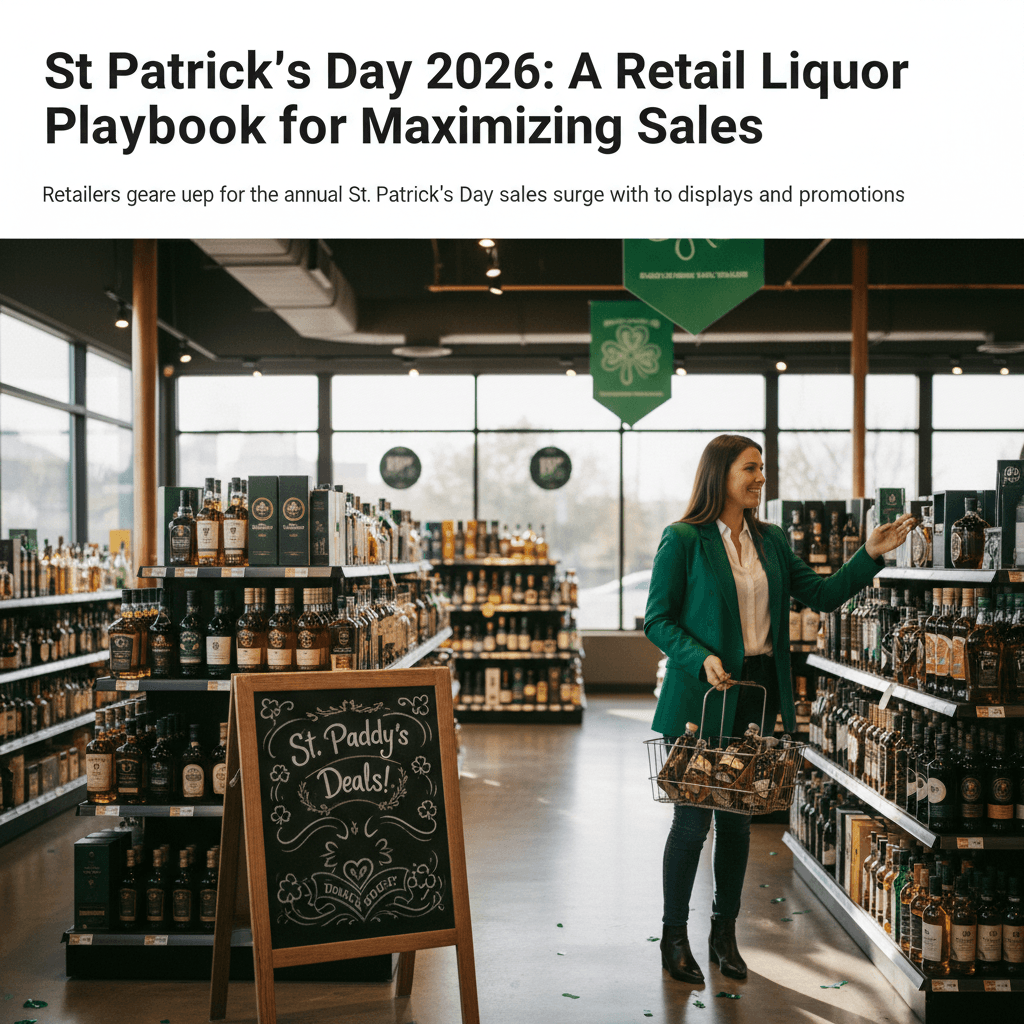
St. Patrick's Day 2026: A Retail Liquor Playbook for Maximizing Sales
By Alden Morris32 min read
Listen to this article34:29
Schedule a free strategy call and Intentionally Creative will build a custom plan for you.
Schedule Your Free Strategy CallFree audit. No commitment.
Get a Free Audit. No commitment.
Maximize your liquor store's St. Patrick's Day 2026 sales with this timeline-based playbook. Covers Irish whiskey merchandising, inventory planning, tasting events, and promotional strategies to boost basket size and foot traffic.
Picture this: it's a Tuesday evening in early March, and your beer cooler is stocked the same way it was in February. No extra Guinness facings, no Irish whiskey endcap, no green-themed POS signage. Then St. Patrick's Day hits — and you watch $5.1 billion in consumer spending flow to the stores that planned ahead.
That's not a hypothetical. That's what happens every March 17th to retailers who treat this holiday like an afterthought.
Alcohol sales don't just tick up on St. Patrick's Day — they explode. Beer purchases surge 174% compared to an average day, and spirits jump 153%, according to Catalina's shopper insights data ↗. No other single-day holiday outside New Year's Eve produces that kind of spike across both categories simultaneously.
Alcohol sales on St. Patrick's Day dwarf typical daily volumes across every major category. Beer leads the charge with a 174% increase over average sales days, while spirits climb 153%, according to retail purchase data tracked by Catalina and NielsenIQ. Roughly 60% of Americans plan to celebrate in 2026, driving a projected $5.1 billion in total spending — approximately $47.45 per person, per the National Retail Federation ↗. Of those buying alcohol, 70% reach for beer, with 31–33% specifically choosing stouts like Guinness, which sees a staggering 395–819% purchase increase during the holiday window. St. Patrick's Day now ranks among the top five alcohol-selling holidays in the U.S., sitting alongside July 4th, Memorial Day, Labor Day, and New Year's Eve. For retail liquor stores, this single day can generate more incremental revenue than entire weeks of normal trade.
Half of celebrators buy food items, 41% buy beverages, and 36% plan alcohol purchases specifically. Those aren't overlapping buckets — they're stacking occasions. Your average ticket climbs when someone grabs Jameson and soda bread mix and a six-pack of Smithwick's.
10 proven liquor store social media content ideas to connect with customers, boost brand visibility, and drive both i...
A Thursday landing is a liquor retailer's dream — if you understand the buying arc. The preceding weekend (March 14–15) is when your serious hosts stock up for gatherings. Thursday itself captures the last-minute "grabbing a bottle on the way home" crowd. And the following weekend (March 21–22) catches the overflow — people who still have green on the brain and leftovers to pair with a pint.
That's three distinct purchase windows from one holiday. Weekend shoppers buy volume — a handle of Tullamore D.E.W., a case of Guinness, mixers for an Irish Mule station. Thursday buyers grab a single bottle of Proper No. Twelve or a four-pack of stout. The following weekend picks up anyone who missed the party and wants their own.
Research from NielsenIQ ↗ confirms that take-home alcohol purchases cluster heavily around weekend shopping trips, which means your biggest revenue window isn't March 17th itself — it's the Saturday before.
This playbook follows a six-weeks-out to day-of to post-holiday timeline, giving you a concrete execution plan at every stage. Start reading now, start executing this weekend.
Discover 7 proven TikTok marketing strategies for liquor stores that build real engagement and bring customers throug...
Which product actually pays your rent on March 17th — the case stack of Guinness by the front door, or the bottle of Redbreast gathering dust on your top shelf?
Most retailers get this wrong. They over-index on beer because 70% of alcohol-buying celebrators reach for it, and Guinness sees a staggering 395–819% purchase spike in March (Catalina shopper data ↗). But NielsenIQ data tells a different story on the P&L: spirits command 45% of St. Patrick's Day dollar share versus beer's 34%. Beer moves bodies through the door. Spirits move your margin needle.
Run the math yourself. A $16 Guinness 12-pack at a typical 22–25% retail margin nets you roughly $3.60–$4.00 gross profit. A $35 bottle of Redbreast 12 at 30–33% margin delivers $10.50–$11.55 — nearly three times the profit occupying a fraction of the shelf space. Multiply that across a season where Irish whiskey generates $190 million in March revenue with 6% year-over-year growth, and you're staring at the fastest-growing whiskey category in America.
Irish whiskey generates substantially more profit per square foot than beer for liquor stores during St. Patrick's Day. According to NielsenIQ ↗, spirits capture 45% of holiday dollar share compared to beer's 34%, and Irish whiskey specifically delivers $190 million in March revenue — growing 6% annually. A single $35 bottle of Redbreast 12 at standard retail margins produces nearly triple the gross profit of a $16 Guinness 12-pack, while consuming far less shelf real estate. Beer drives foot traffic — Guinness household penetration doubles in March — but spirits drive the actual margin. Smart retailers use beer as the anchor and whiskey as the closer, building cross-merchandised displays that convert high-volume beer buyers into higher-margin whiskey purchasers during the 153% overall spirits surge that St. Patrick's Day delivers.
Discover how to promote your liquor store on Instagram with proven strategies. Learn to create engaging content that ...
Your shelf set needs three tiers, stocked at a precise ratio:
Guinness, Smithwick's, Harp, and Kilkenny still drive the foot traffic that creates your whiskey conversion opportunities. Stock them — just don't surrender your endcap to them.
The sharper play: build cross-merchandised bundles. A Guinness 12-pack + Jameson 375ml + pub snacks packaged as an "Irish Night In" bundle lifts average basket size while introducing beer-first buyers to spirits. Research from NRF ↗ shows 50% of celebrators buy food items alongside beverages — give them the excuse to grab all three in one stop.
One more demographic reality you can't afford to ignore: 29% of Gen Z and Millennial drinkers favor hard seltzers over traditional beer or spirits (Numerator ↗). Stock a few Irish-themed or green-labeled seltzer options near the beer cooler. Treat them as incremental revenue — a net-new buyer you'd otherwise lose — not a replacement for your whiskey strategy.
So which should lead your St. Patrick's Day plan? Let beer bring the crowd. Let whiskey bank the profit. Your floor stack of Guinness is the marquee; your whiskey shelf is the box office.
Last March, a store owner in Chicago told me he ordered his Redbreast 12 allocation on February 20th. It arrived March 19th. Two days after St. Patrick's Day. He left $4,000 in whiskey revenue on the shelf — someone else's shelf. That story plays out every year at stores that treat this holiday like a last-minute beer run instead of what it is: a six-week sales operation worth a slice of the projected $5.1 billion in U.S. St. Patrick's Day spending for 2026 ↗.
Liquor stores should begin preparing for St. Patrick's Day no later than six weeks before the holiday — the first week of February. This lead time accounts for 4–6 week distributor allocation windows on high-demand Irish whiskeys like Redbreast and the Spot range, allows adequate time to build themed displays and train staff on product knowledge, and ensures promotional campaigns launch during the peak two-week purchasing window before March 17th. Stores that compress this timeline into two or three weeks consistently miss allocated product, launch promotions after customers have already bought elsewhere, and scramble for restocks that won't arrive in time. According to Catalina's shopper insights ↗, spirits sales surge 153% around the holiday — revenue you capture only if product is on the floor, staff knows how to sell it, and your marketing hits inboxes before the competition's does.
Pull your POS data from last March and apply the Pareto lens: which 20% of your St. Patrick's Day SKUs drove 80% of the revenue? For most stores, the answer clusters around Jameson (the volume play), one or two premium Irish whiskeys, Guinness in multiple formats, and Baileys. That's your reorder core. Everything else is margin gravy.
Place distributor orders immediately. Irish whiskey is the fastest-growing whiskey category in the U.S., generating $190 million in March sales historically, and allocated bottles disappear from warehouse shelves long before they disappear from yours. Redbreast 12 and 15, Green Spot, Yellow Spot — if your rep says "I'll check availability," you're already late. Get confirmations in writing. While you're on the phone, lock down POS kits from Jameson, Guinness, and Baileys. Brand reps have promotional budgets that evaporate by mid-February; the stores that ask first get the best materials, the co-op dollars, and the brand ambassador appearances.
Most store owners think tastings require a huge budget and weeks of planning. Wrong. The highest-ROI tasting you'll run all year needs one folding table, a brand rep, and three bottles of Irish whiskey.
March 14 is your money day. With St. Patrick's Day 2026 falling on a Thursday, that preceding Saturday captures the bulk of prep shopping — and spirits sales already surge 153% during this window, according to Catalina's shopper insights ↗. You want to be pouring when wallets are open.
Contact your Jameson, Tullamore D.E.W., or Redbreast rep at least four weeks out. Most brands will co-fund a tasting — covering product, branded materials, and sometimes even staffing — if you give them lead time. They want the same thing you do: trade-up conversions from a $25 bottle to a $45 one.
Run a tasting event by setting up three to four pours across price tiers during a two-to-three hour window on your peak traffic day. Require no purchase to taste — this removes friction and pulls people off the sidewalk — but offer an event-exclusive discount, something like 10% off any Irish whiskey bought during the tasting. Track every conversion from pour to purchase. At the tasting table, capture emails and phone numbers for your loyalty program. A clipboard and a pen works. A tablet works better. The goal: turn a one-day visitor into a repeat buyer. Research from the National Retail Federation ↗ projects $5.1 billion in total U.S. St. Patrick's Day spending for 2026, and Irish whiskey — the fastest-growing whiskey category at $190 million in March sales historically — deserves prime real estate in your tasting lineup.
What to do instead of guessing your lineup:
Start with Redbreast 12 — photograph the bottle against a green velvet backdrop, post it with the caption "March is coming. Your whiskey shelf isn't ready." That single teaser post, scheduled for March 3, kicks off a 14-day social media campaign that can capture your share of the $5.1 billion Americans will spend on St. Patrick's Day in 2026 ↗.
Your campaign breaks into four phases — and each one demands a different content tone.
Days 14–10 (March 3–7): Tease it. Behind-the-scenes shots of your Irish whiskey display going up. Staff picks filmed on a phone in under 30 seconds. A "something big is coming" story post with a shamrock emoji and nothing else. Build curiosity, not a sales pitch.
Days 9–5 (March 8–12): Teach it. Irish whiskey 101 carousel posts. A 15-second reel showing how to build a proper Irish Coffee. "Did you know?" stats pull hard here — try this one: spirits sales surge 153% around St. Patrick's Day ↗. Educational content gets shared. Sales posts get scrolled past.
Days 4–1 (March 13–16): Push it. "This weekend only" deal graphics. Tasting event reminders with RSVP links. Countdown posts. Last-chance bundle offers. Since St. Patrick's Day 2026 falls on a Thursday, you've got a four-day spending window through the weekend — use every hour of it.
Day-of (March 17): Celebrate it. Customer shout-outs, packed-store photos, "still time to grab a bottle" story posts before close.
A liquor store should promote St. Patrick's Day on social media through a structured two-week campaign that moves from teaser content to educational posts to urgency-driven sales messaging. Begin fourteen days out with behind-the-scenes photos of display builds and staff whiskey picks. Shift to educational content like cocktail recipe reels and Irish whiskey history posts during the middle week — this shareable content extends your organic reach. In the final four days, pivot hard to urgency: countdown posts, limited-time bundle pricing, and tasting event reminders with direct RSVP links. On March 17 itself, post celebration content — customer photos, store energy, and "still time" reminders. Segment your content by platform: short-form video for Instagram Reels and TikTok, static deal graphics for Facebook, and stories for real-time day-of coverage. Every post needs a clear call to action — shop now, RSVP, or view bundles. Download a post-by-post social calendar to execute this framework without guesswork.
10+ years helping liquor retailers and beverage brands grow through data-driven digital marketing. Learn more
Here's where most stores get it wrong: they anchor their highest-traffic endcap with Guinness and stouts. Don't. Beer moves itself during this holiday — research from Integrate.io ↗ confirms a 174% increase in beer sales, and 70% of alcohol-buying celebrators choose beer regardless of where you place it. Your premium endcap belongs to Irish whiskey, where the margins are fatter and the customer needs more guidance to trade up.
Train your floor staff, but skip the generic tasting scripts. Buyers in 2026 expect sharp positioning. Give each team member 2–3 talking points per price tier: "Jameson is your $28 cocktail whiskey — perfect for Irish Mules. Redbreast 12 at $65 is the best pure pot still whiskey you'll hand someone as a gift. It tastes like toasted marzipan, orchard fruit, and a finish that lingers for a full minute." That's a sale. "It's smooth" is not.
Build cross-merchandising zones that actually make sense: Irish whiskey next to cocktail bitters and ginger beer, Guinness stacked beside pub snack mixes, Baileys paired with whole-bean coffee. Numerator reports ↗ that 50% of holiday shoppers buy food items alongside their beverages — put the basket-builder in their path. Schedule your tasting events now, too. Permits take time, and your Jameson rep needs at least two weeks' notice to confirm attendance.
This is your highest-leverage window — more valuable than March 17th itself. St. Patrick's Day 2026 falls on a Thursday, which creates a multi-day spending arc from Thursday through the weekend. Smart shoppers stock up the weekend before. Your promotions should target March 14–15 specifically, with "Stock Up for St. Paddy's Weekend" messaging that frames the purchase as party prep, not impulse.
Launch your social media push now. Fire off your email and SMS blasts to loyalty members with bundle deals — a Jameson + ginger beer + copper mug kit at $45, or a "Taste of Ireland" flight pack with three 375ml bottles. According to the National Retail Federation ↗, per-person spending averages $47.45, so price your bundles right at that psychological anchor.
One non-negotiable deadline: place replenishment orders by March 10th. Distributors stop fulfilling St. Patrick's Day restocks by March 12th at the latest. If you run out of Guinness on March 13th, you're selling empty shelf space for the most profitable four days of your Q1.
March 17th belongs to the single-bottle buyer. They're grabbing one whiskey or a Guinness six-pack on the way to a party. Position grab-and-go displays within arm's reach of the register — Guinness sees a 395–819% purchase increase ↗ during this window, and you want those units moving through the fastest checkout path possible. Staff up and extend hours if your local regulations allow it.
March 18th is the day most stores fumble. It's a Friday. The holiday momentum carries straight into the weekend, and "continuation" buyers will walk in looking for round two. Do not tear down your displays until March 22nd. That extra five days of visual merchandising costs you nothing and captures sales from a customer segment everyone else has already forgotten about.
Spirits sales spike 153% on St. Patrick's Day compared to an average day, according to NielsenIQ ↗. That's not a typo. Yet most liquor stores still dump a few green-labeled bottles on a folding table and call it a display. The gap between what customers want to spend and what stores actually capture is enormous — and it comes down to how you merchandise.
Irish whiskey is the fastest-growing whiskey category in America, pulling in $190 million in March sales historically. Your primary endcap should reflect that momentum with a clean Good/Better/Best tier structure.
Put your Better tier — the $30–$50 bottles like Writers' Tears, the Spot range, and Teeling Small Batch — at eye level. This is where your margin lives. These bottles convert browsers into buyers, especially with shelf talkers that break down tasting notes and price-per-pour math. A $40 bottle at roughly $2.50 per pour sells itself when you frame it that way.
Top shelf gets the Best tier: Redbreast 12, Green Spot, Method and Madness. Tag them "Staff Pick" or "Limited Allocation." Urgency drives action. Bottom shelf holds your high-velocity Good tier movers — Jameson, Tullamore D.E.W., Proper No. Twelve — the bottles people grab without thinking.
One detail that separates sharp operators from everyone else: print a small "Irish Whiskey 101" takeaway card. Costs you pennies. Positions your store as the local authority. Customers keep it, remember you, come back.
With $5.1 billion in projected U.S. St. Patrick's Day spending for 2026, according to the National Retail Federation ↗, and 50% of celebrators buying food items alongside their beverages, bundles are a no-brainer margin play. Three bundles worth building:
"Irish Night In" — Jameson 750ml + Guinness 6-pack + pub snack mix. Price it as a visible savings versus buying each piece separately. This bundle targets the 70% of alcohol-buying celebrators who choose beer, per Numerator research ↗, while pulling whiskey into the basket.
"Irish Coffee Kit" — Tullamore D.E.W. 750ml + Baileys 375ml + a bag of whole-bean coffee. Different occasion, different customer. This one catches the brunch crowd and gift buyers.
"Whiskey Tasting Flight" — Three 375ml bottles (Jameson, Powers, Redbreast) in a simple gift bag. At under $50 for three distinct expressions, this is a revelation for someone exploring Irish whiskey for the first time.
Place these on a dedicated table near your entrance. Not in an aisle. Not by the cooler. Right where foot traffic hits first. Use themed signage — green, gold, shamrock accents — but keep it brand-consistent and sharp, not party-store cheap.
Stock 50ml and 200ml Irish whiskey minis near every register. Jameson pocket bottles, Baileys nips, Tullamore minis. A small countertop sign reading "Add an Irish toast for $5" converts hesitant browsers into impulse buyers. This zone alone can add $3–$8 to your average transaction value — pure margin on zero selling effort.
The optimal St. Patrick's Day liquor store display starts with a tiered Irish whiskey endcap organized by Good, Better, and Best price points, placing $30–$50 mid-tier bottles at eye level where margins are strongest. Cross-merchandised bundles combining whiskey with beer, mixers, or food items belong on a standalone table near the store entrance — not buried in aisles. Register zones should feature 50ml and 200ml mini bottles with clear call-to-action signage for impulse add-ons. Shelf talkers with tasting notes and price-per-pour breakdowns convert curious shoppers into confident buyers. Themed signage using green and gold accents ties the store together without overwhelming your brand standards. Since St. Patrick's Day 2026 lands on a Thursday, displays should go up by the prior weekend to capture the full multi-day spending window that extends through Sunday. This layered approach — destination endcap, bundle table, impulse zone — creates three distinct points of purchase that maximize basket size across every customer type walking through your door.
Intentionally Creative specializes in digital marketing strategies that drive real results. Let us show you what's possible.
Schedule a CallNo staff for a live pour? Print cocktail recipe cards — Irish Mule, Irish Coffee, Emerald Sour — and rubber-band them to bottle necks. This costs you a ream of cardstock and twenty minutes of design. The conversion lift from a recipe card is real: shoppers who see a use case buy.
Go one step further. Film a 60-second video of your staff making an Irish Coffee, post it to Instagram and TikTok, then generate a QR code linking to it. Stick that QR on a shelf talker next to your Irish whiskey display. Customers scan, watch, and grab the bottle plus the cream and brown sugar on their way to checkout. That's a basket-builder with zero labor cost after setup.
The sharpest play here is cross-promotion with a local pub or restaurant. Structure it simply: "Buy a bottle here, get $5 off dinner there." The pub promotes you to their crowd. You promote them to yours. Both businesses win foot traffic from a shared customer base, and you position your store as part of the neighborhood celebration — not just a transaction.
What to do instead of skipping experiential entirely:
Three emails. That's your entire St. Patrick's Day email sequence. March 3: announcement email — here's what's coming, here's why Irish whiskey matters this month. March 10: event invite — your tasting, your bundles, your exclusive offers with an RSVP button. March 15: last-chance reminder — "this weekend only" subject line, bundle pricing front and center.
Your SMS play is a single, well-timed text on the morning of March 14: "Stock up this weekend — Irish whiskey bundles starting at $39. Shop today." One message. Clear price anchor. Done.
Here's where most stores fumble: they blast the same generic email to every customer. Don't. Segment your list. Your spirits buyers get whiskey-forward messaging — Redbreast, Jameson, Powers, tasting notes, cocktail pairings. Your beer buyers? Hit them with the Guinness angle — research from NielsenIQ shows Guinness purchases spike 395–819% ↗ in March. Every message, regardless of segment, needs one unmistakable CTA: shop now, RSVP, or view bundles. If a customer has to guess what you want them to do, you've already lost the click.
Pro tip: Schedule every post and email now, before March 3. The stores that wing their St. Patrick's Day marketing leave money on the shelf.
Last year, a 4,000-square-foot liquor store in South Boston stocked 62 Irish-themed SKUs for St. Patrick's Day. They sold through 11 of them. This year, that same owner cut to 28 SKUs, concentrated 65% of the budget on proven movers, and cleared $14,000 more in gross margin over the same window. The difference wasn't luck — it was the Pareto Principle applied with surgical precision.
Pull your POS data from the last two or three St. Patrick's Day periods. You already know what you'll find: roughly 20% of your SKUs drove 80% of your holiday revenue. The names repeat every year — Jameson Original, Guinness Draught (cans outsell bottles 3-to-1 in most markets), Baileys Original, Jameson Black Barrel, and Tullamore D.E.W.
Stop spreading your open-to-buy across 50 niche SKUs hoping one breaks out. It won't. Allocate 60–70% of your holiday order budget to these proven top movers. According to Catalina's shopper insights ↗, spirits sales surge 153% around St. Patrick's Day, and that volume concentrates heavily in familiar brands consumers already trust.
Key takeaways:
St. Patrick's Day 2026 lands on a Thursday, and that day-of-week placement changes everything. A Thursday holiday creates a multi-day spending window — celebration starts Thursday night and rolls straight into the weekend. Order 15–20% more than you would for a Saturday-landing year, particularly for the March 14–15 pre-game window when customers stock up for house parties.
Use POS velocity tracking in the first week of March to gauge early demand signals. If Jameson is moving 40% faster than the same week last year, your forecast needs adjusting now — not on March 12. Set a hard reorder trigger: if any top-10 SKU drops below three days of supply by March 10, place the replenishment order that afternoon.
Here's the counterintuitive move — slight over-ordering on Irish whiskey is safer than stocking out. Irish whiskey is the fastest-growing whiskey category in the U.S., generating $190 million in March sales historically ↗. Unlike shamrock-shaped cookies, Redbreast 12 and Jameson Black Barrel sell year-round. A leftover case of Tullamore D.E.W. moves by April. A missed sale on March 17 is gone forever.
"The stores that win St. Patrick's Day aren't the ones with the widest selection — they're the ones that never run dry on the top ten." — Regional chain buyer, Northeast U.S.
| Product | Category | Price Tier | Margin % | Priority |
|---|---|---|---|---|
| Jameson Original | Irish Whiskey | $25–30 | 28–32% | A |
| Redbreast 12 | Irish Whiskey | $55–65 | 35–40% | A |
| Guinness Draught (cans) | Stout | $9–12/6pk | 22–26% | A |
| Baileys Original | Irish Cream | $25–30 | 30–34% | A |
| Tullamore D.E.W. | Irish Whiskey | $22–28 | 27–30% | B |
| Jameson Black Barrel | Irish Whiskey | $30–35 | 30–35% | B |
| Powers Gold Label | Irish Whiskey | $22–26 | 28–31% | B |
| Smithwick's | Irish Red Ale | $9–11/6pk | 20–24% | B |
| Irish gin (Drumshanbo, etc.) | Gin | $30–35 | 32–36% | C |
| Seasonal hard seltzers | RTD | $12–16 | 24–28% | C |
A-priority items get full shelf facings and floor displays. B-priority fills out your Irish endcap and gets one reorder if velocity warrants it. C-priority? Stock lightly and don't reorder — these are impulse grabs, not volume drivers. With $5.1 billion in projected U.S. St. Patrick's Day spending for 2026, according to the National Retail Federation ↗, your margin lives and dies on getting the A-tier right.
Liquor store owners should plan St. Patrick's Day inventory by analyzing POS data from the previous two to three years, identifying the top 20% of SKUs that drove 80% of holiday revenue, and concentrating 60–70% of their order budget on those proven sellers. Stock A-priority items like Jameson Original, Guinness Draught, Baileys, and Redbreast 12 at aggressive depths, since beer sales spike 174% and spirits jump 153% versus average days. For 2026, the Thursday holiday placement demands 15–20% higher orders than a weekend-landing year to cover the extended Thursday-through-Sunday selling window. Set reorder triggers at three days of supply by March 10 for any top-ten SKU, favor slight over-ordering on Irish whiskey given its year-round sellability, and limit niche or novelty items to minimal facings with no replenishment. This approach maximizes margin per linear foot while virtually eliminating costly stockouts on your highest-velocity products.
St. Patrick's Day 2026 lands on a Thursday — and that calendar quirk hands you a four-day selling window most store owners waste. Do NOT tear down your displays on March 18. The Friday-through-Sunday stretch after a Thursday holiday still pulls traffic, especially when customers are riding the momentum of a $5.1 billion spending holiday ↗. Shift your signage language from "Celebrate St. Paddy's" to "Keep the Irish Spirit Going This Weekend." That subtle pivot gives shoppers permission to buy without feeling like they missed the party.
Slow-moving seasonal novelty — the green beer kits, the shamrock shot glasses, the Irish cream liqueur knockoffs — mark them down 15–20% starting Friday morning. You want those cleared before April, not collecting dust through Easter. But here's where operators get sloppy: Irish whiskey and Baileys are NOT clearance candidates. Irish whiskey generated $190 million in March sales historically ↗, and it's the fastest-growing whiskey category year-round. Transition those bottles from your holiday endcap to a permanent shelf position. Clearance pricing on a year-round seller is leaving margin on the table.
Liquor stores that maximize post-St. Patrick's Day revenue keep displays active through the trailing weekend, mark down seasonal novelty items 15–20% to clear inventory before April, and transition year-round sellers like Irish whiskey and Baileys from holiday endcaps to permanent shelf positions rather than discounting them. Pull your full-period POS data covering March 1–22 within two weeks while your memory of what worked is still sharp. Document your top 10 SKUs by revenue, top 10 by margin, your five worst underperformers, bundle attachment rates, and tasting event conversion numbers. According to NielsenIQ ↗, beer sales surge 174% and spirits jump 153% on St. Patrick's Day — your data should reflect whether you captured your share of that spike or left it for the competition.
Calculate your holiday ROI with a simple formula: incremental revenue minus incremental costs (labor, display materials, promotional discounts, event expenses). If you ran a tasting event that converted at 8% but cost $400 in labor and product, you need to know whether that math worked before you commit to it again. Write a one-page brief — top wins, biggest misses, three changes for next year — and file it somewhere you'll actually find next February. A shared drive folder labeled "2027 St. Patrick's Day Planning" works. A sticky note in your desk drawer does not.
Every dollar of insight you capture now is a dollar of profit you'll earn next March. Do the review. No excuses.
With a 7x ROAS engine and category-level product ranking strategy, Uncorkit expanded its local and national visibility — translating digital dominance into measurable in-store revenue growth.