The 3-Tier System Explained: What Every Liquor Store Owner Needs to Know
By Alden Morris, Founder & Principal Strategist41 min read
Listen to this article53:33
Schedule a free strategy call and Intentionally Creative will build a custom plan for you.
Schedule Your Free Strategy CallFree audit. No commitment.
Get a Free Audit. No commitment.
Understand the three-tier alcohol distribution system and how it shapes your liquor store's purchasing, compliance, and growth strategy. A complete guide for retail owners.
December 5, 1933 changed everything, and the hangover has lasted 90 years.
When Prohibition ended, the federal government faced a brutal reality: pre-Prohibition America had been dominated by tied house practices, where breweries and distilleries owned the bars that sold their products. Vertical integration ran unchecked. Budweiser's predecessors controlled taps. Suppliers crushed competition by owning retail outright.
Discover 7 proven Instagram content ideas for liquor stores that boost engagement and drive sales. Learn how to promo...
States weren't about to let that happen again.
10 wine club marketing tactics that reduce the 40% year-one cancellation rate and boost member spending at your liquo...
The three-tier system wasn't bureaucratic accident. It was a deliberate structural firewall, separating producers (distilleries, wineries, breweries) from distributors from retailers like your liquor store. According to the National Beer Wholesalers Association, this separation exists specifically to prevent monopolistic control and ensure excise taxes flow properly to state and federal governments.
10 proven liquor store social media content ideas to connect with customers, boost brand visibility, and drive both i...
Understanding that history reframes everything. Compliance stops feeling arbitrary when you know it was engineered to prevent the exact abuses that corrupted alcohol commerce before 1933.
The three-tier alcohol system matters to liquor store owners today because it governs every transaction you make, every product you stock, and every license you hold. As a Tier 3 retailer, you cannot legally purchase directly from producers like Tito's or Jackson Family Wines, you must buy through licensed Tier 2 distributors. This structure, established after Prohibition's repeal and enforced by state alcohol control boards and the Alcohol and Tobacco Tax and Trade Bureau (TTB), determines your supplier relationships, your pricing power, and your exposure to compliance risk. Violations, buying outside the system, accepting improper promotional allowances, or operating across tiers without authorization, carry penalties ranging from fines to license suspension. Most violations aren't malicious. They're the result of owners who never received a clear explanation of the rules they're operating inside.
This guide treats the three-tier system as operational intelligence, not just legal background.
Across every section, you'll build a working understanding of how Tier 1 producers, Tier 2 beer distributors, and Tier 3 retailers like you interact, and where the friction points live. According to VinePair's breakdown of the three-tier system, most retail operators understand the structure exists but lack the specifics needed to protect themselves.
That gap is expensive. Non-compliance penalties are real, preventable, and disproportionately hit independent liquor stores who don't have legal teams on retainer.
Read this as both a foundation and a field manual. By the final section, you'll know exactly where your business sits inside this system, and how to use that knowledge to compete smarter.
Here's what actually happens when a bottle of Tito's Handmade Vodka leaves the distillery and ends up on your liquor store shelf, it doesn't go directly to the retailer. It moves through a legally required chain of custody that touches three separate, government-regulated business tiers before a single consumer can buy it.
So what exactly is this system, and why does it matter?
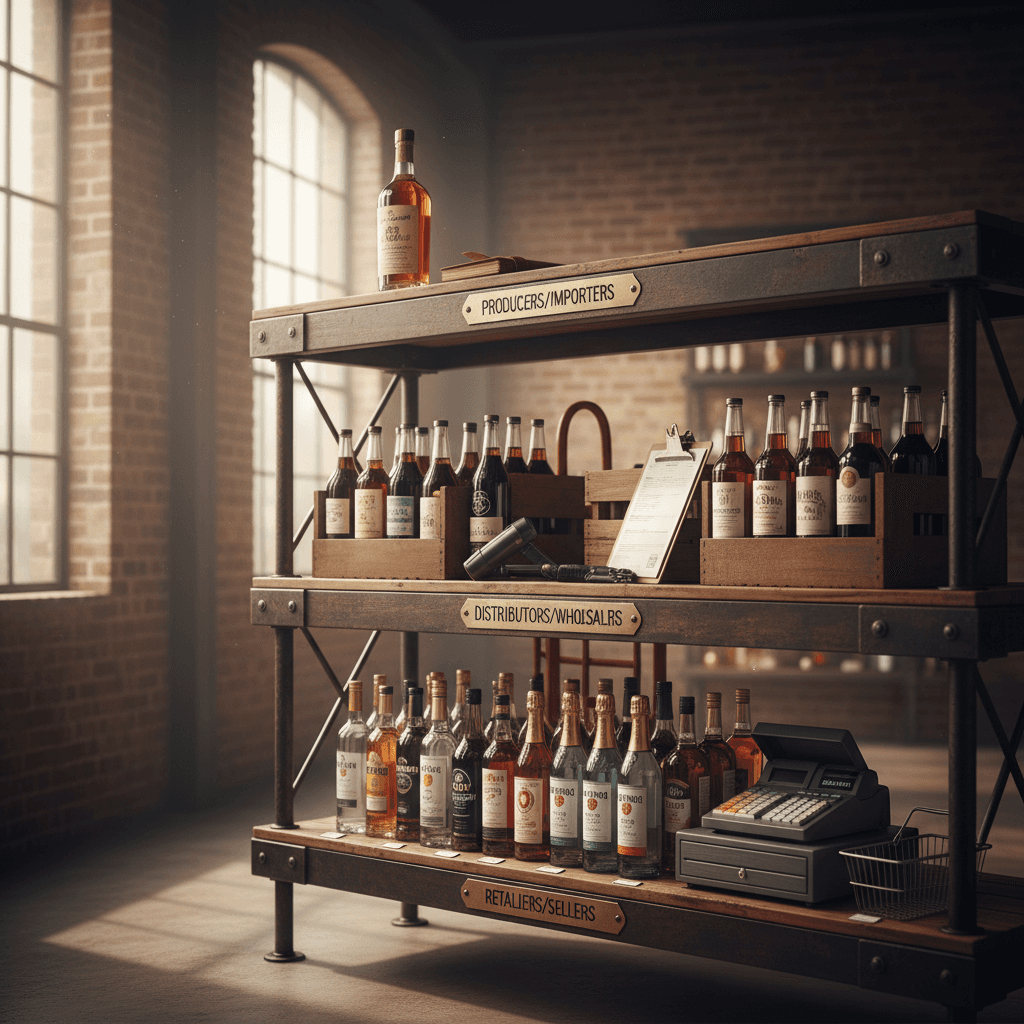
The three-tier system is the legally mandated structure that separates alcohol producers, distributors, and retailers into distinct, non-overlapping business tiers. Every bottle of beer, wine, or spirits sold in the United States moves through this chain, no shortcuts, no direct routes (with narrow exceptions).
Here's how the tiers break down:
Here's what actually happens when a craft distillery bottles its first run of whiskey and tries to get it onto your store's shelves, it runs straight into a wall of federal paperwork before a single case moves anywhere.
Every producer in the three-tier system starts at the same place: the Alcohol and Tobacco Tax and Trade Bureau (TTB). Before Tito's Handmade Vodka sold its first bottle in Texas or a regional craft brewery shipped its first keg, they needed a federal basic permit or Brewer's Notice from the TTB. That permit is the entry ticket to the entire supply chain.
Tier one covers a wide range of operations. Domestic producers, breweries, wineries, and distilleries of every size, sit at the top of the chain. So do importers and authorized agents who bring foreign products into U.S. commerce. A small family winery in Sonoma and a multinational brand like Budweiser's parent company AB InBev both occupy the same tier, subject to the same federal licensing framework, even if their resources and market reach look nothing alike.
Brand registration matters here more than most retailers realize. When you try to order a new SKU from your distributor and it's not available yet, the holdup is often at this stage, the brand hasn't completed state registration. Each state maintains its own approval process layered on top of federal TTB requirements. That new craft gin from a distillery three counties over? It can't legally enter your purchase order until it clears both hurdles.
Producers in the three-tier alcohol system are manufacturers, importers, and agents who hold federal permits issued by the Alcohol and Tobacco Tax and Trade Bureau (TTB) and are legally authorized to produce or introduce alcohol into U.S. commerce. This category includes breweries, wineries, and distilleries of all sizes, as well as importers who bring foreign-produced products into the domestic supply chain. Their core obligation is federal licensing, specifically obtaining a basic permit or Brewer's Notice before any product changes hands. Beyond federal compliance, producers must register their brands at the state level before those products can be ordered by retailers or sold through distributors. Producers also carry responsibility for paying federal excise taxes on alcohol produced or imported, which the TTB collects before product reaches the distribution tier. According to the TTB's own guidance, failure to maintain permit compliance can result in immediate suspension of operations, a risk that makes regulatory accuracy a survival issue, not just a formality.
Here's what actually happens when a bottle of Tito's Vodka leaves the distillery: it doesn't go anywhere near your store. It goes to a distributor first, and that middleman controls more of your business than most liquor store owners realize.
According to the National Beer Wholesalers Association (NBWA), distributors represent a $130+ billion segment of the U.S. alcohol supply chain. They're not just trucks and warehouses. They're legally mandated gatekeepers with licensing requirements, pricing authority, and in many states, franchise law protections that make switching brands or suppliers a legal battle, not a business decision.
Distributors hold state-issued wholesale licenses, and the requirements vary dramatically from state to state. Their core function is straightforward: purchase from producers like breweries, wineries, and distilleries, warehouse the product, then sell exclusively to licensed retailers. Simple in concept. Complex in execution.
Here's the compliance piece most retailers overlook: distributors pay excise taxes at the point of sale to retailers in most states. That makes them a critical checkpoint in the tax collection chain, and it's why states protect this tier so aggressively. Franchise laws in states like Florida, Texas, and Illinois give distributors significant legal control over brand territories. A distillery can't just pull Tito's from one distributor and hand it to another because they got a better deal. The distributor can sue, and often wins.
Alcohol distributors serve as the mandatory middle tier between producers and retailers in the three-tier system, purchasing product from breweries, wineries, and distilleries, then reselling exclusively to licensed retailers like liquor stores, bars, and restaurants. For liquor store owners, distributor relationships directly shape which products you can stock, at what price, and on what timeline. Distributors set minimum order quantities, delivery schedules, and credit terms, all negotiable, but only if you ask. Exclusive distribution agreements mean that if your primary distributor holds the rights to a brand in your market, you have zero alternatives. Distributor consolidation has shrunk the field significantly, fewer large distributors means less leverage for independent retailers. Building a strong relationship with your reps isn't just courtesy; it's a competitive advantage that translates into better placement on delivery routes, early access to allocated products, and flexibility on terms.
Founder and Principal Strategist at Intentionally Creative. 10+ years in three-tier beverage industry marketing, 3 patents pending, CityHive partner. Runs growth for independent liquor retailers and DTC brands.
The federal framework was established after Prohibition's repeal in 1933, with the 21st Amendment returning regulatory authority to individual states. According to the National Beer Wholesalers Association (NBWA), all 50 states operate some version of this three-tier structure, though enforcement, exceptions, and category-specific rules vary dramatically from state to state.
The system's backbone is vertical separation. Entities operating in one tier are generally prohibited from owning or controlling entities in another tier. A distillery can't own the distributor selling its product. A retailer can't hold equity in the brewery supplying its taps.
This separation targets a specific historical problem: tied-house practices. Pre-Prohibition, alcohol producers owned bars outright and used that control to push aggressive, predatory sales tactics, overserving customers, eliminating competitor products, corrupting local politics. The three-tier system was designed to prevent vertical integration from recreating those conditions.
The standalone definition you need:
The three-tier system in the alcohol industry is the legally required separation of alcohol producers (breweries, wineries, distilleries, and importers), distributors (licensed wholesalers who buy from producers and sell to retailers), and retailers (liquor stores, bars, restaurants, and other points of consumer sale) into three distinct business tiers. Established after Prohibition's repeal in 1933, the system prevents vertical monopolies by prohibiting entities in one tier from owning or controlling entities in another. The Alcohol and Tobacco Tax and Trade Bureau (TTB) oversees federal compliance, while each state enforces its own specific regulations, meaning rules around self-distribution, franchise agreements, and tied-house exceptions differ significantly by state. The system applies to beer, wine, and spirits, though category-specific rules can vary.
Exceptions exist, and they're worth knowing. Some states allow self-distribution for small producers. Franchise laws in certain states lock distributors into long-term contracts with suppliers. A handful of states permit limited vertical ownership under specific conditions. These aren't loopholes; they're deliberate state-level policy choices built into the system's architecture.
The practical payoff: try mapping a single SKU, say, a Jackson Family Wines Pinot Noir, from the winery in Sonoma through its distributor network to a retail shelf in three different states. You'll find three completely different regulatory paths. That's the system in action.
Intentionally Creative specializes in digital marketing strategies that drive real results. Let us show you what's possible.
Schedule a CallHere's where the system gets specific, and where a lot of confusion costs retailers real money.
Producers generally cannot sell directly to liquor stores, bars, or restaurants. The whole architecture of the three-tier system exists to prevent that. Tied-house laws, rooted in post-Prohibition reform, make it illegal for a distillery to own a retail shop or for a retailer to hold a financial stake in a supplier. The concern behind those laws was vertical integration, the pre-Prohibition practice of alcohol manufacturers controlling the entire chain from production to the consumer's glass, which drove predatory sales practices and community harm.
Self-distribution rights complicate this picture. According to the Brewers Association, over 40 states now allow some form of self-distribution for small craft producers, meaning a local brewery can bypass the distributor tier entirely and deliver directly to your store. That changes your purchasing options in real ways. If you're in a self-distribution state, you may be able to negotiate directly with a small producer for exclusive local product, better pricing, or first access to limited releases. Outside those states, everything flows through tier two, no exceptions.
Promotional allowances, the marketing dollars producers push through the system to support retail placement, carry their own compliance risks. A distillery offering a retailer a display unit, a promotional discount, or co-op advertising funding must do so within strict state-regulated parameters. Violations of those rules can expose both the producer and the retailer to licensing consequences. The system is designed to keep those relationships at arm's length, which is exactly why understanding where tier one ends and tier two begins matters for every purchasing and marketing decision you make.
The consolidation reality hits small retailers hardest. Southern Glazer's Wine & Spirits alone operates in 44 states. When one company controls that much territory, your negotiating position as a single-location liquor store is limited, unless you're strategic about volume commitments and relationship-building with your local rep.
Distributors typically apply a 25–30% markup over producer cost. That's before your margin. Understanding this math is non-negotiable for managing profitability.
Most distributors publish a price book, a catalog of current product costs to retailers. Smart operators review this regularly and use it to identify where post-off pricing (temporary price reductions) and volume discounts create margin opportunities. Some promotional pricing is legal; some crosses into tied-house territory that regulators watch closely. Know the difference before you negotiate.
Try this yourself: pull your distributor's price book and map your top 20 SKUs against their standard markup. You'll likely find two or three products where a volume commitment unlocks a post-off that meaningfully improves your margin, without changing a single thing about your shelf.
Here's what actually happens when you assume a liquor store license is just a permit to sell: you walk into a compliance minefield that most retailers don't fully understand until they're already in trouble.
The myth worth killing upfront, that a retail license is a one-time hurdle you clear and forget. Your license is a living record. Every purchase, every promotion, every vendor relationship gets scrutinized against it. Liquor stores, bars, and restaurants all operate as Tier 3 retailers, but the rules governing each differ sharply depending on your state and whether you hold an on-premise or off-premise license.
Your state retail license comes in two fundamental forms: on-premise (bars, restaurants) and off-premise (liquor stores, grocers, convenience stores). On-premise licenses permit consumption at the point of sale. Off-premise licenses do not. Selling a bottle to someone who cracks it open in your parking lot? That's a violation on an off-premise license, and it's the kind of thing that triggers a review.
Layered on top of your state license are local permits, zoning approvals, and municipal certificates of occupancy. A city can restrict alcohol sales within 500 feet of a school or church regardless of what your state license permits. These local layers aren't optional add-ons. They're prerequisites.
License renewal cycles vary by state, typically annual or biennial, and carry fees ranging from a few hundred to several thousand dollars. What most retailers miss: your compliance record travels with your license number. Violations don't disappear at renewal. They accumulate. Enough of them, and you're looking at a suspension hearing or non-renewal.
Common triggers for license review:
The core rule of Tier 3 is this: you buy from licensed distributors. Not directly from wineries. Not from a distillery rep who shows up with a "great deal." Not from another retailer who has excess inventory. From licensed Tier 2 distributors only.
This separation exists specifically to prevent the tied house abuses that dominated pre-Prohibition alcohol sales, where producers controlled retail outlets and manipulated pricing and supply. The three-tier system broke that vertical integration, and your purchasing rules enforce that separation every single day.
There are exceptions, and they're state-specific. Some states allow winery self-distribution direct to retail. Craft brewery taproom sales operate under carve-outs in many states. A handful of states permit limited direct-to-retail shipping for wine. According to the National Beer Wholesalers Association (nbwa.org), these exceptions are narrowly defined and don't override the fundamental distributor-purchase requirement for standard retail operations.
Buying from an unlicensed source, even once, even at a significant discount, puts your license at risk. The price break isn't worth it. Full stop.
Record-keeping requirements you cannot skip:
What Tier 3 alcohol retailers are legally required to do includes:
A Tier 3 alcohol retailer must hold a valid state retail license (on-premise or off-premise, depending on business type) and any applicable local permits before selling alcohol. Retailers must purchase exclusively from licensed Tier 2 distributors, with limited state-specific exceptions for direct winery or brewery sales. All purchases require documented invoices and delivery receipts maintained for regulatory audit. Retailers must comply with state minimum pricing laws and price posting requirements where applicable. They cannot accept free goods, equipment, or promotional items from producers or distributors beyond what state law explicitly permits, restrictions designed to prevent tied house arrangements. Violations, including purchasing from unlicensed sources or selling outside licensed hours, are recorded against the license and can trigger suspension, fines, or non-renewal. Compliance isn't periodic, it's continuous and documented.
Pricing control at Tier 3 is more restricted than most new retailers expect. Several states, including New York and New Jersey, maintain minimum bottle pricing or price posting requirements that prevent retailers from undercutting posted prices. You set your retail price, but you can't always set it freely.
What producers and distributors can give you is tightly regulated. Point-of-sale materials (shelf talkers, display signs, branded items), generally permitted within limits. Free product, cash payments, or equipment loans that create retailer dependency, prohibited under tied house laws. The line between a compliant promotional display and an illegal inducement is real, and regulators watch it.
What to do instead of guessing:
The retailers who stay out of trouble aren't the ones who know every rule. They're the ones who've built systems, invoicing, record-keeping, promotional review, that make compliance automatic rather than reactive.
Try this yourself: pull your last 30 days of purchase invoices and match each one against your delivery receipts. If you can't reconcile them cleanly in under an hour, your audit trail has gaps. Fix that before a regulator finds it first.
Here's what actually happens when you open a liquor store in Pennsylvania versus Texas: you're not just dealing with different tax rates or labeling rules. You're operating inside two fundamentally different systems, and the one you're in determines almost everything about your business model.
Think of Pennsylvania's PLCB (Pennsylvania Liquor Control Board) as both your distributor and your regulator. That's the control state model in practice. The state government steps into the Tier 2 distributor role, and in some cases, the Tier 3 retail role, for spirits. Seventeen states currently operate under some version of this model, including Virginia, Utah, and Washington.
For liquor store operators in control states, this means you're purchasing spirits through state-run stores or state-controlled distribution systems. Distilleries like Tito's don't negotiate pricing with you directly. The state sets it. That removes negotiating leverage, but it also removes pricing volatility. What you see in the state's product catalog is what you can carry, no exceptions. State listings control your entire spirits selection, which means your competitive differentiation has to come from service, experience, and the categories the state doesn't control as tightly.
Texas, Florida, Illinois, California, these are license states. Private distributors hold wholesale licenses and compete for your business. Beer distributors, wine distributors, spirits wholesalers, they're all fighting for shelf space in your store. That competition creates real pricing flexibility and access to a broader product range.
The tradeoff? Compliance complexity multiplies fast. Many license states have franchise law protections baked in for distributors, which means if a supplier like Budweiser's distribution partner in your territory decides to prioritize another account, your options for switching are limited. According to the National Beer Wholesalers Association (NBWA), franchise laws exist in over 30 states, they protect distributor relationships, not retailer ones.
More variety. More negotiating room. More regulatory homework.
Control states and license states represent two distinct approaches to alcohol distribution within the three-tier system. In control states, 17 states including Pennsylvania, Virginia, and Utah, the state government acts as the Tier 2 distributor (and sometimes Tier 3 retailer) for spirits, setting prices and controlling product availability through state-run systems. Retailers have limited negotiating power but benefit from pricing predictability. License states, by contrast, allow private distributors to hold wholesale licenses and compete for retailer business. States like Texas, Florida, and California follow this model, offering liquor stores greater product variety and pricing flexibility, but also more complex compliance requirements, including franchise law protections that give distributors significant contractual leverage. The model your state uses directly shapes your margin structure, supplier relationships, and inventory strategy.
Margin structures differ significantly between these two models. Control state retailers often work with thinner spirits margins because the state controls markup. License state retailers can negotiate volume deals, promotional support, and placement incentives, but they also absorb more of the compliance overhead.
Your inventory management strategy, your supplier relationships, your promotional calendar, all of it has to be calibrated to your state's model. A promotional tactic that works in Illinois (a license state with active distributor competition) might be completely unavailable to you in Utah.
The practical move: get intimate with your state's ABC (Alcoholic Beverage Control) agency and its published regulations. Not just a surface read. The actual statutes. Park Street's industry resources and your state ABC website are your starting points. The operators who win long-term aren't just good at retail, they're fluent in the rules of the specific system they're playing in.
Try this yourself: Pull up your state ABC's current product listing or approved vendor list. If it's a state-controlled catalog, that's your ceiling. If it's a license state, call your top three distributors this week and ask what promotional programs they're running this quarter. The answer will tell you exactly how much leverage you actually have.
Here's what actually happens when a liquor store owner gets hit with an ABC audit they weren't prepared for: invoices are missing, POS records are incomplete, and a single purchase from an unlicensed source surfaces in the paper trail. What started as a minor oversight turns into a license suspension, $15,000 in fines, and three weeks of operational chaos.
That's the before. The after looks like a store that runs compliance like a system, not an afterthought.
What compliance requirements does the three-tier system impose on liquor store owners? The three-tier system requires liquor store owners to operate under two simultaneous compliance frameworks: federal and state. At the federal level, the Alcohol and Tobacco Tax and Trade Bureau (TTB) enforces labeling standards, advertising rules, and tied-house prohibitions under the Federal Alcohol Administration Act. These rules prevent producers like distilleries or wineries from offering illegal inducements, free equipment, below-cost goods, or exclusive arrangements, to retailers. At the state level, ABC agencies govern day-to-day retail operations, including licensing, purchasing restrictions, age verification protocols, and hours of sale. Retailers must buy exclusively from licensed distributors, maintain purchase records for two to three years, and pass periodic compliance checks including mystery shopper programs. Non-compliance at either level carries serious consequences: fines, suspension, or permanent license revocation.
The TTB doesn't show up at your door often. But when federal tied-house violations surface, typically through distributor audits or competitor complaints, the consequences reach all the way down to your retail license.
Under the Federal Alcohol Administration Act, it's illegal for producers (think Tito's, Budweiser, or any regional distillery) to provide inducements that could compromise your purchasing independence. That includes:
Federal and state rules don't always align. A practice a distributor calls "standard" in your state may still violate FAA Act provisions. When conflicts arise, federal law doesn't automatically preempt state law, both can apply simultaneously, which means double exposure.
Your state ABC agency is the entity you'll interact with most. They issue your license. They can pull it.
Common violations that trigger ABC enforcement actions:
Hours of sale laws, Sunday sales restrictions, and proximity regulations (distance from schools or churches) vary dramatically by state. What's legal in Texas may be a violation in Pennsylvania.
"The retailers who get in trouble aren't usually the ones trying to cheat the system. They're the ones who didn't know the rules well enough to recognize when someone was breaking them on their behalf."
— Alden Morris, Intentionally Creative
Most states require two to three years of purchase records. That means every invoice, every delivery receipt, every return authorization, organized and retrievable within hours, not days.
Your POS system is a compliance asset most owners underuse. Track purchase volumes by SKU, flag vendor anomalies, and retain transaction-level data that corroborates your invoices. According to the National Beer Wholesalers Association (NBWA), record discrepancies between POS data and invoices are among the top triggers for expanded audits.
Pre-audit documentation checklist:
The cost of non-compliance isn't just the fine. A 30-day suspension during the holiday season can cost a mid-volume store $40,000, $80,000 in lost revenue. Reputational damage in a community-driven retail category compounds that loss well past reopening.
Try this yourself: Pull your last 90 days of purchase invoices right now. Cross-reference three of them against your POS receiving records. If they don't match cleanly, you have a gap worth closing before an auditor finds it first.
Here's what actually happens when a bottle of Tito's Handmade Vodka leaves the distillery and lands on your shelf, the price nearly doubles before a single customer touches it.
The three-tier system alcohol distribution chain creates a stacked markup structure that every liquor store owner needs to understand at a mechanical level. Not conceptually. Mechanically.
The three-tier alcohol system directly impacts liquor store pricing and profit margins by adding two layers of markup between the producer and the consumer. A distillery like Tito's sells to a licensed beer distributor or spirits distributor at a base price. That distributor applies a 25–30% markup before selling to your store. You then apply your own retail markup, typically 25–50% depending on category, competition, and state pricing rules. Excise taxes imposed at the state level layer on top, which is why the same 750ml bottle can cost $4–8 more in a high-tax state like Washington versus one with lower rates. Understanding this full cost stack lets you price competitively without guessing at margin. Work backward from your target margin, account for your distributor's landed cost, and you'll know exactly where your floor is before you write a single purchase order.
The math is straightforward once you see it laid out. A spirits producer, say, a craft distillery, sells a bottle at $12 FOB (freight on board). The distributor lands it at roughly $15–16 after freight, then marks it up 28% to sell to your store at $19–20. You mark it up 40% and retail it at $27–28. The consumer sees $27.99 on the shelf and has no idea three separate businesses just took a cut.
State-level variables complicate this further. Excise taxes, franchise laws, and price posting requirements, which vary dramatically by state, can swing your landed cost by several dollars per case. According to the National Beer Wholesalers Association (NBWA), distributor margins exist partly to offset the regulatory compliance burden built into the system. That's not an excuse for high prices. It's context for why your cost-per-case from the same supplier differs across state lines.
Use this knowledge tactically. When you're setting retail price on a new SKU, build the full stack first: producer SRP, your distributor's invoice price, your target margin, and local competitive pricing. If those numbers don't align, that product may not belong in your store, or it needs a different shelf position.
The system limits what you can negotiate, but not as much as most retailers think.
Legal negotiating levers include volume discounts (buying by the case or pallet), payment terms (net 30 vs. COD), and delivery frequency. Some distributors will consolidate deliveries to reduce their cost and pass savings to preferred accounts. What's off the table: free goods beyond state-legal promotional limits, off-invoice deals, and any cash payments outside the invoicing system. The Alcohol and Tobacco Tax and Trade Bureau (TTB) and state regulators treat these as tied house violations, the same category of abuse the three-tier system was designed to eliminate post-Prohibition.
Building preferred retailer status is the real play. Distributors allocate their best pricing, their best promotional windows, and their most sought-after products to accounts that are easy to do business with, meaning consistent orders, clean payment history, and active sell-through on their portfolio. If you're buying Budweiser products reliably and moving cases efficiently, your rep notices. That relationship equity pays dividends when a limited release hits their warehouse.
Seasonal buying windows matter too. Distributors often run promotional pricing in Q1 (post-holiday inventory flush) and Q3 (pre-holiday build). Timing your forward buys around these windows can compress your cost per case by 8–15% on eligible SKUs.
Limited-release spirits, think allocated bourbons, single-barrel selections, small-production wines from wineries with cult followings, don't flow through the system the way standard products do. Distributors receive a fixed case count from the producer and decide internally how to split it across their retail accounts.
That decision is almost never random.
Your purchase history across a distributor's full portfolio directly influences your allocation access. A retailer who buys broadly across categories, not just the high-velocity SKUs, signals partnership rather than cherry-picking. Distributors track this. They allocate sought-after products to accounts that support their full book of business.
Market intelligence matters here too. Know which distributors carry the brands you want most. Know your rep's decision cycle for allocation releases. According to Park Street, a leading beverage alcohol advisory firm, relationship quality between retailers and distributors is one of the most undervalued variables in retail purchasing strategy. The stores consistently landing allocated bottles aren't the biggest stores. They're the most invested ones.
Try this yourself: pull your last 12 months of purchase data by distributor. Calculate what percentage of their portfolio you're actually buying. If it's under 20%, you're a transactional account, not a preferred one. Start filling gaps strategically, and watch your allocation access shift within two quarters.
The three-tier system isn't static, it's under active pressure from every direction, and most liquor store owners aren't watching closely enough.
Here's what actually happens when a state loosens its direct-to-consumer shipping rules: your customer base quietly starts buying online, and you don't notice until the sales data tells a story you can't ignore.
The 2005 Supreme Court ruling in Granholm v. Heald cracked the door open. It ruled that states couldn't discriminate against out-of-state wineries while allowing in-state ones to ship directly to consumers. Since then, that door has been pushed wider, state by state, bottle by bottle.
Today, over 47 states permit some form of DTC wine shipping. Spirits DTC is the next frontier, with California, New York, and Kentucky actively debating expanded access. Each expansion creates a partial bypass of Tier 2 entirely. Wineries and distilleries ship straight to consumers, cutting out both beer distributors and, critically, liquor stores.
The legal debate is real: does DTC shipping violate the three-tier system's structural intent, or does it simply reflect consumer demand that the system failed to anticipate? Both arguments have merit. But the competitive pressure on brick-and-mortar retail is not theoretical, it's measurable.
Your survival play isn't to lobby against DTC. It's to offer what a website can't: expertise, discovery, and a reason to walk through your door.
A growing number of states now allow small producers, craft breweries, local distilleries, boutique wineries, to self-distribute directly to retailers, bypassing Tier 2 entirely. As of 2024, more than 30 states have some version of self-distribution rights for small producers, according to the Brewers Association.
For liquor stores, this creates an operational wrinkle. Buying from a self-distributing producer means you're no longer working through a licensed wholesaler with established invoicing, delivery schedules, and compliance infrastructure. The compliance burden shifts, partially, to you. Your staff needs to verify producer licenses, track purchase limits, and maintain accurate records that satisfy state regulators.
The upside is real, though. Self-distributing craft brands often offer better margins, exclusive local product, and storytelling that drives foot traffic. A self-distributing distillery like a local craft spirits producer can become a genuine differentiator for your store, something Tito's or Budweiser can't replicate at the neighborhood level.
Build a direct relationship with those producers. Just make sure your compliance documentation is airtight.
The three-tier system was designed in 1933. E-commerce wasn't.
Platforms like Drizly (now integrated into Uber Eats) and Instacart Alcohol operate within three-tier rules by partnering with licensed retailers, not by replacing them. The retailer still holds the license. The platform is a delivery mechanism. That distinction matters enormously when regulators come asking questions.
Age verification technology has become a compliance flashpoint. States like Texas and Florida have specific digital age-gate requirements for online alcohol sales that go beyond a simple checkbox. Biometric verification, third-party ID scanning services, and real-time database checks are becoming standard expectations, not optional add-ons.
The three-tier alcohol system is changing faster than most retailers realize. Direct-to-consumer shipping now operates in over 47 states for wine, with spirits DTC legislation accelerating. Craft producers in more than 30 states can self-distribute, bypassing wholesalers entirely. Online platforms like Drizly and Instacart operate within three-tier rules but create new compliance obligations for licensed retailers. Liquor store owners should watch for state-level DTC expansion bills, changes to self-distribution thresholds, and evolving age verification mandates for digital sales. The TTB continues to update guidance on digital marketing and promotional compliance, which directly affects how stores can advertise online. Retailers who treat compliance as a checkbox will get caught flat-footed. Those who treat it as a strategic advantage, knowing the rules better than their competitors, will use it to build customer trust and market position.
Digital marketing for liquor stores adds another compliance layer that most agencies completely miss. Promotional rules, tied-house restrictions, and supplier co-op advertising guidelines all govern what you can say online, and how. According to the TTB's published guidance on advertising standards, violations can result in license jeopardy, not just fines.
This is exactly where working with an agency that understands all three tiers pays off. Intentionally Creative was built specifically for this, understanding that a liquor store's Instagram post, email campaign, or Google ad exists inside a regulatory framework that most digital marketers have never heard of.
Recommendation: Audit your current digital marketing, every promotion, every email, every social post, against your state's tied-house and advertising compliance rules. If your agency can't explain why a post might be a compliance risk, that's your answer.
Here's what actually happens when liquor store owners treat compliance as an afterthought: they get hit with license suspensions, fines, or worse, and they never saw it coming because nobody built the right infrastructure from the start.
The three-tier system alcohol framework isn't going away. Your job is to operate inside it with precision and confidence.
Liquor stores that survive audits without panic have one thing in common: they built systems before they needed them. Start with two relationships, a beverage alcohol attorney who knows your state's ABC statutes, and a direct contact at your state ABC agency. These aren't optional. They're your early warning system.
Your point-of-sale and inventory system should support audit readiness by default. That means timestamped purchase records, distributor invoice matching, and ID verification logs. Train every employee on three non-negotiables: who you can legally buy from (licensed distributors only, not a distillery rep walking in with samples), how to verify ID, and what constitutes a prohibited inducement under tied-house rules.
Subscribe to your state ABC's regulatory update communications. Rules change. The stores that get caught violating updated regulations are almost always the ones who didn't know the rule changed.
Your distributor reps aren't just order processors. Your top three to five reps are market intelligence assets. Treat them like business partners.
Schedule quarterly business reviews. Bring your purchase data. Show them what's moving, what's stagnating, and what your customers are asking for. Distributors who carry brands like Tito's, Budweiser portfolios, and Jackson Wines manage dozens of retail accounts, the stores that get first access to allocated products and promotional support are the ones that demonstrate value through data and consistency.
Use your numbers to negotiate. A store doing $2M in annual purchases has leverage. Most owners never use it because they don't track the right metrics.
Can your current marketing agency explain the difference between a permissible price promotion and a tied-house violation? If not, that's a liability.
What liquor store owners should do to operate confidently within the three-tier system:
According to the National Beer Wholesalers Association (NBWA), tied-house restrictions, the rules preventing suppliers like breweries and distilleries from controlling retail behavior, remain among the most actively enforced compliance areas for Tier 3 retailers. Your Instagram post about a brand promotion could cross that line without you realizing it.
Standalone Answer, What practical steps should liquor store owners take to stay compliant with the three-tier alcohol system?
Liquor store owners should build compliance infrastructure before they need it: establish a relationship with a beverage alcohol attorney, maintain a direct contact at your state ABC agency, and implement a point-of-sale system that supports audit readiness with timestamped purchase records and invoice matching. Train every employee on who you can legally purchase from (licensed distributors only), ID verification protocols, and what constitutes a prohibited inducement under tied-house rules. Invest in distributor relationships strategically by scheduling quarterly business reviews and using purchase data to negotiate better terms and product access. On the marketing side, vet every agency for beverage alcohol compliance expertise, tied-house and advertising rules vary by state and apply directly to your digital content. Intentionally Creative specializes in digital marketing built specifically for retail liquor stores, with strategies designed to drive traffic and revenue while staying fully within three-tier compliance frameworks.
Intentionally Creative builds marketing strategies specifically for retail liquor stores, not general retail, not restaurants, not bars. The three-tier system creates compliance boundaries that most marketing agencies don't understand. Working with a partner who does means your promotions, your social content, and your email campaigns don't accidentally trigger a tied-house violation.
Your knowledge of the system is a brand differentiator. Customers trust retailers who know their product, their regulations, and their market. That credibility is earned, and it's worth marketing.
Try this yourself: pull your last 90 days of distributor invoices and calculate your top five brands by margin, not just volume. Bring that data to your next distributor meeting. Watch the conversation change.
Picture a third-generation liquor store owner in Cincinnati, call her Maria. She spent years viewing licensing renewals and distributor paperwork as pure overhead. Then something shifted. She started treating the three-tier system alcohol framework as a business intelligence tool rather than a compliance burden. She mapped her distributor relationships, understood which Tito's and Budweiser reps had authority to negotiate, and built purchasing cycles around state excise tax schedules. Her margins improved. Her shelves moved faster. Her staff stopped guessing.
That's the real story here. Retailers who master the three-tier system don't just avoid penalties, they build more efficient, more profitable operations. Knowledge of how distilleries, wineries, and beer distributors actually function within their respective tiers enables smarter purchasing decisions, stronger supplier relationships, and marketing strategies that work within the rules instead of around them. According to the National Beer Wholesalers Association, the three-tier structure exists specifically to prevent the vertical integration and tied-house abuses that once let producers control retail, understanding that history tells you exactly where your leverage as an independent retailer actually lives.
The broader significance of the three-tier system for independent liquor store owners is that it simultaneously constrains and protects them. The system prevents distilleries, wineries, and breweries from owning retail outlets outright, which means a Budweiser or a Jackson Wines can't simply open competing storefronts and undercut independent operators on price. That protection is real and structural. Liquor stores, bars, restaurants, and grocers all operate as Tier 3 retailers precisely because the TTB and state ABC agencies enforce separation between production, distribution, and retail. For independent owners, this creates a defensible market position that no algorithm or big-box competitor can easily replicate. The independent liquor store's role in American beverage culture is worth protecting, and it starts with understanding the rules of the game well enough to use them.
Start with an honest audit. Pull your current supplier agreements, review your state's tied-house regulations, and check whether your digital marketing, your Google Business Profile, your email campaigns, your social content, complies with the promotional restrictions your ABC agency enforces. Most compliance gaps aren't intentional. They're just blind spots.
Intentionally Creative works exclusively with retail liquor store owners to build compliant, high-performing digital marketing strategies. The team understands the three-tier system from every angle, supplier, distributor, and retail counter. If you're ready to turn compliance into competitive advantage, connect with the team at Intentionally Creative ↗ to learn how.
For further reading, bookmark your state ABC agency directory ↗, the TTB's compliance guides ↗, and the full library of liquor store marketing resources on the Intentionally Creative blog. The rules aren't going away. Might as well know them better than anyone else in your market.