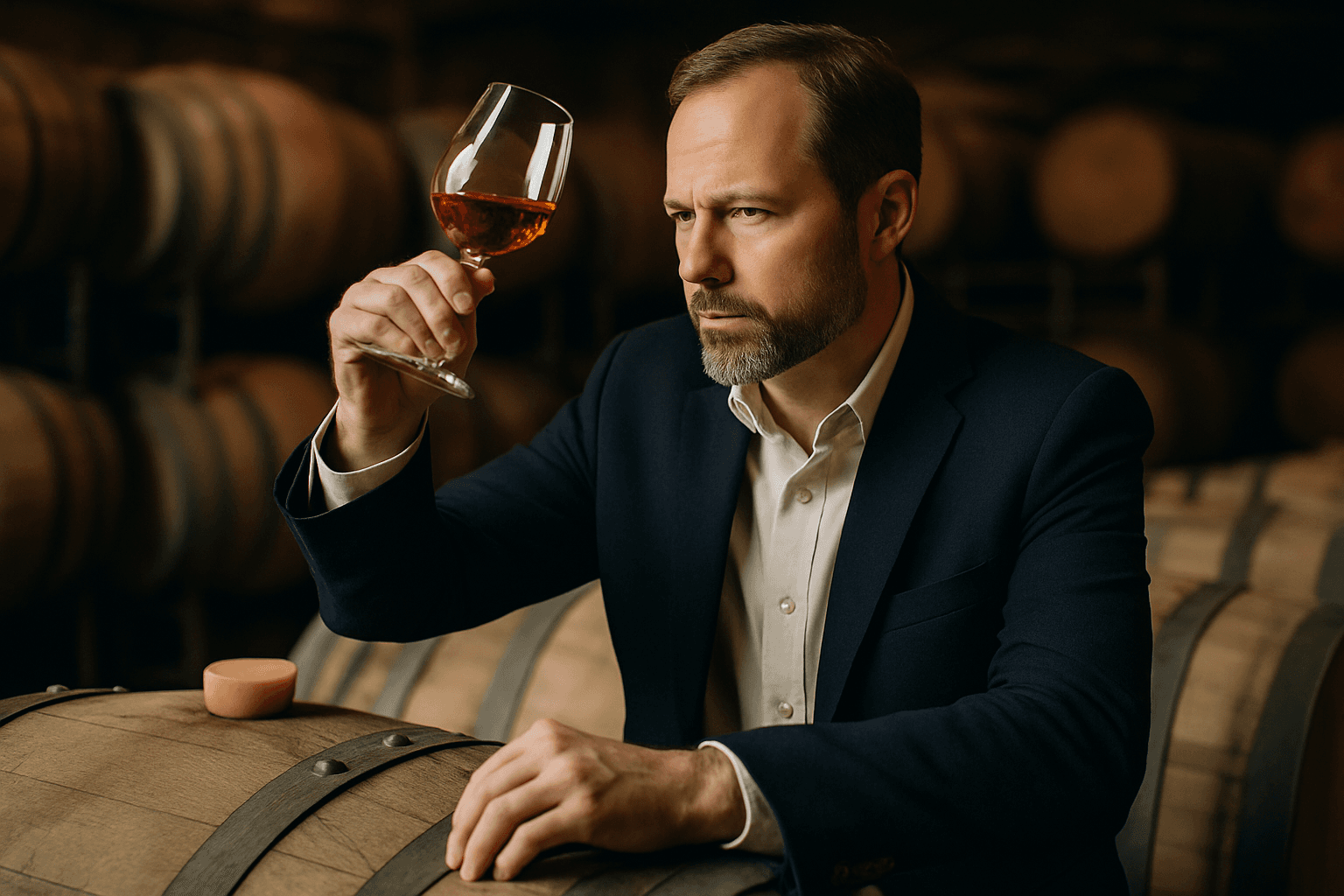
The Anatomy of a Successful Barrel Pick Program
By Alden Morris, Founder & Principal Strategist35 min read
Listen to this article44:30
Schedule a free strategy call and Intentionally Creative will build a custom plan for you.
Schedule Your Free Strategy CallFree audit. No commitment.
Get a Free Audit. No commitment.
A comprehensive guide to building and managing a barrel pick program for liquor retailers and whiskey enthusiasts. Learn how to select barrels, negotiate with distilleries, and create exclusive offerings that drive customer loyalty.
Single barrel selection didn't start as a marketing program. It started as a handshake.
Distillers in Kentucky's early bourbon culture would pull a specific barrel for a trusted buyer, a restaurateur, a retailer, a loyal customer, and that barrel would carry something no blended product ever could: a story. By the 1980s, distilleries like Buffalo Trace and Four Roses began formalizing what had always been an informal practice, turning barrel selection into a structured offering with documented mash bills, warehouse locations, and barrel numbers.
That formalization changed everything. What was once a favor became a program. And for retailers who understood what they were holding, a barrel pick became the single most powerful brand-building tool in the store.
The cultural weight of a well-executed barrel pick is real. Customers don't just buy the whiskey, they buy the story of the selection, the relationship behind it, and the expertise it signals.
This guide covers the full arc of a barrel pick program, from your first call to a distillery rep to the moment that bottle hits your shelf with your store's name on the label.
According to bourbon authority Fred Minnick, programs like Yellowstone's recently launched barrel pick initiative represent a growing trend of distilleries formalizing access for retail partners (source) ↗. That access, however, rewards retailers who come prepared, not those who show up hoping to get lucky.
This guide is written for sophisticated liquor retailers, whiskey buyers, and serious enthusiasts who want to build a program with intention. If you're already stocking allocated bottles, you understand that scarcity alone doesn't build loyalty. A barrel pick program does something different, it makes your store the origin of something rare, not just a stop along the way.
Barrel pick programs earn their gold standard reputation because they transform a retail store from a passive distributor of products into an active curator of rare, unrepeatable whiskey experiences. When a retailer selects a single barrel, they're putting their expertise, palate, and reputation on the label, literally. No two barrels from the same distillery, same mash bill, or same warehouse floor taste identical. That variance is the point. A store-pick bourbon exists once, in limited quantity, and carries a provenance that mass-market bottles cannot replicate. According to The Liquor Bros, the barrel selection process itself, traveling to the distillery, nosing barrels, making a definitive choice, signals a level of expertise that builds deep customer trust (source) ↗. For retailers operating in crowded markets where shelf differentiation is increasingly difficult, a barrel pick program is one of the few moves that competitors cannot simply copy.
Here's what actually happens when a retailer "picks a barrel", and why it's nothing like pulling a bottle off a shelf.
What separates a great whiskey program from a forgettable one? For a growing number of serious retailers, the answer is exclusive access to something no one else can sell.
A barrel pick program is a formal arrangement between a liquor retailer (or enthusiast group) and a distillery to hand-select a single barrel for exclusive bottling under the retailer's name or a co-branded label. That barrel gets pulled from the rickhouse, evaluated on its own merits, and bottled separately from the standard production run, often at cask strength or a proof point unique to that barrel's character. The retailer receives exclusive rights to that barrel's output, typically 150–250 bottles, depending on barrel size and how much angel's share the years claimed.
A barrel pick program is a formal retail-distillery partnership where a buyer physically selects a specific barrel from a distillery's aging inventory for exclusive release. The chosen barrel is bottled independently from the distillery's standard blended production, preserving its individual flavor profile. Retailers or groups receive sole distribution rights to that barrel's yield, usually 150 to 250 bottles, labeled with the barrel number, selection date, and the buyer's name. The process typically involves traveling to the distillery, nosing and tasting samples pulled directly from candidate barrels using a whiskey thief, and choosing the one that meets the selector's criteria. According to The Liquor Bros, no two barrel picks taste identical, even from the same distillery and same mash bill, which is precisely the point. The exclusivity, provenance, and story behind each selection justify both the price premium and the loyalty it builds.
Standard releases are engineered for consistency. Master blenders combine dozens, sometimes hundreds, of barrels to hit a target flavor profile that matches what consumers expect from that label year after year. Barrel picks do the opposite. They celebrate the variation.
Here's the practical difference, broken into what actually changes:
The selector pool is broader than most people assume:
Yellowstone Bourbon's recent barrel pick program launch, covered by Fred Minnick, signals that distilleries are actively expanding access, which means the window for retailers to build these relationships is open right now.
Try this yourself: Contact three distilleries in your state this week and ask specifically about their single-barrel retail program requirements. You'll be surprised how many have a formal process already waiting for the right retailer to call.
Here's what actually happens when you try to land your first barrel pick without a relationship: you call the wrong number, talk to the wrong person, and end up on a waitlist that goes nowhere.
The distilleries running the most coveted single barrel programs, Buffalo Trace, Four Roses, Heaven Hill, Wild Turkey, receive hundreds of retailer inquiries every year. The ones that get access aren't necessarily the biggest stores. They're the most prepared.
Start with an honest inventory of your store's capacity. A single bourbon barrel yields roughly 150–250 bottles depending on entry proof, barrel size, and angel's share loss. That's a real commitment. Before you fall in love with a particular distillery's brand, answer the harder question first: can your customer base actually move that volume in a reasonable window?
Established programs at Buffalo Trace, Four Roses, and Wild Turkey exist precisely because those distilleries built infrastructure around the single barrel experience, dedicated brand ambassadors, standardized selection protocols, consistent barrel inventory. According to The Bourbon Culture's 2026 allocated bourbon secondary price guide, single barrel store picks from Four Roses Small Batch Select and Wild Turkey Rare Breed consistently command secondary premiums of 40–80% over retail, which tells you everything about consumer demand.
Craft distilleries offer a different calculus. Allocations run smaller, sometimes 90 bottles from a 30-gallon barrel, but the storytelling opportunity is stronger. You can bring your customers inside the production process in a way that Buffalo Trace's scale simply doesn't allow. If differentiation matters to your market positioning, a regional craft pick can build loyalty that a big-name barrel can't replicate.
Before committing to any partner, nail down two non-negotiables: minimum purchase requirements and lead times. Some programs require a two-barrel commitment. Others lock you into a 6–9 month window between selection and delivery. That's cash tied up and shelf space promised. Know the terms before you fall in love with the whiskey.
Liquor retailers establish relationships with distilleries for barrel pick programs by working through official brand ambassador and sales representative channels rather than contacting distilleries directly. The process starts with preparing a detailed retailer profile that documents your store's sales volume, customer demographics, email list size, social media following, and any previous barrel pick history. Distilleries evaluate whether your store has the marketing infrastructure to sell through 150–250 bottles, not just the floor space to stock them. Demonstrating active digital marketing capabilities, including email campaigns, social media reach, and event programming, signals that you can move product without discounting. Retailers who approach the conversation with data, "we have 4,200 email subscribers and ran three successful barrel pick events last year", get meetings. Retailers who say "we'd love to do a pick someday" get politely ignored. The brand ambassador is your advocate inside the distillery; treat that relationship like it's worth protecting, because it is.
Your sales rep is the gatekeeper. That's not cynical, it's structural. Brand ambassadors carry internal credibility with their distillery's barrel allocation teams. When they vouch for your store, that endorsement carries weight that a cold inquiry never will. Build that relationship first, even before you're ready to commit to a pick.
The administrative side of barrel picks trips up more retailers than the selection process itself. Label approval alone can take 4–6 weeks depending on your state's TTB compliance requirements and the distillery's internal review process. Some distilleries restrict co-branding entirely, your store name appears on the label, but the design template is locked. Others give you creative latitude within brand guidelines.
Lead times from barrel selection to in-store delivery typically run 3–9 months. That timeline accounts for bottling scheduling, label approval, state distribution routing, and logistics. According to Still Austin's January 2026 Nancy's Picks blog, even well-established retail relationships require significant advance planning to align barrel availability with a store's promotional calendar.
State-specific distribution rules add another layer. In control states, the barrel may need to route through a state warehouse before reaching your floor, adding weeks and sometimes changing your landed cost. Know your state's compliance framework before you sign anything.
Try this yourself: Before your next distillery outreach, build a one-page retailer deck, sales volume, customer profile, social stats, email list size, past pick history if you have it. Send it to your sales rep before you ever mention wanting a barrel. Let the data make the ask for you.
Here's what actually happens when you taste from the thief at a rickhouse: two barrels filled on the same day, from the same mash bill, sitting 40 feet apart, taste nothing alike.
That's not a flaw in the process. That's the entire point.
Warehouse position drives more flavor differentiation than most retailers realize. Barrels on upper floors experience temperature swings of 20–30°F between seasons, sometimes more in metal-clad rickhouses. That aggressive heat cycling forces the whiskey deeper into the wood on hot days and pulls it back out as temperatures drop, accelerating oak extraction and producing bold, tannin-rich, spice-forward profiles. Lower floors stay comparatively stable. The result: softer grain character, less evaporation loss (lower angels' share), and a gentler mouthfeel.
Founder and Principal Strategist at Intentionally Creative. 10+ years in three-tier beverage industry marketing, 3 patents pending, CityHive partner. Runs growth for independent liquor retailers and DTC brands.
Intentionally Creative specializes in digital marketing strategies that drive real results. Let us show you what's possible.
Upper floor vs. lower floor isn't better or worse. It's a targeting decision.
What should you look for when tasting and selecting a whiskey barrel? Start neat, no water, no ice, and work through three distinct stages. On the nose, identify primary aroma markers: vanilla and caramel signal strong oak interaction; fruit esters (think baked apple, dried cherry) indicate ester development from fermentation; floral or herbal notes suggest grain character breaking through. On the palate, assess entry sweetness, mid-palate complexity, and how well the alcohol integrates, a barrel with harsh, hot alcohol hasn't married properly and may need more time. Texture matters: is it thin and sharp or viscous and coating? Evaluate finish length and evolution, does the flavor develop and shift, or does it drop off in 10 seconds? Then add two to three drops of water. Watch how the barrel opens. Some barrels bloom beautifully at lower proof; others lose structure. That response tells you a lot about how it will perform bottled at barrel strength vs. cut proof.
According to Fred Minnick's coverage of emerging barrel pick programs, the most compelling single-barrel selections consistently show mid-palate complexity and finish evolution as differentiating factors, not just nose intensity.
This is where most store picks go wrong. The barrel is excellent. The customer base wasn't considered.
Know exactly who you're buying for before you walk into that rickhouse. High-proof hunters want extraction intensity and heat, upper-floor selections at barrel strength. Approachable sipper seekers want balance, lower proof points, and grain-forward softness. Flavor-forward enthusiasts want something that tells a story: unusual fruit notes, unexpected spice, a finish that surprises.
Align your selection with your store's past bestsellers and seasonal timing. A rich, heavily oaked barrel with dried fruit and dark chocolate notes will move faster in October than in April. A lighter, floral, grain-forward barrel is a spring sell.
Document every tasting note during your selection visit, on paper, in your phone, however it sticks. Those notes become your marketing copy, your staff talking points, and the reason a customer picks your bottle off a shelf with six other single-barrel options next to it.
Try this yourself: Before your next barrel selection trip, pull your last three single-barrel sell-through rates and identify the flavor profile that moved fastest. Use that as your benchmark when you're tasting.
Here's what actually happens when you skip the compliance groundwork on a barrel pick program: you end up with 240 bottles you legally can't sell, a label the TTB rejected, and a distillery partner who's frustrated you didn't do your homework.
That's not a hypothetical. It happens every year to retailers who treat the legal and operational side of barrel picks as an afterthought.
The myth worth busting first: Many retailers assume the distillery handles all the compliance. They don't. Once that barrel is yours, the regulatory responsibility shifts significantly to your side of the equation.
Barrel pick programs operate inside a patchwork of state-specific alcohol beverage control (ABC) regulations, and the rules vary wildly. Retailers in control states like Pennsylvania or Utah face constraints that open market states like Texas or Florida simply don't impose. In some control states, a retailer can't even technically "own" a barrel; the transaction has to be structured differently.
Before you commit to a barrel purchase, consult a beverage alcohol attorney or a compliance consultant who specializes in your state. This is not optional. A one-hour consultation ($200, $500) is cheap insurance against a five-figure compliance problem.
Here's where most retailers underestimate the timeline. Federal law requires TTB (Alcohol and Tobacco Tax and Trade Bureau) approval for every label sold in the U.S., this is called a COLA (Certificate of Label Approval). Budget 60–90 days for approval. Launch your barrel pick marketing before that COLA clears and you're setting yourself up for a painful delay.
Your custom label must include the distillery name, class and type of spirit, alcohol content, and net contents. Work with the distillery early to nail down your proof point, cask strength versus diluted to a specific ABV affects your yield calculation and your label specs simultaneously.
Speaking of yield: plan for variability. Angel's share, barrel size, and proof entry all affect final bottle count. A 53-gallon barrel doesn't automatically yield 240 bottles. You might get 210. You might get 255. Build that range into your financial model before you sign anything.
Running a barrel pick program requires retailers to manage several logistical and legal requirements simultaneously. At the federal level, every custom label requires TTB approval via a Certificate of Label Approval (COLA), a process that typically takes 60–90 days. State-level ABC regulations add another layer, control states and open market states impose different rules on how retailers can purchase, receive, and sell single barrel selections. Retailers must calculate their true cost per bottle by dividing the barrel purchase price by expected yield, then adding label design fees, bottling fees, shipping, and storage. According to The Liquor Bros, these programs also require close coordination with the distillery on proof point decisions and bottle count projections. Pricing should reflect those costs plus a premium for exclusivity, barrel picks consistently command higher margins than standard shelf expressions when positioned and marketed correctly.
What to do instead of winging it:
The operational side of a barrel pick program isn't glamorous. But retailers who get this infrastructure right are the ones who can run these programs repeatedly, profitably, and without the headaches that kill momentum.
Here's what actually happens when you bring home a barrel pick without a marketing plan: it sits on the shelf like any other bottle, and you've left serious money on the table.
A great barrel selection deserves a great story. The whiskey community runs on narrative, the warehouse location, the rick house row, the tasting notes your buyer scribbled on a napkin at the distillery. That raw, unpolished detail is your competitive advantage over every big-box retailer that can't replicate it.
Start with documentation before you ever leave the distillery. Barrel number, warehouse location, age, entry proof, dump proof, capture all of it. Then photograph everything: the rickhouse ladder, the barrel head, your buyer's face when they taste the one. These assets become the foundation of every marketing piece you'll build.
Write the barrel story in first person. "I climbed to the fourth floor of Rickhouse D, and the rickhouse manager pulled sample #47, the moment I tasted it, I knew." That voice converts. Third-person product descriptions do not. Your buyer's authentic account creates the kind of trust that no ad budget can manufacture.
What makes this barrel unique? Nail that answer before you write a single caption. Is it a high-rye mash bill that finished hotter than expected? A warehouse location known for temperature extremes that accelerated maturation? A distillery releasing only 12 store picks nationally this year? Specificity sells.
Liquor retailers who maximize barrel pick sales treat the launch like a product drop, not a shelf reset.
The most effective approach coordinates multiple digital channels around a single launch window, typically 7 to 10 days of pre-launch content followed by a hard release date. Email marketing anchors the campaign. Send a dedicated announcement to your full subscriber list with the complete barrel story, tasting notes, bottle count, and a direct purchase link. Subject lines that include the barrel number and distillery name consistently outperform generic "new arrival" messaging.
On Instagram, document the selection trip in real time using Reels and Stories. According to Fred Minnick's coverage of the Yellowstone Bourbon barrel pick program, behind-the-scenes distillery content drives significantly higher engagement than standard product photography, because the audience wants to feel like they were there. Build anticipation before the bottle ever hits your floor.
Build a dedicated landing page for the barrel. Tasting notes, distillery background, your buyer's story, bottle count, price, and a clear call-to-action. This page serves double duty: it converts browsers into buyers and gives you a trackable URL to share across every channel.
SMS marketing closes the loop. Your highest-intent customers, the ones who've already opted into text alerts, respond to limited-release drops faster than any other channel. A simple "47 bottles. Available now. Link below." message sent at launch can move product within hours.
This is exactly the multi-channel coordination the team at Intentionally Creative ↗ builds for retail clients, email, social, SMS, and web working together around a single campaign calendar so nothing falls through the cracks.
The physical store is still your most powerful marketing channel for a barrel pick. Use it.
Host a release event. A tasting format with your buyer present, or better, a distillery brand ambassador, turns a bottle purchase into an experience. Customers who attend events spend more per transaction and return at higher rates. Numbered bottles and a bottle-signing moment add collectibility that justifies a premium price point and drives word-of-mouth organically.
Shelf talkers matter more than most retailers think. A 4x6 card with the barrel number, a two-sentence buyer's note, and the bottle count remaining ("Only 23 left") creates urgency at the point of decision. According to research covered by The Liquor Bros, store pick programs consistently outperform standard shelf inventory in both velocity and margin, but only when the story is visible at shelf level.
Pre-sale and pre-order options serve two purposes: they gauge real demand before you commit to pricing strategy, and they reward your loyal customers with first access. That exclusivity is the whole point of running a barrel pick program.
Try this yourself: Before your next barrel pick arrives, map out a 10-day content calendar, three Instagram Reels, one email, two SMS alerts, and one in-store event. Execute it once with discipline, track your sell-through rate, and compare it against your last barrel pick launch. The difference will make the case for every future campaign.
Here's what actually happens when you sell a barrel pick without a club structure: you move bottles, pocket the margin, and watch those customers disappear until the next release. No relationship. No predictability. No compounding value.
Now picture this instead, a dedicated member base that pre-commits to every release, shares your picks on social media before you've even sent an email, and drives a waitlist of people begging to join. That's what a barrel pick club actually builds.
The mechanics are straightforward. Members receive guaranteed allocation on every new barrel pick release. In exchange, they pay an annual membership fee or a per-release commitment fee. You get predictable sell-through before the bottles even land. They get access that casual shoppers simply can't buy.
Membership tiers give you flexibility:
That VIP tier does something the other two can't: it transforms customers into co-owners of the story. When someone flies to Kentucky to help your team select a barrel, they don't just buy the bottle, they sell it for you. According to research from OhBev's whiskey market analysis, experiential engagement drives significantly higher repeat purchase rates than promotional discounts alone. The math favors experience over discounts every time.
The best barrel pick clubs we've seen aren't just allocation lists, they're communities. The store becomes the hub, and the whiskey is the reason to gather.
— common thread from high-performing single-store operators
The benefit stack needs to answer one question for every prospective member: Why here, and why now?
Here's a benefit structure that actually converts:
That last point matters more than most retailers realize. A private digital community gives members a place to talk, post, and recruit. Your club grows itself.
A standalone answer for retailers building a barrel pick club:
Retailers can create a barrel pick club by structuring tiered membership around guaranteed bottle allocation, exclusive access, and experiential benefits tied to each release. The model works like this: members pay an annual or per-release fee in exchange for first access to every barrel pick the store selects. Tiers can range from standard allocation to VIP invitations to distillery selection trips. On the operational side, a CRM or email platform like Klaviyo or Mailchimp manages member lists, purchase history, and release communications. A waitlist system handles oversubscribed releases, and that waitlist itself becomes a marketing asset. Transparent communication about bottle counts builds trust. Scarcity should reflect reality, not manufactured pressure. Done right, a barrel pick club converts one-time buyers into brand advocates who post, share, and recruit new members organically, creating recurring revenue and predictable sell-through on every release.
Managing the back end cleanly is what separates clubs that scale from clubs that collapse under their own demand.
Use a CRM, Klaviyo, HubSpot, or even a well-structured spreadsheet at minimum, to track member tier, purchase history, and communication preferences. Every release should trigger an automated sequence: announcement, allocation confirmation, pickup window, and follow-up tasting note.
Waitlist management is where most stores get sloppy. Build it intentionally:
Scarcity is real in barrel picks. According to Bourbon Culture's 2026 allocated bourbon secondary price guide, limited single-barrel releases from top distilleries regularly trade at 2–4x retail on the secondary market. That premium exists because supply is genuinely constrained. Your club doesn't need to manufacture urgency, it needs to communicate reality clearly and consistently.
Try this yourself: Before your next barrel pick release, email your last 90-day whiskey buyers with one question, "Would you pay $X annually for guaranteed access to every barrel we select?" The response rate will tell you exactly how much demand you're leaving on the table.
Here's what actually happens when you go from one barrel pick to a portfolio: the operational complexity doesn't double, it multiplies. Timing, compliance, supplier relationships, and customer data all start pulling in different directions at once. The stores that scale successfully treat it like product development, not just purchasing.
The fall release window, October through December, is where most retailers discover whether their barrel pick program has real infrastructure or just good intentions. Holiday demand exposes every gap in your planning cycle.
Start with 2–4 barrel picks per year. That's not a limitation, that's discipline. It gives your team time to master the compliance paperwork, nail the marketing execution, and actually learn what your customers respond to before you're juggling six releases simultaneously. Stagger categories intentionally: a bourbon in October, a rye for Father's Day in June, a rum or tequila for a store anniversary. Each one serves a different customer segment and a different retail calendar moment.
Build a 12-month barrel pick calendar and work backward from each release date. Distillery lead times vary wildly, some require 90-day advance notice, others need 6 months for label approval alone. If you don't have those timelines mapped, you'll miss your window.
Over-reliance on a single distillery partner is a supply chain risk that most retailers don't recognize until a popular barrel sells out and the next allocation is 14 months away.
According to research from OhBev's whiskey market forecast, categories beyond bourbon, single barrel rum, agave spirits, and single cask Scotch, are posting meaningful growth as consumers broaden their premium spirits consumption. Your barrel pick program should reflect that shift before your competitors figure it out.
Each new distillery relationship carries its own compliance requirements. New label approvals, new state-specific documentation, new distributor contacts. Track this in a simple CRM or even a shared spreadsheet. The retailers who scale cleanly are the ones who treat every new distillery like a new vendor onboarding, not just a fun tasting trip.
Successful retailers scale a barrel pick program from a single selection to an ongoing portfolio by treating each release as a data event, not just a sales event. The metrics that matter: sell-through rate per barrel (how fast did it move?), new customer acquisition per release (did it bring people in who hadn't bought from you before?), repeat purchase rate among barrel pick buyers, and ROI per barrel calculated as total revenue minus total cost including marketing spend. A barrel that sells out in 48 hours but attracts zero new customers tells a different story than one that moves in three weeks but adds 40 new loyalty members. Track both. The stores that build durable programs use this data to guide category expansion, they don't guess what to pick next, they follow the numbers. Over time, that data compounds into a genuine competitive advantage that's nearly impossible for a competitor to replicate quickly.
Your forward-looking move: once you have 8–10 barrel picks in your history, you have enough data to spot patterns. Which categories drive the highest new customer rate? Which release timing generates the best repeat purchase behavior? That's your portfolio strategy. Try this yourself, pull your last three barrel pick releases, calculate the true cost-per-bottle including label design and email marketing, and compare it against your average margin. The answer will tell you exactly where to focus next.
Most barrel pick programs don't fail at the barrel, they fail in the spreadsheet, the inbox, and the handshake.
Here's what actually happens when you skip the compliance calendar: your barrel is bottled, your label is designed, and your launch date is set, then TTB label approval takes 75 days instead of 30. Your seasonal window closes. Your pre-orders go cold. The distillery moves on.
TTB approval runs 60–90 days on average. Build that into your timeline before you confirm anything with your rep or your customers. Overcommitting to barrel volume is the other silent killer. Secure sell-through confidence first, a 60-case commitment on a new expression with no existing customer base is a cash flow problem waiting to happen.
State compliance laws vary wildly. What's legal in Kentucky isn't always legal in California. Run a compliance check before you sign, not after.
A barrel pick without a story is just an expensive bottle with a custom label. Nobody shares that. Nobody drives across town for that.
Announce the selection trip. Post the nosing session. Document the disagreement over which barrel won. The product launch is the conclusion of the story, not the beginning. Retailers who build anticipation before the bottle arrives consistently outperform those who drop a product post and hope for engagement.
Owned channels, email and SMS, convert at dramatically higher rates than social media for limited releases. According to The Bourbon Culture's 2026 allocated release tracking, demand for limited expressions far outpaces supply across most markets, which means your list is your leverage. Capture customer data at point of sale. Every barrel pick buyer is a future buyer, only if you know who they are.
Distillery reps talk to each other. They remember who sells through and who sits on inventory. They remember who sends data back and who ghosts them after the check clears.
Send sell-through reports. Share what moved, what didn't, and what customers said. That information is valuable to the distillery, and it positions you as a retail partner worth allocating to next cycle. According to Still Austin's January 2026 Nancy's Picks documentation, retailers with consistent feedback loops receive priority consideration for future single barrel access.
Over-promising exclusivity to customers without confirming distillery terms is a trust-killer. Verify every exclusivity claim in writing before you market it.
The most common mistakes retailers make with barrel pick programs fall into three categories: operational, marketing, and relationship management. On the operational side, retailers routinely underestimate TTB label approval timelines, which average 60–90 days, causing missed launch windows and frustrated customers. Overcommitting to barrel volume before establishing sell-through history compounds the risk. Marketing errors are equally damaging: launching without a narrative, skipping pre-launch anticipation, and relying solely on social media instead of email and SMS, channels that consistently outperform for limited releases. Retailers also fail to capture customer purchase data, losing the ability to market future barrel picks to proven buyers. On the relationship side, treating distillery reps transactionally, withholding sell-through data, and over-promising exclusivity without confirming terms all erode the partnerships that drive long-term allocation access. Avoiding these mistakes requires process, not luck.
Build the checklist before you build the excitement. Map your TTB timeline, confirm compliance, lock in your story, and protect your distillery relationship like the asset it is.
What separates a great barrel pick from a forgettable one? Intentionality, and the willingness to treat selection as a genuine act of curation, not a checkout box on a vendor checklist.
A barrel pick program, executed with craft and care, is a retailer saying something bold: we tasted hundreds of barrels so you don't have to. That's a promise. And promises, kept consistently, build the kind of customer loyalty that no algorithm can manufacture.
Here's what the best barrel pick programs share:
The ritual mirrors what wine culture has done for decades, and as Bourbon Culture's 2026 allocated bourbon guide ↗ confirms, American whiskey consumers are increasingly sophisticated enough to demand that same level of intentionality from their retailers. They're not just buying a bottle. They're buying the story behind it.
The answer is clear: build the ritual first. The sales follow.
Ask yourself honestly, are you a retailer who sells whiskey, or a retailer who shapes how your community experiences it?
That distinction is everything. Sophisticated retailers who invest in barrel pick programs become cultural anchors. They host the conversation. They set the standard. They're the reason a customer drives past three other liquor stores to get to yours.
A barrel pick program is a profoundly human act of taste and trust, and that matters more now than ever.
A barrel pick program matters beyond sales because it transforms a retail transaction into a cultural experience. Retailers who select, name, and story-tell around a single barrel become educators and community connectors, not just merchants. The customer who buys a barrel pick bottle isn't buying whiskey; they're buying the retailer's palate, their relationship with the distillery, and their membership in something exclusive. According to The Whiskey Wash's top bourbons to hunt in 2026 ↗, enthusiasts actively seek out store picks from trusted retailers, meaning your curation reputation has real market value. For American whiskey culture broadly, barrel pick programs elevate retail from passive distribution to active participation in craft. They create the kind of intentional, human-scaled commerce that faceless e-commerce cannot replicate.
The retailers who understand this don't just sell whiskey. They educate, connect, and celebrate the craft, release after release, barrel after barrel. Build your program with intention, and it will build your brand in return.
You've read the playbook. Now comes the part that separates the retailers who talk about barrel picks from the ones who actually execute them.
Start here, this quarter, not next year:
The barrel pick program is one of the few tools available to an independent retailer that a big-box competitor genuinely cannot replicate. It requires relationships, palate, and community, things that don't scale from a corporate office.
Grab your first barrel. Tell its story. Watch what it does for your brand.
Talk soon, Alden