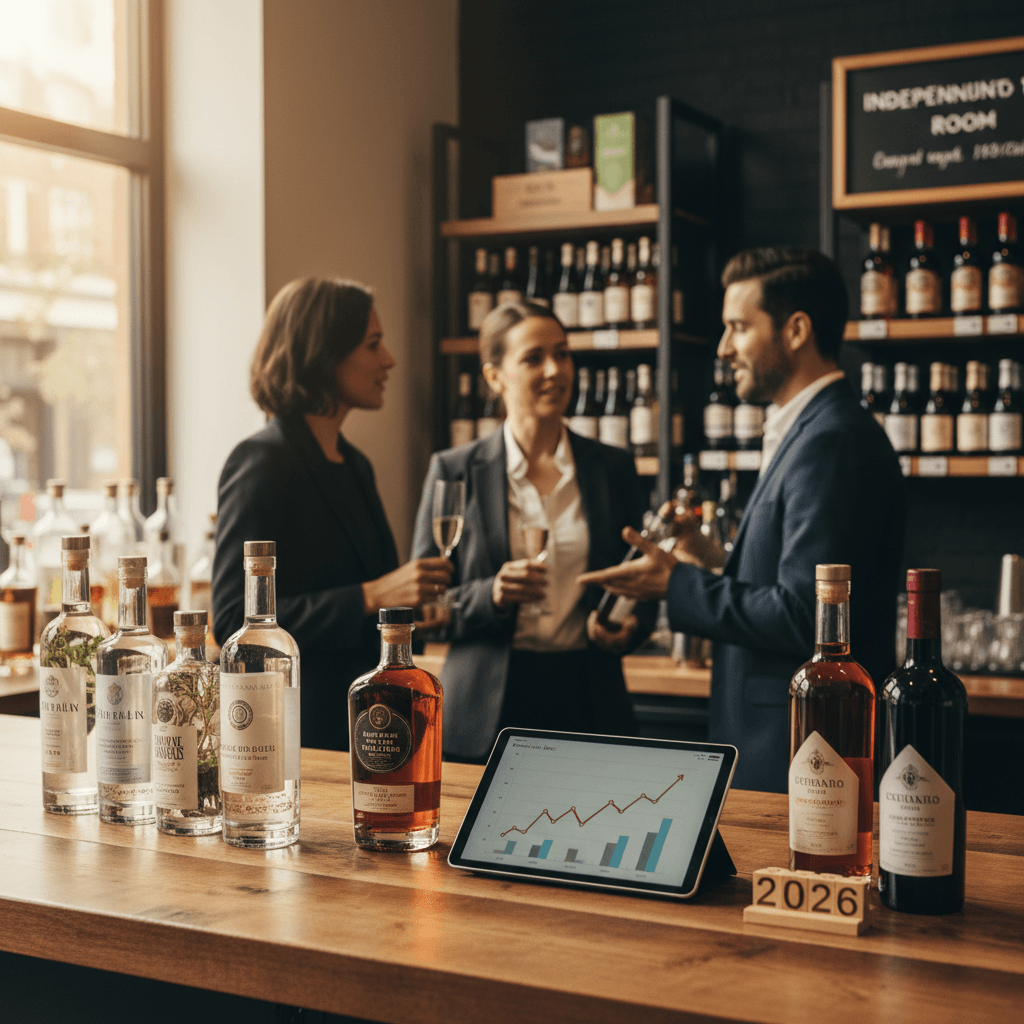
The State of the Industry: Top 5 Liquor Retail Trends to Watch in 2026
By Alden Morris, Founder & Principal Strategist33 min read
Listen to this article42:30
Schedule a free strategy call and Intentionally Creative will build a custom plan for you.
Schedule Your Free Strategy CallFree audit. No commitment.
Get a Free Audit. No commitment.
Explore the top liquor retail industry trends shaping 2026, from premiumization and e-commerce growth to RTD innovation and data-driven merchandising. A forward-looking guide for retail liquor professionals.
The liquor industry has never stood still, but 2026 feels different.
From the post-Prohibition expansion that built the three-tier system into a $250 billion machine, to the craft spirits explosion of the 2010s that put 10,000+ distilleries on the map, to the pandemic years that rewired how Americans buy and consume alcohol, every era has had its defining pressure. The current one is maturation. Growth is harder to find. Margins are thinner. Consumers are more deliberate.
2026 marks a convergence that retail operators can't afford to ignore: shifting consumer values, evolving state-level regulations around direct-to-consumer shipping, and a wave of technology adoption that separates stores running on instinct from those running on data. According to the IWSR, six structural forces are reshaping beverage alcohol simultaneously, not sequentially.
Discover 7 proven Instagram content ideas for liquor stores that boost engagement and drive sales. Learn how to promo...
This guide reflects Intentionally Creative's perspective, a digital marketing agency built exclusively for retail liquor stores, with firsthand experience across all three tiers of the beverage alcohol system.
2026 is a turning point for the liquor retail industry because multiple disruptive forces have arrived at the same moment, not in isolation. Post-pandemic consumer behavior has permanently shifted toward intentional purchasing, shoppers research before they buy, expect personalization, and hold fewer brand loyalties than they did a decade ago. Simultaneously, the craft spirits market that exploded through the 2010s has entered a consolidation phase, forcing retailers to make harder decisions about shelf allocation. Regulatory momentum around direct-to-consumer shipping is accelerating in state legislatures, threatening traditional foot-traffic models. And technology, from AI-powered inventory tools to SMS marketing platforms, has moved from optional to operationally necessary. Research from the IWSR confirms that these six converging drivers are reshaping the category across every price tier and segment. Retailers who treat 2026 as business-as-usual will feel the gap widen between themselves and operators who are actively adapting their buying, marketing, and customer retention strategies right now.
10 proven liquor store social media content ideas to connect with customers, boost brand visibility, and drive both i...
This guide was built for one reader: the liquor retail operator who doesn't have time for theory.
Store owners, buyers, and marketing managers will find each trend section structured around actionable context, not just observation. Knowing that hard seltzers declined 7% matters less than knowing what to stock in that cooler space instead, and why.
Discover 7 proven TikTok marketing strategies for liquor stores that build real engagement and bring customers throug...
Read through the full guide once. Then go back and flag the two or three trends that match your market's current pressure points. A suburban wine-forward shop faces a different 2026 than an urban spirits destination. Datassential's 2026 beverage trend research reinforces that regional variation is significant, what's driving volume in Chicago may be lagging two years behind in mid-sized markets.
Start with the trends that feel most urgent. Build your strategy from there.
Here's what actually happens when you ignore a market shift: your competitors don't.
The global spirits market tells a clear story right now. Projections from the IWSR and Data Insights Market place total market value exceeding $700 billion by 2026, but that headline number masks a more complicated reality underneath. Growth is uneven. Channels are fragmenting. And the retailers who built their businesses on foot traffic alone are feeling it.
The U.S. off-premise channel, your store, the big-box down the street, the DTC platform shipping straight to someone's door, still dominates spirits volume. On-premise never fully recovered its pre-pandemic share. That sounds like good news for retail. It's not automatically good news for independent retail.
Here's the pressure you're actually up against:
According to research from Data Insights Market ↗, the alcoholic beverages industry continues to see compounding pressure on independent operators specifically, not because the category is shrinking, but because the distribution of revenue is concentrating.
Here's what actually happens when a major delivery platform acquires your primary competitor: consumer expectations reset overnight, and they don't reset back.
Online alcohol sales surged more than 400% during COVID-19. The more telling number? They never fully retreated. Uber's acquisition of Drizly, combined with Instacart and GoPuff building out dedicated alcohol verticals, permanently rewired how a significant segment of buyers thinks about purchasing spirits, wine, and beer. Same-day delivery went from a novelty to a baseline expectation, fast.
State-by-state direct-to-consumer shipping regulations are slowly catching up. More markets are opening. The regulatory friction that once protected brick-and-mortar exclusivity is eroding, market by market.
Omnichannel gets thrown around like it just means "having a website." It doesn't.
Real omnichannel execution means your customer sees the same inventory, the same price, and the same promotion whether they're on your website at midnight or standing at your register at noon. It means BOPIS, Buy Online, Pick Up In Store, is a live, functional option, not a broken promise. Click-and-collect consistently converts at higher rates than pure e-commerce because it removes shipping friction while capturing the impulse decision.
Your Google Business Profile is the front door most customers walk through before they ever set foot in your store. Incorrect hours, missing product categories, zero photos, each one costs you a visit.
Here's what actually happens when you stock your cooler based on last year's RTD winners: you lose shelf velocity to a category that rewrites its own rules every 18 months.
The myth worth killing first, hard seltzer is RTD. That framing cost a lot of retailers cooler space when the seltzer bubble deflated. RTD is a format, not a flavor. And the format is evolving fast.
Hard seltzers peaked. Premium canned cocktails didn't get the memo. Spirits-based RTDs, canned Negronis, shelf-stable Martinis, properly made Margaritas, are pulling serious velocity in off-premise retail while malt-based seltzers cede ground. According to IWSR's 2026 beverage alcohol outlook, spirits-based RTDs are outpacing malt-based counterparts in both volume growth and consumer trial rates, driven by a consumer base that now reads ingredient labels on canned drinks the same way they read them on food.
Price architecture spans the full range. A $3 single-serve impulse grab near the register. A $25 four-pack of craft-distillery cocktails sitting next to the full-size bottles. Both move, if you merchandise them intentionally.
The regulatory shift matters here. Spirits-based RTDs face different distribution rules than malt-based products in many states, but consumer preference is pulling the market toward spirits anyway. Shoppers who drink Tito's at home want a canned cocktail made with actual vodka, not a malt base engineered to taste like one.
Functional RTDs are the other real story. Low-ABV, low-calorie, adaptogen-forward formulations are hitting shelves from brands like Kin Euphorics and Ghia, blurring the line between beverage alcohol and wellness. CBD-adjacent formulations remain legally complicated state-by-state, but the consumer appetite is clearly there.
Founder and Principal Strategist at Intentionally Creative. 10+ years in three-tier beverage industry marketing, 3 patents pending, CityHive partner. Runs growth for independent liquor retailers and DTC brands.
The generational handoff is real and it matters to your inventory decisions. Millennials are now the dominant spirits-buying cohort, they drove the premium and craft spirits boom and they're not done. Gen Z is entering the market with a fundamentally different relationship to alcohol: more selective, more sober-curious, more influenced by values than brand legacy.
That's not a threat. That's a targeting brief.
The regulatory picture is messier. State-by-state rules on delivery, licensing, and DTC shipping create a patchwork that large chains navigate with legal teams and lobbyists. Independent operators navigate it with gut instinct and Google searches. The technology adoption gap compounds this, enterprise retailers run sophisticated loyalty programs, automated email flows, and real-time inventory analytics. Many independent stores still run on a POS system from 2014.
The liquor retail industry in 2026 operates as a fully integrated physical-digital system, where the global spirits market is projected to exceed $700 billion and U.S. off-premise retail remains the dominant volume channel. Millennials represent the core purchasing demographic, while Gen Z is entering with different values around moderation and brand ethics. E-commerce normalization post-pandemic has permanently expanded the competitive set, independent retailers now compete with DTC platforms, delivery apps, and national chains running sophisticated digital operations. According to the IWSR's 2026 outlook, six key forces are reshaping beverage alcohol consumption patterns globally, with technology adoption and channel diversification topping the list. Omnichannel presence is no longer a differentiator, it's table stakes. Stores without a functioning digital footprint are invisible to a growing segment of buyers before they ever walk through the door.
The line between physical and digital retail functionally erased itself sometime around 2022. Most retailers just haven't caught up to what that means operationally. A customer checks your website before they check your hours. They look at your Google reviews before they ask your staff for a recommendation. They expect to find your current inventory online the same way they expect to find a restaurant's menu.
The five trends this guide breaks down, technology adoption, consumer behavior shifts, product category movements, marketing strategy, and regulatory evolution, all connect back to this baseline. You can't understand where the industry is going without first being honest about where it stands.
That's what this section just did.
Try this yourself: Pull your last 90 days of sales data and identify your top 10 SKUs by volume. Then check whether those products are featured anywhere on your digital presence, website, Google Business Profile, email, social. If the answer is "barely" or "not at all," you've already found your first gap.
Here's what actually happens when a customer walks into a well-curated liquor store versus a warehouse-style one: they slow down. They ask questions. They spend more.
That behavioral shift is the engine behind premiumization, and it's reshaping how smart retailers think about shelf strategy heading into 2026.
Volume is contracting. Dollar growth is not. That's the paradox defining the spirits market right now, and it's actually good news for independent retailers who know how to work it.
According to IWSR's analysis of key drivers shaping beverage alcohol in 2026, super-premium and ultra-premium segments continue to outperform value tiers even as overall consumption softens. Consumers aren't drinking less because they're disengaged, they're trading up. A customer who used to grab a $28 bottle of bourbon is now reaching for the $65 single barrel. The transaction count drops; the margin per transaction climbs.
Whiskey, tequila, and mezcal are leading this shift. Añejo tequila and single malt Scotch aren't just growing, they're becoming the baseline expectation for a certain type of buyer. Gin and rum are following the same arc, roughly 18 months behind. If you're not already building out a premium rum section, you're setting up a play for next year.
The novelty phase is over. With over 2,000 craft distilleries now operating across the U.S., craft spirits aren't a differentiator by default anymore, they're table stakes. The question isn't whether to stock craft. It's which craft, and why.
Shelf space competition is fierce. Distributors are pushing craft SKUs hard, and the temptation is to stock broadly, a little of everything, hoping something sticks. Retailers who resist that temptation and curate intentionally are outperforming those who don't. The data from Southern Glazer's 2026 Liquid Insights Tour reinforces this: consumers respond to confidence. When your staff can say "we carry this one because the distiller uses a 72-hour fermentation and a pot still, here's what that does to the flavor," you've created a moment that a big-box store simply cannot replicate.
Local and regional craft spirits are your sharpest differentiation tool. A distillery 40 miles away carries a story that no national brand can buy.
Staff education isn't a nice-to-have anymore, it's a revenue driver. A floor associate who can explain the difference between a column-still and pot-still rum, or walk someone through the agave roasting process in mezcal production, converts browsers into buyers and buyers into loyalists.
Premium endcaps, structured tasting events, and bottle club programs are the tactical plays that translate premiumization into actual margin. These aren't complicated to execute. A monthly bottle club with three premium SKUs, tasting notes, and a QR code linking to a short video from the distiller, that's a $600, $800 recurring revenue stream with near-zero overhead.
The digital layer matters too. Use your email list and social content to tell the story behind the bottle before the customer ever walks in. Research from Datassential's 2026 beverage trends report shows that consumers increasingly research premium purchases online before buying in-store. Your Instagram post about that limited-release wheated bourbon isn't just content, it's a presell.
Try this yourself: Pull your top 10 premium SKUs by margin, not volume. Build a 60-second staff training card for each one, origin, production method, one tasting note, one food pairing. Run it as a two-week floor challenge. Track attach rate on those SKUs before and after. The numbers will tell you everything you need to know about whether curation is worth the investment. (It is.)
Intentionally Creative specializes in digital marketing strategies that drive real results. Let us show you what's possible.
Schedule a CallE-commerce is non-negotiable for liquor retailers in 2026. Online alcohol sales have remained structurally elevated since the pandemic, and third-party platforms like Instacart and GoPuff have trained consumers to expect digital access to their local store's inventory. A retailer without a website showing real-time stock isn't just missing online sales, they're invisible to a growing segment of shoppers who research before they walk in. According to IWSR's analysis of key drivers shaping beverage alcohol in 2026 and beyond, digital touchpoints now influence purchase decisions across all retail formats, not just pure-play e-commerce. Local SEO and Google Business Profile optimization directly drive measurable foot traffic. The gap between independent retailers who have built functional omnichannel infrastructure and those still operating on a single-channel model is widening fast. In 2026, that gap translates directly to revenue.
A website with real-time inventory is the floor, not the ceiling. SEO and local search optimization, done right, drive people through your physical door, not just to your cart.
This is exactly where Intentionally Creative operates. The enterprise-level retailers have entire digital teams executing this playbook. Independent liquor store owners don't, but the consumer doesn't care about your team size. They care whether you show up when they search. Intentionally Creative builds and executes omnichannel digital strategies specifically for independent retailers, at budgets that don't require a CFO's approval.
Try this yourself: Search "[your store name] + near me" right now. What you see, or don't see, is exactly what your next customer sees.
Craft distilleries figured out something smart: RTD extensions solve a margin and distribution problem simultaneously. A small-batch bourbon producer can move product into markets where their full-size bottles don't have distribution, through a canned cocktail that fits in a beer distributor's portfolio. That's a structural play, not just a trend.
Canned wine is doing the same thing. Brands like Underwood and Francis Ford Coppola's Sofia have trained consumers to expect quality in aluminum. Premium RTD cocktails are inheriting that permission.
Where you put RTDs determines whether they sell. That's not obvious, most stores default to the beer cooler because that's where cans live. Wrong instinct for premium SKUs.
What to do instead:
Try this yourself: pull your RTD velocity data from the last 90 days, sorted by spirits-based vs. malt-based. If spirits-based isn't outperforming, your placement is probably working against you, not your product selection.
Here's what actually happens when you run a liquor store on gut instinct alone: you over-order the Malbec that moved well in October, miss the rum velocity spike every Memorial Day weekend, and watch $4,000 in dead craft gin inventory collect dust on the bottom shelf. Sound familiar?
POS integration with inventory management used to be a luxury reserved for chain retailers. That's no longer true. Platforms like Backbar and City Hive now put velocity reporting directly in the hands of independent operators, showing you exactly which SKUs turn fastest by season, day of week, and customer segment. Shrinkage, overstock, and dead inventory stop being vague frustrations and become measurable line items you can actually fix.
AI-powered reorder suggestions aren't science fiction. They're running inside retail management tools right now, pulling historical sales data and seasonal patterns to flag when your Tito's stock needs replenishment before the Friday rush, not after. Planogram optimization tools go further, recommending shelf placement based on margin and velocity, so your highest-earning SKUs get eye-level real estate. Customer purchase history enables personalized promotions that actually convert, not spray-and-pray discount blasts.
Here's where most stores leave money on the table. Your inventory data and your digital marketing should be talking to each other, and they usually aren't. Connecting in-store stock levels to your digital ad campaigns means you promote what's actually available, on sale, or exclusive to your location. Email and SMS triggered by purchase behavior, "You bought Casamigos last month, here's what just landed", performs at a completely different level than a generic weekly blast.
This is exactly the gap Intentionally Creative bridges for retail clients: taking real operational data and turning it into digital marketing execution that drives foot traffic and repeat purchases.
Try this yourself: Pull your 90-day velocity report, identify your top 10 SKUs by turn rate, and build your next email campaign exclusively around those products. Then measure open rate against your last three campaigns. The specificity alone will move the number.
Here's what actually happens when a generation decides alcohol isn't their default social lubricant: the entire retail category has to rethink itself from the shelf out.
Five years ago, a customer asking for "something without alcohol" at a liquor store was an edge case. A weird request. Something you'd handle by pointing them toward the juice aisle. Today, that customer is one of your fastest-growing segments, and if your store isn't ready for them, they're buying online or at the specialty grocer down the street.
Dry January participation has grown year-over-year for five consecutive years. Gen Z drinks less per capita than any previous generation, but here's the counterintuitive part, they spend more per occasion. They're not abstaining because they're cheap or disinterested. They're being selective. Mindful drinking has become a lifestyle identity, not just a detox period. These consumers research before they buy, share what they're drinking on social, and expect the same craft-level storytelling from a non-alcoholic spirit that they'd expect from a small-batch bourbon.
Key takeaways:
The shelf has changed. Seedlip, Lyre's, and Monday Whiskey aren't specialty items you special-order for one customer, they're stocked in mainstream liquor retail alongside their full-proof counterparts. According to IWSR's 2026 beverage alcohol outlook, the low- and no-alcohol segment continues to grow at double-digit rates in both volume and value, outpacing most traditional spirits categories.
De-alcoholized wine technology has crossed a critical quality threshold. Early NA wines tasted like grape juice with ambitions. The 2026 versions, produced through spinning cone column or vacuum distillation, preserve aromatic compounds that previous methods destroyed. Consumer acceptance is rising because the product finally deserves it.
Pricing tells the real story. A bottle of Lyre's American Malt retails around $35-40. That's craft whiskey pricing for a zero-proof product. Consumers are paying it. That signals something important: this isn't a budget category. NA buyers want quality, and they'll pay for it, which means your margin opportunity here is real.
The non-alcoholic spirits consumer isn't looking for a lesser experience. They're looking for a different one, and they're willing to pay for it to be done right.
— Southern Glazer's 2026 Liquid Insights Tour
The before: Low/no products scattered across your store, one NA beer buried in the cooler, a bottle of Seedlip facing backward on the bottom shelf of spirits, zero signage.
The after: A dedicated low/no section with clear signage, curated selection across categories (spirits, wine, beer, RTD), and staff who can actually explain the difference between a de-alcoholized wine and a grape juice blend.
The dedicated section vs. integrated placement debate is real, and there's no universal answer. Dedicated sections drive discovery, customers who didn't know they wanted NA options find them. Integrated placement (NA bourbon next to regular bourbon) captures the comparison shopper who's already in the category. Many high-performing stores do both: a destination section plus integrated facing.
Staff training is where most stores drop the ball. Selling NA products requires understanding why the customer is there, pregnancy, sobriety, designated driver, health goals, or just curiosity. That context shapes your recommendation entirely.
The digital opportunity is significant. Low/no search queries have spiked sharply, and "best non-alcoholic spirits" is a high-intent, low-competition keyword most liquor store websites completely ignore. A single well-written product page or Instagram Reel featuring your NA section can drive foot traffic from customers who didn't know you carried the category.
Try this yourself: Pull your last 30 days of Google Business Profile search queries. If "non-alcoholic" or "alcohol-free" appears anywhere in the list, you have documented demand you may not be serving. Start there.
Here's what actually happens when a consumer picks up a bottle and flips it over: they're not just reading the ABV anymore. They're scanning for certifications, checking the QR code, looking for a recycled glass symbol. This shift started quietly a few years back, but heading into 2026, it's a real purchase driver, especially among the 35-and-under demographic that will dominate spirits spending for the next two decades.
The mechanics are straightforward. Brands investing in lightweight glass reduce carbon emissions per case shipped by roughly 20–30%. Refillable formats, already common in European markets, are starting to appear in premium U.S. spirits. Retailers who tell that story, on shelf talkers, in email campaigns, on their Google Business profile, earn trust that a discount can't buy.
Your move: audit five of your top-selling brands for sustainability credentials this quarter. Then communicate what you find. That's a content calendar for the next three months.
Fall 2024 proved something the data had been hinting at for years: the liquor stores that survived, and grew, during soft consumer spending weren't the ones with the lowest prices. They were the ones with a room in the back.
Experiential retail is the technical term. The practical definition: you're selling belonging, not just bottles. Whiskey clubs with monthly allocations and education components. Wine subscription tiers with quarterly tasting events. Spirits 101 classes on Thursday nights that pull in customers who've never set foot in your store before. According to Southern Glazer's 2026 Liquid Insights Tour research, on-premise-style engagement is increasingly influencing off-premise purchase decisions, meaning the experience shapes the sale.
The basket-size math alone justifies the investment. Customers who attend in-store events spend 2–3x more per visit than walk-ins. That's not foot traffic. That's loyalty with a receipt attached.
The liquor store as community hub is also your most durable competitive moat against DtC shipping and big-box undercutting. Amazon can't host your bourbon club.
The three-tier system has held its shape for decades, but the pressure points are multiplying. State-by-state DTC shipping laws shifted meaningfully after Granholm v. Heald in 2005, and the pace of legislative change is accelerating again heading into 2026. As of early 2025, over 20 states allow some form of wine DtC shipping, while spirits DtC remains heavily restricted, but that's the exact category where lobbying pressure is building fastest.
For independent retailers, this cuts both ways. Expanded DtC laws can erode your exclusive local access to certain SKUs. But they can also open new revenue channels if your state permits retailer-to-consumer shipping. The operators getting ahead of this treat legislative monitoring as a business intelligence function, not a compliance afterthought. Set a Google Alert for your state's ABC board. Follow your state's liquor retailer association. Know what's on the docket before it passes.
Liquor retailers in 2026 should monitor three emerging forces beyond the headline trends: sustainability as a purchase driver, experiential retail, and DtC regulatory shifts. Consumers, particularly those under 35, actively research brand sustainability practices before buying, and retailers who communicate supplier sourcing stories on shelf and online build measurable loyalty. Experiential formats like whiskey clubs, spirits education classes, and in-store tasting events drive basket sizes 2–3x higher than standard walk-in visits, according to Southern Glazer's 2026 Liquid Insights Tour findings, while positioning the physical store as a community hub that online competitors can't replicate. On the regulatory side, DtC shipping laws continue evolving state by state, creating both competitive threats and new revenue opportunities for forward-thinking independent operators. Retailers who track their state's ABC legislative calendar as a standard business practice, not a reactive scramble, will be positioned to respond faster than the competition when laws shift.
Here's what actually happens when an independent liquor retailer invests in their digital presence: they start winning searches that national chains assume are already theirs.
Independent retailers have structural advantages that no chain can buy its way out of.
Your store knows the neighborhood. Corporate buyers don't. That asymmetry is your entire business model.
Chains operate on planogram cycles and centralized purchasing decisions that lag local demand by months. You can put a locally distilled bourbon on an end cap this week because a customer asked about it yesterday. That agility compounds over time into genuine community authority.
Staff expertise is your most underutilized asset. A team member who can walk a customer through the difference between a column-distilled and pot-still rum, or recommend a natural wine for a dinner party, creates a transaction that no algorithm replicates. Invest in WSET certifications, supplier education days, and retention. High turnover erases the institutional knowledge that makes your store irreplaceable.
Curation matters more than selection volume. Carrying 3,000 SKUs means nothing if customers can't navigate them. A tightly curated shelf with confident staff recommendations beats a warehouse format every time for the experience-driven shopper driving 2026 purchasing behavior.
A well-optimized Google Business Profile from a 2,000 square foot shop in Denver can outrank Total Wine in local search. That's not theory, it's how local SEO works.
Independent liquor stores can compete directly against large chains and e-commerce platforms in 2026 by combining their natural community advantages with disciplined digital marketing execution. The stores winning this fight optimize their Google Business Profile with accurate hours, fresh photos, and consistent review responses. They run hyper-local social content that showcases staff picks, new arrivals, and community events, content that feels human because it is. Email and SMS campaigns with basic personalization (purchase history, local event tie-ins) drive repeat visits at a fraction of paid ad costs. According to research from IWSR, consumer trust increasingly flows toward retailers who demonstrate genuine expertise, not just broad selection. Chains cannot replicate authentic local voice at scale. That's the gap. Independent retailers who build these digital systems capture customers who are actively searching for exactly what a great local shop offers, they just need to be findable first.
Social content that shows personality builds loyalty faster than promotional posts. A 30-second video of your buyer explaining why they chose a particular mezcal outperforms a "sale this weekend" graphic every time.
Email and SMS with even basic segmentation, by purchase category, frequency, or neighborhood, deliver repeat purchase rates that justify the setup time within 90 days.
Intentionally Creative builds exactly these systems for independent retailers. Full-service digital marketing, local SEO, social content, email, SMS, without the enterprise price tag that assumes you're a 50-location chain.
Start with an audit, not a strategy deck.
Pull up your Google Business Profile right now. Check your hours, photos, and last review response. That's your baseline. If it's incomplete, that's the first fix, before social media, before email, before anything else. According to data from Southern Glazers' 2026 Liquid Insights Tour, discovery increasingly starts with search, which means your Google presence is your storefront before customers ever walk through the door.
Identify which of the five major 2026 trends, premiumization, low-ABV growth, experiential retail, private label, or digital commerce, most directly maps to your existing customer base. Don't try to respond to all five simultaneously.
Prioritize one or two digital initiatives per quarter. A focused email program executed well beats five half-built tools every time.
Try this yourself: block two hours this month to audit your Google Business Profile, your top-performing social post from last quarter, and your email open rate. Those three numbers tell you exactly where to start.
What are all these trends actually about, when you strip away the data and the dashboards?
Think about the last time someone handed you a bottle of something special. Maybe it was a single malt they'd been saving. A natural wine from a small producer you'd never heard of. A limited-release bourbon that took three years to find. That moment, the handoff, the story behind it, the shared anticipation, that's what this industry is actually selling.
Every trend covered in this series points back to that same human core:
The liquor store, at its best, isn't a retail box. It's a cultural institution. The place where someone asks, "What should I bring to my dad's retirement dinner?" and walks out with the right answer. Technology doesn't replace that. It frees you up to do more of it.
The liquor retail industry in 2026 rewards retailers who act now, not those who wait to see how it all shakes out.
Liquor retailers who adapt to 2026 industry trends will be positioned for durable growth across every major category. According to IWSR research, the beverage alcohol market is being reshaped by six structural forces, premiumization, moderation, digital commerce, data personalization, RTD expansion, and experiential retail, all converging simultaneously. Retailers who invest in digital infrastructure today, a functional e-commerce platform, a clean Google Business Profile, an email list they actually use, will capture the customers that underprepared competitors lose. The independent store owner who builds community now, both online and in-store, becomes the trusted local expert that no algorithm can replicate. That trust compounds. It shows up in repeat visits, higher average tickets, and word-of-mouth that no ad budget can buy. The trends are clear. Execution is the differentiator.
The question isn't whether to adapt. It's how fast.
At Intentionally Creative ↗, we work exclusively with retail liquor stores, not restaurants, not breweries, not "beverage alcohol adjacent" brands. Liquor retail, specifically. If you're ready to build a digital presence that actually drives foot traffic and online sales in 2026, that's exactly what we do. Come find us.
The bottle on the shelf is just the beginning of the story. Make sure customers can find yours.
With a 7x ROAS engine and category-level product ranking strategy, Uncorkit expanded its local and national visibility, translating digital dominance into measurable in-store revenue growth.