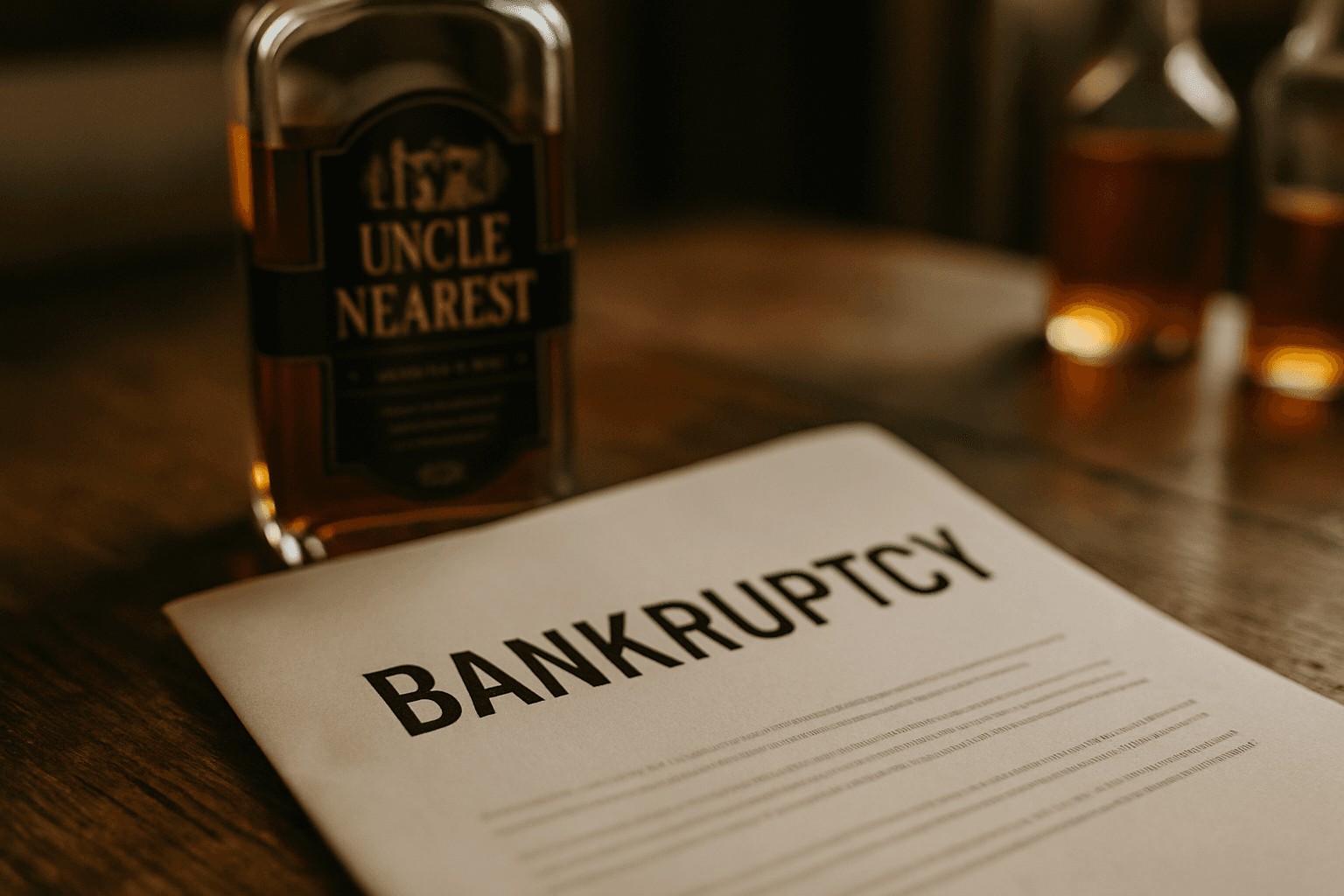
Uncle Nearest's Bankruptcy Filing: What a $108M Default Means for Independent Retailers Carrying Premium Bourbon Brands
By Intentionally Creative10 min read
Listen to this article13:13
Schedule a free strategy call and Intentionally Creative will build a custom plan for you.
Schedule Your Free Strategy CallFree audit. No commitment.
Get a Free Audit. No commitment.
Uncle Nearest bankruptcy filing follows $108M loan default. Here's what independent liquor retailers need to know to protect inventory and manage risk.
If you stock premium bourbon, you've almost certainly had a bottle of Uncle Nearest on your shelf — and probably sold it with pride. The brand's story was irresistible, the liquid won awards, and the growth trajectory looked unstoppable. Then, in early 2025, the Uncle Nearest bankruptcy filing landed like a grenade in the middle of the premium spirits aisle.
The numbers are staggering: $108 million in defaulted loans, a court-appointed receiver, and a fire sale of assets that includes French vineyards and a Cognac château most retailers never knew the company owned. For independent liquor store owners who built shelf space and customer trust around this brand, the fallout is immediate and personal. This isn't a Wall Street story — it's a "what do I do with the inventory in my back room" story.
This post breaks down exactly what happened, what the warning signs looked like, and — most importantly — what you should do right now to protect your business. Because Uncle Nearest won't be the last premium brand to implode, and the retailers who come out ahead will be the ones who saw the playbook clearly enough to act before the next one does.
Not long ago, Uncle Nearest was the darling of the American whiskey world. Built on the legacy of Nearest Green — credited as the first known African American master distiller [VERIFY: some historians dispute the specific "master distiller" title] — the brand had everything going for it: a powerful origin story, award-winning liquid, and explosive growth that earned it "whiskey unicorn" status in industry circles.
Then came the math.
The company defaulted on over $108 million in loans from Farm Credit Mid-America, its primary lender. For a brand that many independent retailers proudly stocked as a premium bourbon success story, the default sent shockwaves through the industry.
What made the debt particularly alarming was how far the company had stretched beyond its core business. Among the non-core assets now being sold off? French vineyards and a Cognac château. That kind of diversification might look visionary on a pitch deck, but it looks very different on a balance sheet when loan payments come due.
This didn't happen overnight. Here's how it unfolded:
For retailers carrying premium bourbon, this timeline matters. The warning signs were visible months before the public filing — missed maturity dates, mounting debt, overexpansion into unrelated categories. The question now is what it means for your store, your inventory, and your customers.
Hindsight is 20/20, but this collapse didn't come out of nowhere. If you were carrying this brand — or still are — here's what was brewing behind the scenes.
When a bourbon brand starts buying French vineyards and a Cognac château, that's not diversification — that's a company spending money it doesn't have on things it doesn't need.
Uncle Nearest built its reputation on a genuinely compelling origin story. That story moved bottles. But somewhere along the way, leadership decided bourbon wasn't enough. The $108 million debt didn't accumulate from making whiskey. It accumulated from empire-building.
For independent retailers, this is a textbook warning sign. When a supplier expands aggressively outside their lane — especially into unrelated international ventures — it often means they're chasing growth with borrowed money.
Here's where it gets messy. Founder Fawn Weaver announced the Chapter 11 filing on Instagram and through a press release — reportedly before the court-appointed receiver even knew. [VERIFY: confirm the specific sequence of events around the filing announcement] The receiver responded by asking a federal judge for sanctions. That's extraordinary, and it signals the kind of leadership instability that should make any business partner nervous.
The receiver has explicitly warned that returning the company to Weaver's control could expose it to additional lawsuits from creditors and investors. Meanwhile, Uncle Nearest has countersued Farm Credit alleging a "smear campaign," creating a legal tangle with no clear resolution.
For retailers who depend on consistent supply, reliable pricing, and brand stability, this level of chaos turns all three into question marks.
The Uncle Nearest situation isn't just a headline — it's a real operational concern if you carry their products. Here's what to watch.
Brands in receivership or bankruptcy often face disrupted production, inconsistent distribution, and unreliable promotional support. Independent retailers get hit hardest because you don't have the leverage of a national chain to demand priority fulfillment.
With leadership attention and capital now pointed at asset sales and legal battles, keeping your shelves stocked is nobody's top priority at headquarters.
Action step: Assess your current Uncle Nearest inventory levels now. Avoid over-ordering until the legal situation stabilizes. Tying up cash in product with an uncertain supply pipeline is a risk you don't need.
If inventory becomes scarce, secondary market speculation could temporarily inflate prices. But don't mistake scarcity hype for long-term brand value — that's a trap.
The bigger concern? Consumer confidence. Customers who connected with the brand's story may feel burned by the financial mismanagement. That emotional disconnect makes premium-priced bottles significantly harder to move off your shelf.
Watch your sell-through rates closely over the next 60 days. The data will tell you what your customers are already deciding.
The Uncle Nearest bankruptcy isn't an isolated incident — it's a warning shot. Spend five minutes in bourbon community forums on Reddit, and you'll find insiders saying the quiet part out loud: "Plenty of these new outfits will face a similar fate" over the next three years. That's not pessimism. It's pattern recognition.
The Uncle Nearest collapse is a case study in what happens when a premium brand overextends. Here's how to make sure your store doesn't get caught holding the bag next time.
Step 1: Audit your shelf exposure. Pull your sales data for the last 12 months. If any single brand accounts for more than 15–20% of your premium bourbon revenue, you're overexposed. Period. It doesn't matter how well it sells today.
Step 2: Spread your bets intentionally. Balance your premium lineup between established distilleries with proven financial stability and newer labels with transparent ownership structures. Rapid growth funded by massive debt isn't the same as sustainable growth. Look for brands that are scaling within their means.
Step 3: Talk to your distributors — and ask hard questions. Your rep likely knows about supply disruptions, shipping delays, or credit issues months before they hit the trade press. Buy them a coffee. Ask directly: "Any brands I should be watching?" Distributors are your early warning system. Use them.
Step 4: Monitor industry news actively. The Uncle Nearest receivership was public since mid-2024, well before the formal bankruptcy filing. Retailers who were paying attention had months to adjust orders and reduce exposure. Set a Google Alert. Follow a trade publication. Spend ten minutes a week staying informed — it's cheaper than writing off dead inventory.
Step 5: Build your markdown plan now, not later. If you're sitting on inventory from an at-risk brand, move it at a slight discount today rather than a steep one tomorrow. Consumers notice when a brand is in trouble, and premium bourbon lives and dies on perception. A 10% markdown that clears your shelf beats a 40% markdown six months from now on bottles nobody wants to buy.
This isn't a one-off. It's a correction.
Over the past five years, the premium spirits market has been flooded with venture-backed brands that prioritized explosive growth over basic profitability. When a brand with a genuinely powerful story ends up liquidating unrelated international assets just to stay solvent, the problem wasn't the product. It was undisciplined expansion funded by debt the business couldn't service.
The brands that survive this cycle will be the ones with real production capacity, manageable balance sheets, and authentic stories — not just marketing budgets.
Here's the upside: independent retailers can pivot faster than chains. You curate. You recommend. You know your customers by name.
This is your moment to lean into your role as a trusted advisor. Customers buying premium bourbon are going to want guidance on which bottles are worth $50+ — and which brands might not be around next year. Your recommendation carries real weight. Use it.
The Uncle Nearest bankruptcy is a wake-up call, not a funeral. The brand may restructure and survive. It may not. Either way, the lesson for independent liquor retailers is the same: no brand is too beloved to fail, and no story — however powerful — can outrun bad math.
Here's what to do this week:
10+ years helping liquor retailers and beverage brands grow through data-driven digital marketing. Learn more
Here's the playbook that keeps repeating: A new premium bourbon brand raises massive capital. The story is compelling. Investors pour in. The brand expands aggressively. Then credit tightens, and the math stops working.
Uncle Nearest's default didn't happen because the bourbon was bad. It happened because the company stretched far beyond its core product while the underlying business couldn't generate enough cash flow to service the debt. This leverage-fueled growth model works exactly until it doesn't.
As an independent retailer, you're uniquely exposed. You bet shelf space on trending premium brands without any window into their balance sheets. So watch for these red flags:
Any combination of these signals should prompt you to diversify your shelf — before the next default scenario leaves you holding dead inventory.
Intentionally Creative specializes in branding strategies that drive real results. Let us show you what's possible.
Schedule a CallThe bottom line: independent retailers who treat supplier risk like any other business risk — systematically, proactively, and without sentiment — are the ones who survive when a brand stumbles under the weight of its own ambition.
The retailers who thrive through market corrections aren't the ones with the best shelves — they're the ones with the best information and the willingness to act on it. You already have the instincts. Now build the system.
Want more actionable insights on managing your liquor retail business through market shifts? Subscribe to our newsletter for data-driven strategies delivered straight to your inbox.