Moët & Chandon's Schiphol Pop-Up Is a Masterclass in Experiential Retail: What Liquor Store Owners Can Steal From Luxury Brand Activations
Discover how experiential retail liquor store marketing ideas from Moët's luxury pop-up can help independent retailers drive loyalty, foot traffic, and sales.
- Why a Champagne Pop-Up in an Airport Should Be on Every Liquor Store Owner's Radar
- What Makes Moët's Pop-Up Work: 4 Principles of Luxury Brand Activation Worth Studying
- The Numbers Behind the Experience: Why Experiential Retail Is a Growth Lever, Not a Gimmick
- 5 Experiential Retail Ideas Liquor Store Owners Can Implement This Quarter
- How to Measure Whether Your Experiential Efforts Are Actually Working
A champagne brand just built a golden temple inside an airport terminal — and it has more to teach independent liquor store owners than a shelf full of retail textbooks. Moët & Chandon's pop-up at Amsterdam's Schiphol Airport isn't just a flex from a luxury house with deep pockets. It's a blueprint for turning a retail space into a destination, a transaction into a memory, and a one-time buyer into a loyal customer. If you've been wondering what experiential retail liquor store marketing actually looks like when it's done right, this is your case study.
You don't compete with Moët. You compete with the other liquor store three miles down the road — the one that's also stacking shelves and hoping foot traffic holds. The difference between stores that grow and stores that stagnate increasingly comes down to one question: Are you giving people a reason to walk in, stay longer, and come back? The tactics behind luxury brand activations aren't locked behind seven-figure budgets. They're built on principles any retailer can borrow.
In this post, we're breaking down exactly what makes the Moët Schiphol pop-up work, why the data says experience-driven retail is no longer optional, and — most importantly — how to adapt these ideas to your store, your budget, and your market starting this quarter.
Why a Champagne Pop-Up in an Airport Should Be on Every Liquor Store Owner's Radar
What Moët & Chandon Built at Schiphol (and Why It Matters Beyond Duty-Free)
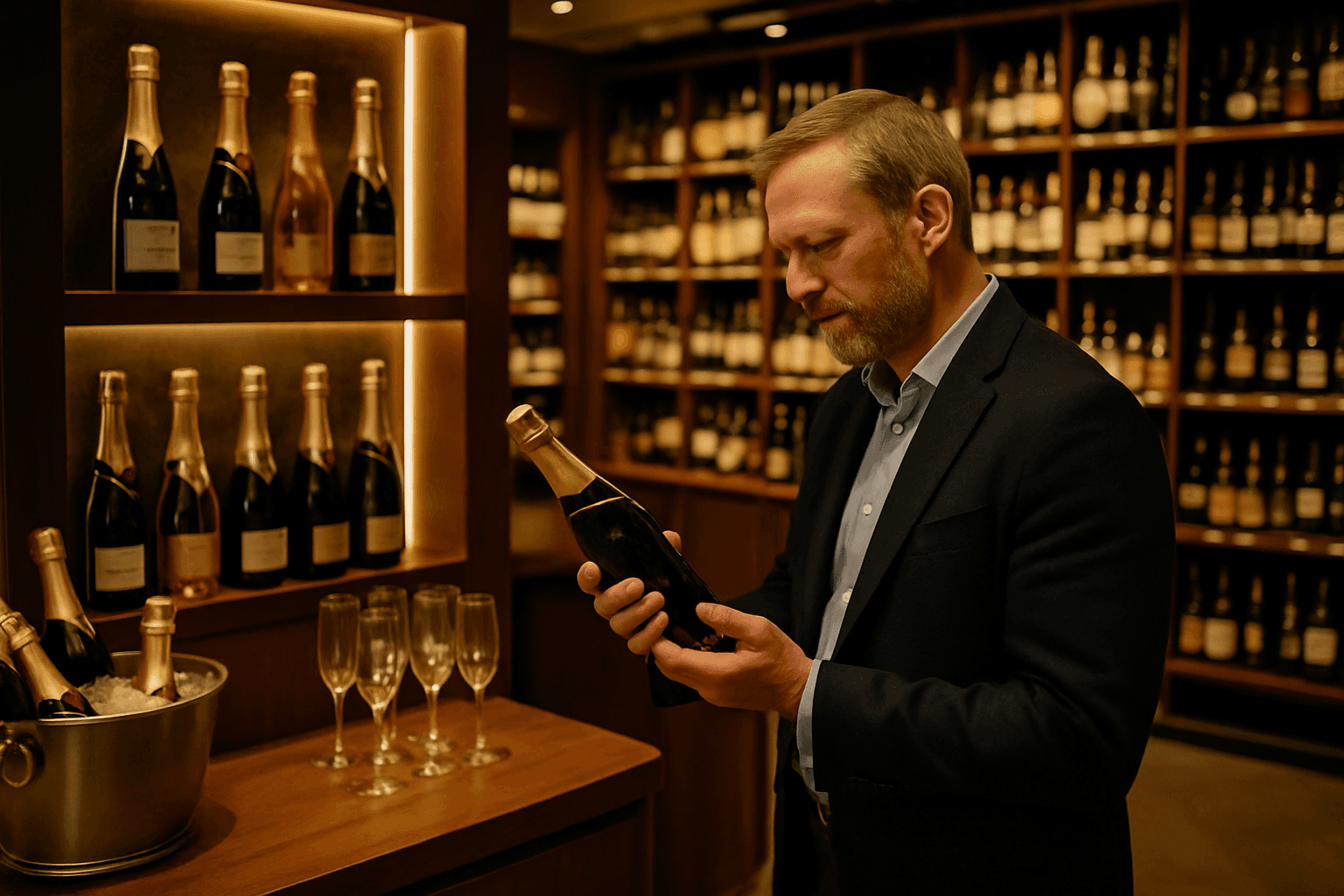
Picture this: You're rushing through Amsterdam's Schiphol Airport, boarding pass in hand, and you stop dead in your tracks. A golden, light-drenched space pulls you in — floor-to-ceiling brand storytelling, guided tastings led by trained ambassadors, and every surface designed to make you feel something before you buy anything. That's the Moët & Chandon Schiphol pop-up, and it's not just selling champagne. It's selling an experience. [VERIFY: Specific details of the Schiphol pop-up activation — confirm golden design, guided tastings, and ambassador staffing against source reporting.]
The activation has turned heads across both the retail and beverage industries because it nails something most stores don't even attempt: it makes the product secondary to the moment. Visitors walk away remembering how the space made them feel, not the price per bottle. And that emotional imprint? It drives purchase decisions long after the trip ends.
Discover 7 proven Instagram content ideas for liquor stores that boost engagement and drive sales. Learn how to promo...
The Bigger Trend: Experiential Retail Is No Longer Optional
Here's the number that matters: US beer, wine, and liquor store revenue is growing at just a 2.2% CAGR, according to IBIS World. That's barely keeping pace with inflation. Layer on the accelerating trend of consumers drinking less — choosing fewer, better bottles — and the margin for differentiation becomes razor-thin.
Stores that feel like destinations will win. Stores that feel like warehouses will lose. It's that simple.
The industry is already moving this direction. AI-powered platforms like PINATA are being deployed at national scale for spirits brand experiential and field marketing execution, signaling serious tech investment in tasting-led, consultation-based retail. But you don't need Moët's budget to borrow Moët's playbook. In the sections ahead, we'll break down the specific tactics driving results and show you how to adapt them — realistically — at independent-store scale.
So what exactly makes this pop-up more than just a pretty photo op? Let's pull it apart.
Avoid TTB violations and Google Ads suspension with this guide to alcohol advertising rules for liquor stores. Expert...
What Makes Moët's Pop-Up Work: 4 Principles of Luxury Brand Activation Worth Studying
The Moët Chandon Schiphol pop-up isn't just pretty — it's engineered. Every detail serves a commercial purpose wrapped in velvet. Here are four principles driving it, and how they translate directly to your store.
Principle 1: Sell the Story, Not Just the Bottle
Moët doesn't hand you a glass and say "this is champagne." They walk you through their heritage — vineyard imagery, the Épernay cellars, the craft behind every bottle. They make you feel something before you taste anything. That emotional scaffolding is what turns a $60 bottle into a $60 experience someone's happy to pay for. [VERIFY: Confirm Moët was founded in 1743 — approximately 281 years of heritage as of 2024.]
You don't need centuries of history to do this. Partner with a local distillery and tell their founder's story on a shelf talker. Train your staff to share one compelling origin detail during tastings. Narrative sells. Period.
Principle 2: Design for the Senses (All of Them)
Luxury brand activations lean hard on multi-sensory design — warm lighting, curated music, even ambient scent. The goal is to slow people down. More dwell time means more discovery, more conversation, more spend.
10 wine club marketing tactics that reduce the 40% year-one cancellation rate and boost member spending at your liquo...
You don't need a Schiphol-sized budget. Swap fluorescent lights for warmer bulbs in your tasting corner. Play a playlist that matches the vibe of what you're pouring. These small shifts change how your store feels, and feeling drives buying.
Principle 3: Make It Shareable Without Begging for Shares
Notice what's missing from luxury pop-ups? Signs that say "Tag us on Instagram!" The design itself does the work — a striking backdrop, beautiful glassware, an unexpected moment. Independent retailers can apply this with a well-designed seasonal display or a tasting nook that looks intentional. When it's genuinely worth photographing, people photograph it.
Principle 4: Use the Experience to Capture Data
Here's where the business case gets sharp. Moët captures emails, taste preferences, and purchase intent at every activation. The stores that win long-term will be the ones building first-party data — not just ringing transactions.
Every tasting event should collect an email. Every sign-up should capture a preference. Independent stores running pop-up events without a data capture strategy are leaving money — and relationships — on the table.
Start treating every in-store experience as both a brand moment and a data moment. That's the real lesson from Moët's playbook.
Those four principles sound compelling in theory. But do the numbers actually back them up? Let's look at what the data says.
The Numbers Behind the Experience: Why Experiential Retail Is a Growth Lever, Not a Gimmick
Consumers Are Drinking Less — But Spending More on Experiences
You've seen it on your shelves. The sober-curious movement isn't a fad — it's an accelerating consumer shift. People are buying fewer bottles but trading up when they do buy. Volume-based sales strategies are losing steam, full stop.
This is exactly why tasting-led and consultation-based in-store experiences have become a critical growth lever. They give customers a reason to spend more per visit — even if they're visiting less often. Think guided tastings, food-pairing classes, or curated seasonal events. These aren't gimmicks. They're how off-premise retailers protect and grow revenue per customer in a market that's shrinking on volume.
Steady Revenue Growth Demands Smarter Differentiation
At 2.2% annual growth, the liquor retail market isn't collapsing — but it's not booming either. In a market growing that slowly, stores competing on price alone are in a race to the bottom.
The industry's biggest players already know this. They're investing heavily in experience-driven marketing because it creates pricing power, cultivates brand loyalty, and drives long-term sales. Promoting alcohol brands in 2025–2026 is fundamentally about lifestyle and experience, not just the product on the shelf. The stores that internalize this shift will capture disproportionate market share in their local areas — while their competitors keep slashing prices and wondering where the margin went.
Alright — enough about why this matters. Let's get into the how. Here are five ideas you can actually execute this quarter without blowing your budget.
5 Experiential Retail Ideas Liquor Store Owners Can Implement This Quarter
Growth in this industry isn't distributed evenly. It's going to stores that give people a reason to walk in. Here's how to make experiential retail liquor store marketing work on a real-world budget.
1. The 'Mini Pop-Up' Tasting Station
Dedicate a small, well-designed area to rotating tastings. The key word is consistent — every Friday from 5–7 PM, for example — so customers build the habit of stopping by. Partner with distributors or local producers who will often supply product and staff at no cost to you. Capture emails at every single session. That list becomes your most valuable marketing asset.
2. Themed Experience Nights With Local Partners
Think "Bourbon & BBQ" pairings, "Champagne 101" classes, or "Mezcal Meets Chocolate" evenings. Partner with local restaurants, cheese shops, or chocolatiers to split costs and cross-promote to each other's audiences. These events transform your store from a transaction point into a community hub — which is exactly the luxury brand activation playbook scaled down to Main Street.
3. The Consultation Corner: Guided Buying as a Service
Train your best staff — or bring in a guest sommelier monthly — to offer free, no-pressure 10-minute guided consultations. This consultation-based model builds the kind of trust that converts to higher average basket sizes. It also positions your store as a place people come for expertise, not just inventory.
4. Seasonal or Limited-Edition Display Takeovers
Redesign one endcap monthly with immersive, story-driven displays. A "Summer in Provence" rosé section. A "Kentucky Heritage" bourbon wall. Use props, origin-story signage, and QR codes linking to content. This is your independent-store version of the Moët Schiphol visual storytelling — no airport terminal required.
5. Digital-Physical Hybrid Experiences
Place QR codes at displays linking to cocktail recipe videos, producer interviews, or exclusive online offers. The tech infrastructure for blending digital and physical retail is becoming accessible even for smaller operators — platforms like PINATA are proof that brands are investing heavily in this space. These are solid pop-up marketing ideas that don't require a luxury budget, just intentional execution.
Running events and building displays is one thing. Knowing whether they're actually working is another. Here's how to keep yourself honest.
Let our team show you what's possible.
our team specializes in branding strategies that drive real results. Let us show you what's possible.
Schedule a CallHow to Measure Whether Your Experiential Efforts Are Actually Working
You ran a tasting. People showed up. It felt successful. But feelings don't pay rent. If you're investing in experience-driven retail, you need to know it's moving the needle.
The Metrics That Matter for In-Store Activations
Here are the KPIs worth tracking at the independent store level:
- Event attendance and repeat attendance rates — Are the same people coming back? That's loyalty forming.
- Email/SMS list growth per event — Every new contact is a future sale.
- Average transaction value on event nights vs. regular nights — This is your money metric.
- Sell-through rate on featured products — Did that brand partnership actually move bottles?
- Social media mentions and tagged posts — Free reach, earned through experience.
Simple Tracking Methods That Don't Require Enterprise Software
You don't need the platforms that national brands use for field marketing execution. A Google Form on a tablet at your tasting captures emails. Your POS data already shows event-night revenue versus your weekly average. Track featured-product sales for 30 days post-activation to see the tail effect.
Experience-driven selling isn't optional — it's your growth lever. These metrics directly tie experience to revenue, proving to yourself (and any skeptical partners) that the investment works.
Now for the question every owner asks — and should ask: what does all of this actually cost?
The Budget Reality: What This Actually Costs (and Where to Find Help)
Let's address the elephant in the room: Moët Chandon's Schiphol pop-up had a budget that probably exceeds your annual revenue. That's fine. The principles behind luxury brand activations scale down beautifully — and cost far less than you think.
Low-Cost, High-Impact Starting Points
A basic tasting event can run $50–$200 out of pocket when you negotiate product support from your distributors. A themed night with a local restaurant, florist, or cheese shop? That might cost nothing beyond staff time if you structure it as a co-marketing arrangement where both parties promote to their audiences.
Wine shops and liquor stores nationwide are already reinventing themselves as experience destinations through tastings, classes, and curated events. The real question isn't whether you can afford to do it. It's whether you can afford not to.
Leveraging Distributor and Brand Partnerships
Most spirits brands have allocated trade marketing budgets specifically for in-store activations. The problem? Many independent retailers never ask.
Your approach matters. Don't request free product. Instead, pitch your store as a stage for their brand story — a place where their target customer already shops. Bring a simple one-page proposal: the event concept, expected foot traffic, how you'll promote it, and what support you need.
Brands are investing more in experiential marketing, not less. That money has to land somewhere. Make sure some of it lands in your store.
The Bottom Line: You Don't Need a Luxury Budget to Create a Luxury-Level Experience
The Moët Chandon Schiphol pop-up didn't work because of a massive budget. It worked because of principles — storytelling, sensory design, data capture, and shareability. Every single one of those scales down to an independent liquor store.
Here's the reality check: with modest industry growth and consumers actively trading volume for quality, price-driven retail is a race to the bottom. The stores that create compelling reasons to visit — beyond discounts — will be the ones still thriving in five years. Experiential retail liquor store marketing isn't a passing trend. It's the new baseline for staying competitive.
So here's your move: pick one idea from this post. Just one. A Friday tasting station. A themed pairing night. A redesigned endcap. Execute it within 30 days. Measure what happens — foot traffic, email signups, social mentions, sales lift. Then iterate.
That's how you build a real experiential strategy. Not with a luxury brand activation budget. One activation at a time.
Need a starting point? Grab a calendar, pick your first event date, and call your top distributor rep this week. The best time to start was last quarter. The second best time is now.
10+ years helping liquor retailers and beverage brands grow through data-driven digital marketing. Learn more