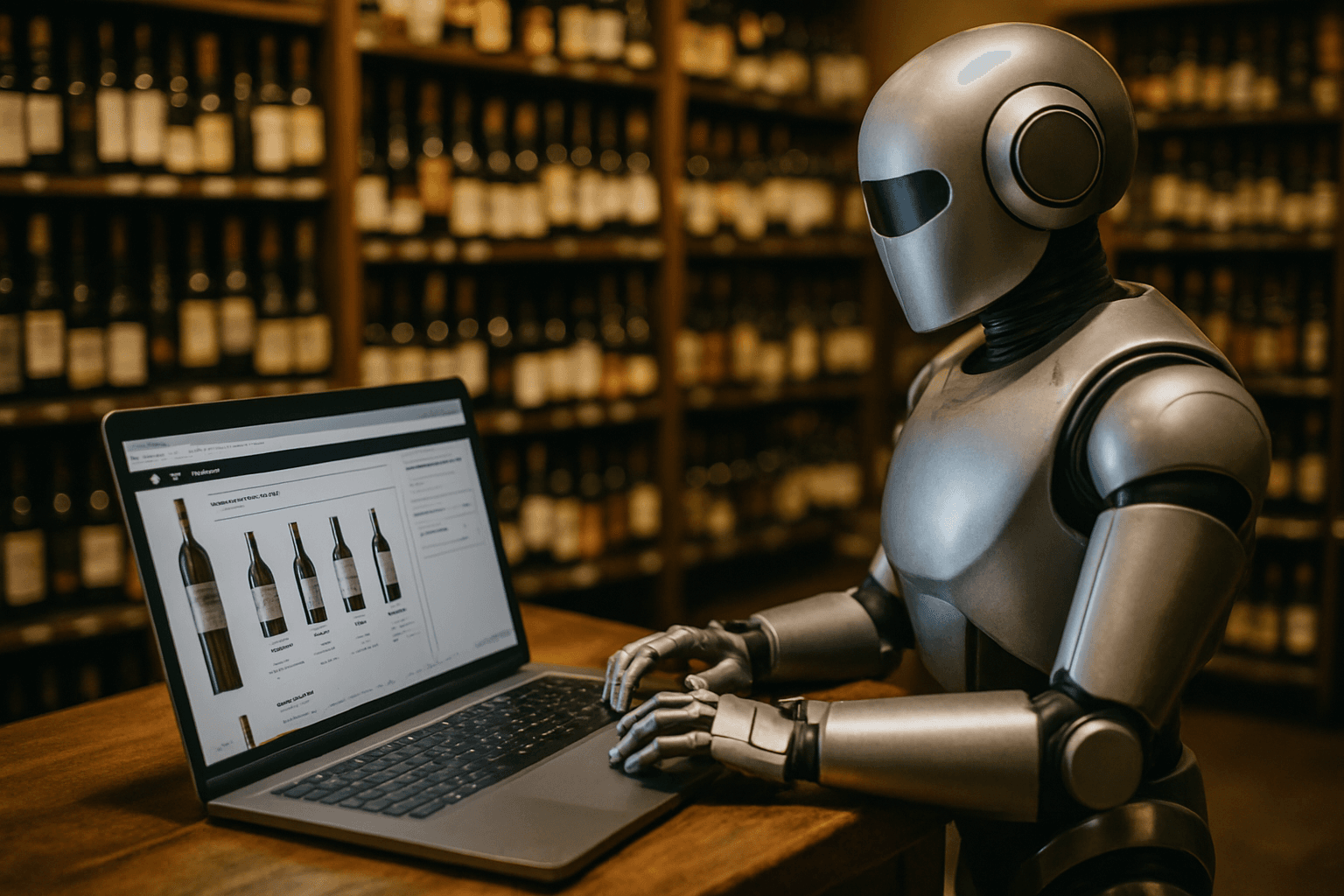
AI Concierge Tools Are Coming to Beverage Retail: How Automated Chat and Recommendation Engines Can Work for Liquor Store Websites
By Intentionally Creative11 min read
Listen to this article15:47
Schedule a free strategy call and Intentionally Creative will build a custom plan for you.
Schedule Your Free Strategy CallFree audit. No commitment.
Get a Free Audit. No commitment.
AI concierge tools for liquor store websites are here. Learn how automated chat, recommendation engines, and AI assistants can boost sales and compete smarter.
The liquor retail industry is at a turning point — and it's not about what's on your shelves. It's about what happens when a customer visits your website and nobody's there to help them.
Picture this: A customer lands on your site at 10:47 PM. They're hosting a dinner party tomorrow. They need a wine that pairs with lamb, a bourbon for their father-in-law, and maybe a mezcal for cocktails. They browse for three minutes, get overwhelmed by 200 options with no guidance, and leave. You just lost a $150 cart — not because your inventory failed them, but because your website couldn't talk to them.
This is the discovery problem, and it's where most liquor store websites quietly bleed revenue.
While big-box chains and online mega-retailers pour millions into personalized digital shopping experiences, most independent stores are still running websites that function like static billboards. The gap is growing, and it's costing you sales you never even see.
But here's the good news: the technology that was once reserved for enterprise-level retailers is now within reach. AI concierge tools for liquor store websites — think intelligent chatbots, recommendation engines, and behind-the-scenes automation — are entering the market at price points and complexity levels that make sense for independent operators. Some are patented platforms backed by massive datasets. Others are scrappy DIY builds you can launch over a weekend. All of them are designed to solve the same fundamental problem: your website can't sell like your best employee can. Yet.
Learn how to optimize your Google Business Profile for liquor stores with tips on photos, posts, reviews, and categor...
In this post, we'll walk through exactly what these tools are, who's building them, what they cost, and whether the ROI justifies the investment for a store your size. No hand-waving — just a practical breakdown of a technology shift that's already reshaping how liquor gets sold online.
Let's cut through the buzzwords. These tools fall into two main categories, and both are designed to do one thing: sell more product while making your customers feel like VIPs.
You've seen those clunky chat bubbles on websites that spit out canned answers. That's not what we're talking about here.
An AI chatbot built for liquor retail is a conversational tool that can answer product questions ("Do you carry mezcal under $40?"), suggest food pairings, guide shoppers through your inventory, and — in some cases — complete the entire purchase right inside the chat window. City Hive's Tipsy Bot, for example, positions itself as the first AI assistant capable of completing actual local alcohol purchases through conversation.
Learn how email segmentation for liquor stores drives repeat sales with a 4,200% ROI. List-building tactics, purchase...
What separates purpose-built tools from generic chatbots? Industry knowledge. Solutions designed for beverage retail understand compliance requirements, delivery zone restrictions, and the sheer complexity of a catalog that might include 5,000+ SKUs across spirits, wine, and beer. Automated chat in this space has to handle age verification, local regulations, and product nuance that a plug-and-play widget simply can't.
A recommendation engine analyzes customer behavior, preferences, and purchase history to surface products your shoppers didn't even know they wanted. DRINKS.com invested heavily enough in this concept to patent their PAIR (Predictive AI Retailing) platform, which leverages large-scale purchasing and preference data to match the right alcohol products with the right customers. [VERIFY: Confirm PAIR patent status and current availability, as DRINKS.com has undergone corporate changes.]
As Bottlecapps has highlighted, this technology moves liquor retail beyond basic search into guided discovery, personalizing the experience and building the kind of loyalty that keeps customers coming back.
Think of it this way: these tools act like your best floor employee — the one who remembers every customer's name and preferences, never calls in sick, and works every shift including holidays. Except this employee can handle hundreds of conversations simultaneously and gets smarter with every interaction.
Wine shops are becoming experience destinations by adding tastings, classes, and events. See how real retailers are d...
The market is moving fast — and a few companies are worth watching closely.
Tipsy Bot positions itself as the first AI assistant that can complete local alcohol purchases end-to-end through conversation. That "end-to-end" part is the key detail. Plenty of chatbots can answer questions like "What pairs well with grilled salmon?" But Tipsy Bot is designed to go further — from preference discovery ("I like smooth reds under $25") through product selection, cart building, and checkout. It's not just a recommendation tool. It's a sales closer. For store owners, that distinction is the difference between a novelty and a revenue driver.
DRINKS.com took a different approach with PAIR — Predictive AI Retailing. This is patented technology, which tells you something important: when a company invests in intellectual property, they're not experimenting. They're building infrastructure. PAIR uses large-scale purchasing behavior, taste profiles, and trend data to match customers with products they're likely to buy — predictive intelligence at a scale no human staff member could replicate. [VERIFY: Confirm PAIR's current operational status and availability to independent retailers.]
Then there's LiquorChat, a purpose-built chat solution for beverage retail that combines conversational ordering with practical logistics — including delivery zone management. [VERIFY: Confirm LiquorChat is a currently active product/company.] That last detail matters more than it sounds. If you're running local delivery, knowing whether a customer's address is in your zone before they build a big cart saves everyone frustration.
The bigger picture: when companies are filing patents and building industry-specific platforms, we're past the "wait and see" phase. These aren't prototypes. They're products — and they're competing for your business.
Not every store owner is ready to invest in an enterprise platform. That's fair. The good news? DIY solutions are more accessible than ever, and they're a legitimate way to start exploring AI-assisted selling without a major commitment.
YouTube is full of step-by-step tutorials showing small business owners how to build ChatGPT-powered chatbots using OpenAI's API and free tools like tawk.to's AI Assist. The basic setup: you train a chatbot on your product catalog, tasting notes, store policies, and common customer questions. Embed it on your website, and it handles inquiries like "What's a good bourbon under $40?" or "Do you carry natural wines?"
It's not magic — it's a straightforward chatbot that runs on your own data.
A homemade chatbot can genuinely improve customer experience. It answers questions at 2 AM. It suggests bottles based on flavor preferences. It keeps browsers on your site longer.
But let's be real about the gaps. DIY chatbots won't process checkout, manage delivery logistics, or navigate alcohol compliance rules out of the box. They need ongoing maintenance and careful prompt engineering to avoid recommending products you don't stock. Compare that to enterprise platforms with dedicated data science teams, and the gap becomes clear.
Still, DIY is a smart way to test the waters. See how your customers actually respond to AI-assisted shopping before writing a bigger check. The data you gather now will make you a smarter buyer later.
So far, we've focused on the tools your customers interact with directly. But the real transformation is happening where your customers can't see it.
All of this sounds promising — but you didn't get into this business by chasing every new trend. Let's talk numbers.
AI concierge tools on liquor store websites create measurable value in four specific areas:
Higher average order values. A recommendation engine that suggests a complementary vermouth when someone adds gin to their cart isn't annoying — it's helpful. Smart upselling and cross-selling work because they're contextual.
Reduced cart abandonment. When a customer hesitates — "Does this ship to my zip code?" "Is this bourbon similar to the one I liked last time?" — a chatbot answers instantly. No waiting, no bouncing to a competitor.
Repeat purchases through personalization. Predictive retailing technology is entering the independent space. Customers who feel understood come back.
Labor savings. Every "What are your hours?" or "Do you carry Blanton's?" handled by automated chat is time your staff spends on higher-value work.
Here's the honest framework: if your website drives meaningful traffic and supports online ordering, the ROI case is strong. If your site is a digital business card with no e-commerce functionality, fix that foundation first.
These tools won't drive traffic — that's marketing. They won't compensate for a weak product selection. And they absolutely won't replace the human relationships that make your store your store. They amplify what's already working.
But the competitive pressure is real. Platforms like City Hive's Tipsy Bot are already enabling conversational AI that completes actual alcohol purchases. As chains and online retailers adopt these tools, customer expectations for personalized digital experiences will rise. Independents who move early gain the advantage. Those who wait will be playing catch-up.
Ready to move from "interesting idea" to actual implementation? You don't need a massive budget or a tech team. You need a plan.
AI tools need a foundation. Before anything else, confirm your website has a functional product catalog, e-commerce capability, and decent traffic. If customers can't browse and buy online, a recommendation engine has nothing to recommend — and a chatbot has no one to talk to. Fix the basics first.
Match your starting point to your budget and goals. Low budget? Build a DIY ChatGPT-powered chatbot to test whether customers actually engage. Mid-range? Explore purpose-built platforms like LiquorChat designed specifically for beverage retail. Ready to invest? Evaluate full-ecosystem solutions — City Hive's Tipsy Bot for conversational commerce, or DRINKS.com's PAIR technology for data-driven recommendations. The options exist across every price point.
Track results from day one. Monitor chat engagement rates, recommendation click-throughs, average order value changes, and customer feedback. Data tells you whether to scale up or pivot — gut feelings don't.
The liquor retail landscape is shifting under everyone's feet. Customers increasingly expect the kind of personalized, instant digital experience they get from every other category — and they're not going to lower those expectations because your industry is more regulated or your store is independently owned.
AI concierge tools for liquor store websites aren't a silver bullet, and we'd never tell you they are. But they are a genuine competitive lever — one that's becoming more accessible, more proven, and more necessary with every quarter that passes. The stores that start experimenting now, even with a simple DIY chatbot, will have the data, the customer insights, and the operational know-how to scale when the technology matures further. The stores that wait will be starting from zero while their competitors are already optimizing.
10+ years helping liquor retailers and beverage brands grow through data-driven digital marketing. Learn more
Back-end AI is quietly reshaping how liquor stores operate, and the stores paying attention are gaining a serious edge.
Imagine your POS sales data feeding directly into a reordering system that knows your Espolòn Blanco flies off shelves every Thursday through Saturday — and automatically flags when stock dips below a two-day supply. That's not science fiction. Predictive purchasing intelligence, like the approach behind DRINKS.com's PAIR platform, is being scaled down for independent retailers. The website payoff? Your online catalog never shows "out of stock" on a trending product right when demand peaks.
Here's where back-end AI directly fuels your digital marketing. If your site lists 2,000 SKUs with copy like "750ml, red wine, Italy" — you're invisible to search engines and unhelpful to shoppers. AI can generate detailed tasting notes, flavor tags, food pairings, and occasion-based descriptions in hours, not weeks.
That clean, rich product data becomes the foundation for everything customer-facing: your recommendation engine serves smarter suggestions, your chatbot pulls accurate tasting notes, and your SEO improves across the board.
Better data in, better customer experience out. It's that straightforward.
Intentionally Creative specializes in web design strategies that drive real results. Let us show you what's possible.
Schedule a CallThe question isn't whether this technology is coming to beverage retail. It's whether you'll be ahead of it or catching up.
Want help figuring out where AI fits into your store's digital strategy? Get in touch with Intentionally Creative — we help liquor retailers build websites and digital experiences that actually sell.