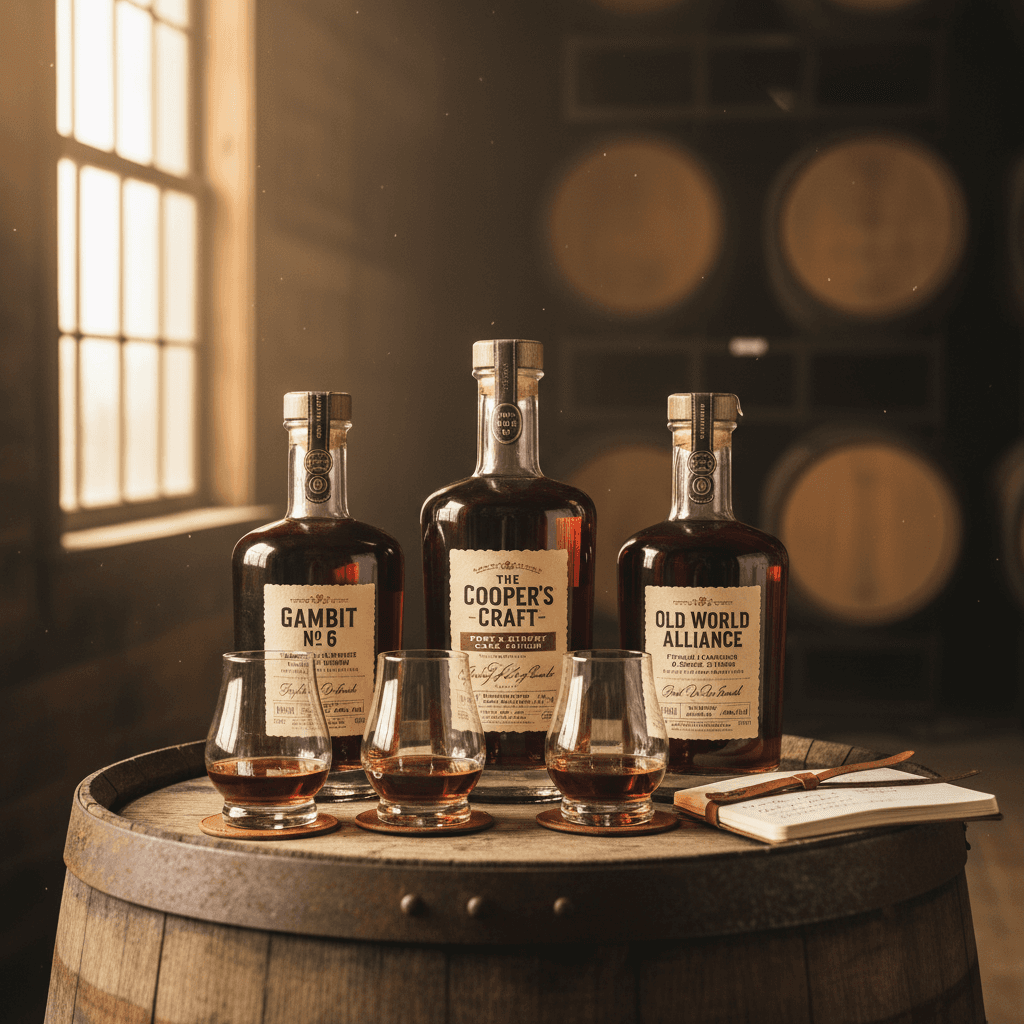
Gambit No. 6 and the Rise of Multi-Barrel-Finish Bourbons: How to Merchandise Limited-Edition Spirits That Justify Premium Price Tags
By Intentionally Creative11 min read
Listen to this article15:03
Schedule a free strategy call and Intentionally Creative will build a custom plan for you.
Schedule Your Free Strategy CallFree audit. No commitment.
Get a Free Audit. No commitment.
Multi-barrel finish bourbon is booming. Learn how to merchandise limited-edition spirits like Gambit No. 6 to justify premium prices and drive retail sales.
Your bourbon aisle is telling a story whether you've planned it or not. And right now, the most profitable chapter in American whiskey retail is being written by bottles that didn't stop at one barrel.
Multi-barrel finish bourbon — spirits aged in a primary cask, then transferred to a second or third barrel for additional flavor development — has quietly evolved from a distiller's experiment into a full-blown retail category. It's winning top honors at major competitions, commanding $60 to $130+ price points that customers are happy to pay, and creating the kind of enthusiast loyalty that turns a one-time buyer into a monthly regular. Yet most independent liquor stores still merchandise these bottles the same way they did five years ago: scattered across the bourbon wall with no connective tissue, no story, and no strategy.
That's a margin problem disguised as a shelving decision. In this guide, we're breaking down exactly how to merchandise limited-edition finished bourbons — using Gambit No. 6 and its award-winning peers as case studies — so every bottle earns its price tag in your customer's mind before they ever crack the seal. From tiered display strategies and staff education to packaging psychology and event-driven drops, here's your playbook for turning premium spirits into your store's competitive edge.
Five years ago, a bourbon finished in a second barrel was a curiosity. Something you'd hand-sell to the adventurous customer. Today? These bottles have their own shelf sections, their own award categories, and their own fiercely loyal customer base. If your store still treats them as one-offs scattered across your bourbon aisle, it's time to rethink your approach.
Functional beverages are projected to hit $248-250B by 2030. Here's what that means for your shelf mix and how to cap...
The proof is in the planograms. Major retailers like Total Wine now dedicate entire themed sections to double-barrel and finished bourbons — their category includes expressions ranging from 3-year-old bourbons finished in heavy toasted oak all the way up to premium limited releases. Curated online platforms like Seelbach's maintain full "Finished Whiskeys" collections as a standalone browsing category.
This shift tells you something critical about limited-edition bourbon merchandising: when the biggest players in retail carve out dedicated real estate for a subcategory, it's no longer a novelty. It's a category demanding its own shelf strategy in your store, too.
Quality validation is driving premium pricing in this space. Shortbarrel Double Oak Bourbon — a $90 bottle — won Best Overall Bourbon at the 2026 WSWA Wine & Spirits Tasting Competition. Not best finished bourbon. Best overall bourbon. That's a credibility signal your customers notice.
Discover 9 proven marketing for liquor stores strategies to capitalize on the booming non-alcoholic beverage market i...
Meanwhile, Barrell Craft Spirits has built an entire brand identity around creative finishing and an expansive cask library. Their Cigar Blend has earned "gold standard" status among enthusiasts, driving the kind of brand loyalty most distilleries dream about. Bardstown Bourbon Co.'s Origin Series, finished in toasted cherry wood and oak at $59.99, proves there's an accessible entry point too.
The takeaway? If you're not merchandising finished bourbons as a distinct, premium category — with intentional placement, clear signage, and a range of price points — you're leaving real money and genuine customer engagement on the table. Let's talk about how to fix that.
Your customers don't need a distilling degree. They need a reason to spend $60–$130 on a bottle instead of grabbing their usual $35 go-to. That reason starts with your team understanding — and confidently explaining — what the finishing process actually delivers.
Diageo's mini canned cocktail launch is reshaping spirits retail. Here are 9 actionable steps for liquor store owners...
Here's the 30-second version your staff should memorize: Bourbon ages in its first barrel, developing core flavors. Then it gets transferred to a second (or third) barrel that has different char levels, toast profiles, or previously held wine. That second barrel adds new layers of complexity — vanilla deepens, fruit notes emerge, spice shifts. It's like a second education for the whiskey.
Litchfield Distillery illustrates this well. They proof their bourbon to 90, then re-barrel it for an additional year in fresh oak. That extra step isn't gimmicky — it's deliberate flavor building. And it's exactly the kind of story that converts a browser into a buyer when your staff tells it with confidence at the shelf.
The range of finishing techniques has exploded, and each one gives you a distinct merchandising angle:
Here's what matters for your merchandising: age isn't the sole value driver anymore. The finishing process is. Put that on your shelf signage and watch the conversation change.
Gambit No. 6 is what happens when a distillery nails every element the modern bourbon buyer is hunting for.
This release represents the best of what the finished bourbon category offers: craft finishing technique, genuine scarcity, a compelling brand narrative, and a price point that reflects the labor behind the liquid. It's the kind of release that belongs in the same conversation as Penelope Bourbon's Private Select program and Maker's Mark Limited Release — multi-finish expressions designed as retailer-exclusive and direct-to-consumer engagement tools.
Here's the competitive reality: bourbon enthusiast communities on Reddit have dedicated threads specifically requesting finished and uniquely finished recommendations. Those people are actively looking for a store that carries exactly this.
Big-box retailers stock double-barrel expressions, sure — some as young as three years old. But they can't tell the story. They can't host the tasting. They can't create the experience.
You can. Releases like Gambit No. 6 aren't just inventory — they're your competitive advantage, giving independent retailers the edge where it matters most: the conversation between your staff and a curious buyer willing to spend more for something worth knowing about.
Your finished bourbons shouldn't be scattered across a sprawling bourbon wall, hoping customers connect the dots. They won't. The retailers winning this category — Total Wine, Seelbach's — have already proven that grouping finished bourbons into a dedicated section drives both discovery and basket size.
Here's an uncomfortable truth about selling a premium limited-edition bottle: the liquid inside matters enormously, but your customer can't taste it before they buy. What they can do is pick up the bottle, read the label, and decide whether this feels like a $100+ purchase.
Cooperstown Distillery houses their limited-edition bourbon in an ornamental baseball bottle that practically sells itself as a display piece. Angel's Envy takes a different approach, positioning its rare finished bourbon releases as premium gifting occasions — the kind of bottle you bring to a dinner party when you want people to remember you brought it.
The bottle becomes part of the purchase rationale. And your merchandising needs to reinforce that.
If you merchandise a premium spirit like everything else on the shelf, customers will treat it like everything else. Dedicated placement, intentional lighting, and minimal but compelling signage signal that this bottle is worth the ask. When a bottle wins a major national competition, that accolade deserves a shelf talker — not a spot crammed between mid-shelf mixers.
Coach your team to sell the story, not the specs. A customer choosing between a $60 entry-tier bottle and a $120 limited release doesn't need a chemistry lesson. They need to know that the bourbon spent extra time in a specialty cask and that production was genuinely limited. Scarcity plus craft equals permission to spend.
Then build in-store moments around limited-edition drops:
Your bourbon customers have done their homework. They've watched the YouTube reviews, scrolled the Reddit threads, and they'll sniff out a generic sales pitch instantly. That's why staff education is the highest-ROI investment in your premium spirits playbook.
Start a 10-minute weekly huddle focused on one featured finished bourbon. Cover three things: tasting notes, the finishing process, and why the price makes sense. That's it.
When your team knows that a bottle was proofed down and re-barreled for an additional year of aging in a specific cask type, they can explain the why behind the price tag. Customers stop seeing $90 as expensive and start seeing it as earned.
Equip your team with comparison language, not feature lists. Something like: "If you like Woodford Reserve Double Oaked, Bardstown's Origin Series takes that same concept but finishes in toasted cherry wood — more complexity, and it's only $59.99."
Or: "Gambit No. 6 sits in that sweet spot between the entry-level finished bourbons and the top-shelf collectibles. It's where you get the best combination of craft and value."
Relatable comparisons like these convert faster because they meet knowledgeable customers where they already are. Your staff becomes the reason people come back — and that's something no big-box retailer can replicate.
Multi-barrel finish bourbon is award-winning, consumer-demanded, and priced to protect your margins — from $60 entry-tier expressions up to $130+ limited releases. Independent retailers are uniquely positioned to own this category through curation, education, and experience that big-box stores simply can't replicate.
10+ years helping liquor retailers and beverage brands grow through data-driven digital marketing. Learn more
Here's how to build a display that actually moves product.
Think in three tiers with real price points your customers will encounter:
Build a dedicated "Multi-Barrel Collection" section — even a 4-foot endcap works. Place your highest-margin limited edition at eye level, flanked by mid-tier options. This is classic price anchoring: that $130 bottle makes the $90 Shortbarrel feel like a smart buy by comparison.
Now the critical piece most retailers skip — shelf talkers. Keep them to one or two sentences that tell the finishing story: what barrel it finished in, what flavors to expect, and why the price reflects extra time and craft. That process story is the value proposition.
When customers understand why a bottle costs what it costs, the premium pricing justifies itself.
Intentionally Creative specializes in digital marketing strategies that drive real results. Let us show you what's possible.
Schedule a CallThese tactics turn a single SKU into a traffic driver and position your store as the destination for bourbon enthusiasts in your market.
The rule is simple: give the bottle the stage it deserves, arm your staff with the narrative, and create urgency. That's how you merchandise limited-edition spirits that justify every dollar of that price tag.
The stores that treat premium spirits as a merchandising category — not just a shelf position — will capture both the margin and the loyal customers that come with it. The opportunity is sitting on your shelf right now. Merchandise it like one.