Geofencing for Liquor Stores: How Location-Based Ads Turn Nearby Shoppers Into Customers
By Intentionally Creative11 min read
Listen to this article14:00
Schedule a free strategy call and Intentionally Creative will build a custom plan for you.
Schedule Your Free Strategy CallFree audit. No commitment.
Get a Free Audit. No commitment.
Geofencing for liquor stores lets you target nearby shoppers with timely ads. Learn how location-based marketing drives real foot traffic and measurable ROI.
Right now, someone is driving past your liquor store. They need a bottle of wine for dinner, a six-pack for the weekend, or a gift-worthy bourbon for a friend's birthday. They're close. They're ready to buy. And they have no idea you exist — because nothing on their phone told them to stop.
That's the problem geofencing for liquor stores solves. Instead of blasting ads across an entire city and hoping for the best, geofencing lets you reach shoppers at the exact moment they're near your door, already in buying mode, already out in the world with their wallet. It's the difference between a billboard on the highway and a friendly tap on the shoulder from someone saying, "Hey — we've got exactly what you're looking for, right around the corner."
In this guide, we'll break down how geofencing actually works, why it's uniquely powerful for beverage retail, and how you can launch your first campaign without a tech degree or a six-figure budget. Whether you're trying to pull customers away from a competitor, re-engage lapsed loyalty members, or simply get more local foot traffic on a slow Tuesday, this is the playbook.
You've probably spent money on digital ads before. Maybe you boosted a Facebook post, ran some Google Ads, or even tried a coupon mailer. And maybe the results were... fine. Underwhelming. Hard to measure.
Geofencing is a different animal entirely — and it's worth understanding why.
10 wine club marketing tactics that reduce the 40% year-one cancellation rate and boost member spending at your liquo...
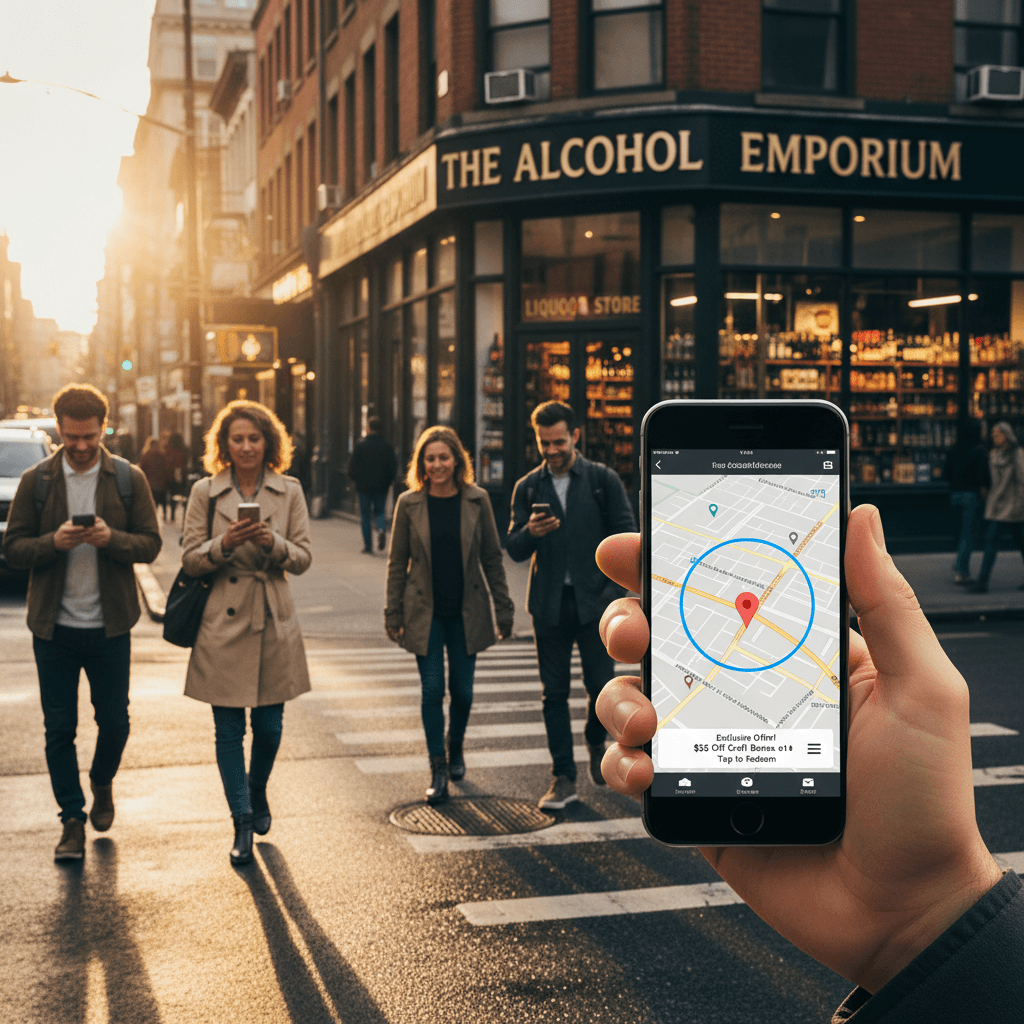
Picture drawing an invisible line around a physical location — your store, a competitor's shop, a concert venue down the street, even a football stadium on game day. That's a geofence. When someone carrying a smartphone crosses that boundary, it triggers an ad on their device. Your ad. Promoting your store, your weekend tasting event, or your craft bourbon selection.
That's it. No mystery. No complicated tech stack you need a PhD to manage.
The ads typically reach consumers within a one-to-three-mile radius, which means you're connecting with people who are already out and about. They're in buying mode. They're close. You're just giving them a reason to choose you.
Here's where location-based advertising separates itself from the usual digital marketing playbook.
10 proven liquor store social media content ideas to connect with customers, boost brand visibility, and drive both i...
Most liquor store marketing casts a wide net — targeting broad demographics across an entire metro area. Geofencing flips that model. Instead of hoping the right person sees your ad at the right time, you're reaching high-intent shoppers at the exact moment they're near your door. It's hyper-local marketing that connects your store with its immediate neighborhood, and the results consistently outperform broader campaigns.
One of the biggest advantages? Foot-traffic attribution — actually tracking whether someone who saw your ad walked into your store. This isn't about racking up impressions or vanity metrics. It's about getting real people through your actual door.
And that's the conversation worth having: not how many people saw your ad, but how many bought a bottle because of it.
Let's demystify the mechanics — because knowing how the technology works will help you use it smarter.
Discover 7 proven TikTok marketing strategies for liquor stores that build real engagement and bring customers throug...
Here's the short version: you draw a virtual boundary around a geographic area (your store, a competitor's location, a nearby event venue), and when someone with a smartphone crosses into that zone, they become eligible to see your ads.
The mechanics rely on GPS data. When consumers are actively using their phones — scrolling through apps, reading articles, checking the weather — your ads can be served based on where they physically are. Most campaigns target a one-to-three-mile radius, meaning you're reaching people who could realistically walk or drive through your door in minutes.
Your ads show up in mobile apps and browsers, not as intrusive pop-ups or creepy notifications. It's standard digital advertising with smarter, location-aware targeting.
Picture this: it's Friday at 4 PM. A shopper drives past your store and opens their phone to check weekend plans. They see an ad for your limited-release bourbon special. The timing feels natural because it is natural — they're already thinking about the weekend.
Context-rich promotions — weekend specials, holiday deals, tastings tied to local events — perform well because the timing and location align with what the consumer is already doing. You're not interrupting their day. You're fitting into it.
And because foot-traffic attribution connects the digital touchpoint to a physical visit, you can measure whether those ad impressions actually drove people into your store — real accountability instead of guesswork.
Here's where geofencing for liquor stores gets really interesting — and maybe a little spicy.
You can draw a virtual boundary around your competitor's location and serve ads to shoppers while they're there. Before they check out. Before they've committed to buying that bottle of Maker's Mark at full price.
Is this legal? Absolutely. Ethical? Yep. It's simply smart advertising — no different from placing a billboard near a rival's parking lot, just way more precise and measurable.
The mechanics are straightforward. You define a geofence around one or more competing stores. When a potential customer's mobile device enters that zone, your ad gets served. They see your offer, your brand, your reason to drive the extra half-mile.
You can then use foot-traffic attribution to track whether those impressions actually brought people through your door, making this one of the most accountable tactics in your marketing arsenal.
Here's the thing: a generic "Visit us instead!" ad won't cut it. Your counter-offer needs teeth.
Think:
One important rule: never trash-talk the competition. These ads work best when they spotlight your strengths, not someone else's weaknesses. Lead with value, not shade. Customers respect confidence — and they'll remember who gave them a reason to switch.
This is where geofencing shifts from an acquisition tool to a full-blown retention engine.
When you connect your location-based campaigns to your loyalty program, you're not just casting a wide net — you're reaching people who already know and like your store. The difference in ROI is significant.
Picture this: a loyalty member who hasn't visited in three weeks drives within a mile of your store. If you have a branded app with push notifications enabled, they can receive a personalized alert — bonus points on their next purchase or a discount on bourbon, their favorite category. Even without an app, you can serve targeted display ads to lapsed loyalty members through your geofencing campaign, reminding them what they're missing. That drive-by becomes a drop-in.
This approach works because it's timely, relevant, and personal. You're not shouting into the void. You're whispering to someone who's already listening.
Beyond immediate sales, this integration is a goldmine for marketing intelligence. You start learning when your customers shop, how often they're nearby without stopping in, and which promotions actually drive repeat visits. Every campaign gets sharper than the last.
Let's address the elephant in the room: privacy concerns around geofencing technology are real, growing, and completely valid.
This technology is powerful — and that power cuts both ways. In late 2023, Google announced changes to how it stores location data, moving it on-device to limit how broadly location information could be accessed — including by law enforcement through geofence warrants. These shifts make consumers (and retailers) understandably more privacy-conscious.
Here's the good news: geofencing for liquor stores operates nothing like surveillance. When you run campaigns through established ad networks, you're working with aggregated, anonymized data. You're not personally tracking anyone. You're serving ads to devices near your store — through the same platforms that power every other form of digital advertising.
The path forward is straightforward:
Customers who understand how you reach them are customers who stick around.
10+ years helping liquor retailers and beverage brands grow through data-driven digital marketing. Learn more
Let's be honest: if you've ever hired a digital marketing agency, you've probably sat through a report full of impressive-sounding numbers that meant absolutely nothing to your bottom line. Tens of thousands of impressions. Hundreds of clicks. And yet — you couldn't point to a single new customer who walked through your door because of it.
You're not wrong to be skeptical. Impressions and clicks are easy to generate and even easier to inflate. They measure attention, not action.
Impressions tell you an ad was served. Clicks tell you someone tapped a screen. Neither tells you whether that person ever set foot in your store, picked up a bottle, or spent a dime. For liquor store owners operating on real margins in real neighborhoods, those vanity metrics are just noise.
The same GPS technology that serves your geofencing ad — detecting a consumer's location near your store — can also detect when that person later walks into your shop. It connects the digital touchpoint to a physical visit, giving you a measurable link between your ad spend and actual store visits.
Is it perfect? No. Specific conversion rate benchmarks vary widely by market, store size, and campaign strategy. But the ability to track real visits is a massive leap forward from the old "spray and pray" approach. Instead of guessing whether your campaign drove results, you're measuring what actually matters — people in your store.
Intentionally Creative specializes in geofencing strategies that drive real results. Let us show you what's possible.
Schedule a CallReady to put this into action? Here's your playbook:
Step 1: Define your geofences. Start with your own store — a one-to-three-mile radius is the sweet spot for most markets. Once that's running, add one or two competitor locations and any nearby event venues or complementary businesses (think wedding venues, catering companies, or popular restaurants).
Step 2: Create offers worth acting on. Weekend bourbon specials, new craft beer arrivals, upcoming tasting events — your ads need urgency. "This Saturday only" outperforms "Come visit us sometime" every single time.
Step 3: Choose the right partner. Location-based advertising for alcohol retail comes with compliance requirements that general ad platforms don't always handle well. Work with a team experienced in beverage alcohol advertising who understands both the tech and the regulations.
Step 4: Set a test budget and measure what matters. Commit to 60-90 days, then evaluate foot-traffic attribution alongside actual sales data — not just impressions.
The first month is about learning — which geofences drive traffic, which offers resonate, which days perform best. By month two, you're optimizing. By month three, you have real performance data to guide your marketing budget with confidence.
Every day, potential customers drive past your store, walk through your neighborhood, and browse their phones within minutes of your front door — without ever knowing what you have to offer. Geofencing for liquor stores closes that gap. It puts your brand, your deals, and your unique selection in front of the people most likely to act on them, right when they're close enough to do something about it.
This isn't theoretical. It's not bleeding-edge technology reserved for big-box chains with massive budgets. It's a practical, measurable marketing strategy that independent liquor retailers are using right now to drive real foot traffic, win customers from competitors, and build lasting loyalty — all with clear accountability that ties ad spend to actual store visits.
The stores that adopt this early gain an edge. The ones that wait will be playing catch-up. Your competitors are already nearby. Your customers are already nearby. The only piece missing is the connection between them and you.
[Ready to launch your first geofencing campaign? Let's talk strategy →]()