How to Build a Loyalty Program That Actually Works for Independent Liquor Stores
By Alden Morris37 min read
Listen to this article42:37
Schedule a free strategy call and Intentionally Creative will build a custom plan for you.
Schedule Your Free Strategy CallFree audit. No commitment.
Get a Free Audit. No commitment.
Learn how to build a loyalty program designed for independent liquor stores — not copied from grocery chains. This step-by-step framework covers compliance, structure, enrollment, and experience-based rewards that drive repeat purchases.
Your loyalty program is bleeding money — and you probably modeled it after a grocery chain.
That's the fatal mistake. Picture this: a customer walks into your shop on a Friday evening, past the hand-written shelf talkers and the small-batch bourbon you drove two counties to source. They're not here because you're cheap. They chose you over Total Wine. They drove past a Costco. And yet, the loyalty card you hand them rewards them the same way Kroger does — points for discounts, a slow race to the bottom you cannot win.
Most independent liquor store loyalty programs fail because they copy a points-for-discounts model built for high-volume grocery chains operating on completely different economics. Independent retailers work on thin margins — often 20–30% on spirits, sometimes less on allocated bottles — and every dollar discounted through a generic rewards program comes straight off the bottom line. Big-box competitors like Total Wine and Costco move enough volume to absorb that erosion; you don't. The irony runs deeper: 60% of alcohol consumers already prefer buying at local independent stores ↗ over big-box retailers, which means your customers are signaling that price isn't their primary driver. They want curation, conversation, access. A program that ignores those motivations and competes solely on price abandons the one advantage independents hold — the relationship.
You're not losing to Total Wine on selection or service. Stop trying to lose to them on price, too.
Forget enrollment numbers. A loyalty program with 2,000 sign-ups and no repeat purchases is a spreadsheet trophy, not a business asset.
10 proven liquor store social media content ideas to connect with customers, boost brand visibility, and drive both i...
The metrics that matter for independent stores: repeat visit frequency, average basket size growth, and customer retention rate. According to Sante HQ ↗, effective loyalty programs increase customer spending by 12–18% annually — that's real margin, not vanity. And the retention math is stark: a 5% increase in customer retention can drive a 25–100% increase in profit. Digital loyalty programs in retail liquor have delivered a 30% boost in customer retention ↗ on their own.
Here's what those numbers look like in practice. Say your average loyal customer spends $65 per visit, twice a month. A 15% basket increase moves that to $75 — an extra $240 per customer per year. Multiply across a few hundred regulars and you've funded a renovation.
The framework this guide builds across nine sections is simple: compliance-first (because some states don't allow liquor loyalty programs at all), experience-led (reward access and discovery, not just discounts), and data-informed (let your POS tell you what your customers actually want). Every section ahead connects back to these three pillars.
Start here: before you design a single reward tier, audit your state's promotional regulations and pull six months of transaction data from your POS. You can't build a program that works if you skip either step.
Discover 7 proven TikTok marketing strategies for liquor stores that build real engagement and bring customers throug...
Do you actually know what separates a loyalty program from a discount gimmick? Most independent liquor store owners don't — and that confusion costs them thousands in misallocated margin every year.
A liquor store loyalty program is a structured system that rewards repeat customers with benefits — such as exclusive access to allocated bottles, members-only tastings, personalized recommendations, and selective discounts — in exchange for continued patronage and purchase data. For independent stores, effective programs emphasize experience and curation over price competition. Unlike grocery or big-box retail loyalty, a liquor program must account for regulated product categories, state-specific legality (some states ban them outright), and a customer base that self-selects for expertise and discovery. According to SanteHQ ↗, well-executed programs drive a 12–18% annual increase in customer spending — not through blanket discounts, but through relevance.
Here's what a loyalty program is not:
A real program captures purchase data, segments your customers by taste and spend, and delivers experiences — a first pour of that new single-barrel selection, a text when the allocated Weller drops, a personal call when you find a Barolo that matches their palate. That's the difference between a program and a promotion.
Discover proven liquor store customer retention tactics to build loyalty, increase profitability through repeat custo...
Sixty percent of alcohol consumers prefer buying spirits at local independent stores over big-box retailers, according to research compiled by WiFi Talents ↗. That preference exists because of you — your palate, your relationships with distributors, your ability to hand-sell a $28 Côtes du Rhône that drinks like a $60 bottle. Your loyalty program should formalize that relationship, not replace it.
Chains optimize for transaction volume. Their programs are engineered around basket size and visit frequency — sterile, algorithmic, impersonal. You should optimize for relationship depth. A 5% increase in customer retention can drive a 25–100% increase in profit, and your natural advantage in retention is the personal connection you already have with your best customers. The program just gives it structure.
Think of it this way: your top 50 customers already get the allocated bottles, the recommendations, the heads-up on new arrivals. A loyalty program extends that treatment — scaled, tracked, and tiered — to your next 200 customers. Bronze gets the newsletter with actual tasting notes you wrote. Silver gets the invite to quarterly tastings. Gold gets the call when the Pappy allocation lands.
Stop giving away margin with blanket discounts. Build a program that makes your best customers feel like insiders — because that's exactly what they already are.
A store owner in Pennsylvania spent three months building a points-based loyalty program, printed 2,000 membership cards, and trained his staff — only to learn his state's Liquor Control Board prohibited the entire structure. He lost roughly $4,500 and had to scrap everything. That's not an outlier story. It happens every year to independent retailers who skip the single most critical step in program design: understanding what your state actually allows.
No, liquor store loyalty programs are not legal in every state. Several states — including Pennsylvania, Utah, and parts of the control-state system where the government operates as the sole retailer — either heavily restrict or outright prohibit loyalty incentives tied to alcohol purchases. Other states permit loyalty programs but impose strict guardrails: you cannot discount below cost, you cannot give away alcohol as a reward, and bundling restrictions may limit how you package deals. Your state's Alcohol Beverage Control (ABC) board is the only authority that matters here. Not your POS vendor's FAQ page, not a Facebook group for store owners, not even this article. Call your ABC board or check their website before you invest a single dollar. The consequences of noncompliance aren't fines you can absorb — violations can cost you your liquor license entirely. That's your business, gone. Treat this as a non-negotiable prerequisite, the same way you'd verify zoning before signing a lease.
According to Sante HQ ↗, loyalty programs drive a 12–18% annual increase in customer spending — but that return drops to zero if regulators shut your program down or, worse, pull your license. The math only works if you're operating legally from day one.
Most loyalty program guides will tell you the same thing: make enrollment as frictionless as possible. Phone number only. No questions. Get them in, get them out. That advice is wrong — or at least, it's incomplete. A bloated member list full of one-time buyers who never engage isn't a loyalty program. It's a vanity metric.
The stores that build real loyalty revenue understand something counterintuitive: a 500-member list with 60% engagement crushes a 2,000-member list at 10%. Every time. The difference starts at enrollment.
Strip enrollment down to a phone number and you'll maximize sign-ups. You'll also maximize ghost members — people who enrolled because the cashier asked, forgot about it by the time they reached their car, and never redeemed a single point. Your database swells. Your engagement rate craters. Your staff loses faith in the program because "nobody uses it."
Here's what the frictionless crowd misses: one qualifying question changes everything. Ask "What do you usually drink — wine, spirits, beer, or a mix?" and two things happen simultaneously. First, you filter. The customer who's buying a single nip on their way somewhere isn't going to bother answering. Good — they weren't going to engage anyway. Second, you gain the single most valuable data point in beverage retail: category preference. That one answer lets you send a relevant first message instead of a generic "Welcome to our rewards program!" blast that gets ignored.
Research from SanteHQ ↗ shows loyalty programs increase customer spending by 12–18% annually — but only when members actually participate. A smaller, genuinely interested base outperforms a massive passive one because engaged members redeem, and redemption drives the repeat visits that move your revenue.
Picture this: a customer buys a bottle of Lagavulin 16 every six weeks like clockwork. Your POS knows it. Your loyalty program knows it. So when that limited Offerman Edition hits your shelf, your system fires off a text before he even thinks to ask. That's not marketing — that's service. And it only happens when your loyalty program talks directly to your point-of-sale system.
Punch cards die in a drawer. Spreadsheets get abandoned by Week 3. Your staff already juggles stocking, carding, and upselling — asking them to manually log loyalty points at checkout is a fantasy. The program has to run itself, or it won't run at all.
Integrating your loyalty program directly with your POS system means every qualifying purchase automatically earns points, updates tier status, and feeds customer profiles — with zero extra keystrokes from your cashier. Most independent liquor store POS platforms now offer native loyalty modules or direct API connections with third-party loyalty providers like Sante, FiveStars, or Kangaroo. The integration works at the transaction level: when a customer checks out using their phone number or linked payment card, the POS transmits purchase data — SKUs, dollar amounts, product categories — to the loyalty engine in real time. That engine applies your earning rules, triggers any automated communications (texts, emails, tier-upgrade alerts), and updates the customer's profile with full purchase history. For stores running systems like mPower Beverage, Bottle POS, or KORONA, these integrations typically take less than a day to configure and require no additional hardware. The result is a program that tracks itself, freeing staff to sell rather than administer.
Research from SanteHQ ↗ shows digital loyalty programs drive a 30% increase in customer retention for retail liquor stores — largely because automation removes the friction that kills manual programs. A 5% bump in retention alone can translate to a 25–100% increase in profit. You can't afford to leave that on a punch card.
10+ years helping liquor retailers and beverage brands grow through data-driven digital marketing. Learn more
Here's where smart operators separate themselves. Price-based rewards — straight discounts, dollars off, BOGO deals — draw the most regulatory scrutiny because they brush up against below-cost selling rules and minimum pricing laws. Experience-based rewards face far less friction. Tastings, early access to allocated bottles, private education events, first dibs on limited releases — these carry real perceived value, especially with your core demographic (research from WiFi Talents ↗ shows 85% of liquor store customers fall between ages 25 and 54, a group that responds strongly to access and exclusivity). A customer who gets a private invite to taste a new single-barrel bourbon selection feels like an insider. That emotional pull rivals any 10%-off coupon, and it keeps you comfortably within legal bounds.
If you do offer discount-based rewards, structure them as percentage-off rather than fixed-price reductions. A "10% off your next purchase" reward is far easier to keep above cost thresholds than a "$5 off any bottle over $20" offer, which could dip below minimum pricing on lower-margin SKUs. Keep your margins visible and defensible.
One final, non-optional step: document your entire program structure — point-earning rates, reward tiers, redemption rules — and have it reviewed by an attorney who knows your state's ABC laws specifically. Not a generalist business lawyer. Not your cousin who passed the bar. Someone who has dealt with alcohol regulatory compliance. A few hundred dollars in legal review protects the 5% increase in customer retention that, according to industry data, can translate to a 25–100% increase in profit. That's the kind of price-to-quality ratio that makes the investment a revelation — skip this step, and you're gambling your entire operation on a guess.
A 5% increase in customer retention can drive a 25–100% increase in profit. That single data point should govern every structural decision you make about your loyalty program. Yet most independent liquor store owners default to the first model they encounter — points — without asking whether it actually fits their business. The wrong structure doesn't just underperform. It actively erodes your margins and trains customers to wait for discounts.
Three program structures dominate retail loyalty: points-based, tiered, and access-based. Each carries distinct advantages and risks for independents. Your choice here determines whether your program becomes a profit engine or a slow bleed.
Points programs are the most common loyalty structure in retail, and for good reason — customers understand them instantly. Spend a dollar, earn a point. Accumulate enough points, redeem for a reward. Clean, simple, scalable.
Here's the problem: for independent liquor stores, points programs almost always devolve into a pure discount mechanism. You offer $5 off for every 500 points. Total Wine offers $10 off for every 500 points. You match. They escalate. You've entered a race to the bottom with opponents who have deeper pockets and thinner margin requirements. You will lose.
Research from SanteHQ ↗ confirms that loyalty programs increase customer spending by 12–18% annually — but that lift evaporates if you're funding it through straight discounts. If you insist on a points model, tie redemption to experiences and exclusive products rather than dollars off. Points toward a private tasting event or a staff-curated discovery pack? That works. Points toward $3 off a bottle of Tito's? That's a coupon program with extra steps.
Tiered programs flip the psychology. Instead of rewarding past purchases with discounts, they incentivize future spending by unlocking progressively better rewards. Aspiration drives behavior — and aspiration runs deep in spirits and wine culture. Nobody brags about their coupon savings. Plenty of people mention their "gold member" status.
Keep it to three tiers maximum. Complexity kills participation. Here's a structure that works:
That Gold tier costs you relatively little to operate — a dinner event, some reserved bottles — but it creates tremendous perceived value. 85% of liquor store customers fall in the 25–54 age range, according to WiFi Talents ↗, a demographic that responds strongly to status and exclusivity. A tiered program converts your best customers into advocates who recruit their friends into the ecosystem.
Forget discounts entirely. The best loyalty program structure for an independent liquor store is access-based — built around exclusive products, curated experiences, and genuine relationships rather than price reductions. Sixty percent of alcohol consumers already prefer buying spirits at local independents over big-box retailers. These customers chose you despite higher prices, which means they value something beyond cost: your curation, your knowledge, your sourcing. An access-based loyalty program reinforces that choice and makes it sticky. Members get first call on allocated bourbon releases, invitations to members-only natural wine tastings, staff-curated "discovery packs" built around their flavor preferences, and barrel picks reserved exclusively for the program. Digital loyalty programs drive a 30% increase in customer retention ↗ in retail liquor — and access-based models outperform discount models because they build emotional investment, not transactional habit. You're selling belonging, not savings.
This model leverages everything independents do best. A big-box retailer can always beat your price on Buffalo Trace. They cannot replicate your relationship with a local distributor who calls you first when four bottles of George T. Stagg hit the warehouse. They cannot recreate your staff's ability to hand-sell a $28 Côtes du Rhône that drinks like a $60 bottle — the kind of recommendation that makes a customer feel like an insider.
Women influence 80% of wine purchasing decisions in households. An access program built around discovery — not just rare bourbon — captures this massive segment through experiences like guided tastings, food-pairing events, and curated mixed cases. Stop competing on price. Compete on access, and you'll own a position no chain can touch.
The hybrid approach works too: use a simple tier structure as your framework, then fill each tier with access-based rewards instead of discounts. Bronze members get the newsletter. Silver members get the tastings. Gold members get the phone call when something special arrives. That combination — tiered aspiration plus access-based rewards — is the structure I'd recommend to any independent operator serious about building a program that actually moves the needle.
Intentionally Creative specializes in loyalty programs strategies that drive real results. Let us show you what's possible.
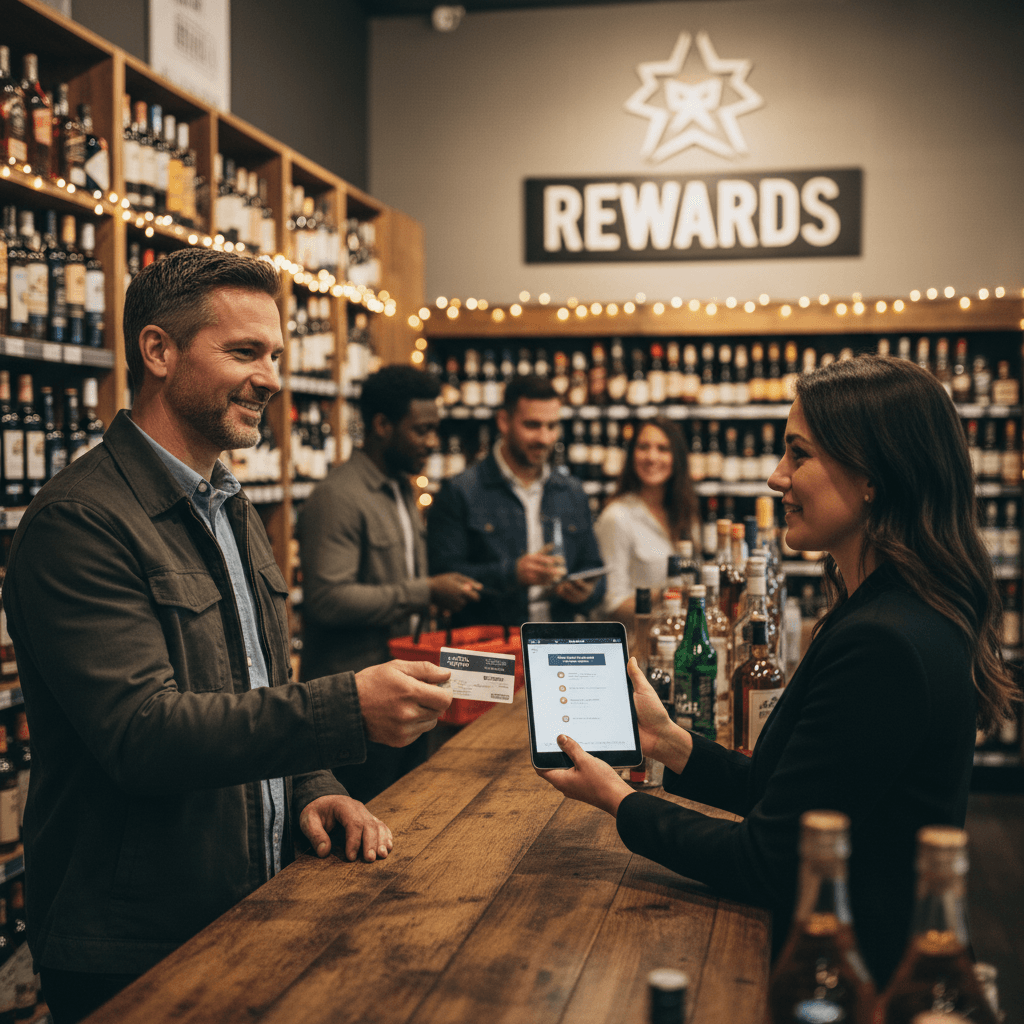
Schedule a CallSince 90% of consumers prefer buying liquor in-store ↗, design your enrollment for the register, not a landing page. Here's the exact flow:
The staff training piece matters more than the technology. Your cashier's tone determines whether enrollment feels like the start of a relationship or a data-harvesting exercise. Script the ask: "We've got a rewards program — what do you usually drink so I can make sure you hear about the good stuff first?" That's an invitation, not a form.
The ideal liquor store loyalty enrollment happens at the register during checkout. Staff should capture a name and phone number or email, then ask one preference question — "What do you usually drink?" — to gather an immediate personalization data point. Within 24 hours, the store sends a welcome message featuring one relevant recommendation based on that answer, such as a new arrival in their preferred category or a staff pick at a strong price point. The customer gets assigned to an entry-level tier automatically, and their first return visit triggers a follow-up communication. This flow balances speed (under 60 seconds at the POS) with data quality, giving the store everything it needs to deliver a personalized first impression that drives early redemption and long-term engagement.
Stop chasing 100% enrollment. It's a trap. Aim for 30–40% of your regular customers in the first 90 days. That's your real base — the people who come in weekly or biweekly and account for the bulk of your revenue. A 5% increase in retention among this group can drive a 25–100% increase in profit ↗, which makes precision far more valuable than scale.
Your key early metric isn't total sign-ups. It's enrollment-to-first-redemption rate — the percentage of new members who actually use a reward within 30 days. If that number sits below 40%, your welcome sequence is broken. If it's above 55%, your enrollment process is attracting the right people.
What to do instead of chasing maximum enrollment:
The enrollment process is the handshake. Make it count, make it personal, and don't be afraid of a little friction. The customers who push through that one extra question are the ones who'll spend 12–18% more with you year after year.
Not every POS system earns a passing grade here. Before you sign a contract or renew one, run through this checklist:
Automatic point and tier tracking at checkout. No pop-ups, no extra screens, no "Did you ask for their loyalty number?" nagging. The system should recognize the customer by phone number, email, or linked card and apply rewards silently. If your staff needs training beyond "it just works," the system isn't good enough.
Customer purchase history reporting. This is the real gold. You want sortable, exportable data showing what each customer buys, how often, and at what price points. Systems like KORONA POS ↗ build these reports natively. If your current POS can't tell you which 50 customers spent the most on bourbon last quarter, switch.
Automated communication triggers. Your POS should integrate with SMS or email platforms to fire messages based on purchase behavior — not just calendar dates. Birthday discounts are table stakes. Purchase-triggered alerts ("You've hit Gold status!") and restock reminders ("Time for another bottle of Hendrick's?") separate serious programs from decorative ones.
Ask your POS vendor hard questions. If they hedge, that tells you everything.
Generic "10% off everything this weekend" blasts are the Bud Light of marketing — they appeal to no one in particular. Your loyalty data lets you do something far more powerful: speak to each customer's actual palate.
A customer who buys Islay Scotch monthly gets an alert when a new Ardbeg limited release arrives. A shopper who rotates through Willamette Valley Pinot Noirs hears about your new Cristom allocation. A household that stocks up on Veuve Clicquot every November gets an early-access text before your holiday inventory lands. According to data from WiFi Talents ↗, women influence 80% of household wine purchases — so that Pinot notification might drive a bigger basket than you'd expect.
This precision is where the preference question you asked at enrollment pays immediate dividends. You already know they prefer bourbon, tequila, or natural wine. Now your POS data confirms it with receipts — literally. Customers who receive targeted promotions based on purchase history spend 12–18% more annually than those who receive generic offers, and 58% of loyal customers visit their preferred store at least once a month.
Practical tip: Start with one automated promotion per week, targeting your top 20% of spenders with a product recommendation matched to their purchase history. Measure redemption rates for 60 days, then expand. Precision beats volume every time — and your POS already has the data to prove it.
Before: Your loyalty members get a generic 10% off coupon every month. They yawn, delete the email, and buy their bourbon at Total Wine instead. Redemption rates hover around 3%. Your program bleeds margin for zero lift.
After: Members receive a text Tuesday morning — "Three bottles of Blanton's hit the shelf. Gold tier gets first pick until noon." By 11:45, all three are gone. That same week, an email lands with your staff's tasting notes on a $28 Côtes du Rhône that drinks like a $50 bottle. Members feel like insiders, not coupon-clippers. Spending climbs. Retention locks in.
The difference between these two stores isn't budget. It's rhythm.
Stop leading with discounts. Lead with access.
The most effective independent liquor store loyalty programs flip the conventional reward ratio: 80% experience-based rewards, 20% discount-based. This isn't theory — research from Sante HQ ↗ confirms that loyalty programs drive a 12–18% annual increase in customer spending, and that lift comes from emotional investment, not nickel-and-dime savings.
Experience rewards that actually move the needle:
Discount rewards — use sparingly:
Discounts should feel like a bonus your members stumble into — never the core reason they signed up.
"The stores winning at loyalty aren't the ones giving away margin," says retail strategist guidance from KoronaPOS ↗. "They're the ones making customers feel like they belong to something worth belonging to."
A liquor store loyalty program should include a structured mix of experience-based rewards and consistent, channel-appropriate communications. The strongest programs offer allocated bottle access, members-only tasting events, curated staff picks with tasting notes, and meet-the-producer experiences as core rewards, with discounts reserved for birthdays and annual appreciation events. Communication should follow a four-touch monthly cadence: a personalized new arrival alert in week one, educational content like pairing guides or producer stories in week two, an event or experience invitation in week three, and a tier status or milestone update in week four. SMS works best for time-sensitive alerts like limited drops, while email carries longer storytelling content. This rhythm respects the inbox while keeping your store top-of-mind — critical when 58% of consumers shop at stores they're loyal to at least once a month.
Here's the calendar your team can implement Monday morning:
| Week | Message Type | Channel | Example |
|---|---|---|---|
| 1 | New arrival alert | SMS + Email | "Just landed: Weller Special Reserve. Members shop first." |
| 2 | Educational content | "Why this $32 Malbec from Mendoza drinks like a 93-pointer" | |
| 3 | Event invitation | SMS + Email | "Saturday tasting: Four Japanese whiskeys, $20, members only" |
| 4 | Tier update / milestone | "You're 200 points from Gold — here's what unlocks" |
Key rules for execution:
A 5% increase in customer retention can drive a 25–100% profit increase, according to industry data from eMarketer ↗. Your communication calendar isn't marketing overhead — it's the engine that converts one-time buyers into regulars who spend more, visit more often, and tell their friends where to shop.
Build the calendar. Staff it. Measure it. Then refine quarterly based on what your members actually open, click, and buy.
As we move into 2026, the liquor stores pulling ahead aren't the ones with the flashiest rewards — they're the ones obsessively tracking four numbers. Just four. Everything else is noise.
Track average visits per member per month against non-members. This is your single most important leading indicator — it tells you whether your program is changing behavior before revenue numbers catch up. According to research from WiFi Talents ↗, 58% of consumers shop at stores they're loyal to at least once a month. If your members aren't hitting that baseline, your incentive structure has a hole in it. A well-run independent store should see members visiting 2–3x more frequently than non-members within the first quarter. Anything less, and your rewards lack the pull to alter shopping routines.
Here's the benchmark: loyalty programs should lift member spending by 12–18% annually, per Sante HQ's analysis of liquor store loyalty data ↗. That's not a hope — that's the floor for a functioning program. If your member ATV isn't outpacing non-member ATV within 90 days, your reward structure needs surgery. Look at your tier thresholds. A bronze member spending $45 per visit won't stretch to $60 unless the silver-tier unlock feels worth it. Price-to-value framing matters here just as much as it does on the shelf — at $5 in monthly rewards, a customer earning $8 in perceived value is a revelation. That gap is what drives the basket size up.
Redemption rate measures what percentage of earned rewards members actually use. Engagement rate captures how many enrolled members interact with your program — redeeming points, responding to offers, or checking balances — within a given period. These are not vanity metrics. A healthy engagement rate sits at 40% or higher. Drop below 20%, and your rewards aren't compelling enough to justify the mental effort of participation. The fix is usually simpler than you think: tighten the earn-to-burn cycle so members redeem within two to three visits instead of eight.
The success of a liquor store loyalty program comes down to four measurable indicators: repeat visit frequency, average transaction value comparison between members and non-members, redemption and engagement rates, and member retention at 90-day and 12-month intervals. Repeat visit frequency reveals whether the program changes shopping behavior. ATV comparison confirms members spend more — expect a 12–18% annual lift. Engagement rate shows whether enrolled members actually participate; 40% or above signals a healthy program, while anything below 20% demands a reward overhaul. Retention rate exposes onboarding failures versus true loyalty gaps. A 5% increase in customer retention can drive a 25–100% increase in profit, according to data cited by eMarketer ↗, making these four metrics the only dashboard an independent liquor store owner needs.
Two checkpoints matter: 90 days and 12 months. The 90-day mark tells you whether your onboarding works — did the member redeem at least once? Did they return after signup? If 90-day retention falls below 50%, you don't have a loyalty problem. You have an onboarding problem. The member signed up, got a generic "welcome" text, and forgot you exist. Digital loyalty programs in retail liquor drive a 30% increase in customer retention, according to Korona POS ↗, but only when the first 90 days include a triggered reward — a free tasting invite, a $5 credit on their second visit, something that pulls them back before the habit window closes.
Annual retention separates real programs from dead ones. If fewer than 60% of your year-one members are still active at month 13, audit your tier resets and expiration policies. The stores getting this right treat the annual retention number the way a winemaker treats acidity — it's the structural backbone that holds everything else together.
Looking ahead, expect POS-integrated dashboards to surface these four metrics automatically. The independent stores that build tracking habits now — even with a simple spreadsheet — will have the data depth to compete with chain-store loyalty machines by the time AI-driven personalization becomes table stakes in 2027.
Your loyalty program doesn't need to be perfect. It needs to exist.
Every week you spend debating tier names or reward percentages is a week your competitors are locking in the customers you should own. A 5% increase in customer retention can drive 25–100% increases in profit ↗, and you're leaving that money on the table while you "think about it." Here's your 30-day blueprint — no excuses.
Check your state's regulations on liquor store loyalty programs first. Some states prohibit them outright, and ignorance isn't a defense. Once you've confirmed legality, lock in your tier structure — bronze, silver, gold works fine — and decide whether you're running an access-led model or a hybrid with points. If you spend more than seven days on this step, you're overthinking it. Pick a structure and move.
Configure your POS loyalty features or bolt on a dedicated platform like Sante HQ or Thirdshelf. Keep enrollment simple: phone number or email only. Complicated sign-ups kill participation rates before they start.
Now train every single staff member — not just your best cashier. Role-play the enrollment conversation until it sounds like a recommendation from a friend, not a script read off a laminated card. "Hey, we just started a rewards program — want me to add your number so you earn points on this purchase?" That's it. Conversational, not transactional.
Your regulars are your beta testers. Enroll your top 50 customers by name. These people already spend with you; now give them a reason to spend more. Research from Sante HQ shows loyalty programs increase customer spending by 12–18% annually ↗ — and your best customers will generate the biggest lift.
Ask each one for feedback after their first reward interaction. Fix what breaks. Adjust what confuses. Then scale.
Open enrollment to everyone. Send a personalized communication — text or email — within 48 hours of each new sign-up. Not a generic blast. A message that references what they bought. Set a 90-day review date on your calendar and protect that appointment like it's a meeting with your landlord.
To launch a loyalty program for your liquor store in 30 days, follow a four-phase rollout: confirm your state allows liquor loyalty programs and define your tier structure in week one; configure POS integration and train all staff on a conversational enrollment pitch in week two; soft launch with your 50 best existing customers to collect feedback and fix issues in week three; then open enrollment to all customers and send your first personalized campaign in week four. Use phone-number-only enrollment to maximize sign-ups, and schedule a 90-day review to assess redemption rates, average basket size, and member retention. Stores running digital loyalty programs see a 30% increase in customer retention ↗, and with 60% of alcohol consumers already preferring to buy at local independents, a structured program converts that preference into habitual spending.
The perfect program doesn't exist. The launched program does. Stop planning. Start building. Your 30 days begin now.
Start by defining a clear, simple reward structure that customers can understand in one sentence—such as "earn 1 point per dollar, redeem 100 points for $5 off." Choose a tracking method (POS-integrated software, a dedicated app, or even a simple punch card), set measurable goals like increasing repeat visits by 20%, and promote the program at checkout and on receipts. The most successful programs launch with a sign-up incentive, such as bonus points or an immediate small discount, to build early momentum.
Points-based programs tend to perform best for independent liquor stores because they're flexible and easy for customers to grasp. Tiered programs—where higher spending unlocks better perks like early access to allocated bottles or exclusive tasting invitations—can also drive significant results, with studies showing tiered members spend up to 25% more than non-members. The key advantage independents have over big-box retailers is personalization, so lean into rewards that reflect your store's unique character, like curated bottle recommendations or members-only staff picks.
Alcohol loyalty program regulations vary significantly by state. Some states, such as Indiana and Utah, restrict or prohibit discount-based incentives on alcohol sales, while others allow points programs as long as rewards aren't redeemed directly for alcohol. Before launching, check with your state's Alcohol Beverage Control (ABC) board or consult a compliance attorney familiar with local liquor laws. A common workaround in restrictive states is offering rewards on non-alcohol purchases like mixers, glassware, or snacks.
Costs range widely depending on complexity. Basic punch-card systems cost virtually nothing, while digital platforms like Square Loyalty, FiveStars, or Belly typically run $50–$200 per month with minimal setup fees. Full POS-integrated solutions with app-based tracking and automated marketing may cost $150–$400 per month but often pay for themselves quickly—retailers using digital loyalty programs report an average 15–20% increase in repeat customer spending. Start lean, prove the ROI, and scale up from there.
The single most effective tactic is training your checkout staff to ask every customer, every time—stores that do this consistently see sign-up rates of 60% or higher among regular shoppers. Make enrollment frictionless by requiring only a phone number or email, not a lengthy form. Offer an immediate, tangible incentive at sign-up, such as 5% off the current purchase or bonus starter points. Reinforce the program with simple signage at the register, shelf talkers near popular products, and occasional reminders on social media highlighting what members are earning.