How to Set Up Geofenced Mobile Ad Campaigns Around Competitor Liquor Stores: Targeting, Creative, and Budget Benchmarks
By Intentionally Creative, Editorial Team12 min read
Listen to this article17:19
Schedule a free strategy call and Intentionally Creative will build a custom plan for you.
Schedule Your Free Strategy CallFree audit. No commitment.
Get a Free Audit. No commitment.
Learn how geofencing liquor store advertising works, target competitor foot traffic, craft winning ad creative, and set smart budgets to drive real store visits.
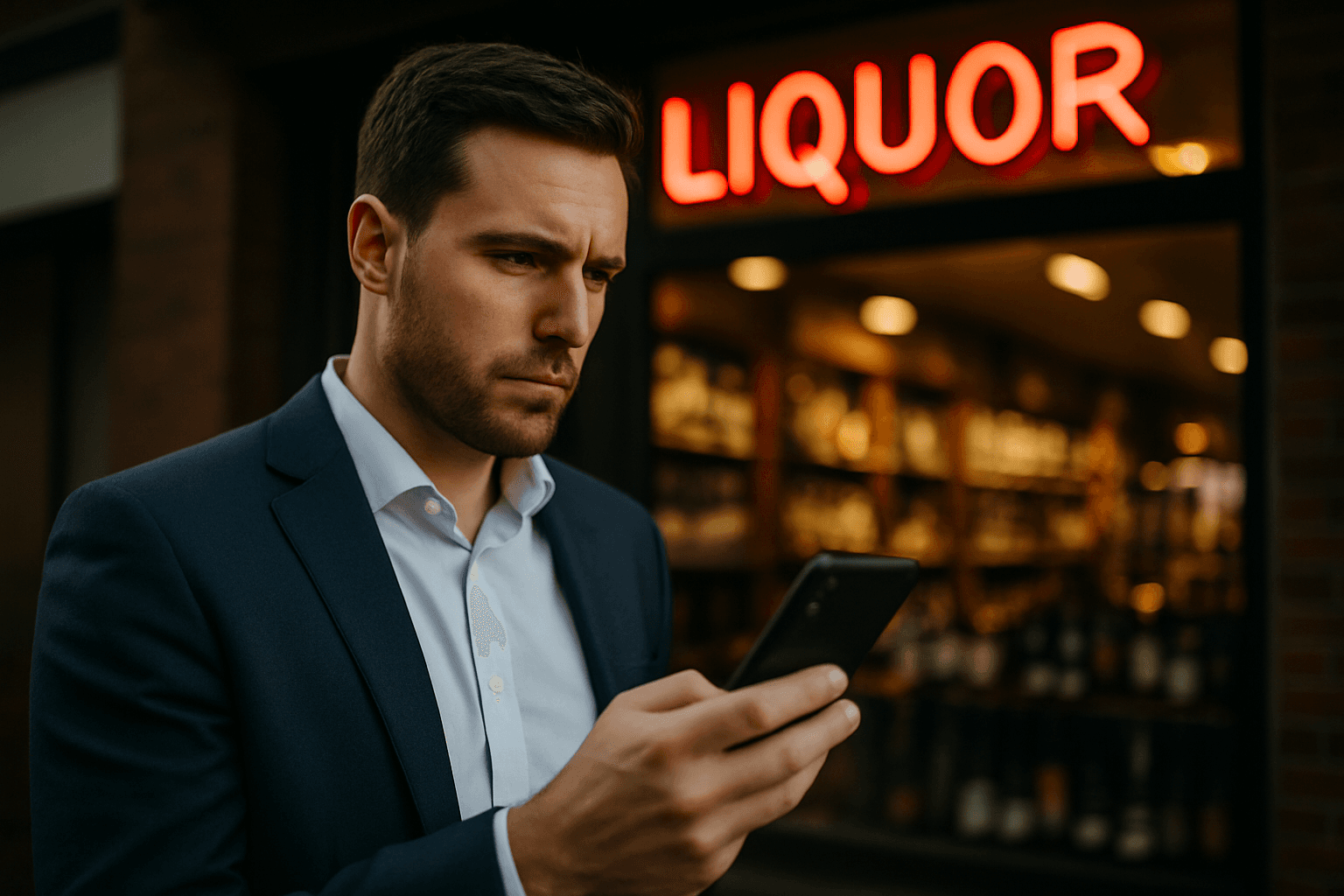
Right now, someone is pulling into your competitor's parking lot to buy a bottle of bourbon. They didn't plan it, they just drove past, remembered they needed something for the weekend, and turned in. What if their phone buzzed with your ad at that exact moment, a better price, a better selection, and directions to your store two minutes away?
That's not hypothetical. That's geofencing liquor store advertising, and it's quietly becoming one of the highest-ROI moves independent liquor retailers can make. Instead of blanketing your zip code with ads and hoping the right people see them, you're targeting consumers who are literally standing at a competitor's door and giving them a reason to come to yours instead.
In this guide, we'll walk through exactly how to set up geofenced mobile ad campaigns around competitor locations, from choosing which stores to target and dialing in your timing, to crafting creative that converts and setting a budget that makes sense for a single-location operator. No fluff, no agency-speak. Just the playbook.
Think of geofencing as drawing an invisible line around a real-world location, say, your competitor's store, that triggers mobile ads the moment a potential customer's phone crosses into that zone. It works through the ad-serving apps already on their device (news apps, weather apps, games), so there's no special download required on their end and no complicated setup on yours. Just targeted, timely ads reaching people who are already in buying mode.
Here's the short version: you pick a location, set a virtual perimeter (typically a 1–5 mile radius), and when someone's mobile device enters that zone, they become eligible to see your ad. Your message shows up on their phone while they're browsing apps, reading news, or checking social media. The real power move? Competitor conquesting, setting fences directly around competing stores and serving ads to their foot traffic in real time.
Stop leaving online sales on the table. Here are the 10 most costly e-commerce mistakes liquor stores make and how to...
Liquor retail checks every box that makes geofenced campaigns work:
Retailers in similar categories have reported measurable in-store visit lifts from precision geofencing, particularly when paired with strong offers and smart timing. [VERIFY: Consider adding a specific, sourced case study here.]
Compare that to broad digital advertising, where you're paying to reach people three towns away who'll never walk through your door. Competitor geofencing puts your budget exactly where it matters, in front of customers who are already spending money on what you sell. They're just spending it somewhere else.
For now.
8 budget-friendly liquor store local advertising ideas to boost foot traffic. Proven strategies from successful retai...
Now that you understand the mechanics, let's get into execution. The first decision you'll make, and one of the most important, is figuring out exactly where to draw those fences.
Before you spend a dollar, you need to answer one question: whose customers are you trying to reach?
The answer shapes everything, your ad creative, your offers, and ultimately your return.
Start with the obvious: direct competitors. These are stores with a similar product mix, price range, and customer base within your trade area. If you're a craft-focused shop, geofencing the Total Wine down the road makes more sense than targeting a convenience store with a beer cooler.
Discover the top SEO mistakes liquor stores make and proven fixes. Learn local SEO tactics to boost visibility and dr...
But don't stop at liquor stores. Some of the best results come from targeting adjacent businesses, grocery chains with liquor sections, big-box retailers like Costco or Sam's Club, even popular bars and restaurants where your ideal customer already spends time and money on alcohol. That kind of lift doesn't come from casting a narrow net on one competitor. It comes from thinking broadly about where your customers already are.
Location-targeted mobile ads typically work within a 1–5 mile radius of each target. The right size depends on your market density:
Here's the rule worth remembering: a tighter geofence almost always outperforms a wider one. Going broad feels like you're reaching more people, but what you're really doing is diluting relevance and burning budget.
Start with 3–5 competitor and adjacent locations, set conservative radii, and let the data tell you where to expand. Geofencing liquor store advertising works best when you treat it like a scalpel, not a sledgehammer.
You've picked your locations and drawn your fences. Next comes the layer that separates campaigns that perform from campaigns that just spend: targeting and timing.
Location is your foundation, but it's not enough on its own. The most effective geofenced campaigns layer multiple targeting dimensions to reach the right person at the right moment.
Start with the non-negotiable: age verification compliance. Every ad platform requires 21+ targeting for alcohol-related campaigns, and this isn't optional, it's legal table stakes. From there, stack on behavioral and demographic filters that sharpen your audience:
These layers transform your campaign from a blunt instrument into a precision tool.
Dayparting means scheduling your ads for specific time windows, and it's where geofencing gets really interesting. Most operators assume they should target peak hours. But off-peak windows often deliver better results at lower cost, particularly Thursday through Saturday evenings and pre-holiday periods when buying intent is high but competitors may be less aggressive with their own promotions.
The real magic is real-time offer delivery. When someone enters your geofence near a competitor, they receive a contextual, timely ad, maybe it's a weekend bourbon deal or a holiday bundle. That immediacy turns a passive impression into an action.
Match your dayparting to your competitive advantage. If you stay open later, target those final evening hours. If your prices beat the competition on weekends, that's your window.
Let's talk money, because a strategy without a budget is just a wish list.
Geofencing liquor store advertising is typically priced on a CPM (cost per thousand impressions) basis. For location-targeted mobile ads, expect to pay somewhere between $8 and $15 CPM, depending on your market density, platform, and how competitive your area is. [VERIFY: CPM ranges can vary by platform and region; confirm these reflect current programmatic geofencing benchmarks.]
That's significantly more efficient than most broad digital advertising, and for good reason. You're not spraying ads across an entire metro area. You're reaching people who are already near a liquor store, which means every dollar works harder.
Our recommended starting budget: $500, $1,500 per month for a single-location liquor store testing 3–5 competitor geofences. At a $12 CPM, that translates to roughly 40,000–125,000 impressions per month, more than enough to generate meaningful data without overcommitting. Run it for 60–90 days, read the results, then scale what's working.
Here's where geofenced campaigns really shine compared to traditional digital: cost-per-visit.
CPM and CPC tell you what you paid for attention. Cost-per-visit tells you what you paid for a person to walk through your door. Modern geofencing platforms can attribute store visits to ad impressions, so you can calculate true ROI down to the dollar.
The math is simple: you're only paying to reach people who are already in buying mode, already near a competitor's store, and already making a purchasing decision. You're not convincing someone to want liquor, you're convincing them to buy it from you.
The biggest advantage of geofencing over traditional ads? You can actually prove it's working.
Foot traffic attribution uses location data to determine whether someone who saw your geofenced ad later walked into your store. It closes the loop between ad spend and real-world results, no guessing, no gut feelings.
When a device enters your competitor's geofence and gets served your ad, that device ID is tracked. If it later appears at your location, that visit is attributed to the campaign. This is the kind of closed-loop measurement that billboard ads and newspaper inserts simply can't offer.
Monitor these metrics consistently:
Run your campaigns for at least 60–90 days before making major budget decisions. The data improves as you optimize. A/B test different offers, dayparts, and competitor locations continuously. Off-peak targeting in particular is worth testing, it often delivers stronger visit rates at lower cost.
Patience plus data equals smarter spending.
Before you launch, let's cover the pitfalls that trip up even experienced operators, so you can avoid burning through budget on rookie mistakes.
You're reaching the right people at the right time in the right place. Now you need to give them a reason to change course, and that comes down to what your ad actually says and looks like.
Your targeting can be razor-sharp, but if your ad creative falls flat, you're burning budget. Remember: you're reaching someone who is already near a competitor's store, possibly walking toward it. You have seconds, not minutes, to change their mind.
Lead with an immediate, geo-targeted offer. Discounts, bundle deals, limited-time promotions, anything that gives a nearby shopper a concrete reason to pivot.
Your copy should be short, benefit-driven, and action-oriented. Something like:
"Cold craft beer. Better prices. 2 minutes away."
That beats vague brand messaging every single time. They don't need your origin story, they need a reason to turn left instead of right.
Two critical rules:
Three formats consistently perform for location-targeted liquor campaigns:
The format matters less than the message. Make the offer clear, make the distance obvious, and make the next step effortless.
Great creative and smart targeting mean nothing if your budget doesn't support the campaign long enough to generate results. Here's how to spend wisely from day one.
Intentionally Creative specializes in geofencing strategies that drive real results. Let us show you what's possible.
Schedule a CallStart small. Measure cost-per-visit. Scale what converts.
Speaking of measuring, this is where geofencing earns its keep compared to every other advertising channel you've tried. Let's talk about proving ROI with actual data.
Even smart operators burn money on geofenced campaigns by making avoidable errors.
Oversized geofences are the biggest culprit. Best-practice radius sits between 1–5 miles around a target location. Go wider and you're paying for impressions from people who'll never drive to your store. Tighter fences mean higher-intent audiences.
Generic creative kills conversions. Don't run a logo-and-tagline ad. Run an offer: "$5 off your first purchase over $30, today only." Action-driven messaging consistently outperforms brand-awareness creative in geofenced campaigns where the audience is already in buying mode.
Pulling the plug early is equally wasteful. These campaigns need 4–6 weeks of data before optimization kicks in. If you judge results after one week, you're not measuring performance, you're measuring noise.
Finally, don't skip compliance. Age-gating and local alcohol advertising regulations aren't optional on mobile platforms, they're your license to operate. Work with your ad platform or agency to ensure every campaign meets federal, state, and local requirements.
Here's the bottom line: your competitors' customers are already nearby, already spending money on liquor, and already reachable on their phones. Geofencing liquor store advertising lets you intercept that intent with the right offer at the right moment, no massive budget required, no guesswork involved.
The playbook is straightforward:
This isn't theoretical. It's a proven, data-backed approach that liquor retailers are already using to pull customers away from the competition and through their own doors.
Ready to put geofencing to work for your store? [Contact the Intentionally Creative team] to build a campaign tailored to your market, your competitors, and your goals. We'll help you draw the fences, you handle the customers walking through the door.