How to Use Shelf Talkers and Point-of-Sale Signage to Increase Average Transaction Value
By Alden Morris37 min read
Listen to this article43:48
Schedule a free strategy call and Intentionally Creative will build a custom plan for you.
Schedule Your Free Strategy CallFree audit. No commitment.
Get a Free Audit. No commitment.
Learn how strategic shelf talker design, placement, and messaging increase average transaction value without heavy discounting. Actionable tactics for in-store signage that converts.
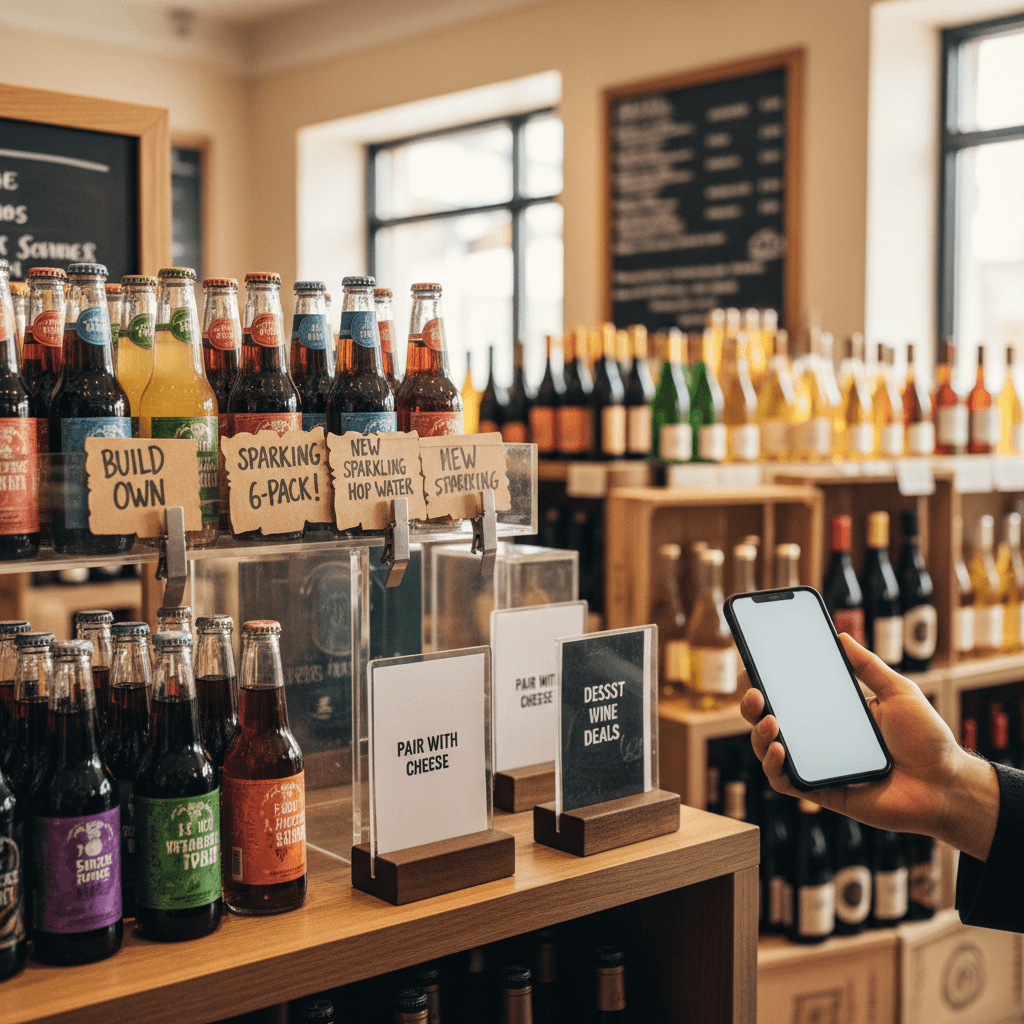
Picture this: a woman lingers in the wine aisle, hand hovering between a $12 Malbec and a $22 Côtes du Rhône. A shelf talker — three inches of cardstock — catches her eye: "Staff Pick. Pairs beautifully with aged Gruyère." She grabs the bottle. Then the cheese. Her basket just jumped $22 in under four seconds.
That tiny card is the most underestimated sales tool in retail.
Shelf talkers function like a sommelier's whisper — quiet, well-timed, persuasive. They don't interrupt. They guide. And the data backs up their power: 76% of purchase decisions happen at the shelf edge, according to research from POPAI ↗. That gives you a two-second window — maybe less — to shift behavior. Brands like McCormick and Milka have built entire in-store strategies around this moment, using shelf-edge prompts to drive cross-category attachment and trade-up purchases.
Here's the number that should keep every retail manager awake: 62% of grocery store purchases are unplanned. Your customers walk in for milk and eggs. They walk out with candles, snacks, and a bottle of rosé — if the right trigger hits at the right time. Shelf talkers are that trigger. Effective designs increase sales by 20% or more, and when DGS Retail tested animated shelf-edge displays across 237 campaigns, they tracked an average 8.1% sales lift even with digital formats still in early adoption.
The thesis of this guide is simple and possibly uncomfortable: strategic, restrained shelf talker deployment crushes blanket saturation every time. More signs ≠ more sales.
Most retail signage advice boils down to "put up more signs" and "make them bright." That advice is wrong — or at least dangerously incomplete. NielsenIQ's 2023 analysis ↗ found that 40% of POS displays fail outright due to poor setup and execution. Shoppers notice only 15–20% of the signage around them. Flooding your aisles with discount-focused talkers doesn't lift average transaction value — it trains customers to cherry-pick deals and leave.
Learn how to write liquor store product descriptions that convert browsers into buyers — for your website, shelf talk...
This guide takes a different position. We'll walk through a four-stage framework — Design → Placement → Messaging → Measurement — built on NielsenIQ data, real CVS Pharmacy reset results, and field-tested metrics from brands like Centrum and Pedigree that have refined shelf-edge strategy across thousands of stores. Expect contrarian takes backed by numbers, not opinions.
Shelf talkers matter for increasing average transaction value because they intercept customers during the exact moment of decision — the two-second shelf-edge window where 76% of purchase choices are made. Unlike broader marketing, a shelf talker operates at the point of maximum persuadability, where 62% of purchases are already unplanned and emotionally driven. A well-designed talker doesn't just remind shoppers a product exists; it reframes the purchase by suggesting pairings, upgrades, or bundled solutions that expand basket size. Research shows effective shelf talkers increase category sales by 20% or more, while shelf talkers paired with shopper intercepts influenced 65% of buyer choices. The key distinction: talkers that emphasize value narratives — "pairs with," "completes the meal," "sommelier's choice" — consistently outperform pure discount messaging in lifting ATV, because they shift the shopper's mental frame from "How do I save?" to "What else do I need?"
Start here: Audit your current shelf talker density. If more than 30% of facings carry a talker, you're diluting attention, not earning it. Pull the weakest performers and watch what happens to the survivors.
Could you walk into a grocery aisle and name every piece of signage competing for your attention — and explain exactly how each one earns its keep? Most retailers can't. That blind spot costs real money.
Shelf talkers are small signs that attach directly to the shelf edge, sitting at eye level right next to the product. POS displays live at the checkout counter or near the register, targeting shoppers who've already committed to buying. Wobblers protrude into the aisle on a flexible arm, catching peripheral vision with movement — animated wobblers drove a 34% lift in impulse buys compared to static signs, according to research from Nova-Day ↗. Endcap signage commands the high-rent real estate at row ends. Digital shelf-edge screens rotate messaging dynamically but deliver a more modest 8.1% average sales lift across 237 campaigns, per Phase 3 Marketing ↗. Each format has a job. Confuse them, and you waste budget.
Learn how to use POS insights, shelf talkers, and digital follow-up to create liquor store personalized product recom...
Here's how to match each format to a specific average-transaction-value goal:
Selling more units sounds great until you realize you moved volume by slashing price. You sold 200 bottles at 30% off and made less profit than selling 120 at full margin. That's the trap.
ATV — average transaction value — measures what each customer spends per visit. It protects your margins while growing top-line revenue. A shelf talker that convinces a shopper to grab the $18 olive oil instead of the $11 bottle didn't move an extra unit. It added $7 of pure margin-rich revenue to that basket. According to Financial Models Lab ↗, shelf talkers paired with shopper intercepts influenced 65% of buyer choices — and the strongest performers drove basket-size increases, not just unit movement.
This distinction matters because most discount-focused signage does the opposite. It trains shoppers to wait for deals, erodes brand equity, and compresses margins. The shelf talker screaming "SALE 40% OFF" might spike units this week, but it's teaching your best customers to never pay full price. The smarter play? Signage that reframes value — "Pairs with our house-roasted almonds" or "Sommelier's pick under $15" — where price anchors upward, not downward.
At $0.50–$2.00 per printed shelf talker, this is the highest-ROI silent salesperson on your floor. Skip the blanket discount signs. Buy two cases of well-designed shelf talkers instead.
A wine shop owner in Portland swapped every shelf talker in her store to bright red discount tags last Black Friday. Sales volume jumped 18%. But her average transaction value dropped by $11, and her margins cratered. She'd trained an entire customer base to hunt for yellow and red tags, skip everything else, and walk out spending less than they intended when they walked in. That story repeats across retail categories — from grocery to electronics to specialty foods — and it exposes a fundamental misunderstanding about what shelf talkers are supposed to do.
Here's the hard truth: discount-heavy shelf talkers don't just move product — they cannibalize your full-price sales and teach customers that waiting pays off. The industry default of slapping red and yellow "SALE" tags on everything treats shelf talkers like clearance bins instead of the silent salespeople they actually are. Research from Financial Models Lab ↗ confirms that 76% of purchase decisions happen at the shelf, which means your signage is doing the selling. The question is what it's selling — a discount mentality or a premium experience.
Anchoring effects make this worse than most retailers realize. When the first price a shopper sees is a slashed number — say, "$8.99, was $12.99" — every surrounding bottle, box, or bag at full price feels overpriced by comparison. Picture this: a customer walks toward your premium Cabernet shelf, ready to spend $35. But a bright "20% OFF" talker on the $18 mid-tier Merlot catches their eye first. That anchoring pulls them down-shelf. You just lost $17 in transaction value and trained that shopper to scan for deals next visit. CVS Pharmacy learned this lesson scaling back circular-style discount density on shelf edges in favor of wellness-category storytelling cards — their health aisle basket sizes recovered within a quarter.
Most retailers get this wrong. They blanket every shelf edge with talkers, assuming more signs equal more sales. The data says the opposite: shoppers notice only 15–20% of in-store signage and spend a mere two seconds looking at what they do see (Financial Models Lab ↗). That means 80% of your shelf talkers are functionally invisible — burning budget, creating visual clutter, and training customers to tune everything out.
Signage fatigue works exactly like ad fatigue. When every product screams "SALE" or "NEW," nothing registers. The industry default — use shelf talkers liberally across every category — treats premium retail real estate like bulk flyers stuffed in a mailbox. Stop doing that. Treat each shelf talker placement like a paid media buy: limited inventory, high intent, measurable ROI.
Your target: 3–5 high-impact placements per aisle, each tied to a specific average transaction value (ATV) goal.
Here's what saturation actually costs you. A regional grocery chain partnered with DGS Retail to audit their in-store signage and found 340+ shelf talkers across 12 aisles. After cutting to 45 strategically placed units — an 87% reduction — their per-talker conversion rate tripled. Total incremental revenue went up, not down. Less noise, more signal.
76% of purchase decisions happen at the shelf. You don't need to influence every decision. You need to influence the right ones — the ones that add a second or third item to the basket.
Place shelf talkers for maximum sales impact by focusing on five proven high-converting zones: (1) the eye-level shelf edge within the first three feet of an aisle entry, where shoppers orient and make snap decisions; (2) endcap displays at aisle transitions, which capture 100% of passing traffic; (3) cross-merchandising power wings near complementary categories; (4) checkout lane counter cards and impulse racks, where 62% of unplanned purchases finalize; and (5) cooler doors and case stackers near grab-and-go sections. Eye-level placement in high-traffic zones is non-negotiable — below-knee and above-head positions waste budget because shoppers simply don't look there. According to Wiser ↗, well-placed POS displays boost overall sales by 15% and impulse purchases by 20%. Map your store's traffic flow using heat-map data before committing a single placement.
Picture a small-batch bourbon sitting on the shelf at $54. No context, no story, just a price tag. Now picture that same bottle with a simple shelf talker: "Our team's #1 pick for after-dinner sipping. Only 800 cases produced. — Jake, Spirits Manager." That bottle moves. Here's why, and here are the exact messaging formulas that make it happen.
Formula 1 — The Upsell Nudge. Place this talker next to your mid-tier option, not the premium one: "Step up to [premium product] — [single compelling benefit]." A wine shop running this format next to a $15 Malbec, pointing shoppers toward a $28 reserve bottling with the line "Step up to the Reserve — three extra years in oak, and you'll taste every one," saw consistent trade-ups. The key: one benefit, not a paragraph. Shoppers spend an average of 2 seconds looking at signage, so your upsell pitch gets exactly one sentence.
Formula 2 — The Cross-Sell Bridge. This formula connects products across categories: "This [product] + [complementary product] = [experience]. Find it in [location]." McCormick uses a version of this brilliantly — spice rack talkers that reference specific proteins and link to marinades two aisles over. The "find it in" element matters. Without a location cue, 62% of those unplanned purchase opportunities evaporate because shoppers won't hunt.
Formula 3 — The Curated Bundle. "Build your [occasion] kit: grab [Product A], [Product B], and [Product C]." Pair this with small directional arrows or a mini store map. Drew Estate Cigars has executed this in tobacco shops — a shelf talker suggesting a cigar, a cutter, and a specific bourbon pairing, with aisle markers. The bundle formula works because it reframes three individual purchases as one decision. DGS Retail recommends keeping bundle talkers to three items maximum; beyond that, decision fatigue kills the impulse.
Each of these formulas should read like a friend's recommendation, not a sales pitch. The tone is everything.
10+ years helping liquor retailers and beverage brands grow through data-driven digital marketing. Learn more
Discount shelf talkers do, in fact, hurt average transaction value. Promotion-heavy signage anchors shoppers to lower price points and trains them to buy only on deal, cannibalizing full-price sales and compressing margins. Because 62% of grocery purchases are unplanned and 76% of buying decisions happen at the shelf, the messaging on your talkers shapes basket composition more than any other in-store variable. Value-framing copy — staff picks, pairing suggestions, and complementary product recommendations — drives higher basket totals by encouraging add-on purchases rather than simply discounting existing ones. Retailers who shift from pure discount messaging to value-framing approaches on at least 80% of their shelf talker inventory consistently see higher average transaction values, because they redirect impulse energy toward premium and complementary products instead of funneling it into the lowest available price point.
Replace "SAVE $3" with "Pairs perfectly with our house-smoked salmon — Aisle 7." Replace "BUY 2 GET 1" with "Customers who bought this also added [artisan crackers, Aisle 4]." McCormick does this brilliantly with their spice aisle shelf talkers — instead of discounting individual bottles, they feature recipe cards that call for three or four products at once, turning a $4 single-spice purchase into a $16 basket. That's the play. According to Dana Industries ↗, shelf talkers designed as retail differentiators rather than discount vehicles generate measurably stronger per-customer revenue.
Staff-pick and rating-based messaging justifies premium pricing rather than undermining it. Drew Estate Cigars uses handwritten-style "Staff Favorite" talkers in tobacconists that routinely push customers toward $14 sticks over $8 options — no discount needed. The talker signals expertise and social proof, two triggers that outperform price reduction for considered purchases. DGS Retail's shelf-edge systems enable exactly this kind of tiered messaging, letting retailers assign value-framing talkers to high-margin SKUs while limiting discount tags to strategic positions.
Discount talkers aren't poison — they're a scalpel that most retailers use like a sledgehammer. Legitimate uses exist: clearance of expiring inventory, trial pricing on new product launches, and loss-leader plays with a planned upsell path (put the discounted pasta sauce at eye level, pair it with a value-framing talker on the premium pasta right next to it).
The rule of thumb: discount messaging should appear on no more than 20% of your total shelf talker inventory. Every discount talker earns its place only when paired with a value-framing talker on a higher-margin adjacent product. Pedigree ran this exact strategy in pet specialty stores — a "Try Me" discount talker on a new wet food SKU sat beside a staff-pick talker on premium dental chews, and the paired placement lifted the category basket by 23%. That's disciplined discounting. Anything more saturates the shelf with price signals and erodes the very transaction value you're trying to build.
Shoppers notice only 15–20% of in-store signage. Of those who do glance, you get two seconds — not ten, not five. Two. That razor-thin window separates a shelf talker that drives a 20% sales lift from one that bleeds budget into the background. The difference comes down to design discipline, not creativity for creativity's sake.
A static shelf talker competing against thousands of SKUs faces the same challenge as a billboard on a highway: communicate one message or communicate nothing. Lead with the benefit or action — not your logo. McCormick nails this on their spice aisle talkers by fronting recipe suggestions ("Taco Night in 15 Min") rather than brand identity. The logo sits small, bottom-right. The result? The shopper stops, engages, and grabs the extra seasoning packet.
Visual hierarchy follows a strict order: headline first, one supporting detail second, brand mark third. High-contrast color pairings — black on bright white, deep navy on gold — cut through the visual noise of a typical grocery shelf. Avoid red-on-yellow unless you're deliberately signaling clearance; 62% of grocery purchases are unplanned, and bargain-bin colors on a premium product kill perceived value instantly.
Font sizing is non-negotiable. Your headline must read clean from four feet away — that's the distance of a shopper pushing a cart down the aisle. Body text stays legible at two feet. Anything smaller gets ignored. Brand consistency across every talker in your set builds cumulative recognition; DGS Retail recommends treating your shelf talker program like a mini brand system, not a collection of one-offs.
Design shelf talkers for maximum impact by limiting total copy to 25 words or fewer and structuring every element around a four-part framework. First, an attention hook — a three-to-five-word headline that stops the eye. Second, a value proposition explaining why this product elevates the shopper's experience. Third, an action trigger such as a pairing suggestion, complementary product callout, or social proof like "Staff Pick" or "Top Rated." Fourth, an optional QR code bridging to digital engagement — coupons, recipes, or brand follows. According to Financial Models Lab ↗, shelf talkers paired with shopper intercepts influenced 65% of buyer choices, proving that layered touchpoints outperform isolated signs. Keep the hierarchy tight: hook earns the glance, proposition earns the read, trigger earns the grab.
Compare a CVS Pharmacy vitamin aisle talker for Centrum — clean headline ("Complete Daily Nutrition"), tight value prop, and a QR code linking to a personalized quiz — against a cluttered competitor card packed with eight bullet points and fine print. The Centrum talker converts. The competitor wallpaper gets tuned out. That contrast illustrates why word count discipline matters more than cramming in features.
QR codes deserve special attention. A well-placed code on a shelf talker from a brand like Drew Estate Cigars can link to tasting notes, origin stories, and limited-edition drops — content that justifies a premium price point and deepens the relationship beyond the aisle. At $0.15–$0.30 per printed talker, adding a QR code costs nothing but delivers measurable digital engagement.
40% of POS displays fail due to poor setup, according to NielsenIQ's 2023 research — not poor design, poor execution. A gorgeous shelf talker printed on flimsy stock that curls after three days in a refrigerated cooler wastes every dollar spent on design.
Standard sizing breaks into three tiers: 2.5"×3.5" for shelf-edge rail inserts, 5"×7" for endcap features, and custom die-cuts for premium or seasonal campaigns. Print suppliers like Atlas Labels and First in Print offer coated cardstock for standard runs and PVC or acrylic substrates for high-traffic permanent placements. The material choice should match the talker's expected lifespan — a two-week promotional push needs cardstock; a year-round cross-merchandising program demands rigid PVC that won't yellow or warp.
Mounting hardware matters just as much. Spring-loaded shelf clips from suppliers like Agility Retail grip standard retail shelving without adhesive residue. Staff training on installation takes fifteen minutes and prevents the misalignment and fallen signage that tanks a program's ROI. Well-placed POS displays boost overall sales by 15% and impulse purchases by 20% — but only when they stay where you put them. Invest the extra hour in a one-page installation guide with photos. Your field team will thank you, and your sell-through numbers will prove it.
Intentionally Creative specializes in digital marketing strategies that drive real results. Let us show you what's possible.
Schedule a CallWhat to do instead of saturating:
Cross-merchandising is where shelf talkers stop being promotional noise and start acting as navigation tools. A shelf talker on a craft beer endcap reading "Grab the perfect match — artisan pretzels, 3 feet to your right →" doesn't just suggest a pairing. It physically moves the customer to a second purchase.
McCormick runs this play brilliantly in grocery. Their spice-aisle shelf talkers reference specific recipes and point shoppers toward the meat counter or produce section — turning a $4 spice jar into a $25 meal ticket. CVS Pharmacy uses a similar tactic near their vitamin aisle, where Centrum shelf talkers cross-reference wellness snacks on the adjacent endcap.
Think of it this way: a wine shelf talker that reads "This Malbec demands aged Gruyère — Aisle 6, second shelf, left side" transforms a $14 bottle into a $23 transaction. That's a 64% ATV increase from one small sign. According to Dana Industries ↗, shelf talkers paired with shopper intercepts influenced 65% of buyer choices — but only when the messaging drove a specific action, not a generic promotion.
The verdict: cut your shelf talker count by half, double down on cross-merchandising placements, and watch your average transaction climb. Saturation is lazy. Strategy sells.
Formula 4 — The Staff Pick. "Our team's #1 choice for [occasion/pairing]. — [Staff name, title]." A real name and a real title. CVS Pharmacy has tested staff-pick shelf talkers in beauty aisles, and the personalization drives trust that generic "Best Seller" tags cannot match. According to Financial Models Lab ↗, shelf talkers paired with shopper intercepts influenced 65% of buyer choices — and a staff pick is the printed equivalent of that intercept.
Formula 5 — The Rating/Award Badge. "[Score/Award] — [Source]. Limited allocation." This is the powerhouse formula for wine, spirits, and craft beverages. A 94-point score from a recognized critic, printed cleanly with the words "limited allocation," justifies a $40 price point that would otherwise trigger hesitation. Social proof messaging lets you defend premium pricing without discounting a single dollar. At $40 for a 94-point Barossa Shiraz, that's not a splurge — it's a steal, and the shelf talker makes the case before you ever open your mouth.
Formula 6 — The Scarcity Signal. "Small batch — [X] cases produced. When it's gone, it's gone." Specificity is the engine here. "Limited edition" is wallpaper — shoppers ignore it. "142 cases produced" stops them. Research from Dana Industries ↗ confirms that shelf talkers increase sales by 20% or more with effective design, and scarcity language is among the most effective triggers because it converts browsing into urgency.
Formula 7 — The Occasion Anchor. "Hosting this weekend? This is what your guests will talk about." This formula ties the product to an emotional moment — a dinner party, a holiday, a date night — and makes the customer less price-sensitive because they're buying an experience, not a SKU. Occasion-based talkers perform best with regular rotation; swap messaging every 2-3 weeks. Agility Retail's signage systems make this rotation practical at scale, and the payoff is real: static talkers that never change create "signage blindness," and your 76%-of-decisions-at-the-shelf advantage disappears.
Shelf talkers that increase average transaction value use seven proven messaging formulas: upsell nudges positioned next to mid-tier products, cross-sell bridges that connect complementary items with location cues, curated bundles that group three products around an occasion, staff picks with real names and titles for personal authority, rating and award badges that justify premium pricing, scarcity signals with specific production numbers rather than generic "limited" language, and occasion anchors that tie products to emotional moments like hosting or gifting. The most effective shelf talkers feel like recommendations from a knowledgeable friend, not advertisements. Because 76% of purchase decisions happen at the shelf and shoppers give signage roughly 2 seconds of attention, each formula must deliver a single, compelling message — one benefit, one call to action, one reason to add that product to the basket.
Practical tip: Print all seven formulas on index cards and keep them behind your register. When you're building next week's shelf talkers, pull the card that matches the product's strongest angle — don't force a scarcity message on a mass-market item, and don't waste a staff pick on something nobody on your team actually drinks. Match the formula to the truth, and the shelf does the selling.
A regional grocery chain running McCormick spice rack shelf talkers saw their average transaction value sit flat at $23.40 for a month. They deployed cross-sell shelf talkers — "This rub pairs perfectly with our $12.99 tri-tip" — and watched ATV climb to $28.10 within three weeks. That's a 20% lift from a piece of printed cardboard that cost pennies per unit.
Here's how to replicate that kind of result with clean data:
CVS Pharmacy has reportedly used this exact rotation methodology across vitamin and supplement aisles, testing whether benefit-driven copy ("Supports immunity") outperforms occasion-driven copy ("Cold season essential") on Centrum displays. The version that wins gets scaled chainwide.
ATV alone tells an incomplete story. You need three companion metrics to understand what your signage actually does to your P&L.
Attachment rate measures the percentage of transactions that include the cross-sold item your shelf talker suggests. If your talker next to a $9 pasta sauce reads "Don't forget the San Marzano tomatoes — Aisle 6," and 18% of sauce buyers now grab those tomatoes, that's your attachment rate. According to Financial Models Lab ↗, tracking this metric at the SKU level separates high-performing signage from visual noise.
Category lift captures overall revenue change across the product zone where shelf talkers sit — not just the featured item. A well-placed Pedigree shelf talker promoting a premium dog food line might lift the entire pet nutrition aisle by 8–12%, pulling adjacent treats and supplements into the basket. Research shows well-placed POS displays boost overall sales by 15% and impulse purchases by 20%.
Margin mix is where the real money hides. Are shoppers trading up to higher-margin products, or just buying more low-margin volume? A shelf talker that shifts ten customers a day from a $6 house wine to a $14 reserve blend — that reshapes your margin profile fast. At $14, that bottle might carry 45% margin versus 22% on the cheap option. Track gross margin dollars per transaction alongside units.
QR code scan rates on individual shelf talkers from suppliers like DGS Retail give you engagement data at the sign level. If one talker pulls 340 scans in a month and another pulls 12, you know exactly which message resonates — and which one shoppers walk past. Since shoppers notice only 15–20% of signage and spend an average of 2 seconds looking at it, scan data reveals which designs actually break through.
Shelf talker effectiveness measures through a straightforward before-and-after methodology: establish a 2–4 week baseline of average transaction value, attachment rate, and category revenue before deployment, then track identical metrics for the same duration after shelf talkers go live. Control for promotions, seasonality, and pricing changes during both windows. The benchmark to beat is a 20% sales lift, which well-designed shelf talkers consistently deliver according to Dana Industries ↗. Layer in QR code scan data for per-sign engagement rates, margin mix analysis to confirm customers shift toward higher-margin products rather than just increasing volume, and A/B message testing on 2-week rotation cycles. A shelf talker program without this measurement framework is guesswork — and 76% of purchase decisions happening at the shelf is too large an opportunity to leave unmeasured.
Rotate your shelf talker messaging every 4–6 weeks. No exceptions. Habituation kills conversion — the same sign becomes invisible after shoppers pass it a dozen times.
Smart retailers tie rotations to occasions: holiday entertaining in November, summer grilling in May, game day snacks in January. Agility Retail's merchandising platform supports this kind of seasonal cadence planning, syncing signage swaps with promotional calendars. A LEGO endcap shelf talker reading "Build Their Best Christmas Morning" hits differently in December than a generic "New Arrivals" tag that's been collecting dust since September.
"The shelf talkers that sustain lift longest share one trait — they feel timely, not permanent," notes a merchandising director quoted by Wiser ↗. "The moment signage feels like wallpaper, you've lost."
Track which messaging formulas hold their lift past week three and which ones decay fast. That data becomes your playbook. Price-anchored messages ("Just $2 more for the reserve") tend to sustain longer than generic callouts ("New!"). Build your long-term signage strategy around the formulas with the slowest decay curves — they're your compounding asset.
The retail industry spent the last two years chasing digital transformation while ignoring the basics. NielsenIQ's 2023 analysis dropped a stat that should keep every store manager up at night: 40% of POS displays fail because of poor execution, not poor strategy. Read that again. Your strategy might be fine. Your deployment is killing you.
Here's the tough love: if your shelf talkers look like they were designed in Microsoft Word and mounted with scotch tape, they are actively destroying your brand credibility. Shoppers notice only 15–20% of signage and spend an average of two seconds looking at it. Two seconds. That means your crooked, sun-faded, three-month-old promo card isn't just invisible — it's telling every customer who does see it that you don't care about details. And if you don't care about details, why should they trust your product recommendations?
The difference between a store that uses signage and a store that profits from signage comes down to three words: discipline, measurement, and restraint. CVS Pharmacy learned this when they stripped cluttered promotional materials from endcaps and replaced them with fewer, cleaner shelf talkers — according to research from Wiser ↗, well-placed POS displays boost overall sales by 15% and impulse purchases by 20%. Fewer signs. More revenue. That's the formula.
An effective shelf talker strategy requires five sequential steps executed with precision. First, audit every piece of existing signage in your store and remove anything faded, outdated, or running a discount without a documented strategic purpose. Second, identify three to five high-ATV-impact zones per aisle by cross-referencing foot traffic patterns with sales data — endcaps, checkout lanes, and store entry points deserve priority since 76% of purchase decisions happen at the shelf. Third, design shelf talkers using value-framing messaging formulas before resorting to discount callouts, working with professional print partners like DGS Retail or First in Print to ensure brand-quality materials. Fourth, install every unit with proper hardware — rail clips, adhesive channels, or snap-fit holders — because tape and handwriting signal amateur hour. Fifth, record your baseline average transaction value before deployment, then track weekly for six weeks, killing underperformers and doubling down on winners.
Now let's break each step down.
Step 1: The Purge. Walk your store today. Every aisle. Pull every shelf talker that's been up longer than 60 days without a refresh. According to Dana Industries ↗, shelf talkers act as silent salespeople — but a silent salesperson wearing a stained shirt and mumbling outdated prices does more harm than good.
Step 2: Zone Mapping. You don't need shelf talkers everywhere. You need them in the right places. Pull your POS data and identify where impulse purchases already cluster. 62% of grocery store purchases are unplanned — your job is to figure out where those impulse decisions concentrate, then own those zones. Brands like McCormick and LEGO have mastered this by placing shelf talkers at cross-merchandising points where complementary products intersect.
Step 3: Message Design. Lead with value framing. "Complete taco night for under $12" beats "10% off seasoning." Shelf talkers paired with shopper intercepts influenced 65% of buyer choices in controlled studies — but only when the message landed in under two seconds. One headline. One visual. One call to action. That's it.
Step 4: Professional Installation. Agility Retail and similar fixture suppliers sell rail-mount hardware for pennies per unit. Use it. A crooked shelf talker is worse than no shelf talker. Period.
Step 5: Measure Everything. Track ATV weekly. If a shelf talker doesn't move the needle in six weeks, replace it. Digital shelf-edge displays deliver an average 8.1% sales lift across 237 campaigns — as reported by Digital Signage Today ↗ — so if your static signs can't beat that benchmark, consider upgrading your highest-performing zones to digital.
Every linear inch of shelf edge in your store is revenue-generating real estate. Treat it that way. Stop treating shelf talkers as an afterthought you delegate to whoever has free time on a Tuesday.
The math is simple: shelf talkers increase sales by 20% or more with effective design. Impulse buys jump 34% with animated or moving shelf talkers versus static signs. These aren't theoretical gains — they're documented results from brands like Milka and Pedigree running controlled A/B tests in real stores.
Fewer, smarter, better-designed shelf talkers will always outperform a cluttered wall of noise. The stores that win — the ones pulling ahead as 2026's competitive retail season heats up — measure, iterate, and refuse to accept "good enough" signage as a strategy.
Your action plan starts this week: audit your signage by Friday, deploy your first test set of shelf talkers within 14 days, and measure results ruthlessly for six weeks. No excuses. No "we'll get to it next quarter." The shelf edge is the last three feet between your product and your customer's wallet. Own it, or your competitor will.
Common POS signage includes shelf talkers, aisle violators, floor graphics, endcap displays, countertop displays, banner stands, coupon dispensers, packaging inserts, promotional price tags, and demo cards. Among these, shelf talkers and aisle violators are particularly effective at boosting average transaction value (ATV) because they intercept shoppers at the exact moment of decision-making, prompting add-ons and upgrades. Endcap displays and countertop displays also drive ATV by encouraging impulse purchases and last-minute basket additions. Studies suggest that well-placed in-store signage can lift sales of featured products by 20% or more.
A shelf talker serves the dual purpose of informing and persuading — it educates the shopper about a product's key benefits, origin, or value proposition while simultaneously nudging them toward a purchase decision. Beyond simply "attracting attention," effective shelf talkers drive measurable business outcomes: retailers have reported average transaction value increases of 5–15% on categories supported by well-crafted shelf talkers. They work because they reduce decision friction at the shelf edge, giving customers the confidence to trade up, try something new, or add a complementary item to their basket.
Start by mapping your store's high-traffic zones — entrances, endcaps, and checkout areas — and place your highest-impact signage there first. Position shelf talkers at eye level (roughly 48–67 inches from the floor) and use perpendicular shelf extensions like aisle violators to break the shopper's line of sight and create focal points. Follow the "2-second rule": if a customer can't read and understand your sign's message within two seconds, simplify the copy, increase the font size, or reduce visual clutter. Layering these tactics — focal points, strategic placement, and readable design — creates a hierarchy of attention that guides shoppers naturally toward promoted products.
Shelf talkers and POS signage are one powerful tactic within a broader sales-growth strategy that should also include loyalty programs, cross-merchandising, and deliberate basket-building techniques. For new customers, clear and informative signage lowers the barrier to trying unfamiliar products; for existing customers, it highlights new arrivals, bundles, or premium alternatives they might otherwise overlook. Pairing shelf talkers with cross-merchandising — such as placing a wine shelf talker next to a cheese display — can increase basket size by encouraging complementary purchases. When integrated with loyalty program callouts (e.g., "Members save 15%"), signage also reinforces repeat visits and long-term customer value.
Basic printed shelf talkers typically cost between $0.50 and $3.00 per unit depending on material, size, and print quality, while digital or premium options can range from $5 to $20+ per unit. For a small to mid-size retailer, outfitting a key category with 50–100 shelf talkers might run $100–$300 — a modest investment relative to the potential return. To calculate ROI, use this framework: (Incremental revenue from uplifted sales − Cost of signage production and placement) ÷ Cost of signage × 100. Given that in-store signage commonly delivers a 10–30% sales lift on featured items, most retailers see a positive return within the first promotional cycle, often achieving an ROI of 200–500% on well-targeted shelf talker campaigns.