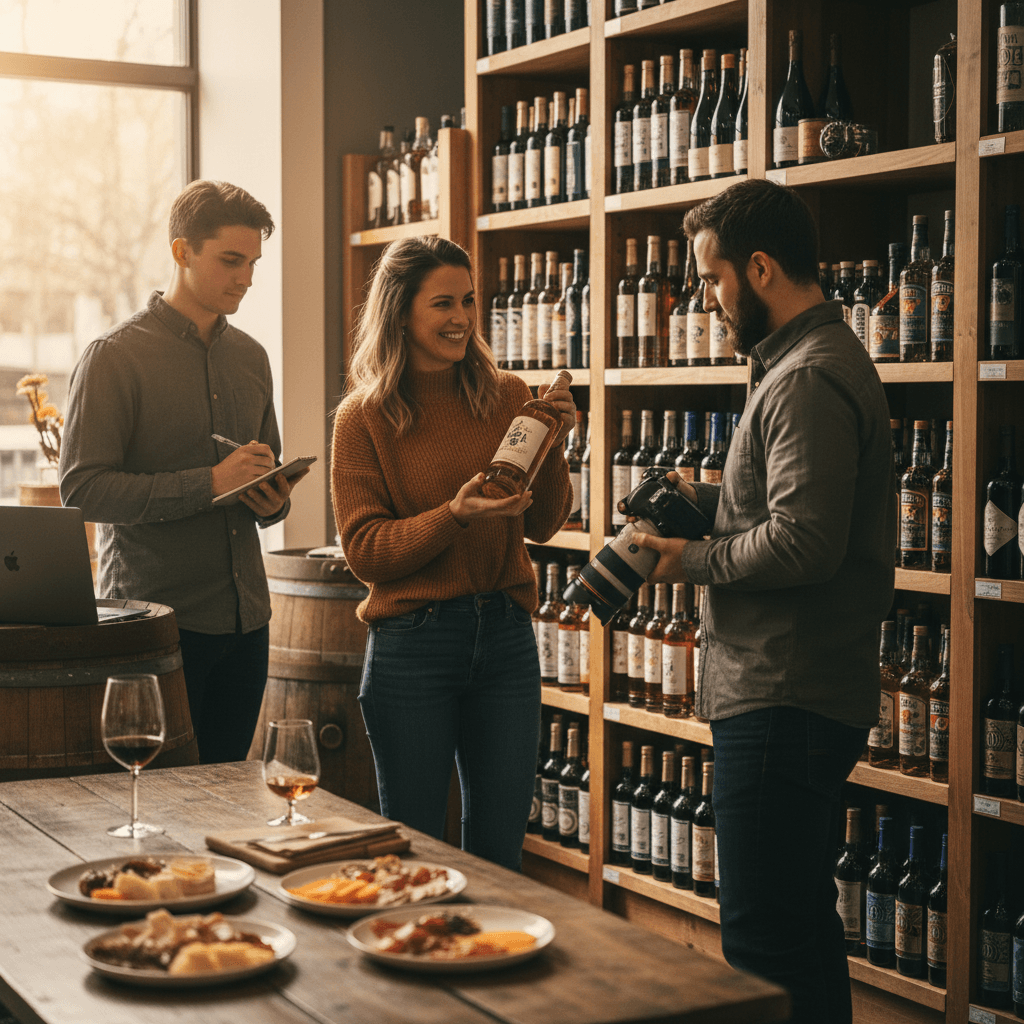
Influencer Marketing for Liquor Stores: How to Partner With Local Food and Drink Creators to Drive Store Visits
By Intentionally Creative11 min read
Listen to this article16:01
Schedule a free strategy call and Intentionally Creative will build a custom plan for you.
Schedule Your Free Strategy CallFree audit. No commitment.
Get a Free Audit. No commitment.
Influencer marketing for liquor stores works. Learn how independent retailers partner with local food and drink creators to drive foot traffic and boost sales.
Your best customers didn't find you through a billboard. They found you because someone they trust — a friend, a bartender, a neighbor — told them your store was worth the trip. Influencer marketing for liquor stores works on exactly the same principle, just at scale. Instead of one word-of-mouth recommendation at a backyard barbecue, it's a local cocktail creator showing 5,000 of their closest followers exactly which bottle to grab from your shelf — and exactly where to find it.
If that sounds too simple, good. It should. The most effective marketing strategies for independent liquor retailers aren't complicated. They're just intentional. And right now, while the big chains dump money into generic digital ads and national brands fight over shrinking market share, local stores have an opening that won't last forever: partnering with the food and drink creators your customers already follow and trust.
This guide breaks down exactly how to do it — from finding the right creators in your market to structuring partnerships, staying compliant, and measuring real results. No fluff, no six-figure budgets required. Just a practical playbook for turning local influence into store visits.
Here's what we hear all the time: "Influencer marketing? That's for craft breweries with taprooms, celebrity tequila brands, and Napa wineries with sunset views." And honestly, that used to be mostly true.
Not anymore.
Discover 7 proven Instagram content ideas for liquor stores that boost engagement and drive sales. Learn how to promo...
Influencer marketing for liquor stores is not only viable — it's arguably a better fit than it is for those bigger players. Here's why.
Think about what makes your store different from a Total Wine or a grocery aisle. You're curated. You're local. Your staff actually knows what they're talking about. You're embedded in your community — sponsoring the softball team, stocking that small-batch bourbon nobody else carries, remembering regulars by name.
That's exactly what influencer marketing rewards: authenticity and local credibility.
A food and drink creator with 5,000 engaged local followers recommending your store isn't an ad — it's a neighbor's recommendation. And micro-influencers (typically 1K–50K followers) consistently deliver higher engagement rates than big-name accounts — [VERIFY: commonly cited as 2–3x higher; source varies by study] — making them remarkably cost-effective for local retail campaigns.
10 wine club marketing tactics that reduce the 40% year-one cancellation rate and boost member spending at your liquo...
Here's a data point worth sitting with: adult beverage brands are increasing influencer marketing spend even as overall American alcohol consumption continues its multi-year decline [VERIFY: confirm current trend data and cite specific source]. The market is shrinking, and the smart money is pouring more into creator partnerships — because the ROI holds up.
According to Bottlecapps ↗, community-led influencer campaigns are driving measurable alcohol sales through trust and authenticity at the local level. If national brands see enough value to double down during a consumption dip, independent stores — with their built-in neighborhood credibility — are even better positioned to benefit.
This isn't about going viral. It's not about hiring a celebrity. Effective liquor store marketing in 2025 looks like smart, affordable partnerships with people your customers already follow. The opportunity is sitting right in your zip code.
You don't need a celebrity endorsement to get people through your door. You need the right person talking to the right audience — and that audience needs to live close enough to actually visit your store.
10 proven liquor store social media content ideas to connect with customers, boost brand visibility, and drive both i...
Let's keep this simple. Micro-influencers have roughly 1,000 to 50,000 followers. Nano-influencers are even smaller — typically under 1,000. What they lack in massive reach, they make up for in something far more valuable for your business: a tight-knit, highly engaged local following.
Here's the thing: a local mixologist with 3,000 engaged followers in your city will drive more foot traffic than a national account with 500,000 followers scattered across the country. Those 3,000 people can actually walk into your shop this weekend. Authenticity beats follower count every time.
This matters now more than ever. Even as consumption trends soften, brands are leaning harder into creator-driven marketing — because targeted, trust-based campaigns deliver where broad-reach advertising doesn't.
Not all creator partnerships are equal. Focus on people who already carry community trust:
These creators don't just promote your store. They validate it. That's something no billboard can replicate.
So you're sold on the concept. Now what does this actually look like in practice? Let's break down the formats that deliver real results.
Short-form video content on TikTok and Instagram Reels dominates alcohol promotion trends heading into 2025–2026, with cocktail recipe and tasting content ranking among the top-performing formats. This isn't surprising — people love watching someone make a beautiful drink in 60 seconds or less.
Here are the content types that perform best:
The magic here? This content feels organic and trustworthy — not like an ad. Viewers trust these recommendations because they come from people they already follow and like. That authenticity is exactly why it drives store visits.
Tastings, bottle signings, and cocktail demos serve double duty. They drive foot traffic on event day and generate shareable social content that keeps working long after the last pour.
Let's be real — compliance isn't the exciting part. But it's non-negotiable, and here's the upside: following the rules actually builds trust with your audience and protects your liquor license.
Every paid partnership needs clear disclosure. That means creators must use #ad, #sponsored, or built-in paid partnership tags on every post. No exceptions. This protects both your store and the creator under FTC guidelines, and it keeps the TTB off your radar.
Age-gating is equally critical. Content promoting alcohol must reach age-appropriate audiences — period.
Both Instagram and TikTok have specific alcohol advertising policies that you need to understand before launching any campaign.
Instagram requires age-gated accounts for alcohol content. TikTok's policies are stricter — [VERIFY: as of recent updates, TikTok prohibits paid alcohol advertising in the US; confirm current policy before publication]. These rules change frequently, so check the latest guidelines before every campaign.
Your quick compliance checklist:
Likes are nice. Sales are better. When you're investing in influencer marketing for liquor stores, you need to track what actually moves your business forward — not just what looks good on a screen.
Stop obsessing over impressions and start watching these numbers:
The ROI from local creator partnerships is real — but only if you're measuring the right things.
You don't need fancy software. Start with these:
Even small wins validate this strategy. A tasting event that draws 30 new customers? A featured bourbon that sells out 48 hours after a creator's Reel? That's proof of concept — and justification to keep investing.
With micro-influencers delivering significantly higher engagement than big-name accounts, these partnerships don't need massive budgets to produce measurable results. This is a strategy that rewards the stores that simply pay attention to the data.
10+ years helping liquor retailers and beverage brands grow through data-driven digital marketing. Learn more
When a local creator films a tasting event at your store, you get content that promotes your next event, your product selection, and your store's vibe — all at once.
One event. Weeks of content. That's the kind of efficiency time-strapped store owners need.
Here's the good news: this doesn't require a talent agency or a six-figure budget. It requires knowing where to look and having a decent pitch.
Start where creators already hang out — Instagram and TikTok. Search local hashtags like #DallasCocktails, #PortlandFoodie, or #[YourCity]Drinks and see who's consistently posting quality content. Check who's tagging the popular restaurants and bars in your area. Those creators already have an audience that cares about local food and drink.
Then ask your own staff. Seriously. Your employees likely follow local creators you've never heard of. That's free market research.
You're looking for micro-influencers — creators with roughly 1K to 50K followers. Their audiences are smaller but significantly more engaged, and because their followers are concentrated locally, the path from "I saw this on Instagram" to "I'm walking into that store" is remarkably short.
When you reach out, be direct and lead with value. Most local creators aren't getting flooded with retailer offers — you might genuinely be their first. Respect their work. Don't ask for free content.
Partnership structures can be simple:
Short-form video content — cocktail recipes, tastings, store walk-throughs — dominates right now, so these partnerships naturally align with what performs best on social platforms.
Start small. One collaboration with one local creator is enough to test the waters. You don't need a full influencer program on day one — you need one good post that drives a few dozen curious customers through your door. That's a strategy you can build on.
Before you hit send on that first DM, though, there's one more thing you need to get right. It's not glamorous, but it could save your liquor license.
Intentionally Creative specializes in digital marketing strategies that drive real results. Let us show you what's possible.
Schedule a CallFrame this as professionalism, not paperwork — because that's exactly what it is.
Here's the bottom line: influencer marketing for liquor stores isn't about chasing viral moments or blowing your budget on a celebrity endorsement. It's about doing what you already do best — building trust and community — and amplifying it through the right local voices.
The data backs this up. Even as overall alcohol consumption declines, brands are increasing influencer spend because it drives real sales. Micro-influencers deliver outsized engagement relative to their follower counts, and community-led campaigns consistently drive actual foot traffic at the local level.
So here's your homework this week: find one local food or drink creator in your market and reach out with a simple partnership idea. One collaboration. One piece of content. See what happens.
The big brands are pouring millions into this because it works. You can do the same thing — more authentically and more affordably — by going local.
Want help building a local creator partnership strategy tailored to your store? Intentionally Creative ↗ can help you find the right partners, craft the outreach, and build a marketing strategy that turns content into foot traffic. Let's talk.