SMS Marketing for Liquor Stores: Compliance Rules, Platform Picks, and the Campaigns That Drive Same-Day Sales
By Intentionally Creative13 min read
Listen to this article16:38
Schedule a free strategy call and Intentionally Creative will build a custom plan for you.
Schedule Your Free Strategy CallFree audit. No commitment.
Get a Free Audit. No commitment.
SMS marketing for liquor stores delivers 98% open rates. Learn alcohol compliance rules, top platforms, and text campaigns that drive same-day sales.
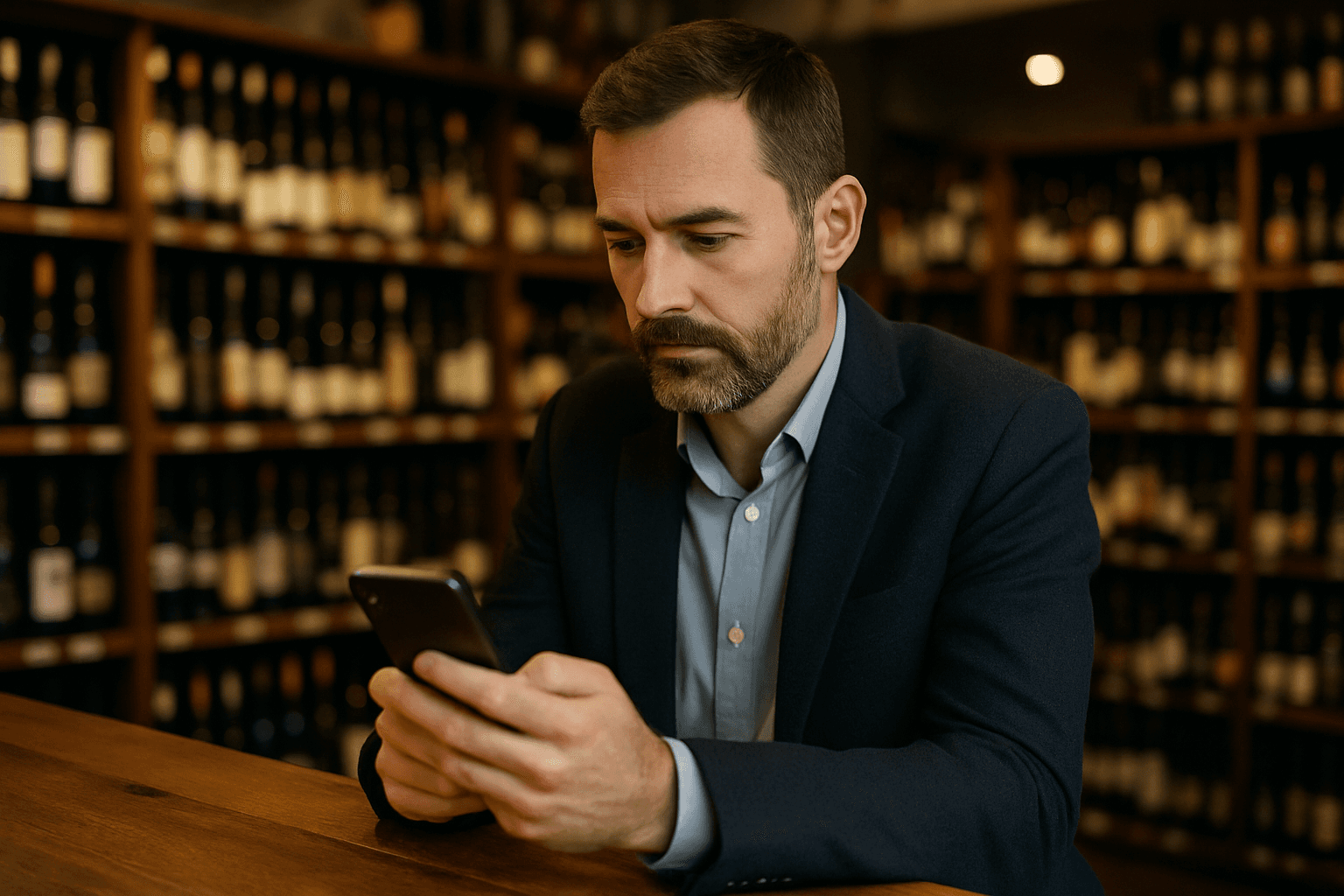
Your customers are already in their cars, deciding where to stop on the way home. They're not opening emails. They're not scrolling through your Instagram. But they will read a text message — as high as 98% of the time, in fact, and usually within three minutes of receiving it. For liquor store owners sitting on a goldmine of repeat, local customers, that's not a fun statistic. That's a business opportunity hiding in plain sight.
SMS marketing for liquor stores is one of the highest-ROI channels available to independent alcohol retailers right now — but it comes with real rules, real platform decisions, and real questions about what actually works. Send the wrong message without proper consent and you're looking at four-figure fines per text. Choose the wrong platform and your campaigns get silently blocked by carriers before they ever reach a customer's phone. But get it right, and you've built a direct line to hundreds (or thousands) of local buyers who are ready to walk through your door today.
This guide covers everything you need to launch with confidence: why SMS dominates other channels for liquor retail, the compliance rules that are non-negotiable, which platforms are actually built for alcohol, seven campaigns proven to drive same-day sales, and how to measure every dollar your texts generate. Let's get into it.
You're competing for attention against every notification, email, and social post on your customers' phones. But there's one channel where you almost always win.
SMS delivers open rates as high as 98%. Email? Roughly 20% on a good day. That's not a marginal difference — it's a completely different league.
For liquor retailers, this matters more than you might think. You're not selling software subscriptions or running brand awareness campaigns. You're driving foot traffic today. When nearly every message gets read — most within three minutes — your weekend whiskey promo actually reaches the people who'd buy it.
Discover the 7 essential marketing budget benchmarks for liquor stores. Learn how top performers allocate spend for m...
Here's what makes SMS such a natural fit for this industry: your business model is hyper-local and impulse-driven.
Most of your customers live within a 5–10 mile radius. They already know your store. They've already been in. SMS doesn't need to introduce you — it just needs to trigger a visit. A well-timed text about a Friday bourbon deal or a new craft beer drop can convert to a same-day sale within hours.
That's the real power here. You're not building awareness. You're activating an existing customer at the exact moment they're deciding where to stop on the way home.
Of course, a channel this powerful comes with strings attached — and in the alcohol industry, those strings are legally binding.
SMS is powerful, but that power comes with real legal guardrails. Ignoring them can cost you everything from your messaging privileges to six figures in fines.
Discover the 10 most costly alcohol marketing compliance mistakes liquor stores make and actionable strategies to mai...
Here's what you actually need to know.
The Telephone Consumer Protection Act (TCPA) is the federal law governing every commercial text message sent in the United States. The rule is straightforward: you need explicit written consent before you send a single promotional text. No exceptions, no gray areas.
The penalties aren't abstract, either. Violations carry fines of $500 per unsolicited message — up to $1,500 for willful violations — and yes, that's per message, per recipient. Class-action lawsuits targeting non-compliant SMS programs are increasingly common, and plaintiffs' attorneys actively look for businesses cutting corners. One poorly managed blast to 2,000 contacts without proper opt-in? That's a potential million-dollar liability.
If you haven't heard the acronym SHAFT, you need to learn it now. It stands for Sex, Hate, Alcohol, Firearms, and Tobacco — the content categories that carriers and compliance bodies flag for extra scrutiny. Alcohol SMS falls squarely in this restricted zone.
What does that mean practically? Every alcohol SMS program in the U.S. must include a 21+ age gate before subscribers receive any promotional messages. This typically looks like a simple confirmation during the opt-in flow: "Are you 21 or older? Reply YES or NO." Without this step documented, you're non-compliant from day one.
10 proven liquor store social media content ideas to connect with customers, boost brand visibility, and drive both i...
Here's the threat most store owners don't see coming: carrier filtering. If your messages lack proper compliance signals — age-gate records, clear opt-in documentation, compliant content — carriers like T-Mobile and Verizon can silently block your texts from ever reaching customers. No bounce notification. No error message. Your campaigns just vanish.
Protect yourself with these non-negotiables:
Getting compliance right isn't complicated — but it is unforgiving. Nail the basics now, and you build a channel that drives revenue for years.
Now that you know the rules, the next question is practical: which platform actually lets you follow them without turning compliance into a full-time job?
Not every SMS platform is built to handle alcohol. Some will flat-out reject you during onboarding. Others will let you sign up, then suspend your account the moment you send a promotion for bourbon. The platform question matters more than most retailers realize.
Here's where the landscape stands right now.
If you run a brick-and-mortar liquor store, Springbig deserves a serious look. It's purpose-built for regulated industries and positions alcohol text message marketing — including MMS with product images — as one of the easiest, most cost-effective channels available. The platform powers over $5 billion in annualized transactions across regulated retail, so it's not a startup guessing at compliance. Built-in age-gating, consent management, and opt-in tracking come standard. For independent retailers who want to launch SMS without a steep learning curve, this is the lowest-friction option.
Selling online? Klaviyo and Postscript are the heavy hitters. Both require merchants to implement 21+ age-gating before subscribers receive any promotional SMS — a non-negotiable for alcohol retail compliance. Their segmentation and automation capabilities are best-in-class, letting you trigger campaigns based on purchase history, browse behavior, and customer lifetime value. The trade-off: these platforms are optimized for e-commerce. Brick-and-mortar stores can absolutely use them, but expect more setup work to connect your POS data and build in-store workflows.
Starting from zero subscribers? Voyage SMS focuses specifically on rapid list growth and higher conversion rates through targeted engagement. If your immediate priority is building a subscriber base fast — before worrying about complex automation — Voyage is worth evaluating.
Your text marketing strategy is only as good as the list behind it. Every subscriber you add carries real weight. But here's the thing — a list of 500 local, engaged customers who actually shop with you will outperform 5,000 unqualified numbers every single time.
Start where the action is: your store. Place a QR code at the register, on shelf talkers, and on receipts that links to an age-gated opt-in page (remember, 21+ verification is mandatory for promotional alcohol SMS under TCPA rules). Keep the ask simple and rewarding: "Text JOIN to [number] for 10% off your next visit."
Then train your staff. A quick, natural line at checkout — "Want to hear about our deals before anyone else? Join our text list" — converts surprisingly well when said in person. No hard sell needed. Just a genuine invitation.
Already have an email list or social following? Use them as a funnel. Send a dedicated email or post promoting your text list with a clear value proposition: "We text once a week. Deals only. No spam."
Want to accelerate growth? Run a social media giveaway — "Win a $50 gift card. Text WINE to [number] to enter." List-building velocity is one of the biggest levers for long-term ROI. A fast-growing, quality list compounds quickly into same-day sales you can actually measure.
Once your list is growing and campaigns are running, there's one more piece that separates stores that think SMS works from stores that know it does: measurement.
Most marketing channels feel like throwing money into the void. SMS marketing for liquor stores is different — but only if you're tracking the right numbers.
Focus on four core metrics:
The attribution piece is critical. Use unique promo codes or simple "show this text" mechanics at checkout to tie in-store sales directly to specific campaigns. No more guesswork.
A healthy opt-out rate sits under 2–3% per campaign. Higher than that? You're texting too often or your offers aren't hitting.
Here's where the math gets exciting. Your cost per message typically runs $0.01–$0.05. Even a modest 5% redemption rate on a 1,000-subscriber list means 50 customers walking through your door — often that same day. If your average transaction is $45, that's $2,250 in revenue from a campaign that cost you $10–$50 to send.
The key is closing the loop between send and sale so you can prove exactly what each message earns.
10+ years helping liquor retailers and beverage brands grow through data-driven digital marketing. Learn more
Worth watching: Santé recently raised $7.6M to build an AI operating system for the wine and liquor industry. Predictive campaign tools and AI-powered SMS features are coming to this space soon.
Before you commit, run through this checklist:
The right platform turns your text campaigns into a same-day revenue driver. Choose the one that handles compliance so you can focus on selling bottles.
You've got the compliance knowledge. You've picked a platform. Now comes the part that actually makes you money.
An open means nothing without a compelling campaign behind it. Here are seven proven formats that turn a text message into a register ring — often within hours of hitting send.
Campaign 1 — Friday Flash Sale: Send a two-hour flash deal on a popular spirit at 2 PM on Friday. Urgency plus timing equals foot traffic. The message practically writes itself:
🥃 $5 off Maker's Mark today only, 2–6 PM. Show this text at checkout. Reply STOP to opt out.
Short, clear, and actionable. That "show this text" mechanic also makes attribution dead simple — you'll know exactly how many sales the campaign drove.
Campaign 2 — New Arrival Alert: Text your list the moment allocated or hard-to-find bottles hit the shelf. Bourbon hunters and wine collectors will race in. Do this consistently and you build a reputation as the store that gives first access — which is worth more than any ad spend.
Campaign 3 — Weekend Pre-Game: Send a Thursday evening text with a curated deal bundle: "Grab your game-day pack: 2 six-packs + chips for $24." You're catching people in planning mode, before they've committed to a competitor.
Campaign 4 — Holiday Countdown: Run a three-text series leading up to major holidays — July 4th, Thanksgiving, New Year's Eve — with escalating deals or gift bundle suggestions. Space them out (seven days, three days, morning-of) so you build anticipation without burning out your list.
Campaign 5 — Loyalty VIP Drop: Reward your best customers with early access to sales or exclusive products through a segmented VIP text list. This is where platforms with strong segmentation — like Klaviyo or Springbig — really shine. Segmentation turns a broadcast tool into a relationship builder.
Campaign 6 — Tasting Event Invite: Promote in-store tastings via SMS with a "Reply YES to RSVP" mechanic. You gauge attendance and boost engagement rates, which keeps your sender reputation healthy.
Campaign 7 — Cross-Channel Funnel: Follow the Nectar Hard Seltzer playbook — use TikTok or Instagram to drive followers into your SMS list with a CTA like "Text CHEERS to 55555 for 10% off." Social builds awareness. SMS closes the sale. Together, they're the strongest one-two punch you can run without a massive budget.
The common thread across all seven? Each campaign gives people a specific reason to walk through your door today — not someday.
Great campaigns need an audience. If you're starting with zero subscribers — or just a handful — building a quality list is faster than you'd think.
Intentionally Creative specializes in sms marketing strategies that drive real results. Let us show you what's possible.
Schedule a CallHere's the recap: SMS marketing for liquor stores pairs near-universal read rates with the most impulse-friendly retail category on the planet. Your customers are local, they buy on a whim, and they almost always have their phone within arm's reach. That's a powerful combination.
Yes, compliance is more involved than selling candles online. You need TCPA-compliant consent, 21+ age-gating, and awareness of SHAFT guidelines. But with the right platform — and there are several built specifically for regulated industries — it's entirely manageable.
Don't overthink the launch. Pick one platform. Build a list starting with your best customers. Send one campaign per week. Track redemptions. Scale what works.
The industry is moving fast. Santé just raised $7.6M to bring AI tools to wine and spirits retail. Platforms like Springbig are powering billions in regulated transactions. Text message marketing for liquor stores isn't experimental anymore — it's infrastructure. The stores building their SMS lists today will have a real competitive edge twelve months from now.
Ready to get started? If you want help building an SMS strategy that's compliant, effective, and actually drives same-day foot traffic, Intentionally Creative can help. Let's talk.