Cart Abandonment and Win-Back Flows: Email Sequences Every Liquor Store Needs Beyond the Welcome Series
By Intentionally Creative10 min read
Listen to this article14:01
Schedule a free strategy call and Intentionally Creative will build a custom plan for you.
Schedule Your Free Strategy CallFree audit. No commitment.
Get a Free Audit. No commitment.
Boost revenue with cart abandonment emails and win-back sequences designed for liquor stores. Practical automation tactics for beverage retailers.
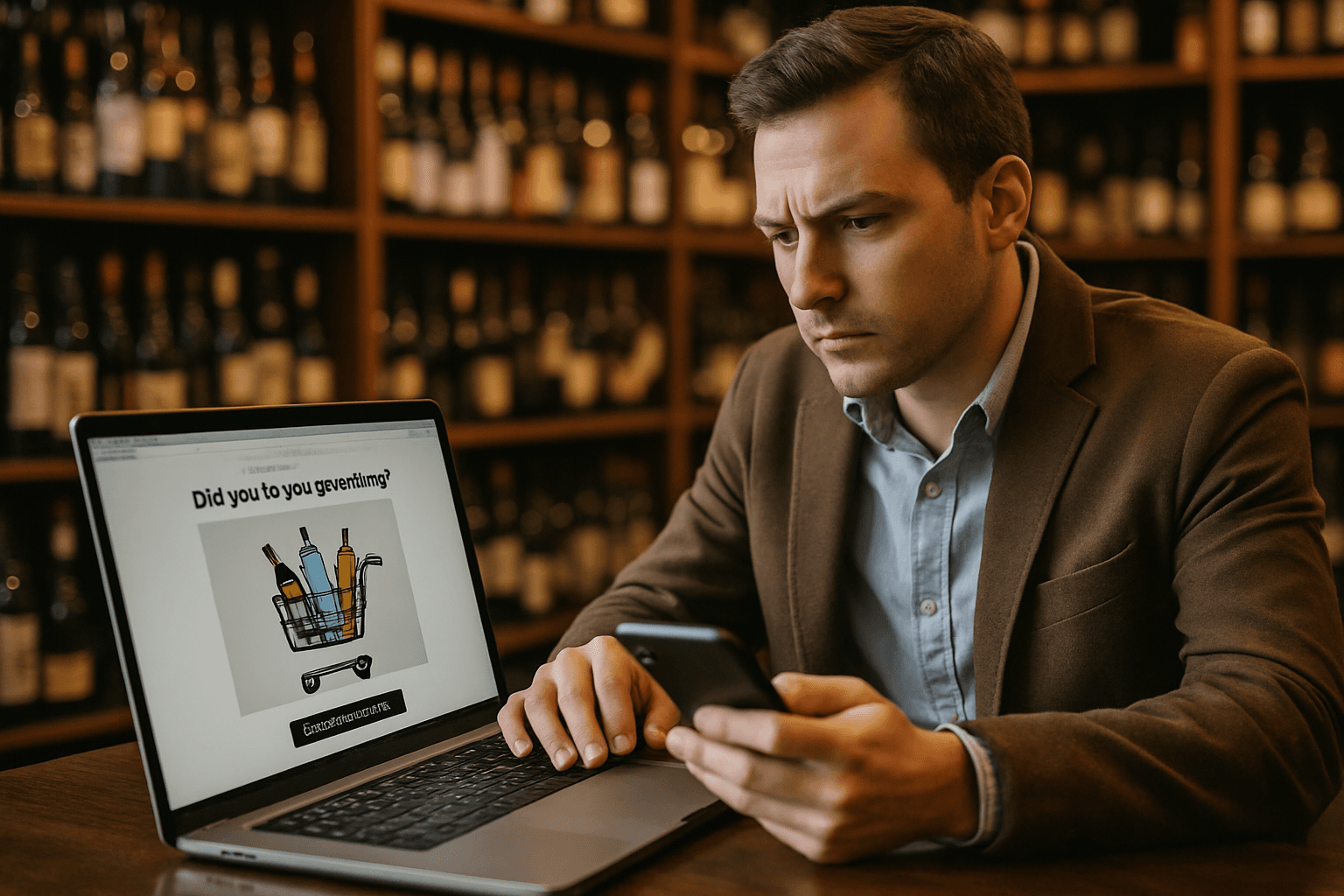
You just watched a customer add three bottles of bourbon, a bottle of red wine, and some craft mixers to their cart. They lingered on your site, browsed your bourbon collection, and then closed the tab. Three hours later, there's been no purchase. No follow-up. No second chance.
Sound familiar?
Most independent liquor stores have a welcome email (and if you don't, that's where to start). Some even have a decent automated sequence set up. But here's where things fall apart for so many retailers: after that initial outreach, there's silence. Your customer browses, adds items to their cart, and then... nothing. The relationship you started building through your welcome series stalls out before it ever has a chance to grow into repeat business.
The good news? You already have the solution sitting in your email platform, waiting to be unlocked. Recovery email flows—including your cart abandonment email for liquor store operations and win-back sequences—work together to capture revenue at every stage of the customer lifecycle, turning interest into action and dormant relationships back into active ones.
Learn proven email marketing strategies for liquor stores that turn subscribers into loyal customers. Build your list...
Welcome emails start relationships, but recovery sequences capture revenue. The welcome series opens the door. The emails that follow determine whether customers stay—and whether they ever come back after they've wandered off.
Beyond the welcome series, ecommerce email automation for beverage retailers allows you to address specific customer behaviors throughout the buying lifecycle. A cart abandonment email for liquor store operations can recover sales that would otherwise vanish. Shopping carts are abandoned for reasons like shipping costs and price comparison, and a timely reminder adds value to customers by bringing them back to what caught their interest in the first place.
A win-back email sequence for alcohol brands targets lapsed customers who've gone quiet. These automated flows work together to capture revenue at every stage—turning interest into action, and dormant relationships back into active ones.
Learn how to build a liquor store email marketing funnel with welcome sequences, smart segmentation, and promo cadenc...
If you've ever watched a customer fill up their online cart only to disappear at checkout, you're not alone. In beverage retail, the reasons go beyond simple second thoughts.
Liquor retail cart abandonment often involves regulatory checks, age verification friction, or shipping concerns on large orders. Unlike standard e-commerce, your store has built-in compliance requirements that can create friction at critical moments. When a customer suddenly realizes they need to verify their age or enter additional information, many simply bail.
Price-conscious shoppers may have added items from multiple stores, comparing totals before committing. Others might have questions about age verification that your site didn't answer clearly enough.
Learn how email segmentation for liquor stores drives repeat sales with a 4,200% ROI. List-building tactics, purchase...
Consider what objections your specific customers might have: shipping costs, price comparison, or verification requirements. Your cart abandonment email for liquor store strategy should reflect what's actually happening on your site.
Segmentation by abandon reason helps tailor recovery messaging. When you can send targeted messages based on whether someone left due to shipping concerns, age verification confusion, or simple price shopping, your win-back email sequence for alcohol brands becomes far more effective. Look at your store's checkout funnel data to identify where customers are dropping off—and build your ecommerce email automation for beverage retailers around those specific leak points.
Your welcome series lays the foundation, but the real money lives in your cart abandonment email for liquor store flows. These automated messages target shoppers who showed intent but didn't complete a purchase—a critical window for recovery.
Timing is everything. Reach out within 1-2 hours while the purchase is still fresh in their mind. Keep it simple: display the product image, name the exact item they left behind, and include one clear call-to-action button. Your subject line should add value—reference the specific product or category they browsed rather than generic phrases like "You left something behind." Subject lines work best when they speak directly to what caught the shopper's interest.
By the 24-hour mark, your customer has likely been comparison shopping. Your second email should acknowledge common reasons carts get abandoned—shipping costs, price, or second-guessing the selection. Reassure them with social proof, highlight your store's benefits, and reaffirm the value. Keep the product front and center with another image and a single CTA. This isn't about pressure—it's about removing friction.
Your final recovery email can lean into urgency, but stay authentic. Offer a small incentive if it makes sense for your margins, or emphasize limited availability. Remind them of the product one last time with imagery and a direct path back to checkout. Abandoned cart emails help recover lost sales when you give shoppers a compelling reason to return.
Each email in this sequence works together to guide hesitant buyers back to the register—turning lost opportunities into revenue through strategic liquor store email marketing.
Even the best-designed email sequence falls flat if nobody opens it. This is where most liquor stores leave money on the table—generic subject lines, no preheader strategy, and body copy that feels transactional rather than helpful.
Your subject line is the gatekeeper to your cart abandonment email for liquor store campaigns. Subject lines should add value to customers since shopping carts are abandoned for a variety of reasons. Avoid the temptation to simply state "you left something behind"—that's a missed opportunity.
Test two approaches: emotional triggers like "Remember that whiskey you browsed?" versus direct messaging such as "Your cart is waiting." Your audience may respond differently based on purchase intent and brand relationship.
Keep preheader text under 40 characters for mobile visibility. Since many subscribers read on smartphones, a truncated message loses impact. Use the preheader to reinforce your subject line's promise or add urgency without repeating the subject.
Keep body copy conversational. A strong liquor store email marketing strategy includes recovery messages that feel helpful rather than desperate. Focus on the product benefits they were interested in, not the abandonment itself. This approach is foundational to any effective win-back email sequence for alcohol brands and ecommerce email automation for beverage retailers.
You've got the strategy and the copy. Now let's make sure your automation actually runs. This is where many indie liquor stores get stuck—not because the concepts are hard, but because platform setup feels overwhelming.
Mailchimp, Klaviyo, and Drip offer solid foundations for ecommerce email automation for beverage retailers. Look for platforms that integrate with your POS and shopping cart systems, handle segmentation cleanly, and support compliance features built for alcohol brands.
Before launching your cart abandonment email for liquor store campaigns, build three foundational segments:
Your win-back email sequence for alcohol brands depends on reaching the right people at the right moment. Set up time-delay triggers based on cart behavior—abandoned cart emails help recover lost sales with proven strategies including timing tactics and templates to convert browsers into buyers.
Your age verification data informs segmentation for compliant messaging. Use it to message only verified-age customers. Always include clear unsubscription options and avoid content that could appeal to minors.
10+ years helping liquor retailers and beverage brands grow through data-driven digital marketing. Learn more
Now that you've set up a system to recover carts in real time, let's talk about customers who've gone dark entirely. While your cart abandonment flow captures immediate intent, win-back sequences rebuild relationships with shoppers who've drifted away.
The term "lapsed" isn't one-size-fits-all. For your store, it might mean customers who haven't purchased in three months, six months, or longer—the right timeframe depends entirely on your sales patterns. Your own purchase data is the best tool here. Look at when one-time buyers typically stop returning, and when repeat customers go quiet. That gap? That's your "lapsed" threshold.
Rather than aggressive "come back now" messaging, think of win-back as reconnecting with a friend. A typical sequence starts with a soft check-in acknowledging their absence—something like "We miss you" paired with a highlight of what's new. The second email can showcase seasonal features or new arrivals tailored to their purchase history. The third (if needed) might offer an incentive, such as a loyalty reward or exclusive discount.
Segmentation makes this work. If you're running a cart abandonment email for liquor store campaigns alongside win-back, you're already collecting behavioral data. Use it here too—customers who bought wine deserve different messaging than those who stocked spirits or mixers. Relevant offers based on past behavior dramatically improve your chances of reactivation.
Not every dormant contact is worth pursuing indefinitely. If a customer hasn't opened any emails after your full win-back sequence, suppress them from active campaigns. Continuing to email unengaged contacts damages deliverability and wastes resources.
However, don't suppress based on purchase silence alone. Some customers prefer shopping in-store over email ordering. For these contacts, consider moving them to a lower-frequency list rather than full suppression. The goal: keep your liquor store email marketing strategy focused on contacts most likely to convert.
Intentionally Creative specializes in email marketing strategies that drive real results. Let us show you what's possible.
Schedule a CallYou can't improve what you don't measure. Once your flows are live, tracking the right metrics tells you what's working, what's not, and where to focus your next round of testing.
Open rates tell part of the story, but recovery rate is where your cart abandonment email for liquor store efforts prove their worth: recovered orders divided by abandoned carts. Monitor unsubscribe rates closely—if customers opt out, your messaging may feel off-target rather than helpful.
Your starting point matters more than industry averages. Track your recovery rate week-over-week to establish what's normal for your store, your audience, and your liquor store email marketing strategy.
Test send times, subject lines, and discount offers systematically. Small tweaks compound into meaningful revenue recovery. Let your own data guide each adjustment—as you test and learn, you'll discover what resonates with your specific customer base.
The beauty of email automation for liquor stores is that it works while you sleep. Once your cart abandonment and win-back sequences are set up, they keep working—capturing lost sales, rekindling dormant relationships, and building the kind of customer loyalty that keeps people coming back to your store instead of scrolling past to a competitor.
Your next step is straightforward: pick one flow to build first. Start with cart abandonment if you want quick wins. Start with win-back if you're looking to re-engage your existing list. Whichever you choose, get it built, launch it, and then measure what happens. You might be surprised how much revenue has been sitting in those abandoned carts all along.