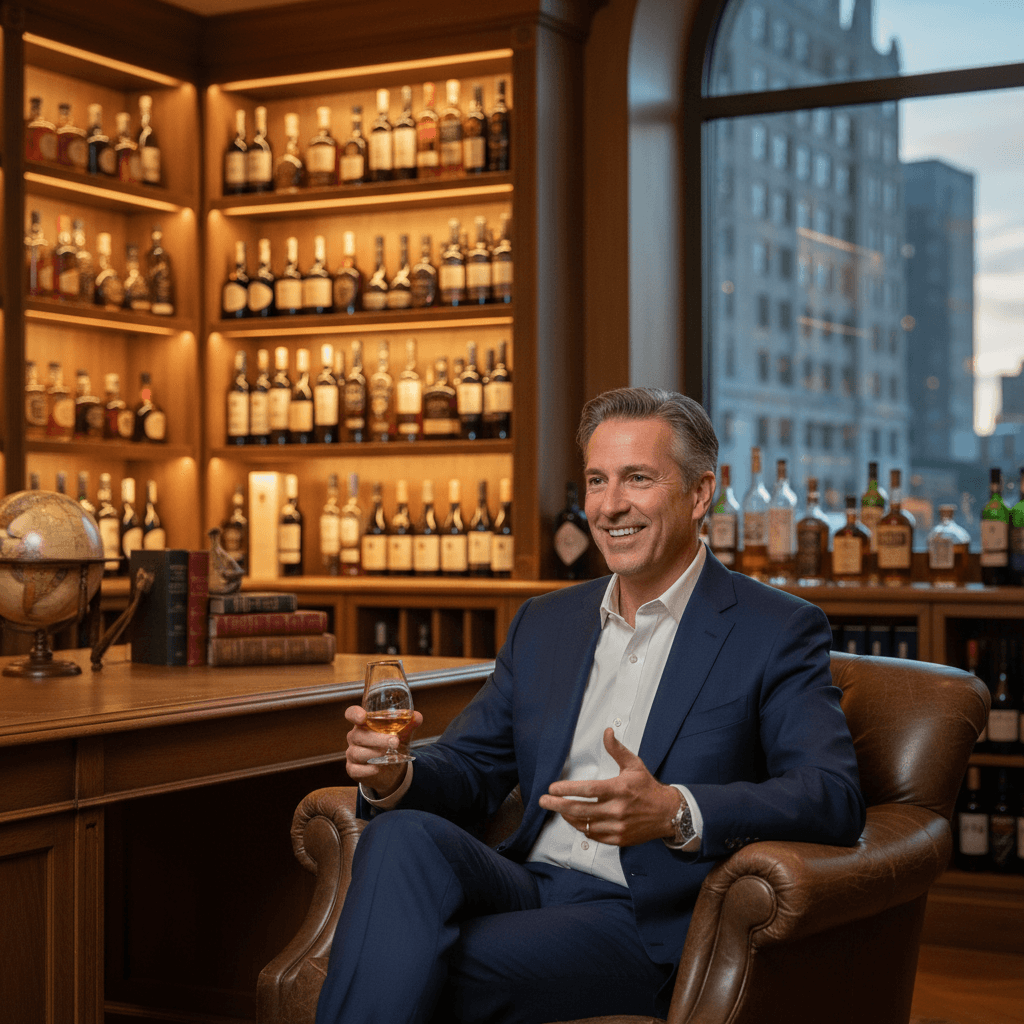
From Founder to CEO: A Conversation with Alden Morris About the Future of Liquor Retail
By Alden Morris26 min read
Listen to this article35:38
Schedule a free strategy call and Intentionally Creative will build a custom plan for you.
Schedule Your Free Strategy CallFree audit. No commitment.
Get a Free Audit. No commitment.
Liquor retail marketing expert Alden Morris shares industry insights, digital strategy comparisons, and bold predictions for the future of independent liquor store growth in this exclusive interview-style guide.
Liquor retail used to be a real estate game. The store with the best corner location won.
That changed fast. The pandemic didn't create the shift to digital — it compressed a decade of consumer behavior change into roughly 18 months. Curbside pickup, delivery apps, and Google search became the new front door for thousands of retail liquor stores. Stores that had never touched a digital marketing budget suddenly needed one yesterday.
Alden Morris saw this coming before most operators did. He built Intentionally Creative around that conviction.
Discover the 7 essential marketing budget benchmarks for liquor stores. Learn how top performers allocate spend for m...
Why is liquor retail marketing changing so dramatically right now? Liquor retail marketing is changing because consumer discovery has moved almost entirely online before a single bottle is touched. Shoppers now search Google for store hours, check Instagram for new arrivals, and order delivery through third-party apps — all before setting foot inside. According to Michigan's Liquor Control Commission spirits purchase data, retail spirits volume has remained competitive even as consumer habits fragment across more channels. The stores capturing that attention aren't the ones with the biggest floor space — they're the ones showing up first in search, running targeted ads, and owning their digital shelf. The operators who treat digital marketing as optional are effectively invisible to a growing segment of buyers who never browse a physical aisle first.
He's not an agency guy who stumbled into liquor. He's a liquor industry veteran who built an agency.
Alden Morris spent over 10 years working across all three tiers of the beverage alcohol system — supplier, distributor, and retail. That's a rare combination. Most marketers know one tier. Morris knows the pressure points in all three, which means he understands exactly why a retail liquor store owner's problems are different from every other retail client.
Discover the 10 most costly alcohol marketing compliance mistakes liquor stores make and actionable strategies to mai...
In May 2022, he founded Intentionally Creative (intentionallycreative.com ↗) — a full-service digital marketing agency built exclusively for retail liquor stores. The agency has since scaled to 17 people with 100% year-over-year growth. That growth isn't accidental. There is no other agency in the U.S. claiming exclusive expertise across the entire three-tier system.
This piece draws directly on Morris's frontline experience. Treat it as the conversation you'd want to have with the most informed person in the room — one who's worked the distributor floor and sat across from retail buyers.
Discover 9 proven liquor store content marketing strategies that combine data-driven personalization, social media en...
If you own or operate a retail liquor store, this is the guide built specifically for you.
Here's a question most liquor store owners can't answer clearly: What exactly is your marketing strategy — and is it actually legal?
Liquor retail marketing is the strategic use of digital and traditional channels — SEO, email, paid search, social media, loyalty programs — to drive foot traffic, online sales, and repeat customers for your store. That definition sounds simple. The execution is not.
General retail marketing doesn't apply here. Alcohol advertising operates under a completely different rulebook. Meta restricts alcohol ads by default. Google requires age-gating and certification. State regulations — like those governing New Jersey's licensed retailers under the NJ ABC framework ↗ — add another layer of compliance that generic agencies routinely ignore. A cookie-cutter agency will run your Facebook campaign straight into a policy violation or, worse, produce ads that technically run but convert nobody because they weren't built for a regulated product category.
The agencies that fail liquor retailers aren't bad at marketing. They're bad at this marketing. There's a difference.
Liquor retail marketing is the strategic deployment of digital and traditional channels — including local SEO, Google Business Profile optimization, email marketing, compliance-aware social media, paid search, and loyalty programs — to drive foot traffic, online sales, and brand loyalty for independent or chain liquor stores. It differs from general retail marketing in one critical way: every channel operates under federal and state alcohol advertising regulations that restrict targeting, creative content, and platform access. Meta requires alcohol ad approvals. Google mandates age-gating. State ABC boards impose their own rules on promotional language. Generic marketing agencies miss these constraints entirely, producing campaigns that either violate policy or simply don't convert in a regulated category. Effective liquor retail marketing requires a practitioner who understands both the digital execution and the compliance framework — not one or the other.
Most liquor stores make the same digital marketing mistakes. And the cost is measurable.
The three most common digital marketing mistakes liquor stores make are neglecting their Google Business Profile, over-relying on social media instead of email, and running paid ads without alcohol-specific compliance guardrails. Google Business Profile is the highest-ROI local marketing tool available — yet most stores configure it once and abandon it. Social media reach for alcohol brands is algorithmically suppressed and subject to platform restrictions that generalist marketers routinely underestimate. Email marketing, by contrast, delivers direct access to your best customers with open rates averaging 20–25% in retail — compared to organic social reach that frequently falls below 5%. Paid advertising compounds these risks: Google and Meta both enforce strict alcohol advertising policies covering age-targeting requirements, landing page compliance, and restricted claims. Stores that work with agencies unfamiliar with these rules face account suspensions that can take weeks to reverse, destroying both momentum and platform trust.
Here's a number worth sitting with: 76% of people who search for something nearby on their smartphone visit a related business within 24 hours. Your Google Business Profile is the first thing those customers see. Most liquor stores treat it like a DMV form — fill it out once, file it away, never look at it again.
Alden Morris is direct about this: "Your Google Business Profile is your digital storefront. If it's outdated, incomplete, or unoptimized, you're losing customers to the store down the street who figured this out."
He's right. And the fix isn't complicated. It just requires consistency.
What an optimized GBP actually looks like in practice:
Here's a myth worth dismantling: running five different marketing tactics means you have a marketing strategy. It doesn't. It means you have five separate expenses with no connective tissue between them.
Most independent liquor stores operate exactly this way — a social post here, a Google ad there, an email blast before Christmas. Each one disconnected from the others. Each one underperforming because none of them know what the others are doing.
A successful full-service digital marketing strategy for a liquor store integrates SEO, Google Business Profile management, email marketing, paid search, social content, and analytics into a single connected system — not a collection of isolated tactics. Each channel informs the others: keyword data from SEO shapes email subject lines, email open rates validate paid ad messaging, and Google Business Profile performance signals which promotions deserve more budget. According to Michigan's Liquor Control Commission licensee purchase data, spirits sales volume across independent retailers varies dramatically by region and season — stores that plan campaigns around actual sales rhythms consistently outperform those that don't. The difference between a store generating $40,000 in monthly revenue and one generating $120,000 often isn't product selection. It's whether their marketing operates as a system or a series of guesses.
Morris puts it plainly: "Most stores are running five disconnected tactics. We build one connected strategy."
That integration is what Intentionally Creative's full-service model delivers — SEO that feeds the email calendar, paid search that amplifies what's already ranking organically, and social content that reinforces the promotions customers are already seeing in their inbox.
What to do instead of running disconnected tactics:
10+ years helping liquor retailers and beverage brands grow through data-driven digital marketing. Learn more
Not every marketing channel delivers equal results for a liquor store. Here's what actually drives revenue:
Intentionally Creative executes across all six of these channels — not as a generalist agency dabbling in alcohol, but as the only U.S. digital marketing agency built exclusively for the beverage alcohol tier system.
The rest of this article uses a direct comparison framework: DIY, generalist agency, or niche specialist. The verdict on which one wins won't surprise you.
Imagine you're six months into running your liquor store and your sales are flat. A buddy recommends you "just post more on Instagram." You spend three hours on a Saturday creating content, schedule it through Meta Business Suite, and two days later the post gets flagged and pulled for violating alcohol advertising policies. No warning. No explanation. Just gone. That scenario plays out hundreds of times a week across independent liquor retail — and it's entirely avoidable with the right marketing partner in your corner.
The appeal of DIY is real. Zero agency fees. You know your customers, your inventory, and your brand better than anyone. For an owner who cut their teeth in marketing before opening a store, this can work — at least early on.
The problem is execution at scale. Alcohol advertising compliance on Meta and Google isn't intuitive. Platform rules change without notice, and a single misstep can get your ad account suspended. Seasonal campaigns, supplier promotions, and holiday inventory planning all require strategic lead time that most owners simply don't have while running daily operations. As Alden Morris puts it: "Most owners are great at running a store. Very few are great at running a store AND a marketing department simultaneously." That's not a criticism — it's a structural reality. Your time has a dollar value. Spend it where it compounds.
Generalist agencies bring real infrastructure — project management systems, creative teams, reporting dashboards. For a basic website refresh or a generic social presence, they can deliver. The cost is usually lower than a specialist, and the onboarding feels professional.
Here's where it breaks down: generalist agencies don't know what they don't know about alcohol retail. They've never navigated supplier co-op funding, where a brand like Tito's or Maker's Mark will partially reimburse your advertising costs if you feature their product correctly. They don't understand the seasonal buying rhythms that drive liquor retail revenue — the pre-Thanksgiving spirits run, the New Year's champagne window, the summer RTD surge. According to Michigan's Liquor Control Commission spirits purchase data, off-premise spirits purchasing spikes over 30% in November and December alone. A generalist agency treats that like any other month. And critically, generalist agencies routinely run afoul of alcohol advertising regulations on Meta and Google — the same compliance trap that catches DIY owners.
This is the option built specifically for what you're dealing with. Intentionally Creative operates at the intersection of all three tiers of the beverage alcohol system — supplier, distributor, and retail. That's not a talking point. It's the operational foundation that makes every campaign smarter. Compliance-aware creative. SEO built around how people actually search for liquor stores. Loyalty program integration that connects to platforms like City Hive. Supplier co-op navigation that puts money back into your marketing budget.
The tradeoff is honest: the investment is higher than DIY, and if your store isn't ready to scale, the ROI timeline stretches. Alden Morris is direct about it: "We built Intentionally Creative specifically because liquor retail has rules, rhythms, and relationships that generalist agencies simply don't understand." This isn't a fit for every store. It's a fit for the owner who's serious about building something durable.
The direct answer: A liquor store owner serious about sustainable growth should work with a niche specialist, not a generalist agency or DIY approach. DIY marketing costs too much time and carries real compliance risk — most owners lack the bandwidth to run both a store and a marketing department effectively. Generalist agencies bring process but lack the alcohol industry knowledge required to navigate Meta and Google advertising restrictions, leverage supplier co-op funding, or time campaigns around the seasonal patterns that drive liquor retail revenue. A niche specialist like Intentionally Creative brings compliance-aware campaigns, deep supplier relationship knowledge, and retail-specific SEO that generalists can't replicate. According to Michigan's LCC spirits purchase data, off-premise sales spike over 30% in Q4 alone — that window requires strategy, not improvisation. For stores ready to compete, the niche specialist delivers the highest return.
| Feature | DIY | Generalist Agency | Niche Specialist |
|---|---|---|---|
| Industry compliance knowledge | ✗ | ✗ | ✓ |
| SEO for liquor retail | Partial | Partial | ✓ |
| Content strategy | Partial | ✓ | ✓ |
| Paid advertising expertise | ✗ | Partial | ✓ |
| Loyalty program integration | ✗ | ✗ | ✓ |
| Supplier co-op navigation | ✗ | ✗ | ✓ |
| Reporting and analytics | ✗ | ✓ | ✓ |
The verdict is clear. If you're choosing between these three options and you want to grow, skip the first two. Buy the specialist.
Intentionally Creative specializes in digital marketing strategies that drive real results. Let us show you what's possible.
Schedule a CallGBP is free. The ROI on optimizing it correctly beats most paid channels for local retail. Ignoring it is leaving money on the table every single week.
Social media feels productive. Post something, watch the likes roll in. But for liquor retail specifically, organic social reach is algorithmically throttled and compliance-restricted across every major platform. Instagram, Facebook, TikTok — all of them apply additional suppression to alcohol-adjacent content. You're building on rented land, and the landlord changes the rules without notice.
Morris frames it plainly: "Social media is rented land. Email is land you own. Every liquor store should be building their list from day one."
The numbers back this up. Retail email marketing averages 20–25% open rates. Organic social reach for the same audience? Often below 5%. That's a 4–5x performance gap — and email reaches people who already opted in to hear from you. These are your best customers.
A curated email list lets you announce allocated bourbon drops, promote weekend tastings, and reward loyalty — without an algorithm deciding who sees it. Start collecting emails at checkout. Offer something worth signing up for. Then actually send.
This one has a real cost. Google and Meta both enforce specific policies for alcohol advertising: mandatory age-gating, compliant landing pages, restricted health claims, and geographic targeting limitations. These aren't suggestions. Violate them and your ad account gets suspended.
Generalist agencies — the kind that handle a dental practice on Monday and a liquor store on Tuesday — routinely miss these requirements. They don't know what they don't know.
Morris has seen the aftermath firsthand: "We've onboarded clients who came to us after a generalist agency got their Google Ads account suspended. Recovery takes weeks. The cost isn't just the downtime — it's the lost trust with the platform."
Account reinstatement is a slow, manual process. During that window, your competitors are capturing every paid click. The damage compounds. Alcohol retail advertising requires an agency that understands the three-tier system, platform-specific compliance requirements, and the difference between a restricted claim and a compliant one. Hiring a generalist to run your paid media is a risk that rarely ends quietly.
Liquor retail doesn't run on a flat calendar. It runs on peaks. Memorial Day. Fourth of July. Football season. Thanksgiving week. New Year's Eve. These aren't surprises — they're scheduled revenue opportunities that stores either prepare for six weeks in advance or scramble to capitalize on at the last minute.
Generalist agencies treat October like March. A niche specialist treats October like the revenue sprint it is — bourbon gift sets, holiday pre-order campaigns, and targeted paid search for "best whiskey gift" starting in early November, not December 22nd.
Intentionally Creative maps the entire retail calendar at the start of each engagement. Every campaign has a build window, a launch window, and a post-peak analysis window. The goal is to be in market before demand peaks — not chasing it.
This is the most underutilized advantage in independent liquor retail, and almost nobody talks about it.
Major spirits suppliers — think Diageo, Brown-Forman, Campari — offer co-op marketing programs that reimburse independent retailers for qualifying marketing expenses. Digital ads, email campaigns, in-store signage. These programs exist to drive sell-through at retail, and suppliers fund them because it's in their interest to do so.
The problem: most independent store owners have never heard of these programs, and most generalist agencies don't know how to access them.
Morris is direct about it: "We help our clients navigate supplier co-op programs. It's one of the most underutilized advantages in independent liquor retail."
For a store spending $2,000 per month on digital marketing, co-op reimbursements can offset 30–50% of that cost — if the campaigns are structured correctly and documentation is submitted properly.
What to do instead of leaving co-op money unclaimed:
Start with a concrete example: a single-location liquor store in Hoboken, New Jersey ranks above Total Wine for "bourbon near me" — not because of a bigger budget, but because their Google Business Profile has 340 verified reviews, weekly photo updates, and hyperlocal content tied to their specific zip code. That is the playbook Morris points to when he talks about what's coming.
National chains are pouring money into digital. The response from independent retailers cannot be to compete dollar-for-dollar. It has to be to own the neighborhood. Neighborhood-level SEO — think block-specific landing pages, local event content, GBP posts tied to community moments — builds the kind of geographic authority that a chain operating 400 locations cannot replicate at scale.
"The stores that own their zip code on Google in the next three years will be nearly impossible to displace," Morris says. That's not a prediction. That's a warning.
Practical tip: Audit your GBP listing today. Check your review velocity, your photo recency, and whether your business categories match how customers actually search. If you haven't posted to GBP in 30 days, you're already losing ground.
Punch cards are dead. They were never really alive.
Digital loyalty programs — the kind tied to email capture, SMS sequences, and purchase history — are the retention engine that separates stores growing their customer lifetime value from stores constantly chasing new foot traffic. The differential is significant: retailers with active digital loyalty programs report repeat purchase rates 30–40% higher than those relying on transactional, one-time interactions.
Morris frames it simply: "Your best customer is worth ten new customers. Loyalty programs are how you keep them."
Platforms like City Hive make this executable for independent retailers — connecting purchase data to automated email flows and SMS campaigns that bring customers back before they forget you exist. The stores winning this game aren't offering the deepest discounts. They're offering the most relevant communication at the right moment.
Practical tip: If your loyalty program lives on a paper card in a drawer by the register, replace it this quarter. Start collecting emails at point of sale and build even a basic automated follow-up sequence. That alone will outperform most punch card programs by a wide margin.
Every liquor store in America will have access to AI content tools within the next 18 months. That means the baseline quality of marketing content across the industry goes up. Generic product descriptions, basic social captions, templated email subject lines — AI handles all of it competently.
Here's the problem: competent is not competitive.
The differentiator shifts entirely to strategy, brand voice, and compliance expertise. AI cannot tell you which products to feature based on your local distributor relationships. It cannot navigate state-specific advertising restrictions — and those restrictions are real. According to the New Jersey Division of Alcoholic Beverage Control's retail licensee guidelines, promotional content must meet specific compliance standards that vary by medium and message type. AI does not know your state's rules. A compliance-fluent strategist does.
Morris puts it directly: "AI is a tool. Strategy is still a human job. The stores that confuse the two will produce content that looks fine and performs terribly."
Practical tip: Use AI to draft. Use human expertise to decide what to say, who to say it to, and whether it's legal to say it in your state.
What are the biggest trends shaping the future of liquor retail marketing? The three trends that will define the next three years are hyper-local SEO dominance, digital loyalty program adoption, and the strategic use of AI-assisted content. Independent liquor retailers that invest in owning their geographic search territory — through Google Business Profile authority, zip-code-level content, and consistent review generation — will hold ground against national chains regardless of budget disparities. Digital loyalty programs tied to email and SMS will drive repeat purchase rates measurably higher than stores without them, making customer retention a primary growth lever rather than an afterthought. AI tools will make content creation faster and more accessible across the industry, but the stores that outperform will be those pairing AI efficiency with human strategy, brand voice, and regulatory compliance knowledge. These three forces will separate the stores that grow from the stores that merely survive.
Before: You call an agency, spend 45 minutes on a discovery call, and walk away with a proposal you don't fully understand — because neither of you knew where your marketing actually stood.
After: You answer five questions, know your score, and show up to that conversation with clarity.
Here's the audit. Be honest.
Score your answers:
| Score | What It Means |
|---|---|
| 0–2 yes answers | Foundational work needed before a partner adds value |
| 3–4 yes answers | Ready — a good partner will accelerate what you've started |
| 5 yes answers | You're already thinking like a marketer. Now scale it. |
"Most store owners I talk to score a 2 or 3. That's not failure — that's exactly the gap a real partner fills. But you need to know your number before you write a check." — Alden Morris, Intentionally Creative
— Alden Morris, Intentionally Creative
The difference between a generalist agency and a specialist is the difference between a well-stocked grocery store wine section and a dedicated bottle shop. One has options. The other has answers.
According to Michigan's LCC Licensee Spirits Purchase Data, retail spirits volume across the state runs into hundreds of millions in annual purchases — which means the competitive pressure on individual store owners is real, measurable, and growing. Generic marketing advice doesn't cut it at that scale.
Here's what actually matters when you're evaluating a partner:
The benchmark for what a niche specialist looks like: intentionallycreative.com ↗. Built exclusively for retail liquor, by someone who's worked the supplier side, the distributor floor, and the retail counter. That's not a marketing angle — that's the actual résumé.
Featured Snippet Answer — "How does a liquor store owner know if they're ready to hire a digital marketing agency?"
A liquor store owner is ready to hire a digital marketing agency when they can answer yes to at least three of five operational questions: Is your Google Business Profile current? Are you sending monthly email campaigns? Do you know your top organic search keywords? Have you run and measured a paid ad campaign in the last year? Do you have a 90-day marketing calendar? Scoring below three means foundational infrastructure — your GBP, your email list, your baseline SEO — needs to be in place first, or you'll pay an agency to build what you should own. Scoring three or higher means a qualified partner can accelerate real results. The partner you choose must have documented compliance knowledge across Google, Meta, and your state's alcohol advertising regulations — not just general digital marketing experience. Agencies like Intentionally Creative, which specialize exclusively in retail liquor, represent the standard worth measuring others against.
The window is closing faster than most owners realize. Retail alcohol sales shifted dramatically post-2020, and the stores capturing market share right now aren't waiting for conditions to stabilize. They're acting.
The most important thing a liquor store owner can do to improve their marketing right now is stop treating it as a general retail problem and start treating it as a three-tier compliance problem with a revenue solution attached. Generalist agencies don't know that you can't run a standard Meta promotion without triggering state ABC violations. DIY tools have a hard ceiling — you'll max out your own expertise before you max out your market opportunity. Niche specialists who operate exclusively inside beverage alcohol retail, like Intentionally Creative, already have the compliance frameworks, the platform relationships, and the category data built. According to Michigan's LCC spirits purchase data, purchase volumes shift significantly year over year — the stores tracking those trends and marketing accordingly are the ones growing. The decision isn't complicated. The delay is costly.
Morris puts it plainly: "The stores that will dominate liquor retail in five years are making decisions right now. Not next quarter. Now."
DIY has a ceiling. Generalists have a compliance problem. Niche specialists have the answers — and the track record to prove it.
Visit intentionallycreative.com ↗ today. See what a marketing partner built specifically for your store actually looks like.
With a 7x ROAS engine and category-level product ranking strategy, Uncorkit expanded its local and national visibility — translating digital dominance into measurable in-store revenue growth.