Geofencing for Liquor Stores: How Location-Based Ads Drive Foot Traffic and Measurable ROI
By Intentionally Creative11 min read
Listen to this article14:14
Schedule a free strategy call and Intentionally Creative will build a custom plan for you.
Schedule Your Free Strategy CallFree audit. No commitment.
Get a Free Audit. No commitment.
Learn how geofencing for liquor stores turns location-based ads into measurable foot traffic and real ROI. A practical guide for independent retailers.
Most liquor store owners know exactly what doesn't work anymore: throwing money at a radio spot and hoping someone remembers your name on the way home from work. The frustrating part was never the spending — it was the not knowing. Did that ad actually bring anyone through the door? You couldn't say for sure, and neither could the rep who sold it to you.
Geofencing for liquor stores flips that equation. It's a location-based advertising strategy that targets real people on their real phones when they're actually near your store — and then tracks whether they showed up. Not estimated reach. Not "brand awareness." Actual, countable store visits tied directly to the ad that triggered them.
If that sounds too good to be the norm, it's because most independent liquor retailers haven't adopted it yet. Which means right now, there's a genuine competitive advantage sitting on the table. This guide breaks down exactly how geofencing works, what it costs, how to measure it, and how to launch your first campaign — no marketing degree required.
You've probably heard the term thrown around at trade shows or in marketing emails. But geofencing isn't some abstract tech concept — it's one of the most practical advertising tools available to you right now, and most of your competitors aren't using it yet.
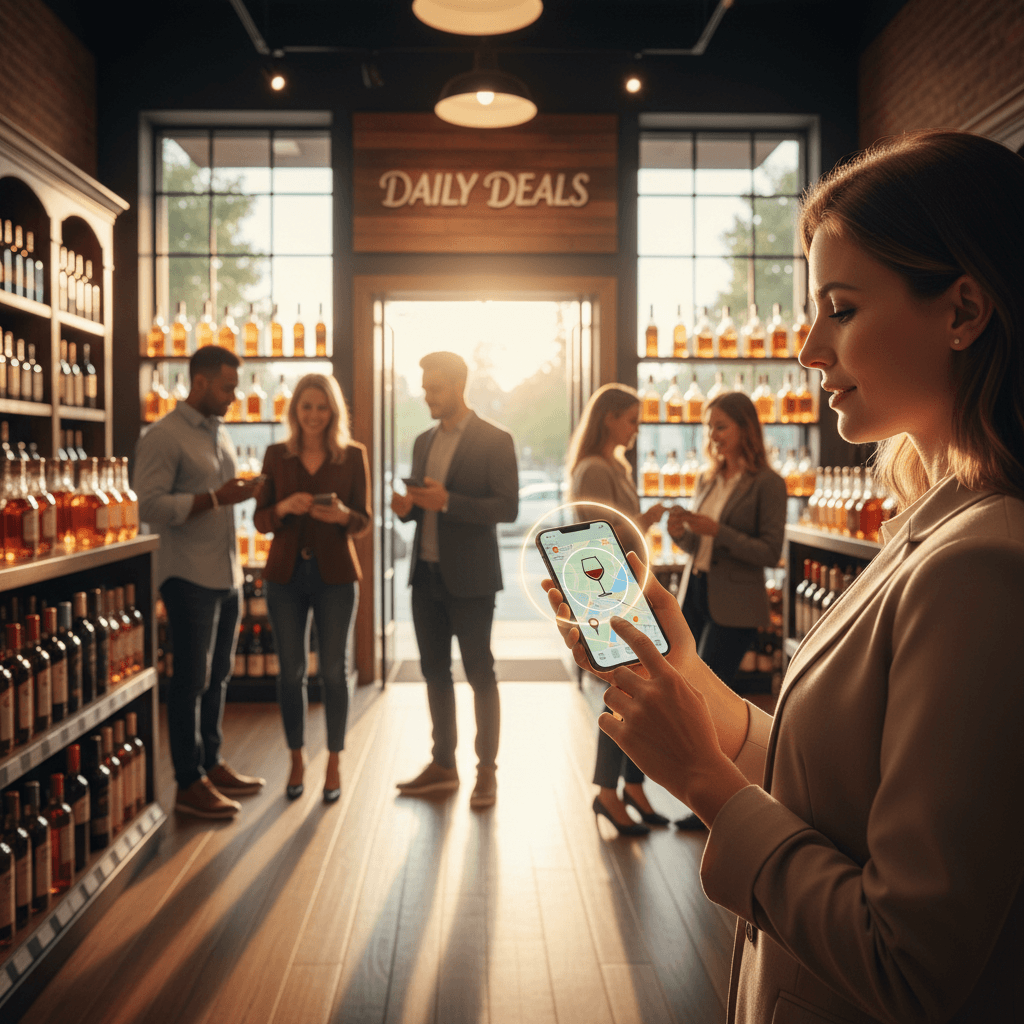
Picture drawing an invisible fence around a physical location — your store, a competitor's shop, a concert venue, a wedding expo center. When a consumer's smartphone crosses that boundary, it triggers a mobile ad served directly to their device.
Avoid these common geofencing mistakes liquor stores make. Learn how to use geofencing as a liquor store to drive foo...
That's it. That's geofencing.
The real power is in the precision. These campaigns typically target consumers within a defined radius of your store — often one to three miles — using GPS and mobile location data to reach people who are actually nearby and likely to walk through your door. No wasted impressions on someone sitting on their couch three towns over wondering what's for dinner.
And here's the metric that changes the game: foot-traffic attribution. You can actually track how many people saw your ad and then showed up at your store. That's not a vanity metric — that's a closed loop between ad spend and real-world results.
Here's something you might already sense intuitively: your physical location is already a high-intent destination. People don't accidentally browse a liquor store — they come to buy. Location-based advertising takes that built-in advantage and extends it into the digital space, reaching consumers who are nearby, likely planning a purchase, and responsive to a well-timed offer.
Stop leaving online sales on the table. Here are the 10 most costly e-commerce mistakes liquor stores make and how to...
Most alcohol retailers have been slow to adopt geofencing, which creates a window. Early movers aren't just keeping up — they're capturing market share while competitors rely on the same old playbook. That window won't stay open forever.
So you understand the concept. Now let's walk through what actually happens when you run a campaign — from the moment a customer crosses your virtual boundary to the moment they walk through your real door.
It's Friday at 4:30 PM. A consumer is driving home from work and passes within two miles of your store. Their phone's location data crosses the virtual boundary — your geofence — and just like that, they're flagged as a potential customer.
Minutes later, they're scrolling a weather app or checking sports scores, and a display ad pops up: "Weekend Bourbon Sale — 15% Off Select Bottles Through Sunday." Your store name. Your address. A clear call to action.
8 budget-friendly liquor store local advertising ideas to boost foot traffic. Proven strategies from successful retai...
Here's why this works so well. In marketing, we talk about "high-intent micro-moments" — and this is a textbook example. This person is already nearby. It's Friday afternoon. They're likely already thinking about picking something up for the weekend. Compare that to a generic social media ad hitting someone's feed on a Tuesday morning in another zip code. The intent gap is enormous.
And because foot-traffic attribution ties ad exposure to actual store visits, you'll know exactly how many of those Friday afternoon impressions turned into real customers.
Geofencing ads aren't intrusive pop-ups or spammy notifications. They're standard mobile display banners and in-app ads — the kind you see while reading an article, checking the weather, or playing a game. Think a clean rectangular banner with your store logo, a product image (a featured bourbon bottle, a wine bundle), a short headline, and a "Get Directions" or "Shop Now" button.
They're served through programmatic ad networks, which means the delivery tech runs itself. You focus on strategy, creative, and budget; the network handles placement and targeting. The result is a professional-looking ad that blends naturally into the apps your customers already use — without feeling pushy.
Once you've got the basics down, here's where geofencing for liquor stores gets really interesting — and a little competitive.
Competitor geofencing means you draw a virtual boundary around a rival liquor store's location. When a shopper enters that zone, they get served your ad on their phone. Right there, while they're browsing someone else's shelves.
Before you ask: yes, this is legal and increasingly common across retail industries. You're simply putting your message in front of people who are already in a buying mindset — standard competitive advertising, just smarter targeting. (That said, always confirm your geofencing platform complies with state-level alcohol advertising regulations.)
The mechanics are straightforward. You select a competitor's address in your geofencing platform, define the radius (usually a tight zone around their storefront), and launch your campaign. When someone enters that fence, they become eligible to see your ads — sometimes for days afterward through retargeting.
The fence alone won't win you customers. Your ad needs a compelling reason to switch. Think:
Practical tip: Start with one or two nearby competitors and test different offers. Foot-traffic attribution lets you see which offer drives the most visits. Once you identify what's working, scale from there.
All of these tactics sound promising on paper. But you've heard promises from ad reps before. Billboards, radio spots, local magazine spreads — they all swore they'd drive traffic. Maybe they did. But could anyone prove it?
That's where geofencing for liquor stores fundamentally changes the conversation. It doesn't just deliver ads — it delivers answers.
There's a famous line in advertising: "I know half my ad budget is wasted. I just don't know which half." Foot-traffic attribution finally kills that uncertainty for brick-and-mortar retailers.
Here's how it works. When your geofencing ad is served to a mobile device, that device's anonymized ID is logged. Later, if that same device enters your store's geofence — meaning the person physically walked into your shop — the visit is recorded as an attributed conversion. Ad exposure in, store visit out. Loop closed.
You're not guessing whether that promotion moved the needle. You're counting the people who showed up because of it.
Foot traffic is the headline metric, but it's not the only one. A well-run campaign should also monitor:
Here's the honest part: not every campaign is a home run on day one. Testing different creative, offers, geofence radius, and timing is part of the optimization process. That's normal — and expected.
Now for the question you've been waiting to ask: what does this actually cost? Here's the truth — geofencing doesn't require a big-box budget.
Most independent stores we work with start testing at $300–$500 per month. That's it. Because geofencing eliminates the geographic waste that eats traditional ad budgets alive, more of every dollar reaches someone who can actually walk through your door.
We recommend a phased approach: start with a geofence around your own store, add one or two competitor locations, then layer in event-based targeting as you learn what performs.
The real power here is that you can track exactly how many people saw your ad and then visited. When you see measurable visits turning into incremental revenue, scaling your budget becomes a confident, data-backed decision rather than a guess.
You've got the strategy. You understand the metrics. Now it's time to put it into motion.
Ready to launch? Here's your roadmap:
10+ years helping liquor retailers and beverage brands grow through data-driven digital marketing. Learn more
Competitor targeting is powerful, but geofencing doesn't have to stop at storefronts. Some of the highest-converting campaigns target customers before they ever think about where to buy.
Think about where your ideal customer already is — and what mindset they're in. Concerts, sports games, food festivals, neighborhood block parties. These people are out, they're social, and they're primed to buy.
You can draw a virtual fence around these venues and serve timely promotions to attendees' phones: game-day beer specials, holiday entertaining bundles, or seasonal cocktail kits. Because you're reaching people who can realistically walk or drive to your store that same day, the path from ad impression to store visit is short — and trackable.
Not every campaign needs pinpoint precision. Zip-code targeting lets you cast a slightly wider net while still eliminating wasted spend on consumers outside your trade area. It's the opposite of spray-and-pray advertising.
Combined with event-based geofencing, these hyper-local tactics focus every dollar on nearby, high-probability customers — stretching your budget further without sacrificing relevance.
Intentionally Creative specializes in geofencing strategies that drive real results. Let us show you what's possible.
Schedule a CallWhat matters is that every variable you adjust produces measurable data. Over time, this builds a performance feedback loop that strengthens everything from brand activations to seasonal promotions, tying results to specific locations and timeframes.
That's not a promise. That's a feedback loop.
Here's the honest truth: geofencing is a tool, not a magic wand. It works best when paired with compelling offers, a well-run store, and consistent testing. Results compound over time as you learn what resonates with your specific customer base.
For years, independent liquor store owners have been told to "invest in marketing" without anyone giving them a clear way to measure what that investment actually returned. Geofencing for liquor stores changes that dynamic entirely. It puts your message in front of nearby, high-intent customers at the exact moment they're most likely to act — and then it shows you, in hard numbers, how many of them walked through your door because of it.
You don't need a massive budget. You don't need a marketing team. You need a smart geofence, a compelling offer, and the willingness to let the data guide your next move.
The retailers who adopt this now will have months of optimization data — and the customer relationships that come with it — by the time their competitors start paying attention. That head start matters.
Want help building campaigns that actually move the needle? Intentionally Creative specializes in geofencing for liquor retailers — from setup to optimization. Let's talk.