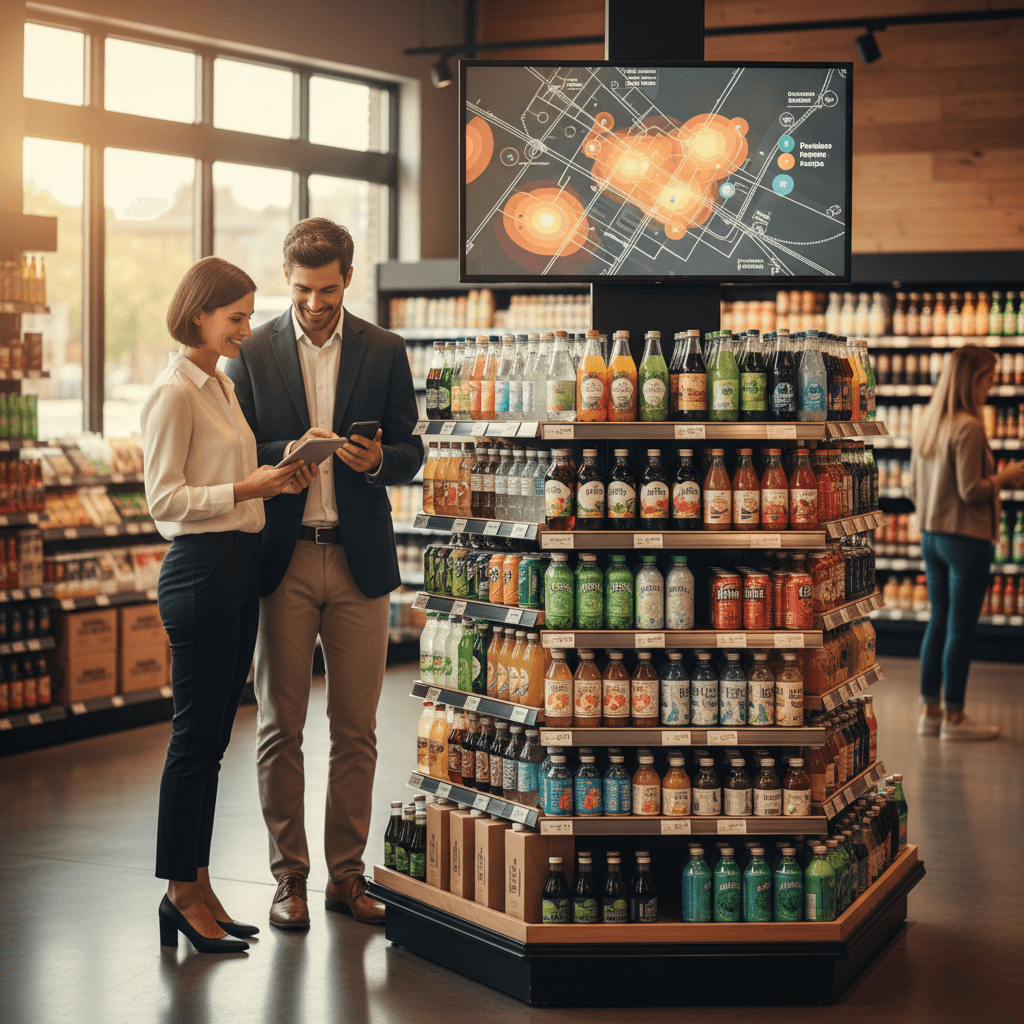
How to Use Customer Purchase Data to Build Personalized Endcap Displays That Increase Basket Size
By Intentionally Creative11 min read
Listen to this article14:39
Schedule a free strategy call and Intentionally Creative will build a custom plan for you.
Schedule Your Free Strategy CallFree audit. No commitment.
Get a Free Audit. No commitment.
Learn how to use POS purchase data to build liquor store endcap displays that actually increase basket size. Data-driven strategies for independent retailers.
Every liquor store has prime real estate that most owners treat like an afterthought. Your endcaps — those high-traffic, high-visibility displays at the end of every aisle — are the single most influential selling space in your store. And right now, there's a good chance yours are stocked based on whatever showed up on last Tuesday's delivery truck. That's not a strategy. That's a missed opportunity, and it's one your POS system can fix.
Here's what most independent retailers don't realize: you're already collecting the data you need to build liquor store endcap displays that genuinely move the needle on basket size. Every transaction, every Friday night rush, every holiday weekend — your point-of-sale system is quietly recording exactly what your customers buy together, when they buy it, and how much they spend. The gap isn't information. It's action.
This guide walks you through how to pull that customer purchase data out of your POS system and turn it into a repeatable, measurable endcap strategy. No six-figure tech budget. No data science degree. Just a smarter way to use what you already have — so your displays stop guessing and start selling.
Let's be honest about what's happening at most independent liquor stores right now: endcap displays get built based on gut instinct, whatever the distributor rep is pushing this week, or — the classic — whatever's overstocked in the back room. There's no strategy. There's no data. There's just a hope that somebody walking by will grab a bottle.
That's not merchandising. That's guessing.
And it's costing you real money in missed basket-building opportunities.
Learn how to use your liquor store POS upsell cross-sell features to turn customer purchase data into automated campa...
The core problem is simple. Most endcaps aren't built around what customers actually buy together — they're built around what's convenient for the store or profitable for the distributor. Those aren't the same thing as what drives your revenue.
Your POS system already knows that customers who buy a bottle of Prosecco on Friday also grab a bag of ice and a $12 snack board. It knows that your bourbon buyers over-index on bitters and cocktail cherries. That purchase data is sitting right there, waiting to inform smarter merchandising decisions. You just haven't pulled it into your display strategy yet.
This isn't theoretical. Kroger has deployed in-store digital screens across nearly 600 wine and spirits departments — using purchase data to drive personalized displays at the shelf level [VERIFY]. Data-driven merchandising isn't experimental anymore. It's becoming the standard.
BJ's Wholesale Club took it even further. After seeing strong enough ROI from their initial digital endcap deployment, they expanded into in-aisle interactive advertising screens [VERIFY]. They didn't scale because it looked cool — they scaled because the numbers worked.
Here's the good news: you don't need that kind of budget to get results. You need to start using the data you already own. Your POS system is the competitive advantage hiding in plain sight.
9 proven loyalty program ideas for liquor stores to boost repeat purchases, increase basket size, and build lasting c...
Your POS system is sitting on a goldmine of purchase data that major chains pay millions to analyze. You already have it. You just need to read it.
Basket analysis sounds technical. It's not. It simply means looking at what products customers buy together in a single transaction, then using those patterns to inform your display decisions.
Your POS data reveals cross-purchase patterns you'd never guess on your own. Maybe your bourbon buyers consistently grab cocktail bitters and Luxardo cherries. Maybe your rosé shoppers add a flavored sparkling water 40% of the time. These aren't hunches — they're behavioral patterns hiding in your transaction reports.
To pull a basic basket analysis, look in your POS system for reports labeled "frequently bought together," "market basket," or "transaction-level item detail." Square, Lightspeed, and most modern systems offer some version of this. Just curiosity and 30 minutes is all it takes.
This is how you build displays that actually grow basket size: you merchandise what people already want to buy together, just in one convenient spot.
Wondering if you need a liquor store marketing agency? These 10 signs show when DIY efforts have hit their limit and ...
Industry reports are useful, but they're lagging indicators. Your POS data is a leading one.
Case in point: sparkling wines are the leading growth driver in the wine category at retail right now, led by Champagne, Prosecco, and California cuvées [VERIFY]. Kroger spotted this early enough to invest in in-store digital merchandising across their wine and spirits departments. But independent stores with sharp eyes on their own data could have spotted local demand surges months before reading about national trends in trade publications.
The same applies to non-alcoholic and low-alcohol beverages — a growing but chronically under-merchandised segment. Your purchase data can tell you whether your customers are already buying into this trend. If they are, it's a smart endcap candidate backed by evidence, not a risky guess taking up prime real estate.
The bottom line: stop building displays based on what you think sells together. Let your data show you what actually does.
You don't need Kroger's budget to build smarter liquor store endcap displays. You just need the data you're already sitting on and a simple process to turn it into revenue.
Here's the framework.
Open your POS system and export transaction-level data from the last 90 days. Not product-level summaries — full basket data, meaning every item purchased together in a single transaction.
Ninety days gives you enough volume to spot real patterns while staying seasonally relevant. You're looking for three things: which products appear in the same basket repeatedly, what the average basket size is when those products co-occur, and whether any of those combos spike on specific days (weekends, holidays, local events).
If your POS doesn't export basket-level data easily, most modern systems let you pull itemized receipts in CSV format. That's all you need.
Now find 3–5 product clusters that show up together with real frequency. Not what you think pairs well — what your customers are actually buying together.
Common clusters that surface in purchase data analysis include tequila + lime mixers + Tajín, Prosecco + flute glasses + cocktail napkins, and craft beer + premium snack mixes. Given the current momentum behind sparkling wines, that bubbly cluster might be your strongest starting point.
The key: cross-merchandising opportunities on your endcaps should be validated by actual basket data, not gut instinct.
You built a data-driven display. Now prove it's actually doing something. Here's how to know if your endcaps are earning their floor space — or just looking pretty.
Track these three numbers for every endcap rotation:
Compare each metric before and after every display change. But here's the key: set a real baseline first. Pull 2–4 weeks of data from the prior month or the same period last year to account for seasonality. A Prosecco endcap will naturally perform differently in December than in March — your baseline matters even more for trending categories.
Without a baseline, you're guessing. With one, you're running a business.
Rotate your displays every 2–4 weeks. Anything longer and you risk "display blindness" — customers literally stop seeing it. Fresh content drives engagement, whether it's on a digital screen or a physical shelf. Each rotation should be a mini-experiment testing a new purchase data hypothesis.
Re-run your basket analysis quarterly. What customers bought together in Q1 may completely shift by Q3.
And if an endcap isn't moving product? The data will tell you within 10 days. Don't wait six weeks to pull a display that's clearly underperforming. Speed beats stubbornness every time.
Kroger has digital screens across hundreds of stores. BJ's is expanding into in-aisle interactive advertising. It's easy to see those headlines and feel like you're already behind.
You're not.
The magic behind those digital screens isn't the screen itself — it's the customer data driving what appears on it. That same principle works with a printed sign, a well-curated shelf, and a sharp eye for your customer base. You don't need a touchscreen to build liquor store endcap displays that resonate. You need a compelling display with the right products and a sign that speaks to your shoppers.
The system is your competitive advantage. Build a repeatable cycle — monthly or bi-weekly — that looks like this: pull data, identify customer clusters, design the display, execute, measure results, iterate.
Create a simple endcap planning calendar that aligns data-driven themes with seasonal moments, local events, and even weather changes. That's how you grow basket size consistently — not with expensive technology, but with disciplined process. The best endcap displays aren't the flashiest. They're the most relevant.
Here's the truth: distributor-driven endcap displays serve the distributor's goals — moving their priority SKUs — not necessarily your margins or your customers' preferences. Your POS data serves both.
This doesn't mean burning distributor relationships. It means negotiating from knowledge. When your purchase data shows that bourbon buyers in your store consistently grab bitters and cocktail cherries, you can propose displays that work for everyone — including the distributor whose bourbon anchors the endcap.
10+ years helping liquor retailers and beverage brands grow through data-driven digital marketing. Learn more
With your clusters identified, build the display using a simple hierarchy:
Give the cluster a name and a pricing callout. "Margarita Night Kit — Everything You Need for $34" works harder than three random products sitting next to each other. A bundled theme gives customers a reason to buy the whole set.
And here's the part most owners overlook: you probably already have the infrastructure. Modular gondola-style endcaps, rounded wood shelves, and adjustable configurations are standard in most stores. This isn't a capital expense — it's a strategy shift. You're not buying new fixtures. You're putting the right products together, backed by evidence your customers already gave you.
Your purchase data is only valuable if it changes what you actually do on the floor. Here are four display concepts you can build this month — each one grounded in real shopping behavior.
If your POS data shows bourbon and ginger beer frequently landing in the same basket, you've got your blueprint. Build a "Kentucky Mule Kit" endcap: bourbon, ginger beer, copper mugs, and lime juice — every item validated by real purchase behavior. You're not guessing what pairs well. You're reflecting what customers already buy together, just making it easier. That's how you grow basket size without a single discount.
Sparkling wines are surging at retail right now. But "sparkling is hot" isn't specific enough. Use your data to identify which sparkling SKUs are gaining velocity in your store, then feature them with occasion-based signage — holidays, brunch, celebrations. You don't need digital screens to act on this insight. You need your data and a well-placed endcap.
Mini-bottle displays at endcaps and registers aren't new. What's new is refining your SKU selection using purchase data. Which full-size spirits are trending upward? Stock those minis. They act as trial-size upsells that lead to future full-bottle purchases — practical personalization at its simplest.
If your transaction data shows growing non-alcoholic and low-ABV purchases, a dedicated endcap tells that customer segment you take them seriously. While competitors ignore this category, you capture the sale — and the loyalty that comes with it.
Intentionally Creative specializes in digital marketing strategies that drive real results. Let us show you what's possible.
Schedule a CallThe data is already in your POS system. The display hardware is likely already on your floor. Start with one endcap, measure the lift, and scale what works.
Your liquor store endcap displays don't need to be bigger, flashier, or more expensive. They need to be smarter — built on what your customers are actually telling you through every transaction they make. One data-driven endcap, measured and iterated, will outperform a dozen gut-instinct displays every single time. The stores that figure this out first win the basket. The ones that don't keep guessing.
Ready to turn your customer purchase data into a merchandising strategy that actually grows your basket size? Intentionally Creative can help you build the playbook.