South African Red Blends Are Having a Moment: How to Merchandise an Emerging Wine Region for Maximum Margin
By Intentionally Creative11 min read
Listen to this article14:29
Schedule a free strategy call and Intentionally Creative will build a custom plan for you.
Schedule Your Free Strategy CallFree audit. No commitment.
Get a Free Audit. No commitment.
South African red blends wine merchandising strategies for liquor stores. Build high-margin shelf sets with data-backed tactics for this trending category.
Every few years, a wine category breaks through that gives independent retailers a real edge — the kind of edge that chains and big-box stores are too slow to act on. Argentine Malbec did it. New Zealand Sauvignon Blanc did it. And right now, South African red blends are sitting at that same inflection point, waiting for smart retailers to make their move.
Here's what makes this one different: the quality floor is absurdly high, the price points leave room for real margin, and the global market is already leaning in. This isn't a speculative play — it's a data-backed opportunity with a narrow window before the rest of the market catches up. If you stock it right, tell the story well, and train your team to hand-sell it, this category can become one of the most profitable sections in your store.
This playbook breaks down exactly how to do that — from the numbers that justify the shelf space to the five steps you can take this week to get ahead.
Let's cut straight to it: this isn't about chasing a trend. It's about recognizing a category with verified quality scores, strong margins, and a story your customers actually want to hear.
Here's the stat that should stop you mid-inventory review: 60% of South African red blends entered in Decanter's panel tasting scored 90+ points [VERIFY: specific tasting year and entry pool]. Read that again. Sixty percent.
Learn how to run compliant, high-performing Google Ads for liquor stores. Covers campaign setup, bidding strategies, ...
For context, that's a remarkably high hit rate compared to more established regions where the bell curve spreads much wider. This isn't one standout producer propping up the average — it's a consistent quality story across the category. When you're building a South African wine retail strategy, you're not gambling on a handful of winners. You're stocking a region that's delivering at a reliable clip.
And the price-to-quality ratio? Quality bottles start around $11 at retail [VERIFY: U.S. retail pricing floor], with standouts like Post House Penny Black landing at $29.99. That's a margin-friendly spread for any store looking to grow its high-margin wine categories.
Europe is already paying attention. According to a USDA report, Europe is the leading export market for South African wines, and improved European demand is the primary growth driver. History tells us what happens next: when European buyers move, U.S. consumer curiosity follows.
This is your first-mover window. Think about what happened with Malbec and Kiwi Sauvignon Blanc — early adopters captured margin before those categories became commoditized and price-compressed. Merchandising emerging wine regions rewards the retailers who build the shelf set before everyone else catches on.
Discover how Provence transformed into a lifestyle brand. Learn provençal wine marketing tactics to boost regional Fr...
Producers like Oldenburg Vineyards are already raising prices significantly on select wines to reflect quality and estate investment [VERIFY: source and timeframe]. The premiumization signal is clear. The question isn't whether this category arrives in the U.S. — it's whether you're positioned when it does.
Quality alone doesn't pay the bills — margin does. And the pricing architecture of South African red blends practically builds itself.
Quality bottles start around $11 USD [VERIFY: U.S. retail pricing], and premium selections like the Post House Penny Black retail at $29.99 at Triangle Wine Company. That's nearly a $19 spread — a wide, profitable lane that most emerging categories can't offer you.
Think of it as three tiers working together:
Independent stores can capture Syrah's momentum with smart displays, staff storytelling, and Old World/New World tast...
And don't overlook format innovation. Lubanzi Red Blend comes in 355ml cans at $6.25 [VERIFY: current availability and price] — perfect for near-register impulse buys or curated discovery sets that pull new customers into the category.
The BFAP Baseline 2025 report identifies trading up as the clear growth path for South African wine [VERIFY: specific claim from report]. This isn't speculation — it's the trajectory. Producers are investing in estate quality and pricing accordingly, and consumers are following them upmarket.
This is the core of a smart South African red blends wine merchandising strategy: because these wines don't yet carry the "prestige tax" of Napa or Bordeaux, your cost basis stays lower while perceived value climbs steadily. That gap between what you pay and what customers will happily spend? That's where your margin lives.
You're not just stocking bottles from an emerging region. You're building a ladder — and the category economics are practically begging you to merchandise it that way.
The difference between a few scattered South African bottles and a category that drives real revenue comes down to one thing: intentional merchandising.
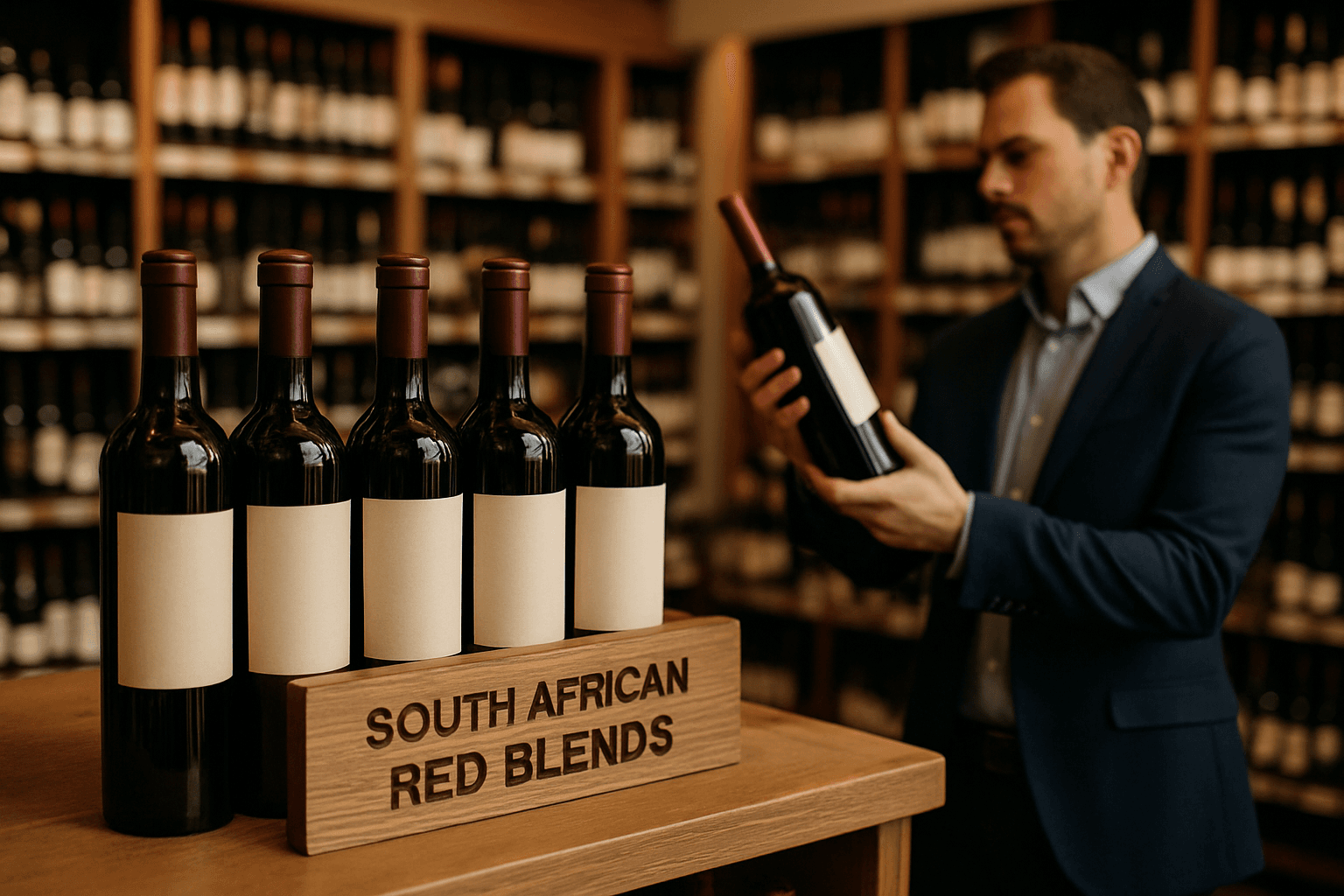
Here's the move: stop sprinkling South African bottles across your red blend section and start building a destination set. A focused 4-to-8 SKU cluster with clear good-better-best tiers gives the category visual weight and tells a story customers can actually follow. That tiered approach is where South African red blends wine merchandising starts generating real margin, not just curiosity.
The built-in versatility helps. These wines span both classic Bordeaux-style Cabernet-Merlot blends and bold Rhône-inspired GSM creations. Your shelf talkers can speak to two audiences from one set. A customer who loves a $15 red blend from Paso Robles and a customer hunting for their next GSM — both have a reason to stop and pick up a bottle.
Tactical tip: Place your destination set at eye level near your Argentinian or Chilean sections. Customers already browsing value-driven Southern Hemisphere wines are your most likely converts. They're already in the mindset of exploring beyond the usual suspects.
Now build the story out. South African Cinsault is being positioned as a trendy, chillable, versatile red — some in the trade are calling it the "little black dress of wine." Place it adjacent to your red blend set and you've created a broader South Africa narrative that gives customers a reason to explore the region, not just grab a single bottle.
For seasonal features, consider a "Discover South Africa" endcap with 3-4 red blends and a Cinsault, supported by a simple shelf talker highlighting those Decanter scores. That stat does the selling for you — no heavy discounting required. Few emerging regions offer this combination of critical credibility and accessible price points.
Hand-selling is where independent stores beat chains and big-box retailers every single time. Your staff's recommendation is your biggest competitive advantage — and South African red blends give them something genuinely exciting to talk about. But they need the right tools.
Keep it simple. Your team doesn't need a sommelier certification. They need three sentences:
That's your South African red blends wine merchandising pitch in 60 seconds flat.
Employees who've tasted the wine sell the wine. Period. This doesn't need to be a formal event — 15 minutes before a shift with two or three bottles open on the counter works perfectly. Pick SKUs across your price range so staff can speak to the difference firsthand. When someone on your floor can say "I tried this last Tuesday and it's incredible for $15," that authenticity moves bottles faster than any shelf talker ever will.
If you've been in this business long enough, you remember the Malbec wave. Retailers who built dedicated sets early — before every grocery chain had a $7.99 endcap — captured years of premium margin. South African red blends are sitting at that exact same inflection point.
The quality is already proven. Producers are investing and pricing upward — a clear premiumization signal. This category is moving upmarket, not toward discount bins. The merchandising range from $11 to $30 is built for high-margin retail.
South African retailers are getting squeezed — producers and distributors increasingly sell direct while overheads climb. Meanwhile, Europe remains the leading export market, with improved European demand driving growth (per USDA data).
The result? The best South African producers are actively seeking strong U.S. retail partners. That gives you real leverage on pricing and allocation — something that disappears once a category goes mainstream.
Smart merchandising means moving before the crowd. Building the set now positions you as a destination, not a follower. Lock in margins today that erode the moment this category hits saturation.
Don't overthink the rollout. Just move:
10+ years helping liquor retailers and beverage brands grow through data-driven digital marketing. Learn more
Your merchandising strategy lives or dies at the shelf. Not in the back office, not on your website — right there, at eye level, in the three seconds a customer decides whether to reach for the bottle or keep walking.
Lead with the data that closes the sale: "60% scored 90+ points in Decanter's panel tasting." That's a consumer-ready stat. Pair it with a value hook — "Bordeaux quality, South African price" — and you've got a one-two punch that works on both the wine curious and the deal hunter.
Keep shelf talkers to three lines max:
Here's the warning: don't over-educate at the shelf. Your customer doesn't need a geography lesson on the Western Cape. They need a reason to grab the bottle. Save the deep cuts for staff training and social media.
Wines of South Africa and Cape Wine 2025 [VERIFY: event name and timing] are pushing a compelling story — optimism, winemaking renaissance, and real people behind the labels. That narrative resonates with today's discovery-minded buyers and makes the category feel fresh rather than risky.
The highest-impact, lowest-effort play? Run a "Staff Pick: South African Red Blend" feature through your loyalty program or email list. Personal recommendations from store staff remain a top purchase driver in independent retail — and they turn a strong category into a repeat-visit reason.
Intentionally Creative specializes in digital marketing strategies that drive real results. Let us show you what's possible.
Schedule a CallThe data says the quality is there. The margin math works. The only question is whether you're going to be the store in your market that owns this category — or the one that catches up later.
South African red blends wine merchandising isn't complicated. The quality is verified, the margins are strong, the consumer curiosity is building, and the producers are eager for U.S. retail partners. Everything is lined up. What's missing is you on the shelf.
The retailers who won with Malbec and Kiwi Sauv Blanc didn't wait for permission. They read the signals, built the set, trained their teams, and captured years of premium margin before the category went mainstream. This is that same moment — except this time, you've got the playbook in front of you.
Pick up the phone, call your distributor, and get those first three SKUs on order. By next weekend, your staff should have tasted them, your shelf talker should be printed, and your customers should be discovering something they didn't know they were looking for. That's how you turn an emerging wine region into one of the most profitable sections in your store.